
Dollar stores operate on razor-thin margins. Dollar Tree, Dollar General, Five Below, and similar discount retailers source thousands of SKUs across dozens of product categories, and the difference between a profitable shipment and a costly one often comes down to a single quality issue — a batch of kitchen utensils with peeling paint, a shipment of hair accessories with incorrect labeling, or a container of toys that fails CPSC safety requirements.
Dollar Tree reported full-year adjusted diluted EPS of $2.56 in 2024, while both Dollar Tree and Dollar General posted revenue growth — with Dollar Tree growing same-store sales by 3.4% and Dollar General by 1.6%. At those volumes, even a 2% defect rate across thousands of SKUs translates to tens of thousands of defective units reaching store shelves. Quality control isn't optional — it's the primary lever for protecting margins.
Partnering with a China-based inspection company gives dollar store importers an efficient, scalable way to manage quality across hundreds of product categories without adding headcount or complexity to their own operations. This guide explains how to structure that partnership for maximum impact.
Key Takeaways
- Dollar store margins leave no room for quality failures — a 2% defect rate across 5,000 SKUs can erase an entire quarter's profit
- Multi-category inspection expertise is essential — household goods, health products, toys, and hardware each require different testing protocols
- AQL inspection at $199 per man-day makes quality control scalable across thousands of SKUs without breaking the budget
- Factory audits are your first line of defense — vet new suppliers before you commit production volume
Why Dollar Store Merchandise Demands Rigorous Quality Control
Thin Margins Mean Defects Destroy Profitability
The dollar store business model is built on high volume and low per-unit cost. Dollar Tree and Dollar General continue to grow, with combined revenue exceeding $70 billion annually. But when your average selling price is $1.25 and your cost structure assumes less than 5% returns, a single quality recall can eliminate the profit on an entire product line.
Consider a real scenario: An importer sources 20,000 units of kitchen utensils (spatulas, tongs, whisks) at $0.42 per unit. During a routine pre-shipment inspection, the inspector discovers that 12% of units have surface coating defects — paint chipping off the handles. Without that inspection, 2,400 defective units would have shipped, The replacement cost, return shipping, and lost shelf time would have exceeded $6,000 — more than the profit on the entire order. The inspection cost $199.
Consumer Safety Liability
Dollar store merchandise spans categories that carry real safety implications. Children's toys must comply with CPSC regulations. Food-contact items (plates, cups, utensils) must meet FDA standards. Health and beauty products (soaps, lotions, cosmetics) must comply with FDA cosmetic regulations. A single safety recall generates negative press coverage that extends far beyond the affected product — it damages the store's overall brand perception. Working with a reputable China inspection company ensures that compliance checks happen before products leave the factory, not after a customer files a complaint.
What a China Inspection Partner Should Provide
Not every inspection company is equipped to handle the breadth of categories that dollar store importers need. Here's what to look for:
Multi-Category Expertise
Your inspection partner needs experience across at least these product groups:
| Product Group | Key Inspection Points | Safety Risk |
|---|---|---|
| Household/kitchen | Surface coating, structural integrity, food-contact safety | High (lead, food contact) |
| Toys/novelties | ASTM F963 compliance, small parts, labeling | High (choking, toxicity) |
| Health/beauty | Ingredient verification, packaging seals, labeling compliance | Medium (allergic reaction) |
| Stationery/crafts | Color accuracy, functional testing, packaging integrity | Low |
| Hardware/tools | Dimensional accuracy, coating quality, torque testing | Medium (mechanical failure) |
| Seasonal/decor | Flammability, colorfastness, structural stability | Medium (fire hazard) |
AQL Inspection at Scale
Dollar store importers typically manage dozens of active orders simultaneously. Your inspection partner needs the infrastructure to handle this volume efficiently:
- Online booking and scheduling — Book inspections across multiple factories without back-and-forth emails
- Real-time reporting — See inspection results as they happen, not days later
- Consistent inspector assignment — Dedicated inspectors who know your product requirements reduce onboarding time
- Bulk scheduling — Coordinate inspections across multiple factories in the same region on the same day to minimize travel costs
With TradeAider's online platform, you can book inspections, track progress, and review results from a single dashboard — critical when you're managing 30+ active orders across 15+ factories.
Factory Audit Capabilities
Before you place a production order with a new dollar store supplier, a factory audit verifies that the facility can actually deliver. A comprehensive factory audit evaluates:
- Production capacity — Can the factory handle your volume without cutting corners?
- Quality management systems — Is there a formal QC process, or do they just "check stuff"?
- Material sourcing — Are they buying raw materials from reputable suppliers or cutting costs with sub-standard inputs?
- Social compliance — Are working conditions acceptable? (Critical for US and EU import requirements)
- Track record — Does the factory have experience manufacturing for dollar store price points?
A factory audit costs the same $199 per man-day as a standard inspection. For a new supplier, this is the highest-ROI quality investment you can make.
Dollar Store Product Categories and Their QC Priorities
Different product categories demand different inspection approaches. Here's how to prioritize your QC resources:
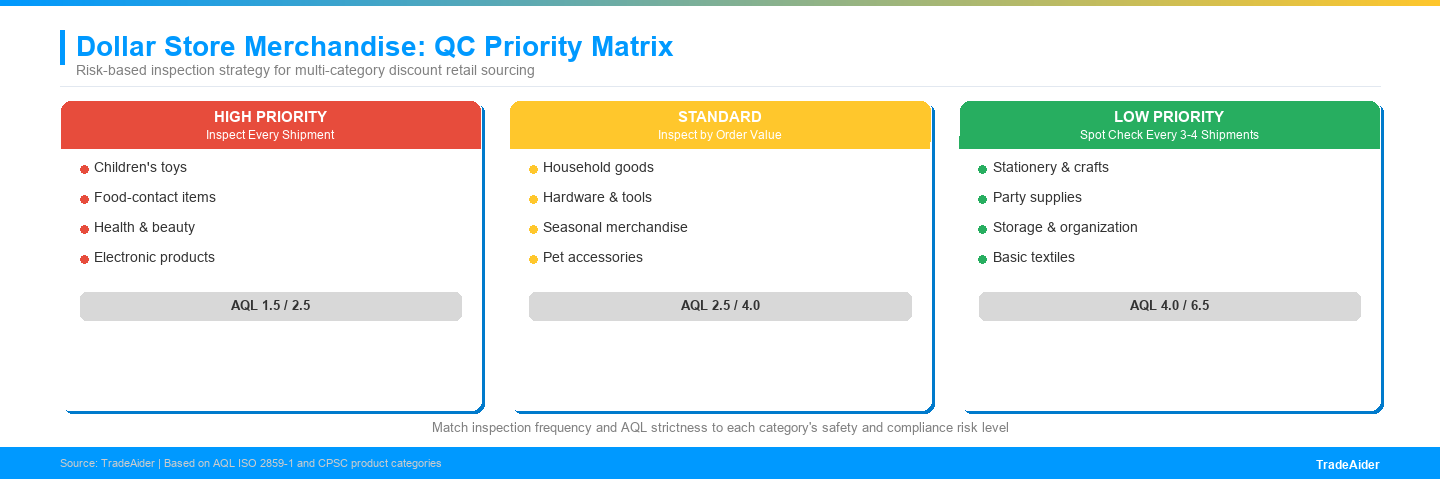
Quality control priority matrix: risk level and inspection frequency should match the product category's safety profile
High-Priority Categories (Inspect Every Shipment)
Children's toys and products require full ASTM F963 compliance verification, small parts testing, heavy metal screening, and labeling checks (age grading, tracking labels, warning statements). These products carry the highest regulatory risk — CPSC recalls generate headlines and lawsuits.
Food-contact items (plates, cups, utensils, containers) must be verified for FDA food-contact material compliance. Lead and cadmium testing on surface coatings is non-negotiable. A single failed lead test on a batch of children's drinking cups can trigger a mandatory recall.
Health and beauty products need ingredient verification, tamper-evident packaging checks, and labeling compliance reviews. FDA requires specific labeling for cosmetics sold in the US market.
Standard-Priority Categories (Inspect Based on Order Value)
Household goods (cleaning tools, organization products, bath accessories) and hardware (basic hand tools, fasteners, adhesive products) should be inspected on high-value orders or when working with a new factory. Key checks include dimensional accuracy, surface finish, functional testing, and packaging integrity.
Seasonal merchandise (Halloween decor, Christmas items, summer goods) has a hard deadline — product that arrives after the season is worthless. Schedule inspections early enough that there's time to rework or replace a failed batch before the selling window closes.
Low-Priority Categories (Inspect Spot Checks)
Stationery, crafts, and party supplies carry lower safety risk but still affect brand perception. Spot-check inspections on every 3rd or 4th shipment are usually sufficient to maintain quality. Focus on color accuracy, functional testing (do pens write? do scissors cut?), and packaging integrity.
Building Your Dollar Store QC Program
A systematic quality control program for dollar store merchandise follows these steps:
- Audit new suppliers before committing volume. A factory audit at $199 tells you whether a supplier can meet your quality, compliance, and volume requirements before you invest in a production order. Schedule a factory audit for every new supplier — it pays for itself on the first avoided defect.
- Set product-specific inspection checklists. Each product category has different failure modes. Toys need small parts and heavy metal checks. Kitchen goods need food-contact compliance. Hardware needs dimensional and functional testing. Your inspection partner should provide category-specific checklists — not a generic form applied to everything.
- Choose AQL levels that match your risk tolerance. For high-safety categories (toys, food-contact), use AQL Level II with 1.5% major / 2.5% minor. For standard categories, AQL Level II with 2.5% major / 4.0% minor is typical. Use the AQL calculator to determine sample sizes for each order quantity.
- Inspect consistently, not randomly. Regular inspection schedules with the same inspectors build institutional knowledge about your products. Inspectors who know your specific defect history catch issues that a fresh pair of eyes might miss.
The Cost Model: Why $199/Man-Day Works for Dollar Stores
The economics of dollar store inspection are straightforward: at $199 per man-day, quality control adds roughly $0.01-0.04 per unit to your product cost, depending on order size. For a 5,000-unit order, one inspection man-day adds $0.04 per unit. For a 20,000-unit order, it adds $0.01. Compare that to the cost of a single return batch ($0.42 per unit plus shipping, processing, and lost shelf time), and the ROI is clear.
TradeAider's transparent $199/man-day pricing with no hidden fees — no weekend surcharges, no holiday premiums, no travel fees in standard manufacturing zones — means you can budget inspection costs accurately across hundreds of orders. Real-time reporting eliminates the "wait and wonder" period; you see results as the inspection happens and can make ship-or-hold decisions the same day.
Schedule a free consultation about your dollar store QC program — we'll help you build an inspection schedule that matches your product categories, order volume, and risk tolerance.
Frequently Asked Questions
How do I inspect dollar store merchandise across so many categories?
You need an inspection partner with multi-category expertise. Rather than hiring separate specialists for each product type, look for a company that maintains inspector teams trained across household goods, toys, health products, and hardware. Your inspection checklists should be product-specific, but the scheduling, reporting, and communication should flow through a single partner for efficiency.
What AQL level should I use for dollar store products?
It depends on the category. For toys and food-contact items, use AQL Level II with 1.5% major / 2.5% minor — these categories carry regulatory risk. For household goods, hardware, and seasonal items, AQL Level II with 2.5% major / 4.0% minor is standard. For low-risk items like stationery and party supplies, AQL Level I may be sufficient for spot checks. Review the inspection standard to understand how AQL applies to your specific products.
Is factory audit necessary for every dollar store supplier?
Yes, for new suppliers. A factory audit at $199 reveals whether a supplier has the capacity, quality systems, and compliance track record to produce for dollar store price points without cutting corners. It's the cheapest due diligence you can do. For existing suppliers with a consistent quality track record (6+ successful inspections), you can transition to inspection-only monitoring.
How do I manage inspections across dozens of factories simultaneously?
Use an inspection partner with an online platform that supports multi-factory scheduling, real-time reporting, and consolidated results. TradeAider's platform lets you book inspections across multiple factories in different cities from a single dashboard, with results visible in real-time. This eliminates the email-based coordination overhead that makes multi-factory QC unmanageable.
Artículos Relacionados
Haga crecer su negocio con el Servicio TradeAider
Haga clic en el botón de abajo para ingresar directamente al Sistema de Servicios TradeAider. Los pasos simples desde la reserva y el pago hasta recibir los informes son fáciles de operar.

