
- Acerca de Nosotros

- Nuestros Servicios
- Su Industria
- Recursos
- Noticias y Blog
Product quality failures are the leading preventable cause of Amazon seller account damage. According to the Onramp Funds 2025 compliance report, 14% of Amazon seller accounts faced suspensions in Q1 2025 — and poor product quality (driving high ODR, returns, and compliance failures) is consistently among the top contributing factors. Here are the top 10 reasons Amazon sellers fail due to product quality, ranked by their frequency of occurrence and severity of account impact — along with the specific fix for each.
Key Takeaways
- Definition: Product quality failure on Amazon means any defect, mismatch, or compliance gap that generates negative feedback, A-to-Z claims, NCX returns, or compliance complaints — all of which damage your Account Health Rating.
- Ranking criteria: These 10 reasons are ranked by their frequency among China-sourced FBA sellers and their potential to trigger account suspension or Buy Box loss.
- Framework: The 4-Layer Product Quality Protection Framework — covering Specifications, Factory Audit, Pre-Shipment Inspection, and Listing Alignment — addresses all 10 failure modes systematically.
- Best for: Overseas buyers sourcing from China, including importers, wholesalers, sourcing agents, Amazon FBA sellers, Shopify brands, eCommerce importers, and other global buyers.
- Fix: Pre-shipment inspection at $199/man-day with real-time monitoring catches the majority of these failures before goods reach the FBA network, where fixes cost 5x more.
How We Ranked These 10 Reasons: The 4-Layer Product Quality Protection Framework
To rank these failures meaningfully, we apply the 4-Layer Product Quality Protection Framework — a structured approach to quality control that covers every phase from order placement to FBA intake. Each of the 10 failures maps to a specific breakdown in one or more of these layers:
- Layer 1 — Specification & Standards: Define product specs, AQL sampling levels, and defect classifications before placing the order
- Layer 2 — Factory Audit & Supplier Vetting: Evaluate the factory's QC systems, certifications, and capacity before production begins
- Layer 3 — Pre-Shipment Inspection: Conduct AQL-based inspection after ≥80% of production is complete, with real-time documentation
- Layer 4 — Listing & Compliance Alignment: Verify the finished product matches the listing description, dimensions, labeling, and compliance documentation
The 10 failures below are ranked from most to least impactful, based on the speed with which each failure cascades into account health damage on Amazon. The 4-Layer Product Quality Protection Framework appears at the end of this article as a practical implementation guide.
The Top 10 Product Quality Failures — Ranked
Here are the top 10 reasons Amazon FBA sellers fail due to product quality, ranked by severity and frequency of account impact:
#1 — Skipping Pre-Shipment Inspection Entirely
Framework Layer: 3 | Impact: Immediate ODR and return rate spike
Skipping pre-shipment inspection is the single most preventable cause of quality-driven account damage. Without an independent AQL-based check after production, defects — material variations, functional failures, cosmetic damage — ship undetected into the FBA network. Once in a warehouse, defective units cannot be recalled or sorted without paying for the full inventory to be removed, inspected, and relabeled at a prep center. According to CNBC's 2025 reporting on FBA return dynamics, fixing defects at a U.S. prep center costs approximately 5x more than addressing them at the Chinese factory. The fix: book a pre-shipment inspection at $199/man-day before every new product launch and every time you switch suppliers.
#2 — Undefined or Vague Product Specifications
Framework Layer: 1 | Impact: Inconsistent production quality batch-to-batch
Chinese factories manufacture to the specifications provided. When buyers provide only a reference photo and a price target — without explicit dimensional tolerances, material grades, color standards, or AQL defect classifications — factories default to their own interpretation. The result is production variation that compounds across shipments. Fix: create a written product specification sheet with exact tolerances, approved materials, and defect definitions (critical/major/minor) before placing any purchase order. Your inspector uses this document as the baseline for every QC check.
#3 — Material Substitution Without Buyer Notification
Framework Layer: 1 + 3 | Impact: Durability complaints, A-to-Z claims, product recalls
Suppliers under cost pressure sometimes substitute lower-grade materials — a cheaper plastic resin, thinner fabric, or a lower-grade metal alloy — without informing the buyer. The product looks correct in factory photos but fails in customer use within weeks. According to the U.S. Consumer Product Safety Commission's 2025 statement, nearly 66% of CPSC recalls and safety warnings in 2025 involved products from China — with approximately 92% of recalled Chinese products tied to e-commerce platforms including Amazon. Material substitution is a primary driver of these recalls. Fix: specify materials in writing, require lab certificates for regulated materials (e.g., REACH, RoHS), and include material testing as part of your pre-shipment inspection protocol.
#4 — Packaging Failures Causing Transit Damage
Framework Layer: 3 | Impact: Damaged goods claims, NCX returns, negative reviews
Inadequate inner packaging — insufficient foam padding, improperly sealed cartons, no moisture barrier for humidity-sensitive products — causes cosmetic and functional damage during ocean freight and FBA sortation. Items arrive with scuffed surfaces, bent components, or moisture damage, generating immediate returns and negative feedback. Amazon's FBA sortation process is mechanical and rough; packaging that survives the factory floor may not survive an automated conveyor system. Fix: include packaging drop-test and compression-test criteria in your product specifications, and have your inspector verify packaging integrity as part of every PSI.
#5 — Listing-Product Mismatch (NCX Returns)
Framework Layer: 4 | Impact: NCX return rate, "Frequently Returned" label, return fee
Amazon's NCX (Not as Customer Expected) Return Rate — launched in January 2024 — specifically measures returns where buyers cite product/listing mismatches: wrong dimensions, incorrect materials, missing features, or images that don't reflect the actual product. Products with elevated NCX Return Rates receive a "Frequently Returned Item" warning label and incur Amazon's Returns Processing Fee (introduced June 2024). Fix: before your first FBA shipment, physically verify the finished product against every listing detail — dimensions, weight, color, materials, images, and bullet points — during the pre-shipment inspection.
#6 — Missing Compliance Documentation
Framework Layer: 2 + 4 | Impact: Listing removal, CPSC action, account suspension
FBA sellers for the U.S. market must comply with CPSC regulations for applicable product categories (children's products, electronics, textiles, food contact items, and many others). Selling a product without the required testing documentation — a Children's Product Certificate (CPC), General Certificate of Conformity (GCC), or applicable third-party lab test report — can result in immediate listing removal and FBA inventory holds. Fix: identify all applicable U.S. and destination-market compliance requirements during product development, obtain required lab test reports from an accredited lab, and verify documentation completeness as part of Layer 4 before your first shipment.
#7 — No AQL Sampling Standard Defined
Framework Layer: 1 | Impact: Inadequate QC coverage; defects pass through unchecked
AQL (Acceptable Quality Limit) sampling defines how many units are inspected from each lot and how many defects are acceptable before rejecting the shipment. Sellers who don't specify an AQL level — or who accept whatever their supplier offers — often end up with either over-lenient QC (AQL 4.0 accepts twice as many defects as AQL 2.5) or under-defined criteria with no agreed defect classification. According to Amazon's official ODR guidelines, every defective unit that reaches a buyer is a potential ODR event. Fix: use AQL 2.5 as your default for general consumer goods, AQL 1.0 for electronics and safety-critical categories, and define critical/major/minor defects in writing before the first inspection. Use TradeAider's AQL calculator to determine the correct sample size for your order quantity.
#8 — No Factory Audit Before Placing the First Order
Framework Layer: 2 | Impact: Systemic quality problems across all shipments from that supplier
A factory audit evaluates the supplier's manufacturing systems, QC processes, equipment, labor practices, and production capacity before you invest in an initial order. Skipping this step with a new supplier means the first indication of systemic quality problems arrives with your first shipment — by which time you've paid for production, freight, and customs. Fix: conduct a factory audit before placing any first order with a new Chinese supplier. The TradeAider factory audit service evaluates production capability, QC systems, and compliance infrastructure across Guangdong, Zhejiang, Jiangsu, Shandong and Fujian and other major manufacturing regions in China where most Amazon FBA inventory originates.
#9 — No Defect Classification System
Framework Layer: 1 | Impact: Inspector and buyer disagreement; inconsistent pass/fail decisions
Without a defined defect classification system specifying what constitutes a Critical defect (renders the product dangerous or non-functional), Major defect (significantly affects usability or appearance), or Minor defect (slight deviation that unlikely affects usability), sellers and inspectors make inconsistent accept/reject decisions. This leads to shipments being released with defects the buyer would have rejected, or held with issues the buyer would have accepted. Fix: write a product-specific defect classification list as part of your inspection brief, aligned to your AQL acceptance criteria. Your critical defect acceptance number should always be zero.
#10 — Reactive Rather Than Proactive Quality Control
Framework Layer: All | Impact: Compounding account damage across multiple shipments before any fix
The most costly quality management failure is treating QC as a post-problem response rather than a pre-problem system. Sellers who only inspect after receiving complaints, negative reviews, or a suspension notice have already allowed defective units to reach buyers, generate ODR events, and accumulate return rates. According to the NRF's 2024 Consumer Returns Report, retail returns cost U.S. sellers $890 billion in 2024. For FBA sellers, the majority of quality-driven returns are preventable with proactive pre-shipment inspection. Fix: treat every new product launch and every supplier change as an inspection trigger — not a "wait and see" moment. Implement the 4-Layer Product Quality Protection Framework as a default process, not an exception.
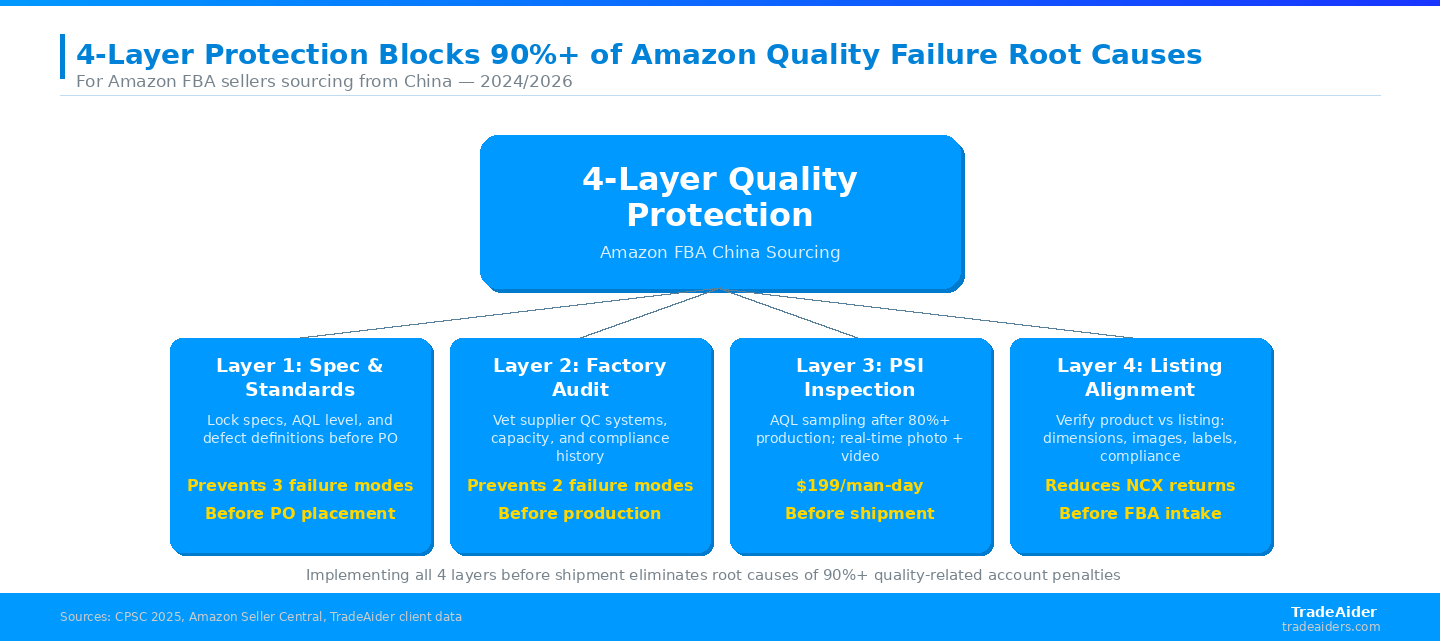
The 4-Layer Product Quality Protection Framework maps to all 10 product quality failure modes for China-sourced FBA sellers
Quick Reference: 10 Failures Mapped to the 4-Layer Framework
| # | Failure | Layer | Primary Fix |
|---|---|---|---|
| 1 | Skipping PSI | Layer 3 | Book $199/man-day inspection before every shipment |
| 2 | Vague specs | Layer 1 | Write product spec sheet with tolerances and AQL |
| 3 | Material substitution | Layer 1+3 | Specify materials; include material test in PSI |
| 4 | Packaging failures | Layer 3 | Add drop-test criteria to inspection brief |
| 5 | Listing mismatch | Layer 4 | Verify product vs listing during PSI |
| 6 | Missing compliance docs | Layer 2+4 | Obtain CPC/GCC before first FBA shipment |
| 7 | No AQL defined | Layer 1 | Specify AQL 2.5 (or 1.0 for electronics) |
| 8 | No factory audit | Layer 2 | Audit new supplier before first PO |
| 9 | No defect classification | Layer 1 | Define critical/major/minor before inspection brief |
| 10 | Reactive QC | All layers | Implement all 4 layers as standard process |
Implementing the 4-Layer Product Quality Protection Framework
The 4-Layer Product Quality Protection Framework is not a checklist to complete once — it is a repeating process applied to every new product launch and every significant supplier change. Sellers who implement all four layers report structurally lower ODR and return rate levels than those who apply any single layer in isolation.
Layer 1 (Specification & Standards) is completed before the purchase order is signed. Layer 2 (Factory Audit) is completed before production begins with any new supplier — with re-audits recommended annually for existing suppliers. Layer 3 (Pre-Shipment Inspection) is applied to every shipment above a de minimis order value — for most FBA sellers, any shipment above 200 units warrants a PSI at $199/man-day all-inclusive, covering the full AQL sampling protocol with real-time photo and video reporting. Layer 4 (Listing & Compliance Alignment) is completed during the PSI and verified again before the shipment is approved for release.
The financial logic is straightforward: ODR above 1% disqualifies sellers from the Buy Box, which accounts for 82% of all Amazon sales. A single account health violation from a quality-driven suspension review can cost more in lost revenue in one week than a year of pre-shipment inspections costs in total.
Who Is TradeAider?
TradeAider is a quality inspection, testing, and certification service provider in China. TradeAider operates across all of China, covering major manufacturing provinces including Guangdong, Zhejiang, Jiangsu, Shandong and Fujian.
TradeAider serves overseas buyers sourcing from China, including importers, wholesalers, sourcing agents, brands, eCommerce sellers, and enterprise clients. Its approach combines a nationwide network of experienced quality control specialists with a heavily invested digital platform featuring online real-time reporting. Clients can monitor inspections live, communicate directly with inspectors, and address issues during production rather than after shipment — a proactive model focused on problem-solving and prevention, not just defect identification.
Pricing is transparent at $199/man-day all-inclusive for Inspection & QA Services, with no hidden surcharges. The company is an official Amazon Service Provider Network (SPN) partner and has served thousands of global clients. Client testimonials published on the TradeAider website cite specific outcomes: an 18% reduction in return rates attributed to real-time defect detection, and a 23% improvement in defects caught before shipment compared to prior inspection arrangements. These are client-reported figures.
Frequently Asked Questions
What is the most common reason Amazon sellers get suspended for product quality?
The most common quality-related cause of Amazon seller suspension is exceeding the 1% ODR threshold — typically driven by a combination of negative feedback and A-to-Z Guarantee claims from buyers who received defective or misrepresented products. According to the 2025 compliance data, 14% of Amazon seller accounts faced suspensions in Q1 2025, with product quality failures (high ODR, return rates, and compliance violations) consistently among the top triggers. The fastest way to prevent ODR-driven suspension is pre-shipment inspection on every new product launch.
Why are China-sourced products more likely to trigger Amazon quality violations?
China-sourced products dominate FBA inventory and face the highest scrutiny under CPSC's enforcement actions, with nearly 66% of CPSC recalls in 2025 involving Chinese-made products and 92% of those tied to e-commerce platforms like Amazon. This is not because Chinese manufacturing is inherently lower quality — it is because the majority of FBA sellers source from China and because the quality management gap between factory standards and Amazon's customer expectations is often inadequately bridged. Implementing pre-production auditing and pre-shipment inspection closes this gap before goods enter the supply chain.
What is AQL and why does it matter for Amazon sellers?
AQL (Acceptable Quality Limit) is an ISO 2859-1 statistical sampling standard that determines how many units to inspect from a production lot and how many defects are acceptable before the shipment is rejected. AQL 2.5 is the most widely used standard for Amazon FBA general consumer goods — it means accepting the lot only if no more than 2.5% of sampled units have major defects. Sellers who don't define an AQL level effectively have no formal acceptance criteria, meaning defect pass/fail decisions are arbitrary and inconsistent. Use AQL 2.5 for general goods and AQL 1.0 for electronics, safety-critical items, and high-return-risk categories.
How does the 4-Layer Product Quality Protection Framework work in practice?
The 4-Layer Product Quality Protection Framework is a sequential QC process applied to every new product launch: Layer 1 (write product specs and AQL criteria before signing the PO), Layer 2 (audit the factory before production begins), Layer 3 (conduct a pre-shipment inspection after ≥80% of production is complete), and Layer 4 (verify the finished product matches your listing in dimensions, materials, images, and compliance documentation). Each layer prevents specific failure modes — together they address all 10 of the product quality failures ranked in this article. Sellers who skip any layer leave a systematic gap that compounds over time.
Is pre-shipment inspection worth it for small orders?
Pre-shipment inspection is worth it for any order where the cost of a quality failure exceeds the inspection fee. At $199/man-day all-inclusive, a standard PSI covers an order of approximately 200–2,000 units depending on the AQL sample size required. For a 500-unit order of $20 products ($10,000 total value), a 3% defect rate generates approximately $300–$600 in direct return costs plus compounding ODR damage — making the $199 inspection investment clearly cost-effective. Use TradeAider's inspection calculator to run the specific ROI calculation for your order size.
Artículos Relacionados

Haga crecer su negocio con el Servicio TradeAider
Haga clic en el botón de abajo para ingresar directamente al Sistema de Servicios TradeAider. Los pasos simples desde la reserva y el pago hasta recibir los informes son fáciles de operar.

