
- Acerca de Nosotros

- Nuestros Servicios
- Su Industria
- Recursos
- Noticias y Blog
A visible conformity logo is only the last field in a UK release decision. The costly gap appears when the destination, sector route, controlled document version, and actual carton range do not point to the same product allocation. Before approving packed consumer goods, a buyer should identify whether each range is going to Great Britain or Northern Ireland, confirm the product-specific route, and then compare the agreed physical fields against that route. A factory visit can corroborate those physical fields; it cannot decide legal conformity or issue a marking approval.
Start With the Market, Not the Mark
Great Britain and Northern Ireland are different market routes, so the release file must name the destination before the team decides which mark, declaration, label, or instruction evidence to compare. CE marking is a manufacturer statement used where relevant EU product rules require it; UKCA marking is a Great Britain conformity marking used under the relevant UK route. The current GOV.UK Great Britain guidance applies to England, Scotland, and Wales and directs businesses to check the relevant product regulations. In practice, “UK-bound” is not a sufficient factory instruction.
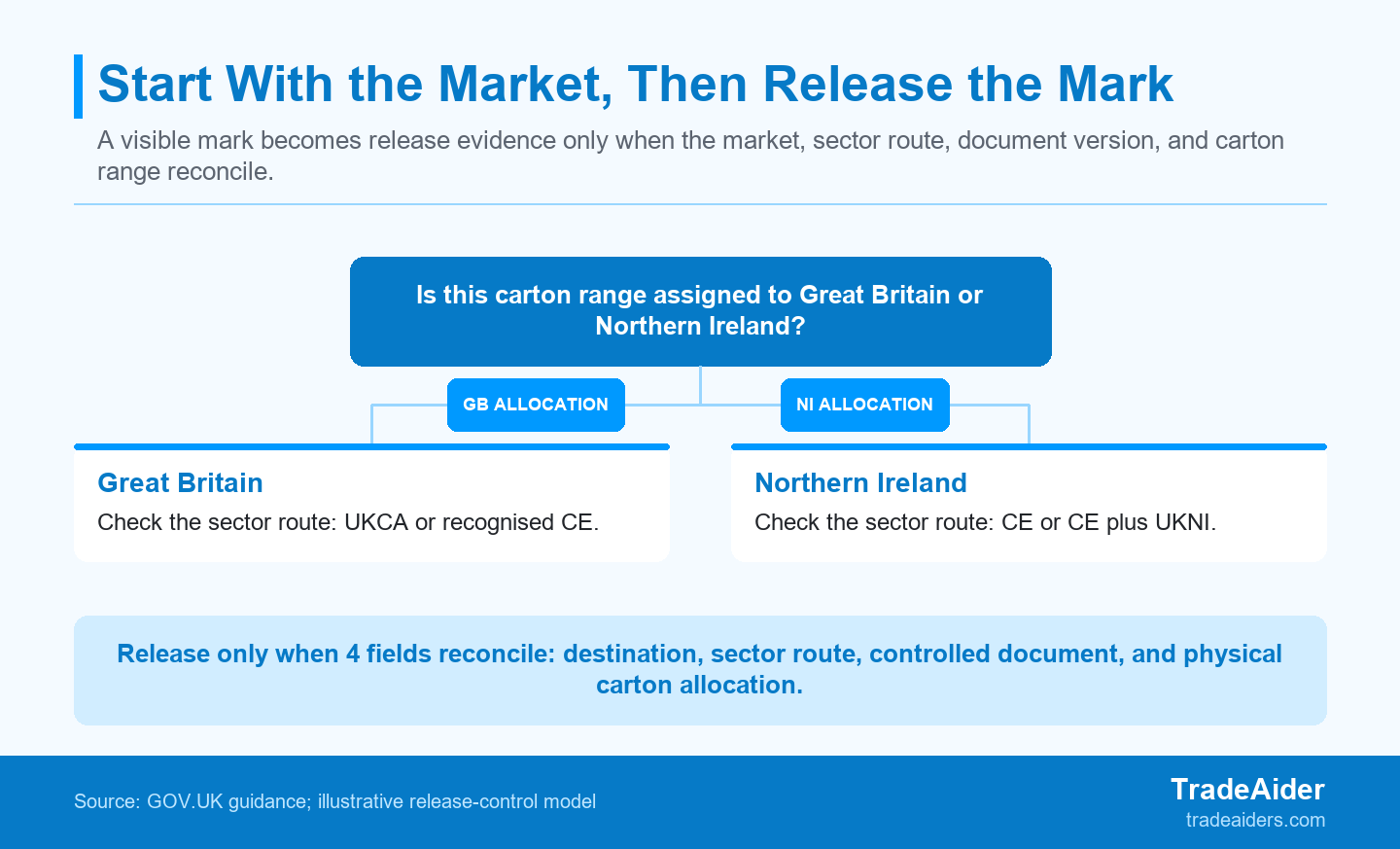
Factory release starts with the destination route; the mark, document version, and carton allocation must then match that route.
For Northern Ireland, the route is different. The Northern Ireland guidance explains the CE and CE-plus-UKNI context. Where a mandatory third-party conformity assessment uses a UK-based notified body, CE and UKNI are used together; UKNI is not used on its own. That distinction belongs in the buyer’s allocation file before labels, leaflets, or cartons are treated as final.
- Name the destination: use Great Britain or Northern Ireland for each SKU and carton allocation, not a generic UK label.
- Identify the sector: the product rule determines whether a conformity mark is required and which route is relevant.
- Control the output: tie the route to a document version, physical version, and identifiable carton range.
For teams coordinating a China-side check, this destination-first format also makes the later inspection brief more usable: TradeAider can be given one named market allocation, one file set, and a defined list of observable fields instead of a generic request to approve “UK compliance.”
At factory release, the useful question is not “Does this product show CE or UKCA?” It is “Which market route does this identified carton range support, and what controlled evidence proves that link?”
Turn the Product Category Into a Route Card
There is no universal consumer-goods answer to “UKCA or CE?” The relevant sector rules determine whether a marking is required and which route is accepted for the named market. The official product-marking table by sector separates Great Britain and Northern Ireland and includes categories such as toys, electrical equipment, EMC, radio equipment, PPE, and RoHS. It is a route-selection resource, not a permission to copy one answer from one category to another.
The same caution applies to standards. GOV.UK says businesses should check whether an EU harmonised standard is also a GB designated standard when using it in a Great Britain route. Its guidance on harmonised and designated standards is why a familiar CE label or standards reference should not be accepted as a stand-alone release answer. For eligible routes, Fast-Track UKCA guidance also shows that the applicable conformity route—not a substituted logo—remains the decisive evidence.
| Release question | Great Britain allocation | Northern Ireland allocation | Factory-release response |
|---|---|---|---|
| Which market is named? | England, Scotland, or Wales | Northern Ireland | Keep each destination in a separately identifiable allocation. |
| What selects the marking route? | The current Great Britain sector rule and applicable route | The Northern Ireland sector route under relevant EU rules | Record the product category and route owner before approving artwork. |
| What must match the packed goods? | Controlled route, declaration reference, labels, instructions, and identifiers | Controlled route, declaration reference, labels, instructions, and identifiers | Map the file version to the product and carton range selected for checking. |
Based on this comparison, the destination changes the route question, while the release discipline stays consistent: identify the sector, retain the controlled evidence, and make the physical allocation traceable. If the product category or route is not known, the buyer should mark that allocation unresolved rather than ask the factory to choose the logo.
Route cards also prevent a common factory handoff problem: a supplier may have a correct-looking product label but no instruction on which product family, document revision, or destination allocation it belongs to. Put the product model, applicable regulation set, route owner, document revision, required mark, instruction language, and carton population on the same controlled sheet. Then a packing team can flag a change before it becomes a shipment-wide sorting exercise.
Build One Controlled Release Packet
A release packet connects the destination, applicable route, controlled document version, accountable operator details, and physical output that will be packed. The current GOV.UK route index connects the market guides with the technical and policy guidance that sits behind them. This is not a new regulatory file for the inspector to create. It is a buyer-controlled handoff that stops a generic declaration, an old artwork file, and an unassigned carton from being mistaken for one coherent decision.
The responsible manufacturer and importer do not have interchangeable jobs. The product-safety guidance for manufacturers and importers places conformity assessment, documentation, marking, consumer information, and traceability in the product compliance process. The release packet should therefore show who owns the route decision and who can retrieve the matching controlled record when a physical difference is found.
If the printer, leaflet supplier, or packing line is still using a provisional source file, check a changing label run during production before final packing spreads an uncontrolled version across a larger allocation. The earlier check does not determine the route; it helps the buyer preserve a physical version that can later be compared with the controlled packet.
Name the Responsible Document and Its Owner
The release file should identify the responsible operator and the exact Declaration of Conformity (DoC)—the manufacturer’s formal declaration that belongs with the applicable technical documentation—for the named route. The Great Britain documentation guidance identifies the technical file and DoC as part of the manufacturer’s route. A file name such as “CE certificate final” is not enough: record the product model, route, owner, revision, retrieval location, and the specific label or leaflet revision it is expected to support. That record should also state which changes require the owner to issue a new revision rather than rely on a verbal supplier confirmation.
Map the Controlled File to the Physical Version
Next, map the controlled file to what can actually be observed: product identifier, visible mark, importer or manufacturer details where relevant, instruction leaflet language and revision, retail-pack artwork, and carton range. The same product-safety guidance places traceability and economic-operator details alongside the product compliance process. A physical match corroborates that selected items use the intended version; it does not prove that the technical evidence is sufficient.
Give each comparison point a pass, hold, or escalate response. A missing leaflet revision can trigger a document check; a different importer address can trigger an allocation hold; a carton without the agreed identifier can widen the sample or require sorting. The report should preserve the observed model, revision, location, and affected range, so the buyer can decide whether the issue is contained or needs a wider check.
Make the Inspection Brief Observational
A pre-shipment inspection is a final-stage comparison of selected finished goods and export packing before dispatch. It can compare agreed labels, instructions, and carton identifiers with the approved release packet, but it cannot issue CE, UKCA, or UKNI approval; decide the legal route; or replace conformity assessment. That boundary protects the buyer as well as the inspection team, because a clean carton photo cannot resolve an unknown product rule or an unversioned document.
Write the brief as a comparison task: identify the approved reference, the expected physical field, the sample or carton population, the photo needed, and the escalation condition. For example, “compare leaflet revision NI-04 and product model PF-12 against the NI carton map” is actionable. “Confirm UK compliance” is not. Before setting those sample checks, review the inspection standard before setting the sample checks so the observable criteria and reporting language are defined before the visit.
Use a Four-Field Factory Release Check
Release a carton range only when four fields reconcile: destination, sector route, controlled document version, and traceable physical shipment range. This is an operational decision rule, not a statutory conformity test. The GOV.UK route index is a useful starting point for finding the market and technical guidance that must feed those fields. The rule’s value is simple: it shows when a physical observation has enough context to support a ship-or-hold decision and when it does not.
- Destination: identify whether the selected SKU and carton range is going to Great Britain or Northern Ireland.
- Sector route: record the product category, applicable route, and owner who confirmed it.
- Controlled document: name the DoC or technical-documentation reference, revision, and responsible owner.
- Physical range: map the product, label, instructions, and export cartons to the same SKU, revision, batch, or carton range.
If any field is missing, hold the affected range and state the correction and recheck condition. Do not accept it merely because another allocation in the order uses the same product shell or a familiar mark. This record gives the buyer a narrow, defensible action: fix the missing link, identify the affected range, and compare it again after correction instead of treating the whole order as one undifferentiated compliance result.
One completed evidence packet does not automatically release a second destination allocation. The packet, physical version, and carton range must reconcile for that allocation too.
Illustrative Scenario: A Split-Destination Order
The following is an illustrative factory-release decision, not a TradeAider client case or a legal conclusion. It shows how a buyer can contain a document-product conflict without calling an entire order compliant or non-compliant based on one logo.
Hold the Unmapped 1,600-Unit Allocation
The illustrative 1,600-unit Northern Ireland allocation should remain on hold until its controlled route, document version, product, instruction leaflet, and carton range can be reconciled. A private-label home appliance brand has 4,800 portable fans ready at a China factory: 3,200 units are allocated to Great Britain and 1,600 to Northern Ireland. The goods are complete and more than 80% export-packed. Final labels, instruction leaflets, and carton marks are already present, but the Northern Ireland cartons are mixed through several ranges.
The buyer has a controlled Great Britain route card and document reference. For Northern Ireland, the factory provides one generic CE label file and an unversioned declaration, but cannot map either one to the NI allocation or explain which assessment route applies. That is material because Northern Ireland guidance follows a different market route from Great Britain. The observation is not “the mark is wrong.” The observation is that the destination, record, and carton population do not reconcile.
The prudent decision is a scoped hold: keep the 1,600-unit NI allocation on hold until the responsible owner supplies the relevant controlled route and document reference, the factory separates or maps the cartons, and a recheck compares selected product identifiers, leaflets, labels, and cartons with that corrected packet. The separately identifiable GB range may be considered under its own controlled packet. This illustrative example does not determine whether a particular portable fan requires a specific mark or whether its testing is sufficient.
Send the Release Brief Before Final Packing
For a pre-shipment inspection for defined physical comparisons, send the destination allocation, product category, route owner, controlled document identifiers, approved label and instruction revisions, product and carton identifiers, expected photos, and hold/recheck rules before the visit. TradeAider scopes this service for orders that are 100% complete and at least 80% packed for export, so the visit is planned against a finished, substantially packed lot.
Before the booking is confirmed, the buyer should make one short release sheet for each destination allocation. It should list the PO or packing list reference, product model, route owner, document identifier and revision, expected label and leaflet revisions, carton or pallet population, sample instructions, required photographs, and the person who decides a hold or recheck. This turns a compliance discussion into a practical factory task without transferring legal responsibility to the inspector.
Set the comparison population before the visit as well. If the range is split by market, SKU, artwork, or instruction revision, identify those boundaries in the sampling brief and state whether a mismatch affects only the selected cartons or the broader allocation. Ask for photos that show both the product-level field and its link to the outer carton or pallet mark. That small preparation step makes a later corrective action faster because the report can point to an identifiable population rather than an isolated image.
The useful deliverable is a report that records what was observed against those references and identifies any mismatch, hold, or recheck point—not an unsupported marking approval. When that packet is ready, send your release packet to TradeAider.
Frequently Asked Questions
Can I Use a CE Mark for Great Britain?
Yes, sometimes, but only where the current Great Britain route for the actual product sector recognises CE evidence. The official sector marking table shows why the product category must be checked before release. Treat the mark as the result of a verified route, not as a universal shortcut for every consumer product.
Is UKCA Used for Products Sold in Northern Ireland?
No, UKCA is not the default instruction for a Northern Ireland consumer-goods shipment in most cases. The applicable route uses CE, or CE together with UKNI where a mandatory third-party assessment uses a UK-based notified body. Confirm the named product sector and current route before locking the label, declaration, and carton map.
Can a Pre-Shipment Inspector Approve UKCA or CE Compliance?
No, a pre-shipment inspector cannot approve UKCA or CE compliance because the visit only compares agreed physical fields. Conformity assessment, technical-file sufficiency, and the legal route stay with the responsible economic operator and appropriate advisers. Use the inspection brief to define observable checks and an escalation path when documents or physical versions do not match.
What Should Be on a UK Factory Release Brief?
Name the destination, product category, sector route owner, controlled document version, expected label and instruction version, traceability fields, carton range, sample checks, photo requirements, and hold or recheck owner. The brief is useful only when the inspector can identify which physical allocation each reference applies to. If any link is unknown, list it as unresolved before release.
Artículos Relacionados



Haga crecer su negocio con el Servicio TradeAider
Haga clic en el botón de abajo para ingresar directamente al Sistema de Servicios TradeAider. Los pasos simples desde la reserva y el pago hasta recibir los informes son fáciles de operar.

