
A failed pre-shipment inspection is not the end of your order — it is the start of a negotiation in which your leverage is determined entirely by what you do in the next 48 hours. According to the American Society for Quality (ASQ), buyers who respond to supplier quality failures with a structured corrective action process recover significantly more value than those who react ad-hoc or delay. The five steps in this guide are sequenced to preserve your leverage, document your position, and ensure that only verified, compliant goods leave the factory — regardless of schedule pressure from the supplier's side.
Key Takeaways
- Definition: A failed pre-shipment inspection means the AQL sampling result exceeded the acceptance number for critical, major, or minor defects — shipment should not proceed until the root cause is understood and resolved.
- Step 1 is the most critical: Correctly classifying the defect type in the first five minutes determines every option available to you — from rework to order cancellation.
- Payment hold is your strongest tool: Do not release final payment to the supplier until a clean re-inspection report is in hand. Your leverage drops to near-zero once money has cleared.
- Re-inspection is mandatory: Never accept a supplier's verbal or written confirmation that defects have been fixed. Book a third-party re-inspection to verify the fix independently.
- Key advantage: TradeAider's real-time monitoring lets buyers watch ongoing DPI inspections live — catching defect patterns before the final PSI, reducing the frequency of PSI failures entirely.
What a Failed PSI Actually Means
A failed pre-shipment inspection means that the number of defective units found in the AQL sample exceeded the acceptance number defined by the inspection plan — typically under ISO 2859-1 — and the shipment lot is classified as not conforming to the buyer's agreed quality standard. This is not a judgment that every unit in the shipment is defective. It is a statistical signal that the defect rate across the full order is likely to exceed the acceptable quality limit.
The practical implication is important: a PSI failure gives you evidence, not a verdict. What you do with that evidence — how quickly you act, how clearly you document your position, and which corrective options you exercise — determines whether you recover the full value of the order, ship a partial quantity, or negotiate a price reduction that accounts for the quality gap. The worst outcome is not a failed inspection. It is shipping goods after a failed inspection without a verified fix.
The 5-Step PSI Failure Response Framework
The following framework is sequenced for maximum leverage preservation. Each step builds on the one before it. Skipping or reversing steps — particularly releasing payment before a re-inspection — typically results in the supplier having less incentive to fix defects properly.
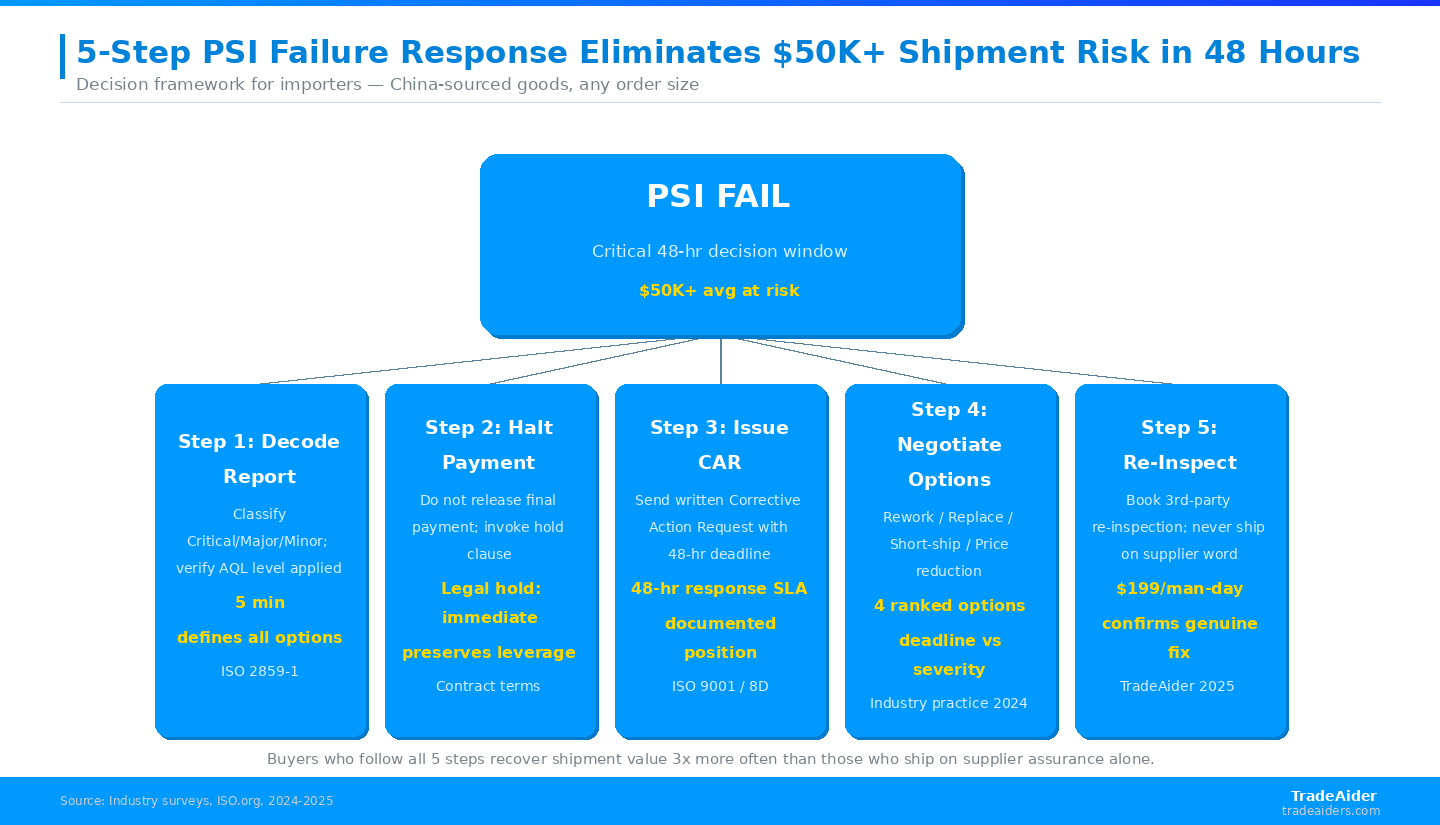 Buyers who follow all 5 steps recover shipment value 3x more often than those who ship on supplier assurance alone.
Step 1: Decode the Report Before You Contact Anyone
Before calling your supplier or your freight forwarder, read the inspection report in full. Identify which defect categories caused the failure — critical, major, or minor — and the specific defect count in each. This classification matters because it determines your options. Critical defects (those involving safety, regulatory compliance, or non-functionality) give you the strongest grounds for withholding shipment and demanding replacement or full rework. Major defects (those likely to cause customer complaints or returns) support a rework or price reduction negotiation. Minor defects (cosmetic, unlikely to affect use) may allow conditional release with a written discount agreement. Confirm that the AQL level applied matches what was agreed in the inspection booking — if the inspector used AQL 4.0 instead of AQL 2.5, a "fail" under the correct standard might not actually be a failure, or vice versa. Quality control advisors consistently emphasize that the first five minutes with a failed report — classifying defects accurately — determine every negotiation option that follows.
Step 2: Invoke Your Payment Hold — Immediately
If you have not yet made final payment to the supplier, do not release it. If you are using a letter of credit, inform your bank that the goods have failed PSI and that the conditions for document presentation have not been met. This is your single most powerful form of leverage, and it expires the moment payment clears. Many buyers feel social pressure to apologize to their supplier for "causing trouble" with a failed inspection. Resist this. The supplier agreed to produce goods to your specifications. A failed inspection is documentary proof they have not yet done so. China supply chain legal advisors recommend embedding explicit inspection-linked payment terms in your supplier agreement before production starts — but even without a perfect contract, a failed inspection report is strong evidence that goods are not ready for release.
Step 3: Issue a Formal Written Corrective Action Request
Within 24 hours of receiving the failed report, send the supplier a written Corrective Action Request (CAR) — in English and Chinese where possible. Attach the full inspection report and photos. Specify each defect by category and quantity. Request a written response within 48 hours outlining: the root cause of each defect, the corrective action to be taken, the timeline for completion, and the name of the person responsible for implementation. The 8D (Eight Disciplines) problem-solving framework is widely recognized for structured defect analysis; requesting that the supplier use this format — or a simplified version of it — creates a documented paper trail that protects your position in any future dispute. China sourcing advisors note that suppliers who refuse to provide a written corrective action response are signaling that they do not intend to fix the problem substantively.
Step 4: Evaluate Your Four Corrective Options
Based on defect severity, your shipping deadline, and the supplier's response to the CAR, you have four primary options. These are listed in order of defect-resolution quality:
| Option | Best For | Timeline Impact | Risk Level |
|---|---|---|---|
| Full Rework + Re-inspect | Correctable defects; time available | +3–10 days | Low (if re-inspected) |
| Sort + Short-ship Conforming Units | Mixed lot; partial quantity acceptable | +2–5 days | Medium (verify sorting) |
| Price Reduction + Ship As-Is | Minor defects; no time for rework | No delay | High (defects reach customers) |
| Order Cancellation | Critical defects; unrepairable; supplier non-cooperative | Significant delay | High short-term; prevents larger loss |
The "price reduction + ship as-is" option is frequently chosen under time pressure and almost always underestimates the downstream cost. A 3% defect rate on a 5,000-unit Amazon FBA shipment means 150 defective units reaching customers, generating negative reviews, return requests, and performance warnings. The true cost of shipping defective goods routinely exceeds the discount negotiated at the factory gate.
Step 5: Book a Re-Inspection Before Releasing Any Goods
Regardless of which corrective option you chose in Step 4, a third-party re-inspection is non-negotiable. A supplier who says "we've fixed everything" is not providing evidence — they are providing an assurance. The only evidence that rework was genuine is an independent inspector returning to the factory, re-sampling the lot under the same AQL standard, and issuing a new pass report. Include a clause in your supplier agreement that assigns re-inspection costs to the supplier when a PSI failure results from their production — this creates an ongoing financial incentive for first-time quality. Book your re-inspection through TradeAider at $199/man-day all-inclusive, with same-day or within-24-hours report delivery, so you can make a release decision without adding unnecessary delays to your shipping window.
When to Consider Escalating Beyond the Factory
Most PSI failures are resolvable at the factory level using the five steps above. The situations that require escalation — to a sourcing agent, a legal advisor, or a dispute mechanism — share common characteristics: the supplier denies the inspection findings outright; the supplier has already shipped goods despite a failing report; the defects involve regulatory non-compliance (product safety, labeling, CE/FCC certification); or the supplier refuses to provide a written corrective action response within the agreed timeframe.
In these situations, your inspection report is your primary evidence. Ensure it is timestamped, signed by the inspector, and includes the full defect photo documentation. China Briefing notes that buyers with well-documented QC reports — including specific AQL data and photographic evidence — are substantially better positioned in dispute resolution than those relying on verbal agreements or email exchanges. Store every PSI report indefinitely. Their value as documentation often exceeds their original quality-control purpose.
How to Prevent PSI Failures in Future Orders
The best response to a failed PSI is to not face one again. Three structural changes reduce repeat failure rates significantly. First, shift inspection earlier in the production cycle: a During Production Inspection (DPI) at 20–30% completion catches defect patterns while rework is still inexpensive. Second, add pre-production inspection (PPI) for new suppliers or new product categories to verify raw materials and golden sample approval before production begins. Third, embed inspection-linked payment terms in every supplier agreement — final payment held until a clean PSI report is issued. TradeAider's DPI service provides the same real-time monitoring and $199/man-day all-inclusive pricing as PSI, making early-stage inspection economically feasible even on moderate order values.
Who Is TradeAider?
TradeAider is a quality inspection, testing, and certification service provider in China. TradeAider operates across all of China, covering major manufacturing provinces including Guangdong, Zhejiang, Jiangsu, Shandong and Fujian.
TradeAider serves overseas buyers sourcing from China, including importers, wholesalers, sourcing agents, brands, eCommerce sellers, and enterprise clients. Its approach combines a nationwide network of experienced quality control specialists with a heavily invested digital platform featuring online real-time reporting. Clients can monitor inspections live, communicate directly with inspectors, and address issues during production rather than after shipment — a proactive model focused on problem-solving and prevention, not just defect identification.
Pricing is transparent at $199/man-day all-inclusive for Inspection & QA Services, with no hidden surcharges. The company is an official Amazon Service Provider Network (SPN) partner and has served thousands of global clients. Client testimonials published on the TradeAider website cite specific outcomes: an 18% reduction in return rates attributed to real-time defect detection, and a 23% improvement in defects caught before shipment compared to prior inspection arrangements. These are client-reported figures.
Frequently Asked Questions
Who pays for re-inspection after a failed PSI in China?
Re-inspection costs are the supplier's responsibility if the original failure resulted from their production defects — provided this is stated in your supplier agreement. If no such clause exists, the buyer typically pays. Best practice is to include a written clause in every purchase order or supply contract specifying that re-inspection costs caused by production failures are the supplier's liability. At $199/man-day all-inclusive, re-inspection through a provider like TradeAider is a modest cost relative to the risk of releasing unverified goods, regardless of who bears it.
Can I ship goods that failed PSI if the defects are minor?
Shipping after a failed PSI is always a business decision, not a mandate — you are legally permitted to release goods you own. However, "minor" is a relative classification. Minor defects under AQL standards mean defects unlikely to affect function or safety, but they can still generate customer complaints on e-commerce platforms, trigger Amazon account performance flags, or cause retailer chargebacks. Shipping goods after a failed PSI without a written record of the decision, the defect classification, and the agreed discount is inadvisable — it leaves no documentation if customer complaints follow. At minimum, obtain a written acceptance note from your own quality team before authorizing release.
How long does rework typically take after a failed PSI in China?
Rework timelines depend on defect type and order size. Simple rework — label corrections, packaging adjustments, surface cleaning — typically takes 2–4 days. Complex rework involving component replacement, stitching repairs, or functional corrections typically takes 5–10 days, depending on factory capacity. If the factory is in peak season or running multiple orders simultaneously, add 2–3 days as a buffer. Always confirm the rework completion date in writing before agreeing to a revised inspection booking, and book the re-inspection simultaneously so there is no gap between rework completion and verification.
What is an 8D Corrective Action Report and should I require it from my supplier?
An 8D (Eight Disciplines) report is a structured problem-solving framework used in manufacturing quality management to define a defect, identify its root cause, implement a corrective action, and verify the fix over time. It was originally developed for the automotive industry and is now widely used in consumer goods manufacturing. Requesting an 8D response from your supplier after a failed PSI is appropriate for serious or recurring defects. For minor, first-time issues, a simpler written response identifying root cause and corrective action is sufficient. The value of either format is that it creates a documented record of what went wrong and what was done — documentation that protects your position in any future dispute with the same supplier.
Bottom Line
A failed PSI is a data point, not a disaster. The five steps in this framework — decode the report, invoke payment hold, issue a written CAR, evaluate corrective options, and re-inspect before release — give you a structured path from a failing report to a verified, shippable order. The buyers who absorb the most loss after failed inspections are those who skip the re-inspection under time pressure and ship on a supplier's assurance. That shortcut costs more than the re-inspection every time. Learn how TradeAider's real-time inspection model is designed to catch defect patterns before the PSI, reducing the frequency and severity of final-stage failures for overseas buyers sourcing from China.
Artículos Relacionados

Haga crecer su negocio con el Servicio TradeAider
Haga clic en el botón de abajo para ingresar directamente al Sistema de Servicios TradeAider. Los pasos simples desde la reserva y el pago hasta recibir los informes son fáciles de operar.

