
- About Us

- Our Services
- Your Industry
- Resources
- News & Blog
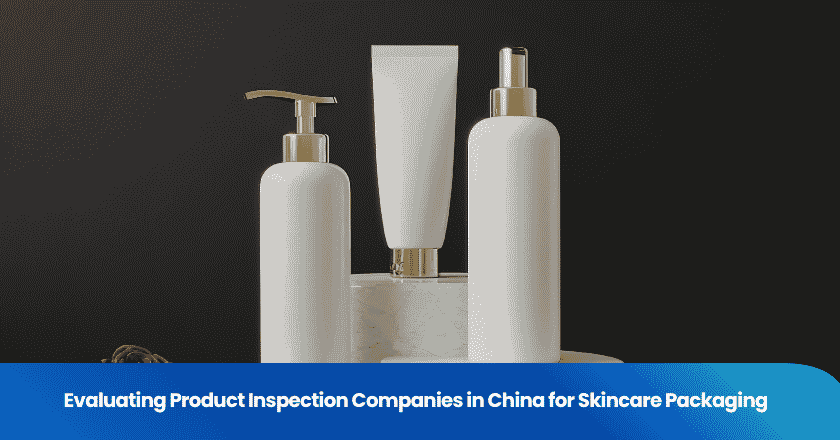
Choosing the wrong quality control partner for your skincare packaging order can be an expensive lesson. A leaking pump bottle discovered by customers at home costs far more — in refunds, negative reviews, and reorders — than a thorough inspection would have. But with dozens of inspection companies operating across China, how do you tell a genuinely capable partner from one that simply ticks boxes? This guide walks through the six criteria that matter most when vetting a product inspection company in China for skincare packaging sourcing. To understand why TradeAider's approach is built around these criteria, it's worth starting with what most generic inspection companies get wrong.
Key Takeaways
- Product-specific experience matters more than general QC credentials — ask whether the company has inspected cosmetic packaging with pumps, droppers, and snap caps before.
- Real-time reporting capability separates modern agencies from legacy ones — same-day access to photos and findings lets you act before the shipment moves.
- Transparent pricing protects your budget — a flat $199/man-day model removes the guesswork from cost planning across multiple SKUs.
Why Skincare Packaging Demands a Specialist Eye
Skincare packaging is one of the more technically demanding categories in beauty sourcing. A serum dropper that passes a basic visual check may still fail when filled with an oil-based formula. A lotion pump that looks perfect in photos may have a dip tube misalignment that causes air locks. Unlike apparel or hard goods, cosmetic packaging defects are often invisible until the product is filled, shipped across climate zones, or opened by a consumer.
This is why an inspection company's product familiarity is the first thing to assess — not just their general China presence. Experienced China QC practitioners consistently emphasize that checklist customization for the specific product type is what separates reliable agencies from generic ones. Generic checklists that cover quantity, packaging, and visual appearance will miss functional defects specific to pump mechanisms, torque strength, or seal integrity.
Criterion 1: Skincare Packaging Experience and Checklist Depth
The first question to ask any prospective inspection partner is simple: can you show me a sample checklist you've used for cosmetic bottles or packaging components? A credible agency should be able to produce a document that includes torque testing for caps, pump mechanism function checks, fill-volume verification, labeling alignment, and seal integrity protocols — not just a generic "appearance and quantity" template.
Professional inspection agencies customise their checklists upon client requirements — and the best ones can even provide video footage of the production line. The CPSC's guidance on third-party testing defines the independence standard that inspection companies should meet: a qualifying third-party body is one that is not owned, managed, or controlled by the manufacturer or private labeler of the product being assessed. If an agency tells you their standard checklist covers cosmetic packaging without offering to adapt it to your specific bottle type, treat that as a warning sign.
What a Strong Skincare Packaging Checklist Covers
| Inspection Area | What to Check | Why It Matters |
|---|---|---|
| Sealing Performance | Positive/negative pressure leak test | Prevents leakage in transit and on shelf |
| Cap Torque | Opening and fastening torque measurement | Too loose = leaks; too tight = poor consumer experience |
| Pump/Dispenser Function | Dip tube alignment, locking mechanism, stroke volume | Air locks and leaks stem from dispenser defects |
| Wall Thickness | Sidewall flex and uniformity check | Thin walls deform when filled or during shipping |
| Labeling and Print | Alignment, adhesion, ink quality | Non-compliant labeling triggers import issues and returns |
| Quantity & Carton | Unit count, inner/outer carton integrity | Shortfalls and crush damage are common shipment issues |
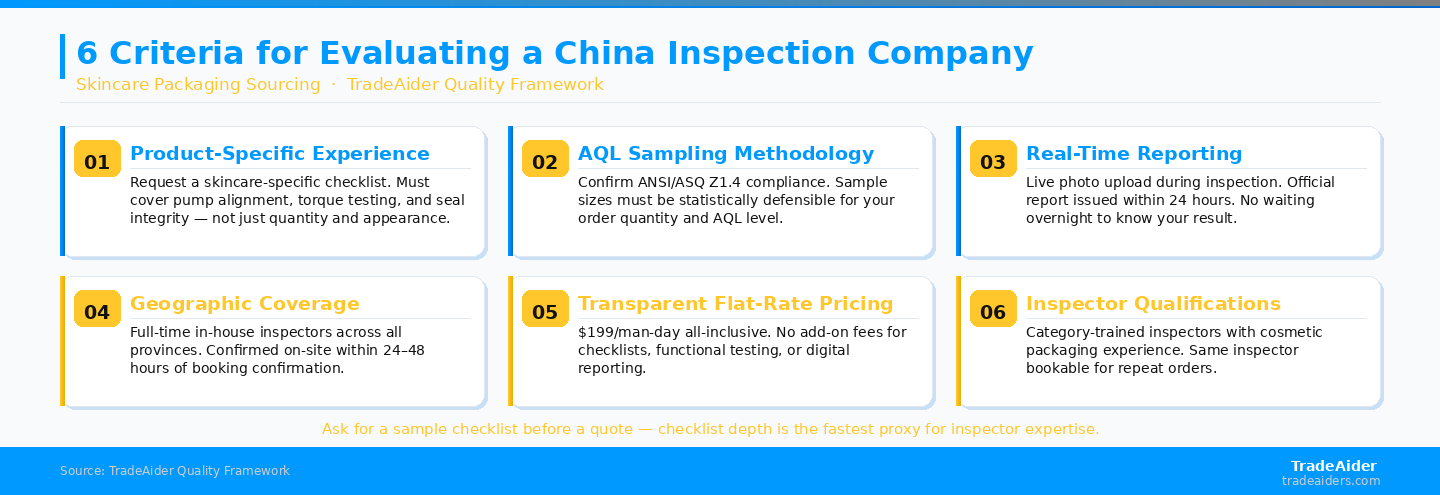 The six evaluation criteria — weighted by impact on skincare packaging quality outcomes.
Criterion 2: AQL-Based Sampling Methodology
Any inspection company worth considering should reference AQL (Acceptance Quality Limit) standards — specifically ANSI/ASQ Z1.4 — as the basis for determining their sample sizes. AQL sampling gives you a statistically defensible pass/fail framework rather than an arbitrary handful of units. For skincare packaging, most importers work with AQL 2.5 for major defects (functional failures like leaks or misaligned pumps) and AQL 4.0 for minor defects (cosmetic blemishes).
When evaluating agencies, ask whether they can explain how they calculate sample sizes for your specific order quantity and which AQL level they recommend for your product category. Agencies that can't answer this question fluently are likely not running structured inspections. For a practical overview of how international packaging test standards intersect with AQL sampling, Keystone Compliance's personal care packaging testing overview explains how ASTM standards like F2338 govern seal strength testing for beauty products. TradeAider's AQL calculator is a free tool importers can use to verify that proposed sample sizes are statistically sound before booking any inspection.
Criterion 3: Real-Time Reporting and Communication
One of the most practical differentiators between inspection companies is how and when they deliver their findings. Legacy agencies may send a PDF report the following morning — by which time a factory may have already loaded defective goods. Modern inspection companies provide real-time visibility through digital platforms, allowing importers to review photos, defect classifications, and preliminary findings while the inspector is still on-site.
For skincare packaging, this matters because decisions about rework, hold, or rejection often need to happen within hours, not days. A Shopify beauty brand sourcing from Guangdong reported that real-time photo access during a pre-shipment inspection allowed them to spot a batch of pumps with incorrectly sized dip tubes before the order was sealed — a defect that would have resulted in a near-total reorder. Same-day official reports make this kind of intervention routine rather than exceptional.
Questions to Ask About Reporting: When interviewing inspection agencies, ask: Do inspectors upload photos in real time? Is there a client portal where I can view findings as they happen? How are defect classifications communicated — and can I access raw photos rather than curated selections? How quickly is the official written report issued? What happens if findings are borderline — can I speak to the inspector directly?
Criterion 4: Geographic Coverage and Turnaround
Skincare packaging is manufactured across a wide footprint in China — from mold-injection facilities in Zhejiang to printing operations in Guangdong and Shandong. An inspection company's ability to deploy an inspector to your specific factory location within 24–48 hours is a practical necessity, not a luxury. Agencies that rely heavily on subcontractors or have thin coverage outside major coastal cities will create scheduling delays that compress your QC window dangerously close to ship dates.
Ask prospective agencies for their typical deployment timeline from booking to inspection for your factory's province. Many professional inspection companies can confirm an inspection date within 48 hours and deploy in-house (not subcontracted) inspectors across all major manufacturing regions. The FDA's guidance on cosmetic safety reinforces the principle that impartial, independent verification — not supplier self-declaration — is the accepted standard for consumer goods entering the US market. Confirm whether the company uses its own full-time staff or a network of freelance inspectors — the latter introduces consistency risks.
Criterion 5: Transparent, Flat-Rate Pricing
Pricing models in China's inspection industry range from transparent flat rates to opaque per-defect or volume-based structures that make budgeting difficult. For importers managing multiple SKUs, a flat man-day rate is the most plannable model. At $199/man-day, you know exactly what each inspection costs regardless of product complexity or order size, which allows you to build QC costs into your landed price model from the start.
Be cautious of agencies that quote unusually low day rates but charge add-ons for detailed checklists, lab-style functional tests, or digital reporting. The total cost of a thorough inspection should be predictable upfront. TradeAider's flat rate of $199/man-day means you know exactly what each inspection costs regardless of SKU count or order complexity. For a quick estimate of how many man-days your order requires, use the free inspection cost calculator.
Criterion 6: Inspector Qualifications and Consistency
The quality of an inspection ultimately rests on the individual standing on the factory floor. Ask agencies how their inspectors are trained, what category specializations they hold, and whether the same inspector can be requested for repeat orders. For cosmetic packaging, inspectors should have familiarity with plastic molding processes, labeling compliance, and basic functional testing of dispensing mechanisms. The FDA's cosmetics import surveillance page confirms why independent third-party verification matters: product safety verification must be objective, not influenced by the party whose goods are being assessed.
A well-structured QC operation, as outlined by sourcing industry resources, treats inspector qualifications as a core criterion — evaluating the likelihood and severity of defect types using risk assessment frameworks that inform both checklist design and defect prioritization. Agencies that rotate inspectors without client visibility are harder to hold accountable over time.
A Practical Evaluation Scenario
Consider an Amazon FBA seller sourcing 5,000 units of an airless pump bottle from a Guangzhou supplier. Before booking an inspection, they send the same product brief to three agencies and ask each to return a sample checklist. Agency A returns a five-line generic template. Agency B returns a detailed 30-point list covering torque, fill volume tolerance, pump stroke count, UV coating adhesion, and seal integrity — and offers to customize it further. Agency C quotes the lowest price but can only deploy within seven days and uses subcontracted inspectors.
The right choice is Agency B — not because of the price point, but because the checklist quality signals that the agency actually understands what can go wrong with airless pump bottles. This is the practical test: ask for the checklist before you ask for the quote.
Frequently Asked Questions
How many inspection man-days does a typical skincare packaging order require?
Most pre-shipment inspections for skincare packaging orders of 2,000–10,000 units require one man-day. Larger orders or those with multiple SKUs may require two man-days to allow proper AQL sampling across variants. Your inspection company should be able to confirm this based on your order quantity and SKU count before booking.
Should I inspect skincare packaging before or after filling?
Pre-shipment inspection of empty packaging should happen before filling, as functional tests (leakage, torque, pump mechanism) are most accurate on empty or water-filled units. If you're sourcing filled products, the inspection timing shifts to when 80–100% of production is complete — but empty packaging components should ideally be assessed at the PPI (Pre-Production Inspection) or DPI stage, which focuses on raw materials and early production samples. For more on how these inspection types differ, see TradeAider's inspection standards guide.
What's the difference between a product inspection and a factory audit for packaging suppliers?
A product inspection evaluates the specific goods in your order against your checklist. A factory audit evaluates the supplier's overall quality management system, equipment, and production capability — independent of any particular shipment. For new skincare packaging suppliers, a factory audit should come first, followed by product inspections on each order. To understand what TradeAider's factory audit covers, visit the about us page to learn how the team is structured to deliver both services.
Can I specify which tests I want included in a skincare packaging inspection?
Yes, and you should. A professional inspection company will let you define the checklist — including specific functional tests like torque measurement, fill volume tolerance, and leakage protocols. The more precise your instructions before inspection day, the more useful the findings will be. Always provide your golden sample (an approved reference unit) so the inspector has an objective benchmark to compare against.
Ready to book a pre-shipment inspection for your next skincare packaging order? Contact our team to discuss your requirements and receive a quote within 24 hours.

Related Articles
Grow your business with TradeAider Service
Click the button below to directly enter the TradeAider Service System. The simple steps from booking and payment to receiving reports are easy to operate.

