
- About Us

- Our Services
- Your Industry
- Resources
- News & Blog
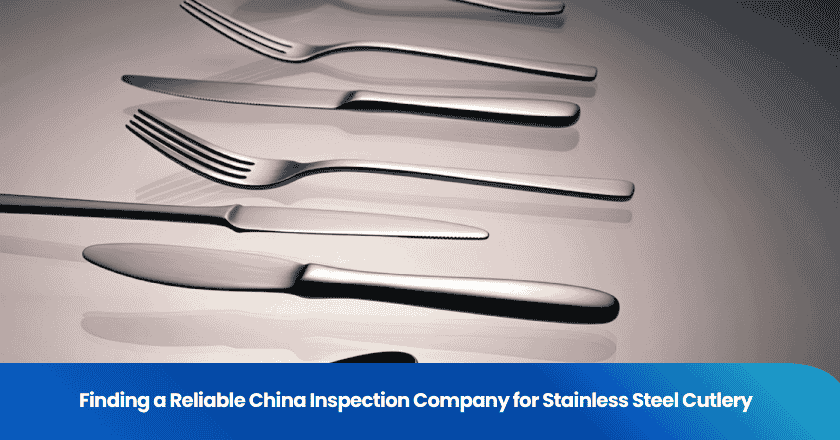
Stainless steel cutlery from China ranges from everyday kitchen utensils to premium flatware sold in department stores worldwide. But stainless steel is a deceptive material — it looks fine on the surface while hiding grade substitution, dimensional problems, and finishing defects that only a trained inspector with the right testing methods can catch. Choosing the right inspection company to protect your cutlery brand is a decision that directly affects your product quality, customer satisfaction, and bottom line. Here is how to find a partner you can trust.
Key Takeaways
- Grade verification is the most critical inspection step — 201 and 304 stainless steel look identical but perform very differently in real-world use
- The magnetic test is the fastest on-site method to distinguish genuine 304 from lower-grade alternatives
- Dimensional precision in cutlery affects both aesthetics and functionality — tine spacing, edge sharpness, and balance all require measurement
- Surface finish quality separates premium cutlery from budget alternatives and directly impacts customer perception of value
- Industry-specific experience in stainless steel flatware matters more than general inspection volume — you need inspectors who understand cutlery manufacturing
Why Stainless Steel Cutlery Needs Specialized Inspection
Stainless steel cutlery looks simple — it's a fork, a knife, a spoon. But the manufacturing process involves precision stamping, grinding, polishing, and heat treatment steps where dozens of things can go wrong. A fork with tines that are too far apart won't hold food properly. A knife blade with inconsistent hardness will dull quickly or chip. A spoon with an uneven polish looks cheap on the retail shelf. These aren't problems you can spot by glancing at a shipping carton — they require systematic inspection by someone who knows what they're looking for.
The Grade Substitution Risk
The most common and most costly problem in Chinese stainless steel cutlery manufacturing is grade substitution. Factories quote prices based on 304 stainless steel but ship products made from cheaper 201 grade. Both look identical to the naked eye. Both shine under the same polish. But 201 contains more manganese and less nickel than 304, making it significantly more prone to corrosion — especially in the dishwasher, where chloride exposure accelerates rust formation (per Diversified Metal Suppliers' stainless steel grade comparison).
An Amazon FBA seller who sourced stainless steel flatware sets learned this lesson expensively: customer reviews started mentioning rust spots after two weeks of dishwashing. Lab testing confirmed the factory had substituted 201-grade stainless steel for the specified 304. The resulting product recall, inventory disposal, and listing damage cost far more than proper inspection would have.
Dimensional Precision and Its Impact on User Experience
Cutlery dimensions affect more than aesthetics — they determine how the product performs in a customer's hand. Fork tine spacing that's too wide lets food slip through. Knife blades that are too thick require excessive force to cut. Handle weight that's unbalanced causes wrist fatigue during extended use. These issues create negative customer experiences even when the stainless steel grade is correct.
What to Look for in an Inspection Company
Stainless Steel Expertise
Not every inspection company is qualified to inspect cutlery. When evaluating potential partners, ask specific questions about their experience with stainless steel flatware:
- Can your inspectors perform magnetic testing to verify stainless steel grade?
- Do you have experience with dimensional inspection of cutlery — tine spacing, blade thickness, handle balance?
- Do you understand the difference between mirror polish, satin finish, and brushed finish specifications?
- Can you coordinate laboratory testing for composition verification if needed?
If the inspection company can't answer these questions confidently, they're generalists who will treat your cutlery like any other product — and miss the defects that matter most.
Real-Time Reporting Capability
Cutlery production runs are often large — 50,000 to 500,000 pieces per order. When an inspection reveals a systematic problem like grade substitution or a dimensional issue caused by worn tooling, you need to know immediately, not three days from now. Real-time inspection reporting lets you halt production, adjust the process, or change the batch before the entire order is manufactured with the same defect (per TradeAider's pre-shipment inspection service).
Pricing Transparency
Inspection pricing for cutlery should be straightforward — a per man-day rate with no surprises. Ask about additional fees for weekend inspections (common in Chinese manufacturing, where Saturday work is standard), holiday surcharges, travel costs to factory locations outside major manufacturing hubs, and any per-report charges. Transparent pricing at $199 per man-day with all fees included is the standard to look for.
The Four-Step Inspection Framework for Stainless Steel Cutlery
Reliable cutlery inspection follows a structured framework that addresses the specific risks at each stage. Here's what each step covers and why it matters.
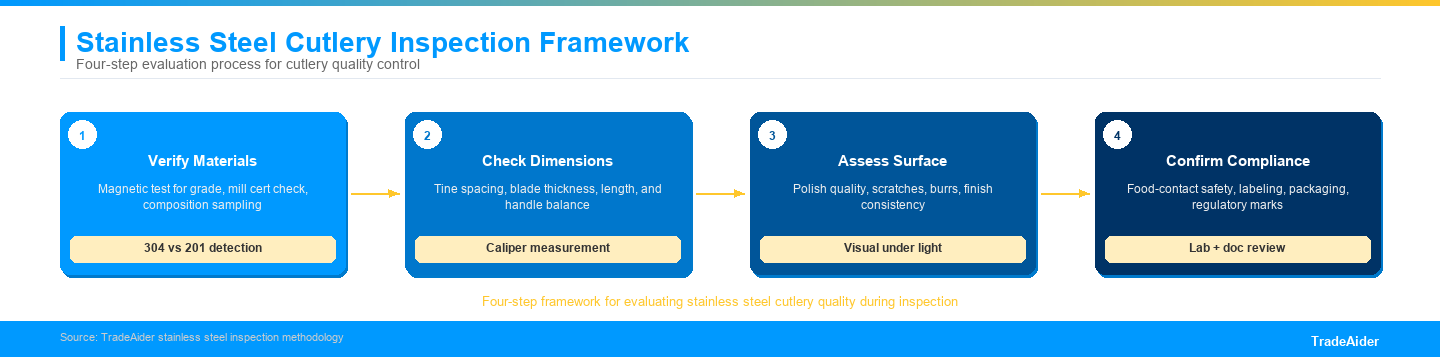
The four-step cutlery evaluation framework: each step addresses a specific category of risk that cannot be caught by later steps
Step 1: Material Verification
Material verification happens at the raw material stage or at the very beginning of production. The inspector confirms that the stainless steel coils or sheets being fed into the stamping machines match the specified grade. This is where the magnetic test is performed — 304 stainless steel is austenitic and non-magnetic, so a magnet should not stick. If the magnet sticks, the material is likely 201 or another ferritic grade.
For comprehensive verification, samples are collected for laboratory composition analysis using spectrometry or XRF testing. This provides definitive grade confirmation beyond what on-site testing can determine.
Step 2: Dimensional Checks
During and after production, inspectors use calipers, gauges, and go/no-go fixtures to verify dimensional specifications. For cutlery, the critical dimensions include:
- Tine length and spacing on forks — must be consistent across the production run
- Blade thickness and profile on knives — affects cutting performance and safety
- Bowl depth and shape on spoons — determines proper portion size
- Handle dimensions and weight distribution — affects balance and comfort
- Overall length — must match specifications across the entire set
Dimensional variation in cutlery often indicates worn stamping tools, which means the problem will worsen as production continues. Catching this during during-production inspection lets you address the tooling issue before the entire batch is affected.
Step 3: Surface Quality Assessment
Surface finish is where premium cutlery earns its price point. Inspectors evaluate the polish quality under controlled lighting, looking for:
- Scratches and swirl marks from inconsistent grinding or polishing
- Water spots and stains from inadequate drying after wash cycles
- Burrs and rough edges from stamping — particularly dangerous on knife blades and fork tines
- Polish consistency across the set — all pieces should match in reflectivity and finish
Step 4: Compliance Verification
The final step confirms that your cutlery meets regulatory requirements for the target market. This includes verifying food-contact safety compliance (particularly important for products marketed as food-safe), confirming that labeling and markings are correct, and checking packaging quality to prevent damage during shipping (per Tuoze's comparison of 201 vs 304 stainless steel in cutlery).
Key Inspection Tests for Stainless Steel Cutlery
| Test | What It Checks | Method | Cost Level |
|---|---|---|---|
| Magnetic Test | Grade verification (304 vs 201) | Magnet applied to surface | Included in inspection |
| Dimensional Measurement | Tine spacing, blade thickness, length | Calipers and gauges | Included in inspection |
| Surface Inspection | Polish quality, scratches, burrs | Visual under controlled light | Included in inspection |
| Composition Analysis | Exact chromium/nickel content | Laboratory spectrometry | Additional lab fee |
| Corrosion Resistance | Salt spray or pitting resistance | ASTM B117 salt spray | Additional lab fee |
Red Flags When Choosing an Inspection Partner
- No stainless steel experience: If the company can't describe specific cutlery inspection protocols, they're learning on your time and your money
- Reports take more than 24 hours: For cutlery with tight production schedules, delayed reporting means delayed decisions
- Can't explain their magnetic testing procedure: This is the most basic on-site test for stainless steel — an inspector who can't describe it doesn't understand the material
- No composition verification option: If the company can't coordinate lab testing for grade verification, they can't provide complete cutlery inspection
- Unclear pricing: If you can't get a straight answer on the total cost per man-day, expect surprises on the invoice
Practical Tips for Stainless Steel Cutlery Importers
- Always specify the exact grade in your purchase order and inspection requirements — "304 stainless steel" not just "stainless steel"
- Include the magnetic test in every inspection checklist — it's fast, free, and catches the most common form of fraud
- Request composition testing on the first production run with any new supplier — the lab cost ($200-400) is cheap insurance against grade substitution
- Provide physical samples or reference pieces to your inspector for dimensional comparison — this eliminates ambiguity about acceptable tolerances
- Inspect during production, not just before shipment — dimensional drift from worn tooling is a progressive problem that gets worse through the production run
For importers who want a structured, transparent approach to cutlery quality control, contact TradeAider's team to discuss an inspection plan built around your specific product requirements. Or use the inspection cost calculator to estimate your total quality control investment before committing to an order.
Frequently Asked Questions
How do I verify stainless steel grade during inspection?
The fastest method is the magnetic test: a magnet should not stick to genuine 304 stainless steel. If the magnet adheres, the material likely contains less nickel and more manganese, indicating a lower grade like 201. For definitive verification, collect production samples for laboratory composition analysis using spectrometry or XRF testing, which provides exact chromium, nickel, and manganese percentages.
What is the difference between 201 and 304 stainless steel for cutlery?
304 stainless steel contains 18-20% chromium and 8-10.5% nickel, providing excellent corrosion resistance. 201 contains 16-18% chromium but only 3.5-5.5% nickel, with more manganese substituted. Both look identical, but 201 is significantly more prone to rust, especially in dishwashers or coastal environments. For cutlery, 304 is the minimum acceptable grade for quality products; 430 is sometimes used for budget lines but has different magnetic and corrosion properties.
How much does stainless steel cutlery inspection cost in China?
Standard inspection pricing applies: approximately $199-$350 per man-day for on-site inspection. Laboratory composition testing adds $200-400 per test. A typical approach is one man-day of on-site inspection plus composition testing on the first run with a new supplier, then on-site inspection only for subsequent runs if material consistency is confirmed. You can estimate your total cost using TradeAider's transparent $199/man-day rate with the inspection cost calculator.
How long does a cutlery inspection take?
A standard pre-shipment inspection for stainless steel cutlery typically takes one man-day per 1,000-3,000 pieces, depending on the number of items in the set (individual fork, knife, spoon versus complete sets) and the complexity of the testing requirements. If composition testing is required, add 5-7 business days for laboratory analysis. Your inspection company should provide a time estimate based on your specific lot size and testing scope.
Related Articles

Grow your business with TradeAider Service
Click the button below to directly enter the TradeAider Service System. The simple steps from booking and payment to receiving reports are easy to operate.

