

Accessories quality inspection is not a small add-on check; it verifies small parts, trims, components, add-ons, and packaged accessories against buyer requirements before missing, unsafe, mismatched, or poorly attached items reach customers, and TradeAider keeps that evidence tied to release action. The practical answer is to inspect the risks that can still be changed, record the evidence that proves conformity, and decide whether to release, hold, sort, rework, test, or reinspect before the shipment moves beyond buyer control.
Key Takeaways
- Accessory checks need subgroup detail: color, size, SKU, set composition, attachment method, and packing variant should be visible in the report.
- Function and attachment matter: zippers, buckles, straps, trims, clips, buttons, chargers, and small add-ons should be checked against how customers use them.
- Safety boundaries must be explicit: children's products, small parts, sharp points, choking hazards, restricted substances, and tracking labels may require rules beyond visual inspection.
- The checklist should end in action: release, hold, sort, rework, test, or reinspect should be clear from the evidence.
What Counts as Accessories Quality Inspection?
Accessories quality inspection covers the small items and add-on components that support a finished product: trims, buttons, zipper pulls, buckles, straps, chargers, cables, clips, hangtags, gift items, spare parts, decorative pieces, labels, inserts, and bundled components. ISO/IEC 17020:2026 defines inspection as determining conformity with requirements, which means accessories should be checked against the buyer's file rather than treated as harmless extras.
Small accessory mistakes can become large customer issues. A missing strap can make a bag incomplete. A weak buckle can cause a return. A wrong hangtag can block retail receiving. A small detachable part can raise safety concerns in children's products. ISO 9001 is relevant because controlled requirements and process checks are still needed even when the component is inexpensive.
Accessories often fail in subgroups
Accessory defects are often hidden in variation. One color may have weak plating, one size may have mismatched labels, one carton may contain the wrong insert, or one production batch may use a different attachment method. A checklist that only says appearance OK can miss these patterns. The inspector should map accessory subgroups by SKU, color, size, version, destination, set composition, or carton group before deciding whether a defect is isolated.
A 30,000-piece accessory order can look clean in aggregate while one 5,000-piece color subgroup carries the defect. Subgroup mapping keeps the buyer from accepting a general pass result when the actual risk sits inside one version, carton group, or destination label.
The main product can pass while accessories fail
Importers often focus on the main product and treat accessories as secondary, but the customer receives the whole set. A garment with missing buttons, a toy with a wrong accessory pack, a bag with a weak strap, or an electronic item with a mislabeled cable can fail customer acceptance even when the main item looks good. Accessory inspection protects the completeness and usability of the finished offer.
That is why accessory inspection should count complete sets, not only individual pieces. If 1 missing strap affects each packed bag in a 600-carton subgroup, the main product may look fine while the customer receives an incomplete retail unit.
Checklist Example: Core Accessory Inspection Points
A practical accessory checklist starts with identity and completeness, then moves to workmanship, function, attachment, labels, packing, and safety boundaries. The exact checks should change by product category, but the structure stays useful because accessory defects usually come from mismatch, missing items, weak assembly, poor finish, or wrong packaging.
BLS describes quality control inspectors as examining products and materials for defects or deviations from specifications. For accessories, the specification may be a set list, color standard, attachment requirement, artwork file, pull-strength expectation, barcode file, or packaging method. The checklist should make those requirements visible.
| Checklist area | Example checks | Release risk if missed |
|---|---|---|
| Identity and set | SKU, color, size, model, component count, approved sample match | Wrong or incomplete set ships |
| Workmanship and finish | Scratches, stains, plating, burrs, loose threads, deformation | Visible customer complaints increase |
| Function | Open, close, pull, fit, charge, lock, clip, fasten | Accessory cannot support product use |
| Attachment | Stitching, glue, rivet, snap, buckle, seam, torque, alignment | Part detaches or fails in use |
| Labels and packing | Barcode, hangtag, warning label, insert, carton mark, polybag | Retail, warehouse, or compliance issue |
| Safety boundary | Small parts, sharp edges, choking warning, restricted-risk flag | Critical hold or testing needed |
This table should be adapted for each product. A cable accessory needs different function checks from a garment trim, and a children's accessory needs a stricter safety boundary than a decorative adult-market item.
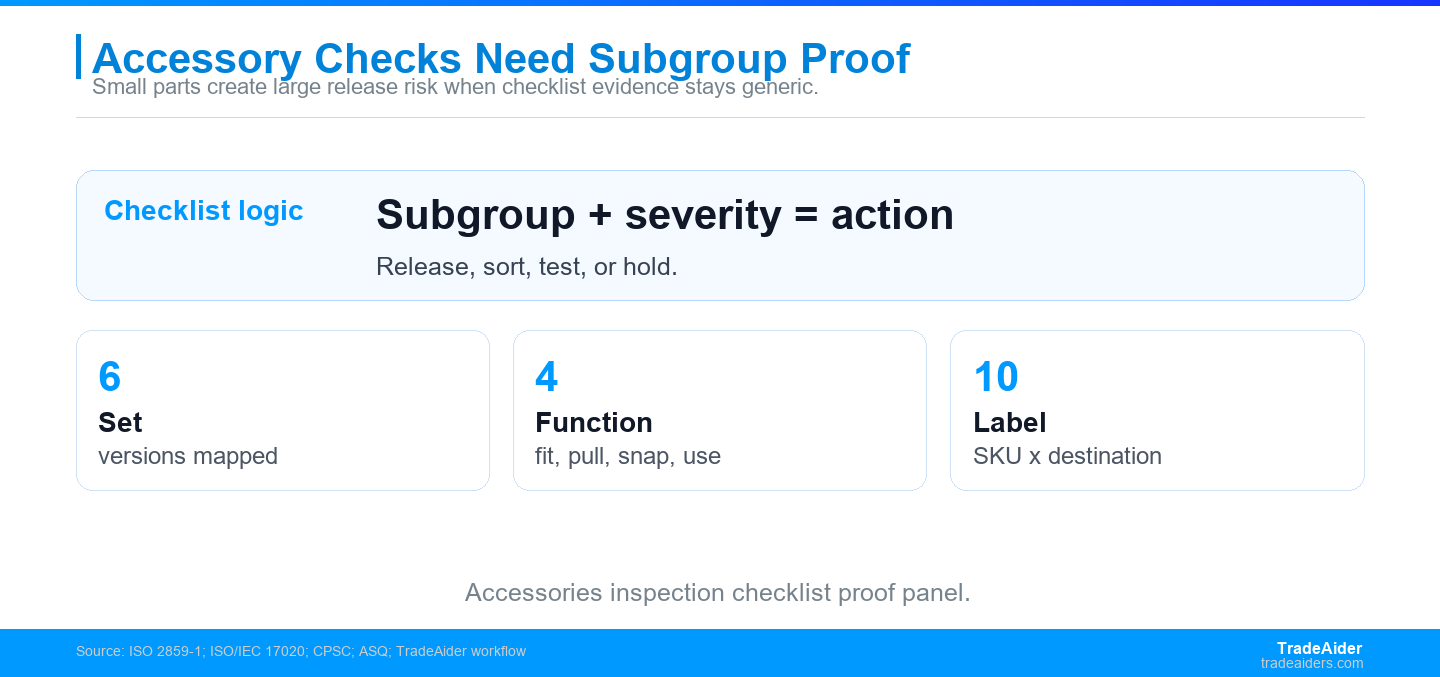
Accessory inspection should separate identity, function, attachment, label, packing, and safety risks before the buyer releases a shipment.
Checklist Example: Bags, Garments, Toys, and Electronics Accessories
Different accessory categories fail in different ways. A good checklist does not copy the same line items for every product. It starts with the way the accessory is used by the customer and the way it can block saleability. The inspector should check both individual accessory quality and whether the accessory belongs correctly with the finished product.
O*NET reflects how inspection work can include testing, sorting, sampling, measuring, and weighing. That is useful for accessory inspection because many checks are small but concrete: strap pull, button fit, zipper movement, cable fit, battery compartment closure, insert count, label position, or component weight where relevant.
| Accessory type | Inspection examples | Best-practice note |
|---|---|---|
| Bag accessories | Straps, buckles, zippers, pulls, rivets, hangtags | Check attachment strength and color match |
| Garment accessories | Buttons, snaps, trims, drawcords, spare parts, labels | Check set completeness and secure attachment |
| Toy accessories | Small parts, edges, labels, instructions, set pieces | Flag age grading and safety requirements early |
| Electronics accessories | Cables, chargers, adapters, labels, manuals, inserts | Separate visual fit from electrical safety proof |
| Retail accessories | Barcodes, polybags, tags, shelf labels, carton marks | Match destination and customer receiving rules |
Sampling and Defect Classification for Accessories
ISO 2859-1:2026 provides current AQL-indexed sampling schemes for lot-by-lot inspection by attributes. ASQ explains acceptance sampling as a way to make accept-or-reject decisions from sample evidence. For accessories, sampling must reflect subgroup variation because small components are often produced, packed, or sourced separately from the main product.
Defect classification also needs care. A minor surface scratch on a hidden spare part may be low risk. A loose sharp metal piece, choking hazard, missing warning label, wrong barcode, nonfunctional charger, or strap that detaches during a simple check may be major or critical. The buyer should define critical, major, and minor accessory defects before the inspection date.
Critical accessory defects need a zero-tolerance mindset
Many buyers allow some minor defects within an AQL rule, but critical accessory defects should be treated differently. Sharp edges, small parts in the wrong age category, exposed electrical risk, missing safety warnings, or detachable components that can create injury risk may require immediate hold, testing, or engineering review. The inspection checklist should identify these risks before the visit so they are not buried under normal workmanship comments.
Critical risk is not averaged away by a good minor-defect count. One sharp edge, choking-risk part, exposed wire, or missing safety warning can justify a hold even when 499 other checked accessories look acceptable.
Subgroup sampling prevents false confidence
If an order includes six accessory versions and the sample comes mainly from one version, the buyer may receive a clean report that says little about the other five versions. The inspector should sample across relevant subgroups where possible and record which subgroups were checked. This is especially important for colorways, size runs, multi-piece sets, replacement parts, destination-specific labels, and accessories sourced from different suppliers.
For a 6-version accessory order, sampling mostly one version means the buyer may inspect only 16.7 percent of the variation map. A better process records which versions were checked and where any targeted findings sit.
Safety, Labeling, and Testing Boundaries
Accessory safety depends on product category and destination market. CPSC small parts guidance is a useful example for U.S. children's products because small parts, balls, marbles, balloons, and certain toys can require choking-hazard warnings or restrictions. That does not mean every accessory follows the same rule; it means the buyer should identify regulated categories before relying on visual inspection alone.
CPSC tracking label guidance also matters for children's products because tracking labels help identify producer, location, date, and cohort information where required. CPSIA provides broader context for children's product safety obligations. If an accessory is intended for children, safety, label, certificate, and testing questions should be settled before final shipment release.
- Flag small detachable parts when the product is for children or age grading is uncertain.
- Check warning labels, age labels, tracking labels, and instructions where applicable.
- Separate visual inspection from lab testing for restricted substances, electrical safety, or material claims.
- Treat sharp points, sharp edges, exposed wires, choking hazards, and missing warnings as release-blocking risks.
- Confirm destination-market label versions before packing is complete.
Scenario Estimate: Why Small Accessories Need Specific Evidence
Consider a 30,000-piece accessory order with six versions. A generic inspection might check appearance, count a few cartons, and say the goods are acceptable. A stronger inspection maps the six versions, samples across the lot, records finish defects by subgroup, tests simple functions, checks attachment points, verifies labels, and flags any safety boundary that visual inspection cannot close.
The difference is not theoretical. If one version has the wrong label or weak attachment, the buyer needs targeted sorting rather than a vague supplier promise. If the issue is safety-related, the buyer may need to hold the whole subgroup until testing or engineering review confirms the risk. Specific evidence keeps a small defect from becoming a large receiving problem.
Calculated from 30,000 accessories and a 500-unit inspected sample, 500 divided by 30,000 equals 1.67 percent of the lot reviewed as direct sample evidence. Calculated from 6 accessory subgroups and 3 defect severities, the checklist creates 18 places where defects can be classified instead of hidden in a general comment. Calculated from USD 0.12 repacking cost and 4,000 mislabeled units, 4,000 x USD 0.12 equals USD 480 before relabeling material or shipment delay. Calculated from 4 attachment checks on a 200-unit subgroup, pull, stitch, glue, and alignment equals 800 individual observations if every sampled unit is reviewed consistently. Calculated from 2 destination label versions and 5 SKUs, 2 x 5 equals 10 label combinations that must match the carton and product. Calculated from 1 critical finding and 0 allowed critical defects, 1 minus 0 equals 1 release-blocking exception regardless of minor-defect counts. Calculated from 8 checklist rows and 6 accessory subgroups, 8 x 6 equals 48 inspection cells to plan before sampling starts. Calculated from 12 carton positions and 6 subgroups, 12 x 6 equals 72 possible carton-subgroup sampling combinations.
How TradeAider Supports Accessories Quality Inspection
TradeAider can build accessory checks into the right inspection stage. If accessory materials, approved samples, or artwork are not ready, Pre-Production Inspection can verify setup before production starts. If accessory attachment or finish defects may spread during production, During Production Inspection can check early output and correction evidence. If the shipment is ready for release, Pre-Shipment Inspection can verify the completed lot when it is 100 percent finished and at least 80 percent packed.
For hidden risk, TradeAider can coordinate product testing services so chemical, safety, or performance claims are not judged by appearance alone. For sample planning, the AQL calculator and inspection standard guide can help align lot size, inspection level, and defect severity before the visit.
To prepare an accessory inspection, send the full set list, SKU map, approved samples, artwork, barcode files, label rules, packing method, destination market, product age grading if relevant, and known failure points. Then contact TradeAider before the supplier packs variation into cartons that are harder to sort.
Accessories Inspection Best-Practice Checklist
Use this checklist as a practical planning tool before booking inspection. It keeps the report focused on the accessory risks that usually decide release.
- Map every accessory by SKU, color, size, version, set, and destination label.
- Check identity, quantity, set completeness, approved sample match, and product pairing.
- Inspect finish, workmanship, edge condition, color, printing, plating, and deformation.
- Run simple function checks such as pull, fasten, zip, snap, charge fit, clip, open, close, or assemble.
- Check attachment points such as stitching, glue, rivets, snaps, buckles, seams, and alignment.
- Verify retail labels, barcodes, warnings, inserts, manuals, carton marks, and packing method.
- Flag small parts, sharp edges, chemical, electrical, and children's product risks for testing or specialist review.
- Record defects by severity, count, photo, location, carton identity, and subgroup.
- Define release, hold, sorting, rework, testing, and reinspection authority before the inspection.
The best accessory checklist is not the longest one. It is the one that makes the buyer's real release risk impossible to overlook. TradeAider can turn these 9 checklist lines into a subgroup-based inspection brief before accessories are sealed into cartons.
Frequently Asked Questions
What is accessories quality inspection?
Accessories quality inspection checks small components and bundled items against buyer requirements before they create customer or retail problems. It covers trims, add-ons, spare parts, labels, inserts, identity, quantity, workmanship, function, attachment, labels, packing, and safety boundaries. The buyer can then release, hold, sort, rework, test, or reinspect with evidence.
What should an accessories inspection checklist include?
An accessories inspection checklist should include the checks that decide completeness, usability, safety, retail acceptance, and release action. Include accessory identity, set completeness, approved sample match, color and finish, function, attachment strength, labels, barcodes, warnings, inserts, packing, carton marks, subgroup sampling, defect severity, photo evidence, and any testing or compliance boundary that visual inspection cannot prove.
Are accessories inspected with the same AQL plan as the main product?
Accessories can sometimes use the same overall AQL logic, but buyer teams should still consider accessory variation separately. If accessories have different SKUs, colors, versions, suppliers, or destination labels, the sample should represent those subgroups where possible. The buyer should define defect severity separately because a small accessory can create a major, critical, or compliance-related issue.
When do accessories need product testing instead of visual inspection?
Accessories need product testing when the buyer must prove hidden properties that cannot be judged by visual appearance alone. Testing may be needed for chemical content, restricted substances, electrical safety, flammability, material composition, performance, or children's product safety. Visual inspection can flag missing labels, visible hazards, poor workmanship, or function issues, but it should not be used as proof of hidden properties.

Articles Connexes

Développez votre entreprise avec le Service TradeAider
Cliquez sur le bouton ci-dessous pour accéder directement au Système de Service TradeAider. Les étapes simples de la réservation et du paiement à la réception des rapports sont faciles à utiliser.

