
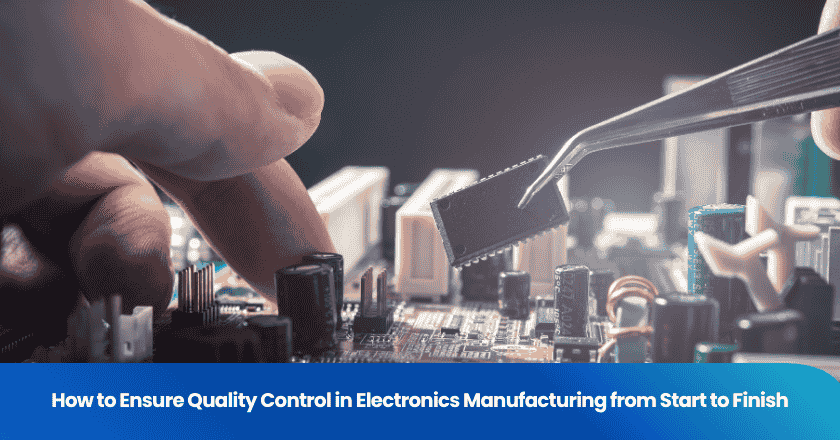
Quality control in electronics manufacturing works best as a chain of evidence, not as one last inspection. A buyer first defines the approved build, then checks the risks that can change at each stage: components, assembly, handling, device behavior, market documentation, and the packed shipment. Each handoff should answer one practical question: does the evidence cover the exact version and lot that will be released?
That distinction matters when a finished unit looks acceptable but carries an unapproved component, an untested firmware revision, or incomplete market evidence. A final visit can confirm the current lot against an agreed scope. It cannot recreate proof that was never collected earlier.
Key Takeaways
- Set the approved product version and change path before components are ordered.
- Use separate evidence for workmanship, process control, function, and market requirements.
- Contain a changed sub-lot until the evidence covers that exact population.
- Use final inspection to confirm a traceable packed lot, not to rescue an unclear build.
Set the Release File Before Components Are Ordered
Start with a release file that identifies the approved sample, product revision, bill of materials (BOM), functional expectations, visible acceptance rules, packaging, labels, and the person who can approve a change. A bill of materials (BOM) lists the approved components and their revision identifiers for this build. Without it, a buyer cannot tell whether a part on the line is the agreed part or merely a plausible substitute.
ISO 9001 describes a quality management system that is established, implemented, maintained, and continually improved. For an importer, that system-level idea becomes practical when the factory, buyer, and inspector work from the same controlled version rather than from screenshots, verbal approvals, or an old sample.
Record what must happen when a part, firmware, process setting, label, or carton changes. A change record should state the affected requirement, the units involved, the evidence needed, and who may release them. When the order is still at the reference stage, check pre-production inspection availability to verify the approved materials and requirements before production scales.
Make the file usable on the factory floor. Match every critical requirement to an observable point, a record, or a test result. For a charging product, that may mean identifying the approved adapter, connector, battery configuration, charging behavior, markings, and carton contents. For a wireless accessory, it may also mean naming the hardware and software configuration being built. The more clearly these details are tied to the approved version, the easier it is to spot a meaningful deviation before it reaches the packed lot.
Use Five Gates to Keep Quality Control Connected
The five gates below are an operational model, not a universal test standard. Their value is simple: each gate creates evidence that the next decision can use. A buyer who waits until the last gate has fewer choices and less clarity about the source of a problem.
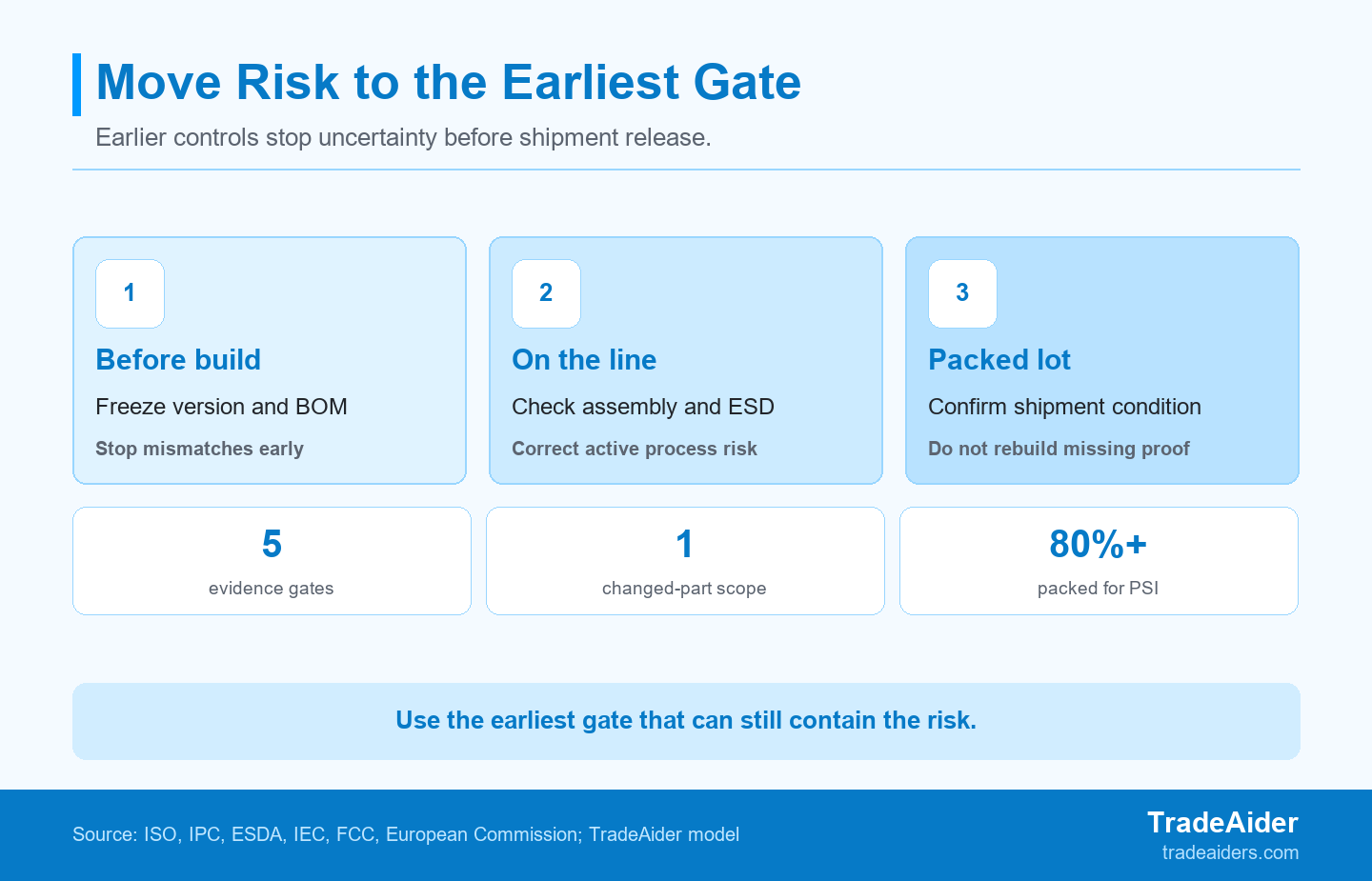
Move high-impact production risks to the earliest evidence gate; final inspection confirms the packed lot but cannot recreate earlier proof.
| Gate | Buyer Question | Evidence to Keep | If It Fails |
|---|---|---|---|
| 1. Requirements | What build is approved? | Version, BOM, sample, acceptance rules | Clarify before ordering |
| 2. Components | Are approved parts being used? | Part identity, lot traceability, change record | Contain the affected group |
| 3. Assembly and ESD | Is the process producing the intended build? | Workmanship, line controls, handling records | Correct while the line is active |
| 4. Function | Does the current build perform as intended? | Test method, result, version, conditions | Retest the defined scope |
| 5. Packed-lot release | Does the shipment match the approved lot? | Sampling result, cartons, labels, quantity | Hold or release the shipment |
Before using the map, review TradeAider's inspection standard and adapt the agreed checks to the product, risk, and destination. The point is not to collect more forms. It is to ensure that every form can influence a release decision.
Separate Workmanship From Manufacturing Process
IPC distinguishes J-STD-001 soldering-process requirements from IPC-A-610 post-assembly acceptance criteria. That distinction gives a buyer two useful questions: does the finished assembly meet the agreed visual acceptance point, and was the soldering process controlled as required?
IPC describes IPC-A-610 as visual quality acceptability requirements. A visual inspection can therefore be highly valuable for solder joints, component placement, contamination, or damage. It should not be presented as evidence that every electrical function, component identity, or market requirement has been proven.
Use the pair in a controlled way. The inspection brief should name the agreed class, revision, inspection object, and acceptance point. It should also state whether the inspector is checking finished workmanship, observing a process condition, reviewing traceability, or escalating a concern for technical assessment. Those are different assignments, and combining them into one vague request produces a vague report.
Treat ESD as a Line-System Check
Electrostatic discharge (ESD) is an electrical charge transfer that can harm sensitive circuitry. The damage may not be obvious during a finished-unit visual check, which is why ESD belongs at the active-line gate. Look for a working system: grounded people and work surfaces where applicable, appropriate handling materials, defined procedures, and records that show the controls are being maintained.
Ask the factory to show how the system is applied across the relevant work area, rather than treating wrist straps or a single meter reading as the whole answer. The review can include the defined handling route for boards and sensitive parts, the condition of work surfaces and containers, the response to an out-of-control finding, and the records that connect those controls to the production window being observed. This makes the observation useful for a current line decision.
ANSI/ESD S20.20 describes administrative and technical requirements for an ESD control programme. The practical boundary is important. A visitor can observe whether agreed controls are in use; that observation does not certify the entire programme or rule out every later failure. During an active build, check during-production inspection availability when a finding can still lead to correction, containment, or a focused review.
Keep Market Evidence Outside the Visual-Inspection Claim
Electronics buyers often need safety, wireless, and materials evidence alongside factory quality controls. These workstreams may inform one another, but they do not have the same proof. IEC 62368-1:2023 addresses product safety through energy sources and safeguards for equipment in its scope. That is different from confirming that a particular unit has a clean enclosure or an acceptable solder joint.
For products with radio functions, the applicable market path may require separate authorization evidence. The FCC states that RF devices subject to equipment authorization must meet technical requirements before US importation or marketing. For EU materials restrictions, the European Commission explains that RoHS restricts hazardous substances in electrical and electronic equipment.
Treat these as product- and market-specific evidence routes. An inspector can verify agreed markings, documents presented, and observable product conditions. The buyer still needs qualified support to determine which safety, RF, chemical, or documentation obligations apply to the actual product and destination.
Keep the documentation list current when the target market, radio module, charger, material, or product configuration changes. A declaration that names one product family or hardware revision does not automatically cover every variation on the purchase order. The release file should therefore point to the current documents, their scope, and the owner who resolves a mismatch before the lot is released.
Run Functional Tests Against the Current Build
Functional testing has more value when its scope is unmistakable. Link the test record to the product revision, firmware version, component configuration, test method, limits, and lot or serial range. That makes a result useful when a factory asks whether a prior pass can cover a later change.
Choose the functions that matter to the product, such as charging, power draw, buttons, ports, displays, wireless pairing, or protective shutdown. A broad pass statement is weaker than a short record that names what was tested and under which conditions. Independent observations and real-time reporting also help the buyer act before shipment.
Where a function can vary by battery lot, connector, radio module, or software setting, preserve the identifiers that tie the result to that configuration. A report that says only “passed” may be useful for a discussion, but it does not show whether a later sub-lot remains within the tested scope. This discipline also makes it easier to decide whether a finding calls for containment, rework, or a focused retest. For a summary of independent, real-time inspection visibility, see why importers choose TradeAider.
Worked Scenario: Power Bank With a Substitute USB-C Protection IC
Identify What the Earlier Evidence Does Not Cover
Illustrative scenario: an importer is preparing a US and EU launch of 5400 20,000 mAh power banks from China. The approved BOM names one USB-C protection IC.
During production, the supplier proposes a substitute because the approved part has a longer lead time. The original functional plan was written for the approved component and the buyer must decide whether that record can be extended.
The factory can identify 1,350 units assembled with the substitute and 4,050 units that remain traceable to the approved part. The substitute group is physically segregated before release review.
The 1,350-unit group is 25% of the order and is physically segregated. Existing assembly checks show acceptable workmanship. However, the available functional record does not say whether it covers the substitute IC during charging, discharge, and protection conditions. The buyer should not extend that earlier result merely because the finished housings look the same.
The second observation is about scope, not appearance. The supplier can show the substitute part code and the affected assembly records, but cannot show a targeted record tying that part to the product's protective behavior. That gap is enough to make the substitute group a separate decision population.
First, define the population: which units contain the substitute, which functions it could affect, and what evidence covers only the approved part. Sampling can then be agreed for a defined lot. The buyer should record that scope in the release file. Use the AQL calculator for the agreed lot, while keeping in mind that a sampling plan does not replace the targeted functional evidence needed for a changed protective component.
Contain First, Then Verify
Hold the 1,350-unit substitute group. The 4,050 traceable units may continue through their own release review only if their documents, packaging, and sampling evidence are complete. This is a scoped decision, not a blanket rejection of the order.
Ask for the substitute part identity, change record, and a focused test plan covering the functions the protection IC could affect. The goal is to close a named evidence gap, not to repeat every production check.
Review the targeted results and traceability before extending any release decision to the substitute group. The scenario illustrates an operational containment rule; product-specific engineering and market review still determine the appropriate tests.
This illustrative example uses a traceable subset of the order, not the entire shipment. It is not a client case, and it shows how a buyer can avoid releasing unsupported units while preserving the evidence that still applies to the 4,050 approved-part units.
Use Final Inspection as a Release Check, Not a Rescue Check
ISO 2859-1:2026 defines AQL-indexed acceptance sampling plans for lot-by-lot inspection. Acceptance Quality Limit (AQL) is a named sampling basis for a defined lot. It helps set an agreed sample size and accept or reject threshold. It does not prove every functional characteristic, confirm an unreviewed component change, or determine market compliance.
A pre-shipment inspection (PSI) is a final inspection of the completed order. For TradeAider, PSI readiness means 100% of the order quantity is completed and at least 80% is packed for export. At that point, confirm the sampled units, quantity, carton condition, labels, product version, and any open corrective action against the release file. When the order meets that condition and a shipment check is needed, schedule a pre-shipment inspection.
Prepare a QC Packet Before the Factory Visit
Bring one concise packet: the approved product version, BOM, reference sample, visible acceptance rules, functional checks, target-market evidence list, lot-traceability method, packaging requirements, and the person who can approve a hold or release. Send it before the visit so the factory and inspector know what evidence they are expected to collect.
Include a one-line decision rule for each check. For example, identify whether a critical finding stops shipment, whether a major finding requires a corrective-action response, and who may accept a documented deviation. Add the latest production quantity, packed quantity, carton marks, and any known changes since the approved sample. This gives an inspector a defined scope and gives the buyer a clear way to interpret the report.
Before the visit, confirm the factory contact, production timing, access to the relevant records, and the communication route for a hold. After the visit, compare the report with the release file rather than reading defects in isolation. A visible issue may be easy to correct, while a traceability or scope gap may require the buyer to pause the affected sub-lot until the needed information arrives.
That preparation keeps the visit focused on decisions that are still open, rather than producing a report that arrives after the shipment has become difficult to change. It also gives the buyer a practical record of what was agreed, what was found, and which party owns the next decision.
When the release packet and factory timing are confirmed, Contact TradeAider to schedule your inspection
Frequently Asked Questions
Can a Final Inspection Guarantee Electronics Quality?
A final inspection cannot guarantee electronics quality because it confirms only the current lot against an agreed scope. Use it to verify the shipment's observable condition, quantity, labels, packaging, and selected sample results for that shipment. Pair it with controlled requirements, process checks, functional records, and change reviews created before packing.
What Should an Electronics QC File Contain Before Production?
An electronics QC file should identify the approved version, BOM, samples, acceptance rules, test method, packaging requirements, and change-approval owner. It should also state which lot identifiers connect components, assemblies, test records, and cartons. A short, controlled file is more useful than a long checklist that does not name the product revision or release decision.
How Does ESD Affect Electronics Manufacturing Quality Control?
ESD can damage sensitive parts without leaving a visible mark, so buyers need evidence of a working control programme rather than a one-time bench observation. Review the controls while the line is active, then connect findings to the affected process and lot. This helps the factory correct a handling risk before it becomes an intermittent field issue.
When Is a PSI Ready for an Electronics Order?
A PSI is ready when 100% of the order is complete and at least 80% is packed for export, allowing the inspection to represent the shipment. Confirm that the selected sample, cartons, labels, quantities, and open corrective actions refer to the same traceable population. If a changed sub-lot remains unresolved, keep its release decision separate.
Articles Connexes

Développez votre entreprise avec le Service TradeAider
Cliquez sur le bouton ci-dessous pour accéder directement au Système de Service TradeAider. Les étapes simples de la réservation et du paiement à la réception des rapports sont faciles à utiliser.

