
Quality assurance and quality compliance are connected, but they do not answer the same release question. Quality assurance asks whether the process can repeatedly meet defined requirements. Quality compliance asks whether the actual product, its claims, and its evidence meet the obligations that apply to its market. Quality control and independent inspection then check defined output and the current lot; neither automatically replaces the other two functions.
That distinction matters whenever a supplier presents a strong factory system, a clean final report, or a folder of documents as though it were a single all-purpose pass. An importer needs a more precise question: what does this evidence cover, and does it cover the exact product configuration, claim, and shipment that may be released? The answer determines whether the next step is prevention, document review, corrective action, inspection, or a hold.
Key Takeaways
- Quality assurance builds a capable, controlled way of working before defects become the only signal.
- Quality compliance connects the current product and its claims to the applicable requirements and supporting evidence.
- Quality control measures current output; independent inspection verifies an agreed scope for a process, product, or lot.
- A clean process record or acceptable sample does not automatically resolve a mismatch between the product being sold and the file supporting it.
How QA, Compliance, QC, and Inspection Differ
The practical difference is timing and proof. Quality assurance (QA) is planned work that builds confidence a process can meet requirements consistently. Quality compliance focuses on whether the product and its evidence meet the obligations that apply. Quality control (QC) is the operational measurement and response work used to control current output. Inspection is a defined, independent observation of an agreed product, process, or lot. For a buyer setting the scope, it helps to review TradeAider's inspection standard before treating any report as broader than its stated checks.
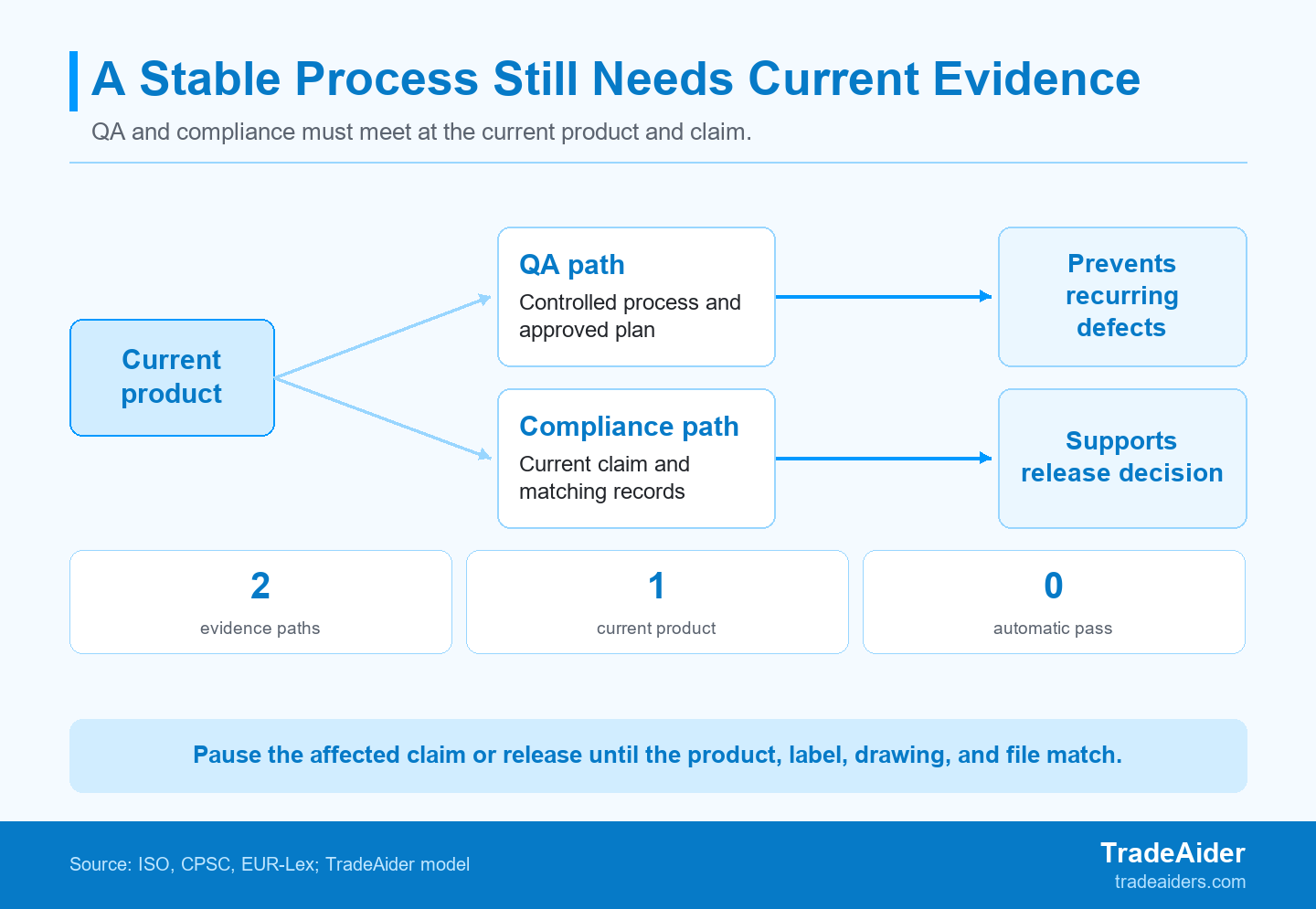
A stable process and a current compliance file must both match the product before a release decision is reliable.
| Function | Main decision | Typical proof | What it cannot prove alone |
|---|---|---|---|
| Quality assurance | Can the process repeatedly meet defined requirements? | Control plan, training, change route, records | That the current claim has applicable product-market evidence |
| Quality compliance | Does the current product meet the obligations that apply? | Current configuration, claim, technical record, applicable evidence | That every unit in the shipment is free from workmanship defects |
| Quality control | Is current output within the agreed acceptance criteria? | Measurements, observations, defect records, corrective response | That the factory system or technical file is complete |
| Independent inspection | Does the selected scope match the agreed checks now? | Observed product, packaging, quantity, selected records, sampling result | That an unseen process or unsupported claim is automatically acceptable |
When QC or an inspection uses sampling, its boundary should remain visible. ISO 2859-1:2026 defines AQL-indexed acceptance sampling plans for lot-by-lot inspection. That helps a buyer set a sample-based decision for a named lot. It does not turn a sample into proof that every technical, documentary, or market requirement has been addressed.
Quality Assurance Builds Capability Before Output
QA is where prevention earns its value. The buyer and factory define what should be built, how changes are handled, who owns key controls, and which records show that the planned work occurred. ISO 9001 defines requirements for a quality management system that is established, implemented, maintained, and continually improved. In an import order, that system idea becomes useful only when it reaches the actual purchase: the approved drawing, material expectation, visible acceptance criteria, packaging rules, and change owner should be clear enough to guide production.
A quality plan is a practical bridge between a general system and a particular order. ISO 10005 gives guidance for establishing, reviewing, accepting, applying, and revising quality plans. A buyer can use that logic to keep one controlled release file for the product rather than relying on screenshots, an old sample, and verbal approvals that cannot be reconciled later.
Start the file before output exists. Identify the intended product version, approved materials, critical dimensions or functions, labeling and packaging requirements, and the route for approving a change. If the order is still at that stage, check pre-production inspection availability so the requirement set can be observed before a production-scale mistake becomes expensive to sort out. QA is strongest when it makes a later deviation easier to see, not when it creates the impression that no later verification is needed.
Quality Compliance Establishes Applicable Product Evidence
Quality compliance asks a different question: what obligations apply to this product, in this market, with this configuration and claim? ISO 37301 specifies requirements and guidance for an effective and responsive compliance management system. For an importer, the useful lesson is not that one standard decides every product rule. It is that applicable obligations need a deliberate route for identifying, assigning, reviewing, and maintaining evidence.
The evidence path is product and market specific. In the United States, CPSC explains that covered consumer products can have testing and certification responsibilities tied to applicable requirements. That example does not establish what applies to a particular item. It shows why the buyer should not accept a broad phrase such as “compliant” without checking product, version, market, and evidence scope.
In the European Union, Article 9 of the GPSR requires an internal risk analysis and technical documentation with product characteristics relevant to safety before market placement. This example likewise does not determine which obligations apply to a particular product. It shows why the product, its claim, and its technical evidence should be considered as one current scope.
That is also why a clean QA record cannot automatically support a new retail claim. The process may be stable, while the current label, specification, test record, or technical file still describes a different configuration. The right response is to identify the gap and seek qualified product-specific support, not to ask an inspector to make a regulatory determination outside the agreed scope.
When that gap may need technical evidence, review product testing options with the current product details and intended market in hand.
An Audit Is Useful, but It Is Not a Product Release
Supplier audits can be valuable evidence for QA. They can examine whether a supplier has defined processes, records, responsibilities, and review routines. ISO 19011 provides guidance for auditing management systems, including quality management systems. That is a meaningful input to a sourcing decision, especially before an order is placed or when a supplier is being developed.
Still, an audit is not a release certificate for every future unit, label, or market claim. A well-run system reduces uncertainty; it does not eliminate the need to check whether a current product matches its current requirements and evidence. An audit can show that a supplier has a procedure for revisions, training, calibration, or corrective action. It may also reveal where the procedure is weak or inconsistently applied. Those are valuable findings because they shape supplier development and future order controls. A buyer can use the results to decide whether to increase observation, improve incoming checks, require a corrective plan, or postpone a production scale-up. The report should identify both the observed practice and the evidence reviewed, so a later team does not confuse an audit conclusion with a current product result. Yet audits do not show that a final carton carries the right version, that a specific claim is supported, or that a corrective action reached the lot about to ship. This keeps the next decision scoped and timely. Buyers can compare the audit criteria with the release file, then list any product-specific questions that an audit result does not answer. This separation keeps a supplier capability review useful without turning it into a substitute for product evidence.
Use One Evidence Register Across the Four Functions
A short evidence register brings the four functions together without blending their conclusions. Use a row for each release-critical requirement or claim. Record the product version, the physical marking or characteristic to compare, the relevant owner, the supporting file or result, the lot it covers, and the decision that remains open. The format can be simple. Its value is that the product, record, and release scope must be visible in the same place. Give each open item a due date and a decision owner, so a missing file is not mistaken for a closed issue.
For example, a row for a carton label might show the approved wording, the current artwork revision, the cartons carrying it, the person who approved it, and whether the supporting file covers the finished version. A row for a measurement might show the specified limit, the test method, the production window, the result, and the response if it drifts. This prevents a common failure of handoffs: one person sees a process record, another sees the product, and nobody compares both before shipment.
Use the register while the factory can still correct, segregate, relabel, or clarify. Independent observation and real-time reporting can also help the buyer retain decision time. The report becomes more useful when its findings connect to a named release question rather than a generic pass or fail. When correction remains practical, use a during-production inspection.
Worked Scenario: A Load Claim Does Not Match the Current File
A Stable Process, an Unstable Release Claim
An importer is preparing a home-organization launch in the United States and European Union and needs a release decision before the booked vessel cutoff. The buyer has already reviewed factory controls for incoming steel and weld operations. Those controls support a useful QA conversation because they show how the supplier intends to keep the build consistent. They do not, by themselves, decide which load claim can appear on the finished product.
The order contains 3,600 collapsible steel storage racks in 900 cartons. The buyer's commercial file describes a 100 kg configuration, while the final retail label visible on the finished rack states a 150 kg load claim. No conclusion should be drawn from those numbers alone. The release question is whether the actual rack, its current claim, and the technical evidence refer to the same configuration.
All 3,600 racks are assembled, 900 cartons are closed, and carton marks identify the production week. The factory's weld and incoming-material controls are documented, but the current label and file do not describe the same claim. This makes the order operationally ready for a document-to-product comparison, yet not ready to rely on the higher claim without reconciliation.
The current product label says 150 kg while the supplied file identifies a 100 kg configuration. The mismatch is visible, specific, and linked to a retail claim rather than a vague concern about factory quality.
The drawing and record do not show a released revision that links the 150 kg claim to the finished rack. Carton records identify the marked lot, allowing the buyer to isolate the affected release decision instead of treating the whole situation as an unexplained quality problem.
The process records can support a QA discussion, and an inspection can confirm that the 150 kg marking is present. Neither fact establishes that the current claim is supported by a matching product configuration and record. The evidence gap is a claim-configuration conflict, not a workmanship defect. A sample that looks solid cannot close it, and a strong process history cannot expand a technical file beyond the product it actually covers.
Use a conditional release: do not rely on the 150 kg claim or release the affected marked population under that claim until the product, label, drawing, and evidence are reconciled. That is not a blanket rejection of the supplier. It is a disciplined decision to preserve the difference between a process pass, an inspection observation, and an evidence-supported claim.
Align the intended claim, current label, product configuration, and controlled record. If the label must change, apply the controlled revision to the identified cartons and record the verification owner before final release. If the claim is to remain, the buyer should obtain the appropriate product-specific assessment rather than treating prior process records as a replacement. The corrective action should name the affected cartons, not merely request that the factory “fix the paperwork.”
Compare a current rack marking and carton label with the controlled drawing and the final technical file for the released configuration; then confirm the corrected population is the same marked lot. The verification gate is narrow on purpose. It checks whether the stated mismatch has been closed and whether the release scope is traceable, instead of asking a last-minute inspection to recreate every earlier engineering or compliance decision.
This illustrative scenario shows an operational release decision. It does not decide the applicable legal requirements, allowable load claims, or test method for any market. Those choices depend on the product, destination, and qualified review. The example simply shows why current product evidence must agree with the current product claim before a buyer treats a shipment as ready. For independent visibility on such release questions, learn why importers work with TradeAider.
Use Final Inspection for the Current Lot
Final inspection is valuable when it confirms the shipment that is actually about to move. The buyer can use a defined sample plan, product checks, carton checks, quantity verification, and selected release-file comparisons to make the current lot visible. Acceptance Quality Limit (AQL) gives a buyer a documented choice of units from the shipment being inspected. ISO 2859-1 defines AQL-indexed acceptance sampling plans for lot-by-lot inspection. The sampling basis should be agreed before the visit, alongside the product version, critical criteria, and the action required if a finding occurs.
For TradeAider, pre-shipment inspection (PSI) readiness means 100% of the order quantity is completed and at least 80% is packed for export. That timing helps the selected cartons represent the shipment rather than an earlier production snapshot. It also gives the buyer a practical point to compare product, quantity, packaging, labels, and open corrective actions against the release file.
Before the visit, send the factory and inspector the current product reference, selected sample rules, label and carton requirements, packed quantity, known deviations, and the escalation contact. Confirm which finding stops release, which finding requires a corrective response, and who can accept a documented deviation. That preparation does not make the inspection broader than its scope. It makes the report easier to use because the buyer receives observations against a stated decision instead of a list that must be interpreted after the logistics window has closed.
When those conditions are met, the booking also needs a confirmed factory contact. Then schedule a pre-shipment inspection.
Do not use final inspection as a rescue step for an unclear claim, a missing product record, or an unresolved version change. It can report what is present in the agreed sample and lot. The buyer still needs the right owner to determine whether the underlying evidence is adequate for the intended product and market. A good release decision combines those inputs without forcing one report to carry work it was never designed to do.
Prepare the Release File Before Booking
Before booking, assemble the current product version, approved requirements, physical marking or artwork, supporting evidence list, lot or carton identifiers, packing status, and the person who can authorize a hold or release. Add the exact question that the inspection needs to help answer. That package lets the factory, buyer, and inspector work from the same decision inputs, and it makes deviations easier to route quickly. State whether the priority is workmanship, quantity, packaging, a visible claim, a production condition, or an open document mismatch. Attach the latest carton count and packing progress. This lets the booking conversation focus on the right stage and avoids an inspector arriving with a broad request that no one can translate into a useful release decision.
Keep the action path just as specific. If a discrepancy appears, name whether the factory should correct, isolate, relabel, provide a record, or pause shipment. Set the response owner and the time by which the buyer needs an answer. That turns the report into a decision tool rather than an after-the-fact summary.
For an active order, request a product-specific inspection plan today.
Frequently Asked Questions
What Is the Difference Between Quality Assurance and Quality Compliance?
Quality assurance builds confidence that a controlled process can meet defined requirements consistently for a planned product and order. Quality compliance establishes that the actual product, its current claims, and its supporting evidence meet the obligations that apply. The two functions should connect, but a process record does not automatically establish that a particular configuration, label, or market claim is supported.
Can a Factory With Strong QA Still Have a Compliance Problem?
A factory with strong QA can still have a compliance problem when the current product configuration, label, claim, or technical file does not match the applicable evidence. Treat that as a scoped document-to-product question. Identify the affected lot and decision, then resolve the mismatch before relying on the claim or shipment release.
Is Quality Control the Same as an Inspection?
Quality control is the operational measurement and corrective activity used to control current output, while an inspection is a defined observation of an agreed product, process, or lot. An inspection can contribute useful independent evidence, but its result is limited by the scope, sample, timing, records, and acceptance criteria that were agreed for the visit.
When Is a Pre-Shipment Inspection Ready for an Import Order?
A pre-shipment inspection is ready for a current, representative shipment release decision when the buyer can see enough completed and packed output to act on the result. For TradeAider, that means 100% of the order quantity is complete and at least 80% is packed for export. Confirm that the product version, labels, cartons, quantities, and open actions all refer to the same traceable lot before the inspection begins.

Articles Connexes

Développez votre entreprise avec le Service TradeAider
Cliquez sur le bouton ci-dessous pour accéder directement au Système de Service TradeAider. Les étapes simples de la réservation et du paiement à la réception des rapports sont faciles à utiliser.

