
CPSIA flammability testing for children's sleepwear is a scope-and-evidence problem: first decide whether the garment is sleepwear under 16 CFR parts 1615 or 1616, then prove fabric, seam, trim, production, label, and certificate evidence before the lot is released. Importers should not treat a soft pajama, robe, loungewear set, or tight-fitting exception as a simple apparel QC item until the regulatory scope is settled.
Key Takeaways
- Children's sleepwear rules are category-specific: sizes 0 through 6X fall under 16 CFR part 1615, and sizes 7 through 14 fall under 16 CFR part 1616.
- Testing is not one sample: CPSC guidance separates fabric production units, garment production units, prototype seams and trims, and production garment seams.
- Exceptions need proof: infant garments, underwear, diapers, and tight-fitting sleepwear have different boundaries and should not be assumed from style alone.
- Inspection supports compliance evidence: TradeAider can check labels, unit IDs, packing, trims, and lot matching, but required lab testing and certification remain separate compliance work.
What CPSIA Flammability Testing Means for Children's Sleepwear
CPSC sleepwear guidance explains that in-scope children's sleepwear must pass flammability testing under 16 CFR parts 1615 and 1616. The practical distinction is size range: 16 CFR part 1615 covers sizes 0 through 6X, while 16 CFR part 1616 covers sizes 7 through 14.
The purpose is not a generic fabric quality check. CPSC sleepwear lab bulletin says the standards address ignition of children's sleepwear and require loose sleepwear to meet flammability requirements unless it qualifies as tight-fitting sleepwear. That makes merchandising, intended use, size, fit, fabric, trims, and labels part of the compliance question.
| Decision point | Why it matters | Evidence buyers should request |
|---|---|---|
| Is it sleepwear? | Rules apply to garments intended for sleep or sleep-related use | Product description, marketing copy, style, age range, label claim |
| Which size range? | Part 1615 and Part 1616 separate size coverage | Size chart, garment measurements, SKU list |
| Is an exception claimed? | Infant or tight-fitting claims need defined proof | Measurements, tag language, applicable standard citation |
| What was tested? | Fabric, seam, trim, and garment evidence may differ | FPU/GPU records, test report, lab scope |
| Can the lot be traced? | Labels and unit IDs connect testing to shipment | FPU/GPU ID, tracking label, carton spread |
Scope comes before sample testing
The first mistake is sending fabric to a lab before the buyer has decided what the product is. A robe marketed for bedtime, a plush loungewear set, and a snug pajama set can look similar in a showroom but have different compliance paths. The buyer should settle intended use, marketing language, size range, and fit category before testing or inspection.
CPSC notes that diapers, underwear, infant garments, and tight-fitting garments are excepted from children's sleepwear flammability testing under parts 1615 and 1616 and instead may be subject to 16 CFR part 1610 or other applicable requirements. That does not mean the product is unregulated; it means the evidence path changes.
Fabric, seam, trim, and garment evidence must connect
Sleepwear failures can appear after a supplier changes trim, stitching, print, colorway, fabric finish, or laundering assumption. A fabric test report alone does not prove that production garment seams and trims comply. Buyers should map each report to the actual SKU, color, trim package, and production unit being shipped.
For importers, the risk is not only that a test fails. The deeper risk is that the evidence cannot be traced to the current lot. If the product passes one lab report but the production garment uses a different trim or a different fabric finish, the release file is incomplete.
Testing Workflow and Acceptance Evidence
CPSC guidance describes Fabric Production Unit and Garment Production Unit testing. It states that an FPU may cover up to 5,000 yards of finished fabric and a GPU may cover up to 500 dozen finished garments. These are not buyer quality targets; they are evidence boundaries that help connect test results to production lots.
| Workflow step | Compliance question | Inspection support |
|---|---|---|
| Classify product | Sleepwear, infant garment, tight-fitting garment, or daywear? | Compare garment, label, size chart, and marketing claim |
| Test fabric unit | Does the fabric unit meet the required test path? | Match fabric roll, color/print group, and report ID |
| Test seam and trim | Do prototype seams and trims perform as required? | Check trim, thread, applique, zipper, snap, and decoration against file |
| Verify production unit | Does the finished garment lot match the tested unit? | Check production garment seams, labels, carton spread, and size run |
| Issue certificate | Can the importer certify with correct citations and records? | Match CPC elements to product, lab, date, factory, and shipment |
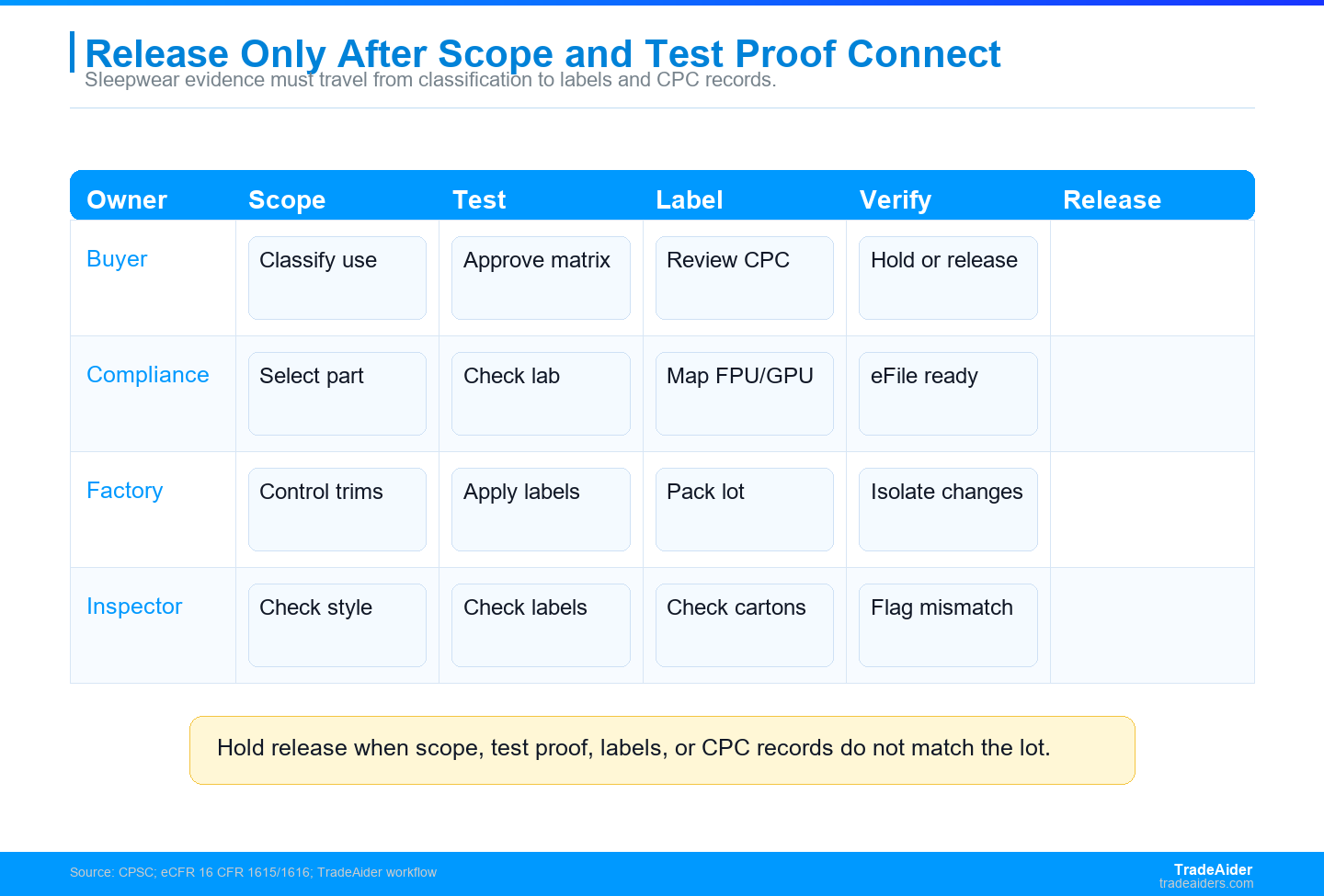
Children's sleepwear release should move from scope decision to testing proof, labels, certificate, and shipment evidence.
Common Compliance Mistakes Before Shipment
Most pre-shipment mistakes are not dramatic. They are small evidence gaps that become serious because children's sleepwear is a safety-sensitive category. A wrong standard citation, missing unit identification, old report, label mismatch, or unverified trim change can be enough to stop release or require more review.
Testing to the general clothing textile rule when sleepwear rules apply
CPSC's lab bulletin warns that some children's pajamas have been incorrectly tested to the general clothing textile flammability standard rather than the sleepwear standards. That is a high-risk error because part 1615 and part 1616 carry sleepwear-specific scope, sampling, and labeling expectations.
The buyer should not accept the phrase flammability tested without checking the standard citation. A test report that cites the wrong rule can look complete to a non-specialist while failing to support the exact product being imported.
In practice, the report review should check the named product, size range, laboratory, standard citation, issue date, sample description, and production unit reference before anyone uses the result as release evidence. The risk is that a factory file can contain a real test report but still fail the buyer's actual question because the report belongs to a different garment, market claim, trim package, or production date.
Changing colors, prints, trims, or fit after testing
A second mistake is treating a passed test as permanent evidence for every later variation. Different colors, prints, trims, laundering assumptions, and fit changes can affect how the garment should be grouped and documented. The more the production lot differs from the tested sample, the more careful the buyer should be before release.
CPSC CPC guidance also matters because children's products subject to safety rules require certification based on the applicable rules and test results from a CPSC-accepted laboratory. The accepted-lab rule list in 16 CFR 1112.15 helps buyers confirm which rules and test methods sit inside the third-party conformity assessment framework. Beginning July 8, 2026, CPSC guidance says importers of most regulated consumer products will be required to eFile certificates of compliance with CBP through a PGA Message Set. Importers should verify whether that requirement applies to their product before shipment.
Scenario Estimate: Why Evidence Mapping Matters
Consider an importer with 4 pajama styles, 5 sizes, 3 colorways, and 2 trim packages. That creates 120 style-size-color-trim combinations before packaging and label versions are counted. The estimate is illustrative, but it shows why one report folder can become unreliable if it does not map to production variation.
If even 5 percent of those combinations have a changed trim, label, or fit assumption, the buyer has 6 combinations that need extra review. The decision implication is to create a scope matrix before final inspection: product classification, size range, fit status, FPU/GPU connection, label requirement, and CPC record owner.
Calculated from 4 styles x 5 sizes x 3 colors x 2 trim packages equals 120 garment variations to map before cartons are counted. Calculated from 2 label paths x 120 variations equals 240 style-variation questions when the buyer has both standard sleepwear and tight-fitting exception paths. Calculated from 3 evidence owners x 120 variations creates 360 possible handoffs if buyer, factory, and lab ownership is unclear. Calculated from 120 variations x 5 percent change rate means 6 combinations need extra review before release. Calculated from a 500-dozen GPU boundary and 600 dozen finished garments means at least 2 garment evidence groupings to check with the compliance owner. Calculated from the July 8, 2026 eFiling date and a 4-week production calendar, certificate readiness means the importer should finish the CPC review before week 4, not after final packing. Calculated from 6 changed combinations x 3 evidence owners creates 18 follow-up questions before final release. Result: the trade-off is practical: the matrix takes time, but it reduces the risk that one changed trim or label path invalidates the shipment file.
This means the inspection checklist should not be a generic pajama checklist. It should ask whether the physical goods still match the product classification and the evidence grouping. The decision rule is to hold release when a visible production change cannot be tied back to an approved test report, CPC record, or compliance owner.
For a buyer, the most useful inspection output is a comparison between the approved compliance file and the live lot. The report should show which styles, sizes, colors, trims, labels, and carton groups were checked, then flag any visible difference that could affect the certificate owner. A clean measurement result is helpful, but it does not answer the larger compliance question if the garment identity, fit claim, or label path has shifted.
That comparison should be prepared before the inspector arrives. If the buyer sends only a purchase order and a few photos, the factory visit may confirm workmanship but miss the evidence that matters for children's sleepwear. A better file includes the size chart, fit claim, label artwork, tested style reference, trim list, carton plan, and the person responsible for deciding whether a variation needs compliance review.
Inspection Checklist Before Releasing Children's Sleepwear
A children's sleepwear inspection should not promise regulatory approval, but it can prevent avoidable shipment mistakes. The inspector should verify that the physical lot matches the compliance file and that visible labels, trims, packing, and product identity do not contradict the test and certificate evidence.
| Inspection area | What to check | Escalate when |
|---|---|---|
| Product identity | Style, intended use, size range, age grade, fit claim | Sleepwear scope is unclear or marketing language conflicts |
| Labels | Unit ID, care label, tracking label, warning or tight-fit tag where applicable | Required label is missing, loose, or mismatched |
| Trims and components | Buttons, snaps, zippers, applique, waistbands, cuffs | Production trims differ from tested file |
| Packing | SKU, size, color, carton, polybag, destination | Mixed sizes or market labels appear in same carton group |
| Documentation | Test report, lab, CPC, date, factory, product description | Report cannot be tied to current shipment |
How TradeAider Supports the Evidence Layer
TradeAider can support children's sleepwear buyers by checking the physical lot against the compliance file during pre-shipment inspection or by using during production inspection when trims, labels, or packing are still changing. The service should be used to document product identity, label consistency, visible workmanship, packing status, and rework results.
When the issue is testing or certification, use product testing coordination and a qualified compliance resource. TradeAider's role is not to replace a CPSC-accepted laboratory or legal compliance review. Its value is real-time evidence: what is actually in the factory, which carton groups were checked, and what must be held before shipment.
FAQ
Are all children's pajamas subject to 16 CFR parts 1615 and 1616?
No, not every children's garment follows the same path, but sleepwear and sleep-related garments in the covered size ranges must be evaluated carefully. Infant garments, diapers, underwear, and tight-fitting sleepwear may follow different boundaries. The buyer should document the product's intended use, size, fit, labels, and standard citation before testing or shipment.
Can tight-fitting sleepwear avoid the sleepwear flammability test?
Tight-fitting sleepwear can be excepted from parts 1615 and 1616 only when it meets the defined fit, measurement, labeling, and scope conditions. It is not enough for a supplier to call a garment snug. Buyers should verify measurements, label language, and applicable standards before relying on the exception.
What is the difference between FPU and GPU testing?
FPU testing is tied to a fabric production unit, while GPU testing is tied to garment production evidence such as prototype seams, trims, and finished garment seams. The distinction matters because a fabric can pass while a production garment changes the seam, trim, or construction risk. Importers should connect both records to the shipment.
What should inspectors check if lab testing is already complete?
Inspectors should check whether the actual lot still matches the lab and certificate file. That means style, fabric, color or print grouping, trim, labels, unit IDs, packing, carton marks, and product description. If any visible item changed after testing, the buyer should hold release and ask the compliance owner or lab whether retesting or updated certification is needed.

Articles Connexes
Développez votre entreprise avec le Service TradeAider
Cliquez sur le bouton ci-dessous pour accéder directement au Système de Service TradeAider. Les étapes simples de la réservation et du paiement à la réception des rapports sont faciles à utiliser.

