
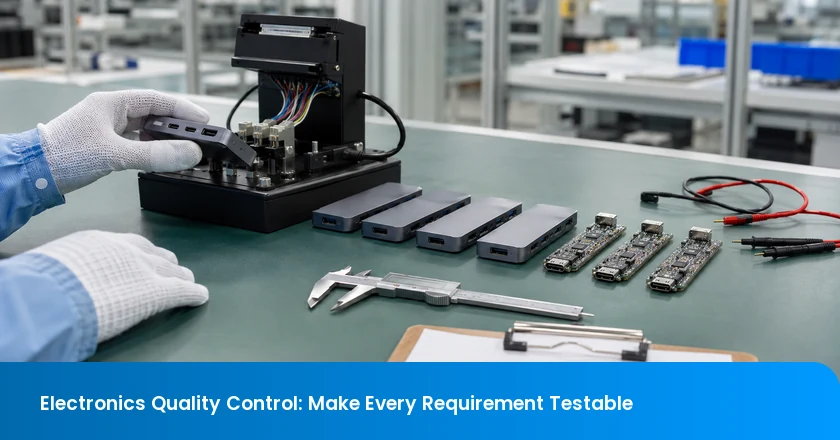
Electronics quality control fails when a product promise reaches the factory as a vague instruction such as “check all functions.” A useful control plan makes each important requirement testable: it identifies the failure to prevent, fixes the operating condition, defines the pass-or-fail boundary, and ties the result to the exact hardware, firmware, and production population under review. Without those connections, a report can say “pass” while leaving the buyer unable to tell what was actually proved.
Define Electronics Quality Before Choosing a Test
Electronics quality control begins by converting the product promise into observable or measurable acceptance criteria, not by copying a generic inspection checklist. An acceptance criterion is a written condition that distinguishes an acceptable result from an unacceptable result for a named requirement. Start with what the finished item is expected to do in the buyer's market. A USB-C hub may need to restore Ethernet after a computer wakes, a charger may need to hold its rated output under a stated load, and an enclosure may need to preserve connector alignment after assembly. Each promise creates a different failure and demands different evidence.
Do not begin by asking which tests the factory normally performs. That reverses the logic. A factory's standard routine may be useful, but it reflects its equipment and habits rather than the complete product promise. First name the requirement and consequence. Then decide whether it can be checked through visual inspection, measurement, functional exercise, a qualified laboratory method, supplier process evidence, or a combination of those sources.
Translate Each Product Feature Into a Failure Risk
A feature belongs in the control plan when its failure would change safety, function, interoperability, durability, labeling, or the buyer's commercial promise. Safety-related questions need particular care: IEC 62368-1:2023, within its stated equipment scope, classifies energy sources and prescribes safeguards. That hazard-based structure illustrates why “powers on” cannot stand in for a product-specific safety assessment.
Prioritize by consequence and detectability. A crooked label can be visible at final inspection. An intermittent interface fault may appear only after a particular cable, host state, or reconnect sequence. A component substitution may be invisible from outside. The more hidden or consequential the failure, the earlier the buyer should identify the right evidence owner and the less confidence should be placed in a generic visual check.
Turn the Risk Into a Written Acceptance Criterion
A usable acceptance criterion states the characteristic, test condition, expected result, and decision boundary clearly enough for the supplier, buyer, laboratory, and inspector to reach the same interpretation. For measured requirements, it also needs a decision rule: the documented rule used to turn a measured result into a conformity decision. NIST's definition specifically addresses how measurement uncertainty is considered when conformity with a requirement is stated.
Write the condition so another party can repeat it. “Ethernet works” is too loose. A better instruction names the approved host, cable, firmware, power profile, sleep duration, wake action, reconnect time, number of cycles, and expected status. Confirm those references before bulk production. A scoped pre-production inspection service can document whether the current specification, approved sample, components, and firmware references are aligned; it does not create missing engineering limits or make the buyer's release decision.
Use a Four-Part Acceptance Rule
Every important electronics check needs four connected parts: the requirement, the method and condition, the pass-or-fail rule, and the product revision or lot identity represented by the result. Build identity means the model, component set, PCB revision, firmware, and production revision represented by a test or inspection record. If any one of the four parts is missing, the result may remain useful background, but it is not yet complete evidence for the goods being considered.
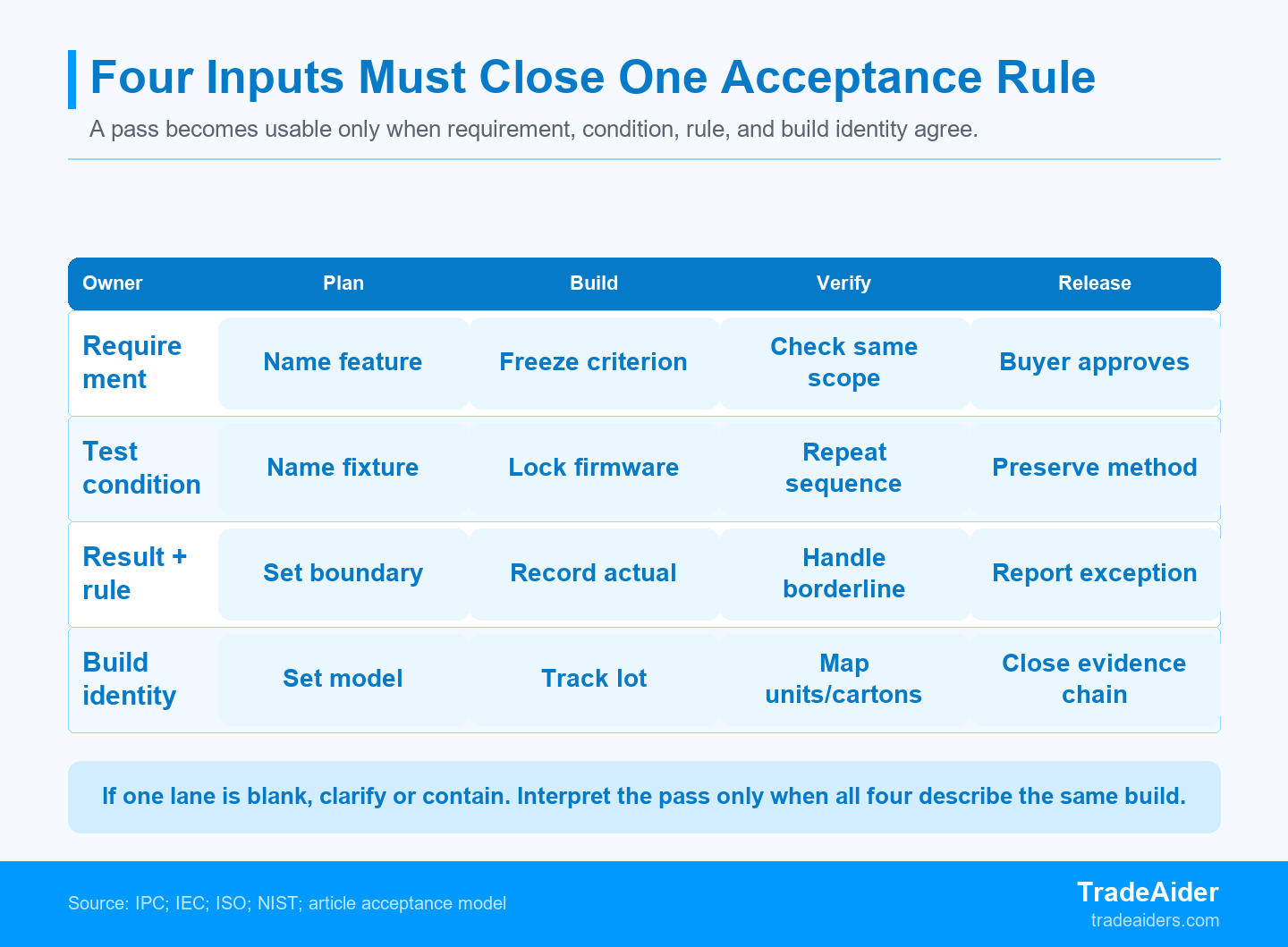
A pass result becomes decision evidence only when all four inputs describe the same product question and represented build.
| Required part | Question it must answer | Typical evidence gap |
|---|---|---|
| Requirement | What product promise or risk is being evaluated? | A checklist says “function test” without naming the function |
| Method and condition | How, with what equipment, and under which operating state? | No fixture, load, cable, sequence, or software reference |
| Decision rule | What result passes, fails, or needs technical review? | A number appears without tolerance or borderline treatment |
| Build identity | Which model, revision, units, sample, and lot does the result represent? | A report cannot be mapped to current goods |
Laboratory competence and the buyer's acceptance model are related but different questions. The NIST standards registry identifies ISO/IEC 17025:2017 as the competence standard for testing and calibration laboratories. Even when a competent laboratory performs the work, the buyer still needs to confirm that the requested method, sample, product version, and stated conformity decision answer the current order's question.
Separate Workmanship, Function, Reliability, and Compliance
Electronics quality evidence should be divided by the question it answers because workmanship inspection, functional verification, environmental testing, and market compliance are not interchangeable. A good-looking PCB does not prove interface behavior. A function check does not establish endurance. A passed environmental exposure does not by itself establish legal market scope.
| Evidence layer | Primary question | What it cannot prove alone |
|---|---|---|
| Workmanship | Is the assembly visibly acceptable against an agreed standard and class? | Every powered function or hidden material condition |
| Function | Does the current build perform the named operation under a controlled condition? | Long-term reliability or unrestricted compatibility |
| Reliability | How does an identified sample respond to a specified exposure or duration? | Every production lot or every real-world environment |
| Compliance | Does the evidence address a defined legal, safety, or program scope? | Overall commercial quality outside that scope |
Match Workmanship and Functional Checks to the Current Build
Workmanship criteria describe assembly acceptability, while functional tests must name the actual operating condition, interface, accessory, fixture, and software state used to exercise the product. IPC explains that IPC-A-610 presents acceptance requirements for electronic assemblies and is used with J-STD-001 for assembly process and soldering criteria. Those criteria answer an assembly question; they do not replace the finished product's functional specification.
Functional claims need their own controlled methods. The USB-IF publishes a revision-controlled USB Type-C functional test specification, showing why an interface claim belongs to a defined program and method rather than an improvised plug-in demonstration. For a buyer's production check, name the claims being exercised and the approved equipment state. Avoid describing a limited factory check as certification or full interoperability coverage.
Keep Reliability and Compliance Evidence in Their Own Scope
Environmental and compliance tests apply defined severities, samples, and legal or program scopes, so their reports should be matched to the model and revision rather than treated as a generic factory pass. The IEC 60068-1 overview addresses environmental test methods, severities, and atmospheric conditions for specimens under transport, storage, and operating conditions. The selected exposure and specimen identity therefore matter as much as the word “tested.”
Market evidence has a separate boundary. The EU RoHS Directive lays down rules restricting specified hazardous substances in electrical and electronic equipment within its defined scope. A supplier declaration, bill of materials, or laboratory report should be reviewed against the applicable product and current component set. Where a qualified method or market-scope review is needed, a product testing service should be scoped to the named model, sample, method, and question. An on-site visual inspection cannot turn an unmatched report into current compliance evidence.
Lock Test Conditions and the Decision Rule
A numeric limit is not complete unless the control plan also names how the result is measured, how uncertainty near the limit is handled, and whether the decision applies to one unit, a sample, or a production lot. A decision rule is the documented rule used to turn a measured or observed result into a conformity decision. It should be agreed before results are known so that neither side can move the boundary after seeing an inconvenient value.
Separate three decisions. First, did the individual unit meet the criterion under the specified method? Second, what does the sampling plan allow the buyer to conclude about the lot? Third, does the available evidence support release, containment, rework, retest, or technical escalation? These are not the same question. One failed unit may trigger a lot rule, but one passed unit does not prove every unit conforms.
Under an illustrative timing model, suppose a borderline output reading takes 20 minutes to clarify while goods are still at the test station, but four hours to reconstruct after 24 cartons are sealed because staff must locate units, reopen cartons, and rebuild the firmware record. The later clarification uses twelve times as much handling time: 240 minutes divided by 20 minutes. This is not a universal cost ratio. It shows why the test condition, borderline treatment, and traceability fields should be fixed while the evidence is still easy to connect to physical units.
Illustrative Scenario: A Passing Report With Missing Test Conditions
When a factory pass record omits the fixture, firmware, operating load, and lot mapping, the buyer cannot tell whether the tested condition represents the cartons under review. The problem is not proof that every unit is defective. It is the absence of a defensible boundary between tested goods, untested conditions, and the packed population.
Why the Initial Pass Could Not Support Release
A pass label without the controlled test condition and carton-to-lot identity cannot separate an untested condition from a conforming result. The following example is illustrative. It is not a TradeAider client case and does not establish a sampling recommendation or predicted defect rate.
An importer is preparing 2,400 unbranded USB-C hubs for a retail program. The agreed feature list includes display output, data transfer, Ethernet reconnection after computer sleep, and power pass-through. The supplier reports 100% end-of-line checks across three 800-unit build lots now packed into 24 export cartons. Its summary marks every lot as passed. A separate 20-unit verification sample finds three hubs that do not restore Ethernet after the host wakes. The factory log records serial numbers and “pass,” but omits the host model, fixture version, firmware, power profile, reconnect sequence, build-lot identity, and carton map.
The supplier says its test confirms Ethernet, yet the record does not show whether sleep-and-wake reconnection was included. The three findings also cannot be connected to one of the build lots or to a known carton group. The factory pass records and the verification findings therefore describe uncertain conditions and uncertain populations.
Neither side has enough evidence for a broad conclusion. The three findings do not prove that all 2,400 hubs fail, while the end-of-line log does not prove that the reconnect requirement was exercised. Because the tested condition and represented population are both unclear, the buyer cannot narrow the issue to one lot. The buyer holds all 24 cartons, freezes the current firmware and fixture reference, defines the reconnect sequence and expected result, and requires a carton-to-build-lot map before retesting identified units from each lot.
The supplier reconstructs the lot map, records the host, fixture, firmware, power profile, and sequence, then repeats the agreed reconnect check on identified units. A failing lot remains contained for root-cause work. Another lot can be considered separately only when its evidence chain closes. The buyer can review the scope again when each retest record names the unit, build lot, carton group, firmware, fixture, operating condition, expected result, and actual result. This illustrative example begins with 3 reconnect findings in a 20 unit verification sample; it does not set a sample size, certify USB compliance, predict a defect rate, or make a final release decision.
Retest the Missing Condition and Record the Represented Scope
A useful retest repeats the agreed condition on identified units, records the result against the current firmware and fixture, and connects those units to the affected production population. The retest record needs actual observations, not only a new “pass” label. If a result changes after a firmware reload or fixture adjustment, preserve both states and record the corrective action.
The purpose is to create a narrower, evidence-backed decision boundary. Once the units, method, and lot are connected, the buyer may be able to keep one affected population on hold while reviewing another separately. If the records still cannot establish the represented scope, repeating the test on anonymous units adds activity without resolving the release question.
Reopen Evidence When the Product Revision Changes
A component, firmware, PCB, power-supply, enclosure, cable, or label change should trigger a documented review of which prior evidence still applies and which checks must be repeated. Do not automatically retest everything. Start with the changed object, identify the functions and requirements it can affect, and reopen only the evidence whose assumptions no longer hold.
A replacement Ethernet controller may reopen interface, thermal, firmware, and substance-document questions. A carton artwork change may affect labeling and packing checks without changing the powered functional method. A new power adapter can change input, output, plug, marking, safety, and market-scope questions even when the hub PCB is untouched. Record the revision, reason, effective lot, approved evidence, open checks, and owner. “Equivalent component” is a supplier description, not a completed impact review.
| Change | Review first | Evidence action |
|---|---|---|
| Firmware | Functions, timing, interface behavior, displayed version | Repeat affected functional checks on the released build |
| PCB or component | Electrical behavior, assembly, thermal and material scope | Run an impact review and reopen affected reports or checks |
| Power supply or cable | Rating, connector, load behavior, markings, destination | Match the accessory revision to applicable evidence |
| Label or packaging | Required text, barcode, model identity, contents, protection | Update artwork references and final packing criteria |
Place Each Check at the Earliest Useful Gate
A control belongs at the earliest production stage that can reveal the named failure and still allow the supplier to contain its cause without relying on final inspection as a rescue step. Confirm requirements, approved references, high-risk components, firmware, and methods before volume builds. Watch process-sensitive workmanship and selected function controls while production is active. Use final inspection for the completed goods, quantity, identity, appearance, packaging, and scoped functions that remain practical to verify.
The gate should match what can still be changed. A during-production inspection can document identified assembly and functional controls while the supplier can still isolate a shift, fixture, component batch, or work-in-progress group. It cannot retroactively define an absent product limit, prove an unperformed laboratory condition, or release the goods for the buyer.
| Gate | Electronics decision | Useful record |
|---|---|---|
| Before production | Are specifications, samples, BOM, firmware, and methods aligned? | Approved revision packet and unresolved-risk list |
| During production | Is a process or function drifting within an identifiable population? | Time, line, fixture, lot, unit, observation, and containment record |
| Laboratory or specialist review | Does the named sample meet the applicable technical question? | Scope-matched report with sample and method identity |
| Before shipment | Do completed goods and records match the order under review? | Lot-specific inspection findings and exception status |
Prepare a Control Packet Before the Inspection
The inspection packet should identify the current model, BOM or component revision, firmware, approved references, test conditions, defect classes, sampling plan, and the records expected from the visit. Send one controlled version to the supplier and inspection team. If two files disagree, the packet should state which version governs and who can approve a change.
For each functional check, include the equipment or fixture ID, accessory, connection, operating state, sequence, expected result, actual-result field, and response to a failure. For workmanship, name the applicable reference, class, viewing or magnification condition where relevant, and defect examples that matter to the buyer. For traceability, list the unit, lot, carton, and build fields that must appear in photographs or records.
Keep laboratory and compliance evidence indexed rather than pasted into a single undifferentiated file. The index should show document title, issuer, sample or model, revision, date, method or scope, and the requirement it supports. Mark open gaps before the visit. An inspector can then verify observable facts and collect agreed records without being asked to make an unplanned legal, engineering, or commercial judgment on site.
Five Controls That Make Electronics Requirements Testable
Electronics quality control becomes reviewable when the buyer links the product risk, written criterion, controlled method, decision rule, and current build identity before collecting a pass result. Apply five controls to the next electronics order:
- Start with the product failure and consequence, then select the evidence layer that can actually answer it.
- Write the characteristic, operating condition, expected result, and pass-or-fail boundary before testing starts.
- Connect every result to the current model, hardware, firmware, sample, build lot, and packed population it represents.
- Reopen only the affected evidence when a component, PCB, software, accessory, label, or packaging revision changes.
- Keep technical evidence and the buyer's ship-or-hold decision separate; inspection findings support that decision but do not replace it.
When the order is complete, the current build is identified, and the buyer has provided the final packing status and acceptance criteria, TradeAider can report observations against that agreed scope. The buyer remains responsible for the product specification, applicable requirements, and release decision. For that final-lot review, request a scope-matched pre-shipment inspection.
Frequently Asked Questions
What should an electronics quality control plan include?
It should connect each important product risk to a written characteristic, a controlled test or inspection method, a clear acceptance rule, and the exact model, revision, and lot represented by the result. The plan should also name who owns technical interpretation, how failures are contained, which records must be retained, and what change reopens earlier evidence. This gives the supplier and inspector repeatable instructions while preserving the buyer's release authority.
Is IPC-A-610 alone enough for complete finished-product acceptance?
No. IPC-A-610 provides widely used electronic-assembly acceptance criteria, but the buyer still needs product-specific functional, safety, interface, labeling, packaging, and market requirements where they apply. Assembly workmanship is one evidence layer. A finished-product decision may also require controlled powered checks, traceability to the current hardware and firmware, scope-matched laboratory evidence, and a lot rule agreed before inspection.
Can a golden sample replace written test limits?
No. A golden sample can clarify appearance, construction, or expected behavior, but it cannot explain every test condition, tolerance, defect class, or decision rule unless those expectations are also documented. Keep the sample identified, dated, approved, and connected to the specification. If the relevant characteristic needs measurement or a controlled operating sequence, write that method and criterion separately instead of asking people to infer them from the sample.
When does an electronics component change require retesting?
Retesting is needed when the change can affect a requirement or invalidate the evidence used for that requirement; the buyer should document the impact review instead of automatically repeating everything or accepting similarity without analysis. Identify the changed part and effective lot, map the functions, safety questions, materials, interfaces, and labels it can influence, then repeat or update the affected checks. Preserve the review even when the conclusion is that existing evidence remains applicable.

Articles Connexes


Développez votre entreprise avec le Service TradeAider
Cliquez sur le bouton ci-dessous pour accéder directement au Système de Service TradeAider. Les étapes simples de la réservation et du paiement à la réception des rapports sont faciles à utiliser.

