

A sourcing manager is not finished when a supplier is found or a quote is received. The role becomes valuable when the buyer can explain why one option matches the requested product, what evidence supports that conclusion, who owns the commercial exposure, and how the order will be controlled after award.
A practical test is simple: if the requirement, supplier evidence, commercial terms, and quality-control handoff point to different versions of the order, the purchase order is not ready. A lower price may still be useful information, but it is not yet a supplier decision.
A Sourcing Manager Owns the Decision Record, Not Just the Quote
A sourcing manager creates an awardable decision when the buyer requirement, supplier evidence, commercial allocation, and operational handoff identify the same supplier option. The CIPS Global Standard makes a useful distinction here: professional capability combines enabling skills with applied practices such as sourcing, contract management, evaluation, and improvement. For an importer, those practices meet in one question: can this supplier deliver this defined order on terms the buyer understands?
That question prevents two common errors. First, it stops a manager from treating a polished capability presentation as proof of fit. Second, it stops the team from postponing product, packaging, and inspection decisions until after the supplier has already been awarded. The decision record does not need to be a long report. It needs to be complete enough that procurement, product, finance, and quality teams can see the same order.
Translate Demand Into an Awardable Requirement
The first responsibility is to convert a product request into a controlled requirement that states configuration, quantity, target market, quality evidence, delivery window, and commercial assumptions. “Insulated bottle, blue, 36,000 units” is not yet enough. A comparable requirement also identifies the capacity, lid, finish, retail pack, carton expectation, required approvals, change route, and the date on which each assumption was accepted.
Keep one version-controlled reference that suppliers can quote against. It may combine a specification, approved sample references, packaging instructions, and the buyer’s delivery assumptions. If a supplier proposes an alternative, record it as an alternative—not as an invisible change inside a revised price. Before production begins, an agreed pre-production inspection scope can help the buyer turn that reference into a practical readiness check for the actual product, materials, and factory plan.
Use Skills That Change the Supplier Decision
The useful sourcing skills are not isolated traits; they are the ability to clarify requirements, test evidence, negotiate a comparable commercial position, and coordinate the next control owner. That emphasis matches current professional priorities: in its 2026 survey, CIPS reported new technology skills and risk management at 47% each among respondents’ development priorities, followed by negotiation at 42%.
Apply those skills in sequence. Clarify the order before asking for price. Analyze the evidence before deciding whether the supplier is comparable. Negotiate the cost and risk allocation only after the comparison basis is stable. Then coordinate the handoff so the people checking the order know what the buyer actually awarded. Strong communication matters because it closes these gaps; it is not a substitute for closing them.
Evaluate Supplier Fit on Evidence, Not a Capability Deck
Supplier evaluation is more reliable when the manager separates what the supplier says from what the buyer can connect to the exact product, facility, capacity window, and risk conditions. A useful public-procurement parallel comes from UK supplier-selection guidance: evidence should be connected to legal, financial, or technical capacity and be proportionate to the contract. The guide is not a private-sector rulebook, but its logic is practical for import buyers.
Start with the risk that could change the award. A repeat supplier making a familiar, low-consequence SKU may need a focused confirmation of the current configuration and capacity window. A new supplier, a complex product, a new market, a tight launch date, or a supplier-proposed change needs more evidence. The point is not to make every candidate complete the same long questionnaire. It is to make the missing information visible before the buyer commits money, tooling, or a delivery promise.
| Decision record | What it should identify | What a mismatch means |
|---|---|---|
| Buyer requirement | Product, packaging, quantity, timing, and approval basis | The quote may cover a different order |
| Supplier evidence | Named supplier, facility, relevant capability, and current conditions | The buyer cannot tell what the evidence supports |
| Commercial record | Price basis, payment, trade term, tooling, and change cost | The lowest unit price may not be comparable |
| Control handoff | Check stage, records, owner, and escalation route | A problem may surface after the buyer has fewer options |
Match Due Diligence to the Supplier Risk
Due diligence should be risk-based: collect the identity, capability, financial, operational, and responsible-business evidence that could change this specific award decision, then refresh it when the underlying conditions change. As one bounded example, HMRC describes using internal and external data sources and reports in its supplier-selection due diligence. For a private importer, the practical lesson is to record which source supports which conclusion rather than relying on an untraceable “approved supplier” label.
Match the review to the decision. Confirm the legal supplier and factory relationship when that matters to the order. Ask whether the relevant process, capacity, tooling, or subcontracting route has been identified. Check whether the evidence is current enough for the award window. A factory audit service may be useful when the buyer needs an agreed on-site assessment of a prospective supplier’s system; it does not choose the supplier or replace the buyer’s commercial judgment.
Escalate when the evidence conflicts with the quote, is tied to a different facility, cannot be linked to the actual configuration, or becomes stale after a material change. These are decision triggers, not automatic disqualifications. The manager’s job is to identify the gap, assign an owner, and decide whether it is small enough to correct or large enough to pause the award.
Make Cost, Risk, and Incoterms Visible
A lower unit price is not a lower total exposure until the buyer has matched product configuration, packaging, payment, tooling, transport responsibilities, and change costs across the options. ICC explains that Incoterms 2020 allocate buyer and seller obligations, costs, and risks for transport, delivery, and export/import formalities in B2B sale contracts. They are trade rules, not a complete purchase agreement, but they make the ownership question impossible to ignore.
Normalize the comparison in a shared worksheet or award packet. Put the same quantity, pack count, quality reference, payment condition, trade term, delivery location, tooling assumption, and validity period beside each quote. Identify what is included, excluded, or still undecided. Then ask a precise question: if the buyer selects this option, who pays, who acts, and what evidence proves that the promised configuration is the one that will be shipped?
Turn a Supplier Choice Into an Executable Handoff
Award is only the start of supplier control. The sourcing manager must hand the approved requirement, evidence boundaries, commercial ownership, and change rules to the people who will produce, inspect, and receive the goods. An order that leaves sourcing with only a price and a delivery date makes every later team rediscover the buyer’s intent.
The handoff should name the governing product reference, the supplier and facility that will make it, the records that must remain attached to the order, and the changes that require explicit buyer approval. It should also make the next control decision visible: check before production, during production, before shipment, or use another evidence route appropriate to the product and market. That clarity prevents a final inspection from being asked to solve a problem that needed attention before the line started.
Put Product Checks and Change Control in the Purchase Order
The purchase order should point to the governing specification, sample, packaging instruction, inspection stage, and change-approval route so a later check can be tied to the same purchased configuration. It should not rely on an unlabeled sample photo or a chat message that only one person can find. Where the buyer needs an on-site production check, define the product, timing, observations, and escalation questions before booking during-production inspection.
Make change control specific. A material, supplier, tooling, label, packaging, process, or delivery change does not always make the order unacceptable. It does mean the manager needs a decision on whether the approved evidence still covers the changed condition. Record the change, affected scope, required evidence, decision owner, and next check. That turns “please keep us updated” into an action a supplier and buyer can both verify.
Run Supplier Management as a Review Cycle
A sourcing manager should revisit supplier evidence after a material change, capacity shift, delivery failure, corrective action, or newly relevant risk instead of assuming the first qualification remains complete forever. UK guidance on supplier financial standing likewise treats assessment and monitoring as work that can continue after award. Its public-procurement context is specific, but the review-cycle principle is broadly useful.
Set review triggers in advance: a major change to the order, an unexplained quality failure, a corrective action that needs verification, a missed delivery, or a new dependency that changes exposure. Then log the outcome as continue, correct, requalify, or hold. This protects the relationship as much as it protects the buyer because the supplier sees what evidence is being asked for and why.
Illustrative Scenario: The Lowest Quote Has an Unclear Handoff
When a lower quote does not align with the product configuration, delivery terms, or control evidence, the manager should hold the award until the mismatch is resolved rather than treating price as a decision. The scenario below is illustrative. It shows the record logic an importer can use; it is not a TradeAider customer case or a universal supplier-selection rule.
Hold the Award Until Four Records Align
A purchase order becomes defensible when the requirement record, supplier evidence record, commercial record, and control handoff all name the same product and supplier option. This is the decision test: a mismatch means the buyer has a question to resolve, not permission to average the two versions of the order.
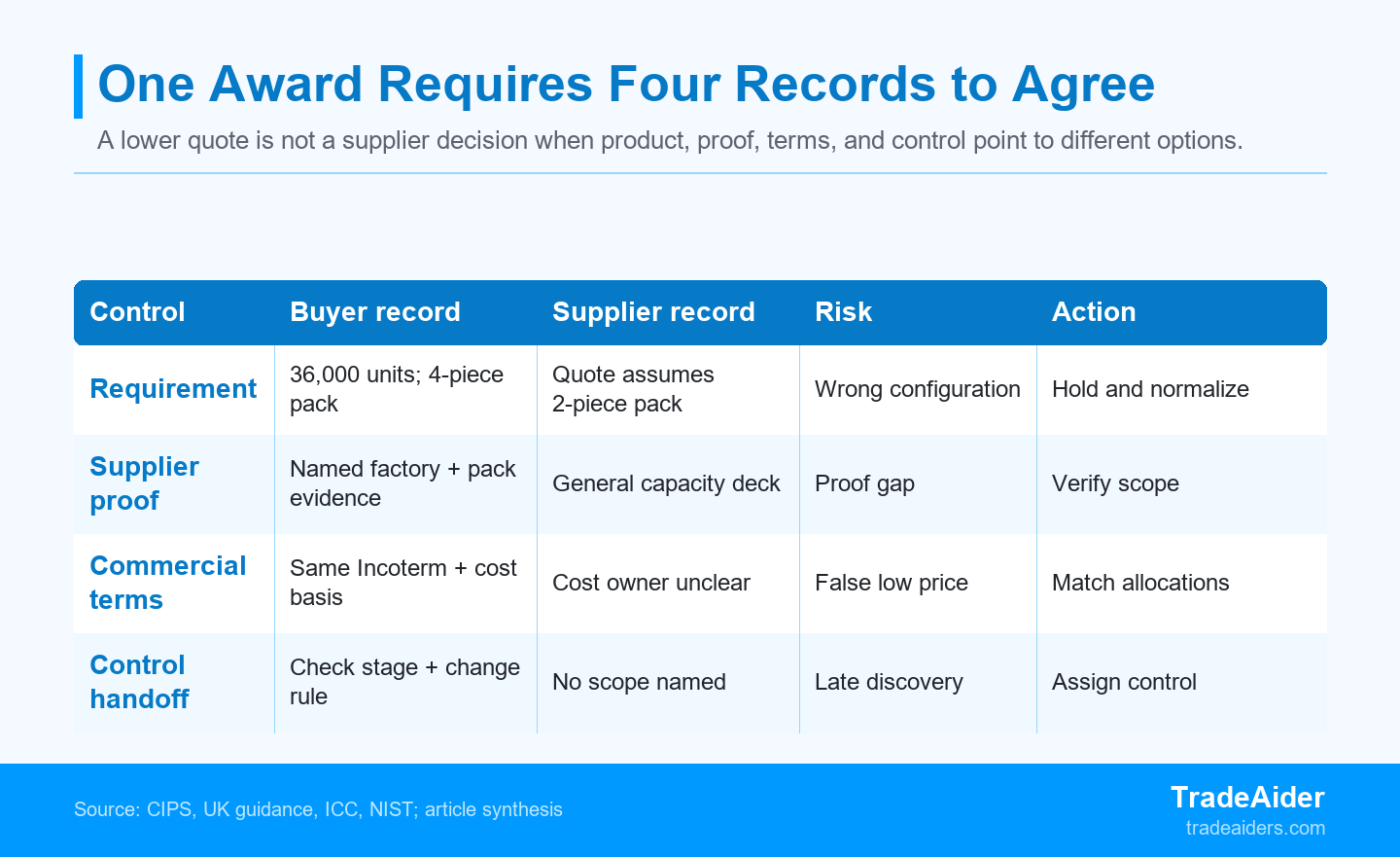
A supplier award should pause when any record points to a different product configuration, owner, or inspection condition.
An illustrative importer is choosing a supplier for an insulated drinkware launch with three retail colorways. The planned order is 36,000 units across three colorways, with 12,000 units per colorway for one seasonal launch. Two suppliers can make the bottle. The lower quote assumes a two-piece retail pack, while the buyer requirement and the other quote use a four-piece pack with a defined carton layout.
The lower quote names the bottle and unit price but does not attach the four-piece packaging specification or a production-control handoff. Its capability presentation gives a general capacity statement, yet it does not connect the packaging configuration to the planned 36,000-unit order. The buyer therefore has a price, but not proof that both suppliers are pricing the same pack, carton load, and inspection scope.
The price gap cannot be evaluated by itself. A different pack count can change packaging materials, labor, carton layout, transport assumptions, and the observations required before release. The buyer holds the award and asks each supplier for the same controlled requirement, a named packaging record, a matched trade-term breakdown, and a pre-production control plan before the commercial comparison is reopened.
The lower-cost supplier revises the quote to the four-piece pack, attaches a packaging reference, identifies the factory responsible for the configuration, and confirms the stage at which the buyer can verify the order. The purchase order proceeds only after all four records identify the same 36,000-unit, three-colorway configuration. This illustrative example does not establish supplier suitability, verify a factory, determine a legal obligation, or represent TradeAider client data.
Use a Four-Record Award Packet
A concise award packet gives the buyer a repeatable way to document why a supplier was selected and what must remain true when the order reaches production and final inspection. In its ICT-specific context, NIST describes due diligence research as gathering pertinent supplier or product information to support informed acquisition decisions. Use that principle here without extending the NIST guide beyond its stated technology scope.
Define an award packet as a controlled record set supporting a supplier-selection decision. Keep it short enough to be used, but do not omit an unresolved mismatch. The packet should contain:
- the approved buyer requirement, including configuration, packaging, quantity, destination, and change rule;
- the supplier and facility evidence that supports the exact option under consideration;
- the normalized commercial comparison, including the named trade term and assumptions that affect cost or risk; and
- the production and inspection handoff: control stage, records required, decision owner, and escalation path.
If the buyer wants an independent party to check a defined production or shipment condition, the award packet makes the scope more usable. Before choosing a provider, readers can review TradeAider's inspection approach and compare it with the evidence they need.
Four Responsibilities That Make Supplier Awards Defensible
A sourcing manager adds the most value by connecting the product requirement, proportionate supplier evidence, comparable commercial terms, and the next quality-control handoff. Before award, use these four responsibilities as a decision test:
- Control the requirement. A supplier cannot quote comparably if the product and pack are still ambiguous.
- Match evidence to risk. Ask for information that can change this award, then refresh it when relevant conditions change.
- Normalize commercial ownership. Make costs, trade terms, responsibilities, and exceptions visible before negotiation.
- Hand off a known order. Give production and inspection teams the configuration, check stage, and approval route they need.
When the order is complete and the final-lot question is clear, the buyer can request a scoped pre-shipment inspection.
Frequently Asked Questions
What does a sourcing manager own after a supplier is shortlisted?
A sourcing manager owns the decision record that connects the requirement, supplier evidence, commercial terms, and handoff conditions before an award is released. After the shortlist, the role is not simply to obtain a better price. It is to show that the selected option still matches the requested product and that the next teams can act on the same version. Product approval, commercial authority, and final release remain with the buyer unless the parties explicitly assign them otherwise.
How should a sourcing manager compare two supplier quotes?
Compare quotes only after normalizing product configuration, trade term, quantity, packaging, payment conditions, tooling assumptions, and the evidence that supports each line item. Put omissions and alternatives in their own fields rather than forcing them into the unit price. If one supplier is quoting a different pack count, a different delivery responsibility, or an unconfirmed factory route, the options are not yet comparable. Resolve the difference first, then negotiate the commercial position.
When does supplier due diligence need a deeper review?
Require deeper review when the supplier is new, the product or market risk is higher, the evidence conflicts, or a change weakens traceability. The review should be proportionate to the decision, not identical for every supplier. For example, a changed factory, an unclear subcontracting route, a capacity claim tied to a tight launch, or an unresolved corrective action can all justify more specific evidence. Record the trigger and the resolution so the team knows why the decision was reopened.
Can an inspection service choose the supplier for the buyer?
No. An inspection service can verify an agreed product or production scope, but the buyer retains supplier selection, commercial approval, and final release authority. A third party is most useful when the buyer has defined what needs checking, which product or lot is in scope, and what question the inspection should answer. The resulting observations can inform a sourcing decision, but they do not replace the buyer’s own requirement, contract, or approval process.

Articles Connexes


Développez votre entreprise avec le Service TradeAider
Cliquez sur le bouton ci-dessous pour accéder directement au Système de Service TradeAider. Les étapes simples de la réservation et du paiement à la réception des rapports sont faciles à utiliser.

