
Apparel QC standards work only when each one answers a different release question and supports a clear release decision. A care label does not prove sleeve length. A measurement table does not prove that the packed carton contains the right SKU. A laboratory report does not show that the current lot has clean stitching, correct labeling, or intact retail packaging. Importers get better results when they assemble these requirements into one garment-specific evidence file instead of treating them as one long checklist.
That distinction matters because apparel changes easily after approval. A fabric mill can change, a wash can shift color, a size label can be switched during packing, or a factory can substitute a zipper, button, hangtag, or polybag. The right response is not to memorize ten acronyms. It is to know which requirement controls the customer promise, which one controls market-facing claims, which one guides inspection, and which proof is needed before the order moves.
TradeAider helps importers turn those buyer-owned requirements into an inspection scope that stays tied to the actual garment and shipment decision. The useful starting point is always the same: identify the reference that must match, the check that can verify it, and the result that would justify release, correction, or a targeted hold.
Key takeaways
- Start with the approved garment file before applying a lot-sampling plan.
- Separate buyer specifications, regulatory labels, testing evidence, and finished-lot inspection evidence.
- Use measurement tolerances and a graded sample to make size and construction checks repeatable.
- Use an agreed sampling plan to judge selected lot attributes, not to replace a compliance review.
- Release only when garments, labels, packing, and supporting documents describe the same sellable SKU.
The Ten Standards Belong in Four Evidence Layers
The strongest apparel QC program does not rank every standard equally; it assigns each one to the product, destination, lot, or shipment decision it can actually support. FTC apparel-labeling guidance is a useful boundary: consumer-facing identifiers establish product identity, while the buyer's signed reference still controls the physical item ordered. Data from that guidance identifies fiber content, country of origin, and responsible-business identity as distinct disclosure information for covered textile and wool products.
For U.S.-bound textile apparel, the FTC explains that most textile and wool products require labels that state fiber content, country of origin, and the responsible business identity. The FTC also administers the Care Labeling Rule, which requires manufacturers and importers to provide regular-care instructions for covered apparel. Those requirements sit beside, rather than inside, the buyer's own garment specification. A buyer still needs to check the physical lot against its signed style, measurements, trims, workmanship, and pack-out.
Before a current lot can move, the release file should reconcile the approved garment, market label, sampled lot, and packing record. Those four evidence layers answer different questions, but together they support one shipment decision. The key insight is that no one layer can safely stand in for the other three.
| No. | Standard or guideline | Decision it supports | Evidence to retain |
|---|---|---|---|
| 1 | Approved product file | What garment should be made? | Signed sample, BOM, construction notes |
| 2 | Measurement specification | Does the garment fit the agreed size? | Point-of-measure sheet and tolerances |
| 3 | Workmanship defect standard | Which sewn, finished, or appearance faults matter? | Defect definitions and reference photos |
| 4 | Fiber-content and origin labeling | Can the item carry its market-facing textile identity? | Approved label artwork and garment photos |
| 5 | Care-label evidence | Are washing and care claims supportable? | Care instruction, test basis, component review |
| 6 | Product-category compliance review | Does a destination market trigger a separate file? | Applicable reports, certificates, warnings |
| 7 | ISO 2859-1 acceptance sampling | How are selected lot attributes sampled? | Lot size, sample plan, defect classes |
| 8 | Measurement-method discipline | Can the result be repeated against the spec? | Method, tool, point, result, tolerance |
| 9 | Packing and assortment standard | Does the carton deliver the promised SKU mix? | Carton mark, ratio, fold, polybag, count |
| 10 | Release and corrective-action record | Can the buyer release, hold, or recheck a known lot? | Inspection report, hold boundary, recheck proof |
1-3: Lock the Garment the Buyer Actually Approved
The approved sample, measurement specification, and workmanship standard are the buyer's first three controls because they define the physical garment before labels and lot sampling enter the conversation. ISO 9001:2015 similarly frames quality management around meeting customer and applicable requirements through planned, controlled processes. Data from the ISO listing supports that process-control boundary; it does not turn the standard into a pass certificate for a specific garment. A TradeAider pre-production inspection can align the physical reference before repeated sewing and packing begin.
A tech pack is the product specification package that identifies fabric composition, weight or construction where relevant, color standard, pattern pieces, stitch type, seam allowance, trims, label placement, fold method, and packaging components. The approved sample supplies the visual interpretation, but it should not be the only record. A sample can fade, become separated from its revision notes, or hide a detail that the factory needs in writing. Pair it with a dated specification and a bill of materials that identifies what may not be substituted without review.
A measurement standard also needs more than a size chart. For every point that controls fit, name the garment position, the size, the tolerance, the method, and whether the garment is laid flat, stretched, buttoned, or otherwise prepared. A tape measure placed at the wrong point can make a compliant garment appear out of tolerance. A useful report shows the point of measure and the actual result so the buyer can compare it to the same revision of the spec.
Workmanship is where many apparel briefs become vague. Define what counts as an open seam, skipped stitch, puckering, uneven hem, loose thread, needle damage, stain, shade variation, print registration error, broken zipper, missing trim, or sharp component. The severity should follow the customer consequence. A hidden loose thread may be minor; a cracked snap on children's wear or a wrong size label may justify a different release action. An inspection standard can make those expectations checkable before the visit.
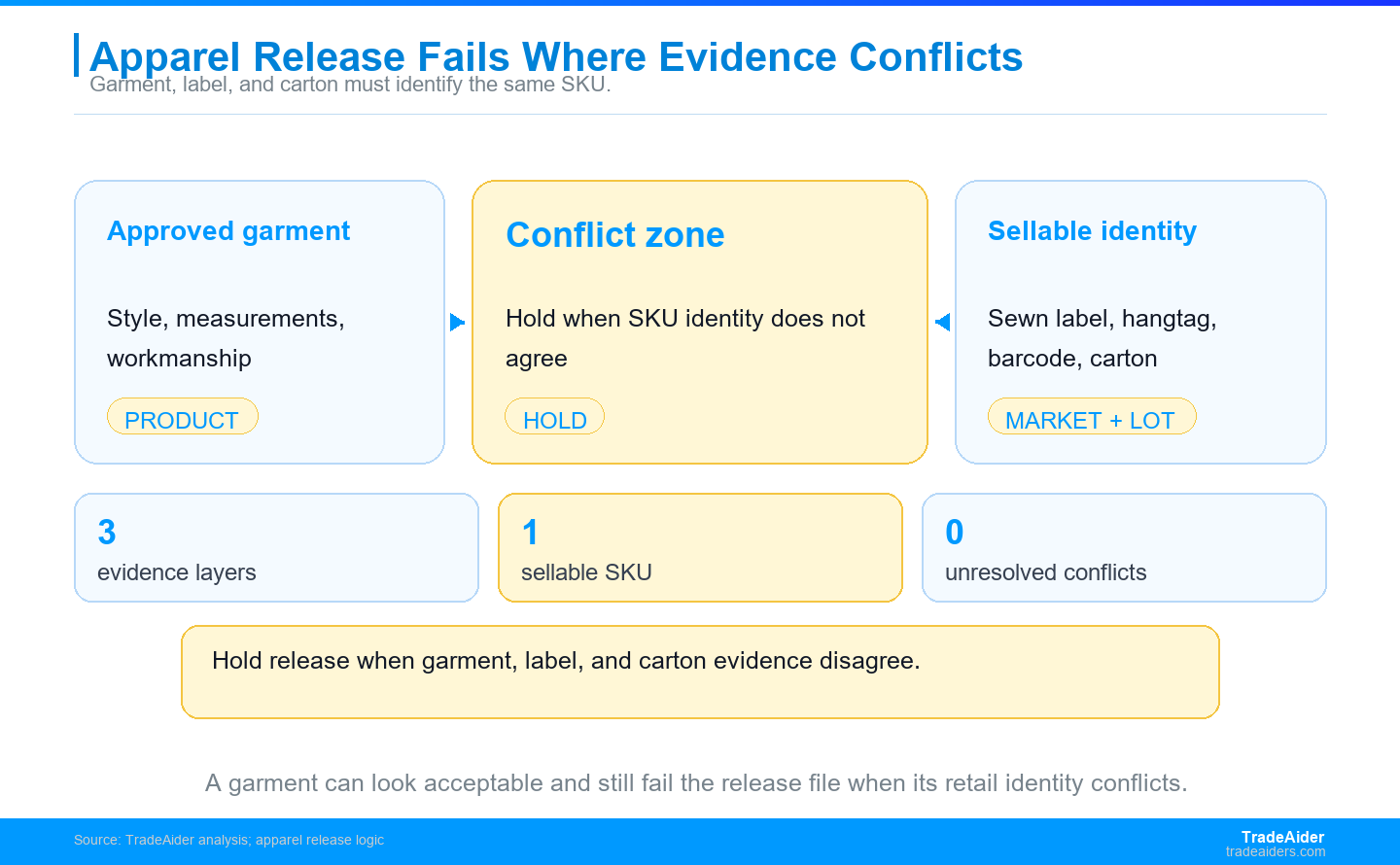
Apparel release evidence is strongest when the approved garment, market-facing label, and packed lot all describe the same SKU.
4-6: Treat Labels and Category Rules as Their Own File
Market-facing apparel information is not a cosmetic afterthought: a label, care statement, warning, or category-specific requirement must be linked to the actual garment and destination market. The FTC Care Labeling Rule makes that distinction concrete for covered apparel offered for sale in the United States. Data from the rule establishes the consumer-facing role of care information; physical inspection then verifies the version attached to the current item.
FTC apparel-labeling guidance explains the U.S. label categories for textile, wool, fur, apparel, and leather matters. For covered textile and wool products, fiber content, country of origin, and a responsible business identity are not interchangeable with a factory's internal SKU code. Inspect the sewn-in label, hangtag, packaging, and carton mark against approved artwork; then confirm that they point to the same style, color, size, and destination-market version.
The FTC care-label rule text requires manufacturers and importers to attach care labels so consumers can see or readily find them when covered apparel is offered for sale. The rule also depends on reliable evidence for care instructions. That gives the importer two related but different tasks: retain the care-evidence basis, and inspect whether the current garment carries the approved instruction in the correct place and form.
The FTC Textile Fiber Rule is another market-information boundary. Data from the rule supports the use of approved fiber-content wording, while the buyer's inspection still checks whether the finished item carries the planned label version.
A laboratory report and a lot inspection are complementary, not interchangeable. ISO/IEC 17025:2017 addresses competence requirements for testing and calibration laboratories. Data from that standard is why a visual lot check should not be presented as laboratory proof.
Some products require a separate category review. Children's sleepwear, children's products, protective clothing, performance claims, and destination-specific restrictions can create requirements that a standard garment inspection cannot settle. Do not ask an on-site inspector to infer laboratory conclusions from a label or a feel test. Define the category, intended market, applicable document, and physical checks before the visit.
7-10: Use Inspection to Judge the Current Lot
Sampling, measurement, packing checks, and a correction record convert the quality file into a decision about the current export lot. ISO 2859-1:2026 provides acceptance-sampling schemes for inspection by attributes, but it does not replace the buyer's garment specification or destination-market compliance review. Data from the standard defines the sampling role; the buyer still defines the attributes worth sampling.
ISO 2859-1:2026 describes acceptance-sampling schemes for inspection by attributes. AQL is a sampling approach for checking selected lot attributes; it helps the buyer agree how a lot will be sampled and what defect classifications will be used. It does not decide the garment's tolerances, label claims, wash performance, or compliance route. Those decisions belong in the product and market layers first. Use a sample plan after the lot and check list have been agreed, not as a substitute for them.
During the visit, measurement should sit beside workmanship rather than disappearing into it. The inspector should record which size was checked, which point was measured, which sample was selected, and whether the reading was compared to the applicable tolerance. For apparel with multiple colorways, sizes, or assortments, make the selection logic visible. A defect found only in one color can still be a production pattern if that color used a different fabric, wash, print line, or packing team.
Packing is also an apparel standard. Check carton mark, inner quantity, size ratio, color ratio, folding, polybag, barcode, hangtag, tissue, moisture protection, and export-carton condition against the packing instruction. A garment can pass appearance inspection and still create an ecommerce receiving failure if the carton ratio or barcode is wrong. Record the pack-out evidence alongside the physical sample so a later correction can be tied to an identifiable carton range.
Keep the result usable by recording the selected carton, style, color, size, pack ratio, and the exact instruction used for comparison. That turns a finding into a recheckable observation instead of a vague note that another team must interpret later. It also makes it easier to decide whether a mismatch belongs to one packing run, one colorway, or a broader assortment problem.
An apparel order is not release-ready merely because the fabric looks right. The approved garment, label, lot sample, and carton evidence must agree.
When a recurring issue appears before packing is complete, a During Production Inspection can focus on the changing production boundary while garments, labels, and packing records are still easier to separate. That service does not replace required testing or destination-market review. Its value is practical: it gives the buyer a chance to compare current output with the approved file before completed assortments make a correction broader and harder to verify.
Worked Scenario: A Correct Garment in the Wrong Retail Identity
The following illustrative scenario applies inspection to a stated retail-identity requirement; ISO/IEC 17020 frames inspection around stated conformity requirements. Data from the standard keeps the example focused on an agreed requirement rather than an inspector's personal preference.
A Catalog Identity Conflict in an Illustrative 6,000-Piece Order
Illustrative scenario: an importer is preparing a women's knit-top order for an online retail assortment. ISO/IEC 17020 frames inspection around stated conformity requirements, which is the limited role applied in this example. Data from that scope keeps the conflict focused on retail identity rather than a claim that every garment is physically defective.
The order contains 6,000 garments in three colors and five sizes, so the physical item, retail tag, barcode record, and carton ratio all need to identify the same sellable SKU.
Garments are complete and cartons are undergoing packing checks before export release; the approved sample, measurements, and sewing quality are acceptable in the selected sample.
Selected navy cartons contain mixed small and medium hangtags.
Sewn size labels remain consistent with the physical garments.
The mismatch is not a simple loose-accessory defect. It creates a retail identity problem because the garment size, hangtag, barcode record, and carton assortment may no longer agree.
Hold the affected carton range and verify the approved SKU matrix before release.
Isolate the related hangtag batch, replace incorrect tags, and recheck named cartons after the factory corrects the retail-facing identity.
Confirm the garment size, hangtag, barcode record, and carton assortment agree after correction, then record the carton range, SKU and size combinations checked, and follow-up result.
This is an illustrative scenario only: a corrected navy carton does not automatically prove that black and ivory assortments are clear, but there is no reason to rework all 6,000 garments without evidence. For a completed order, a Pre-Shipment Inspection can be scoped around garment construction, labels, packing ratios, and the specific evidence the buyer needs to release the export lot.
Turn the Ten Standards Into One Release File
The final apparel release file should let a buyer see, without guessing, whether the product reference, market information, inspected lot, and corrective evidence still point to one sellable garment. ISO 10005:2018 provides guidance for quality plans that can be established, applied, reviewed, and revised for a specific output or contract. Data from that guidance supports keeping the garment order's controls and changes in one reviewable record. In practice, that record makes a correction and its follow-up easier to audit.
Before release, review the approved sample and specification revision, applicable label and care artwork, required category documents, sample selection, measurement results, defect findings, packing evidence, and any recheck result. A defect tally is only one part of that file. The practical question is whether the finding changes the product itself, the sellable identity, the customer experience, or the shipment population.
A useful release note separates three outcomes. First, some observations can be accepted because they meet the agreed tolerance or defect rule. Second, some require targeted correction but leave a named, traceable scope: for example, a specific label batch, carton range, colorway, or packing shift. Third, some findings leave the buyer unable to identify the sellable SKU or affected population. Those should remain open until the factory supplies matching physical evidence and a documented recheck result. This approach avoids both extremes: releasing against an unclear record and demanding a whole-order rework without a defined reason.
Use the corrective record as a bridge between the factory and the buyer. It should name the original reference, describe the mismatch in plain language, identify the affected product or carton boundary, state the intended correction, and record what will be checked again. Ask for photographs only when they help prove the specific point at issue. A general photo of folded garments does not resolve a label-placement question, just as a clean carton photo does not resolve a measurement deviation. The recheck should revisit the same SKU, condition, and decision criterion that caused the hold.
TradeAider can help translate an apparel order's garment file into a practical inspection scope, including measurements, workmanship, labels, and packing evidence. When the order is ready for a release-stage review, contact TradeAider's team with the approved references, order status, destination market, critical checks, and any known factory change.
Frequently Asked Questions
Is AQL enough for apparel quality control?
No, AQL is useful only after the buyer has defined the garment, destination-market requirements, and inspection attributes. It helps structure lot sampling for agreed defect classes, but it does not define the product specification, size tolerances, label claims, care evidence, or a category-specific compliance file. The report should still show which lot, garments, points of measure, and defect classes were actually checked.
What should an apparel inspection measure before shipment?
An apparel inspection should measure the points that control the approved fit and customer expectation, using the stated size, garment condition, method, and tolerance. Typical checks may include chest, body length, sleeve length, inseam, waist, opening, or placement dimensions, but the correct list comes from the buyer's specification rather than a universal chart.
Do care labels need supporting evidence for apparel?
Yes, care instructions need a reasonable basis before they are printed on covered apparel for sale in the United States. The physical lot then needs a different check: confirm that the sewn label is present, readable, placed as approved, and consistent with the intended market version. Retain the support for the instruction and inspect the current label separately.
Can a good garment still fail release before shipment?
Yes, a well-sewn garment can still fail release before shipment when its fiber label, care label, barcode, size tag, carton ratio, destination-market file, or packing condition does not match the approved SKU. Physical quality and retail identity are related but separate checks. Release depends on alignment across the item, its customer-facing information, and the export-pack record.
When should an importer schedule an apparel inspection?
An importer should schedule an early review when fabrics, trims, labels, measurements, or approved references remain uncertain. Use an in-process review when a repeated production risk needs containment while output is still traceable. Use a pre-shipment review when the completed garments, labels, packing ratios, and export cartons need one buyer-facing release decision.

Articles Connexes



Développez votre entreprise avec le Service TradeAider
Cliquez sur le bouton ci-dessous pour accéder directement au Système de Service TradeAider. Les étapes simples de la réservation et du paiement à la réception des rapports sont faciles à utiliser.

