
- À Propos de Nous

- Nos Services
- Votre Industrie
- Ressources
- Actualités et Blog
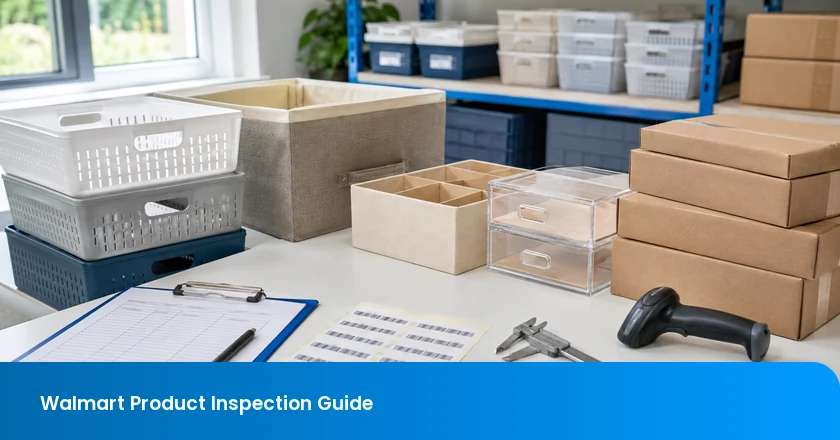
A Walmart product inspection is most useful when it is a seller-controlled release decision, not a universal Walmart “pass.” Before inventory moves, the listed selling unit, the physical product, its packaging, and its supporting records should point to the same current lot. That catches the problem a generic checklist misses: goods can look acceptable while an old carton label, changed pack count, or unmatched product identifier makes the result unsafe to apply to the inventory that will actually be listed or shipped.
Start With the Selling Unit, Not a Generic Product Name
An inspection scope should begin with the exact selling configuration and its Marketplace identity, not with an unspecific product label. Walmart Marketplace’s product identifier policy says that a model number or SKU is not itself a valid product ID. Put both identifiers in the brief: the factory SKU for internal traceability and the listing identity for the exact configuration a customer will buy.
- Listing proof: product ID, variation, and sellable pack count.
- Product proof: the actual material, components, appearance, and agreed function.
- Packaging proof: consumer pack, label, carton, and quantity relationship.
- Evidence proof: the approved files, tally, and records that identify the current population.
This distinction is practical rather than bureaucratic. The product record and the factory control code may be related, but they are not interchangeable. When the information is fixed before sampling, the reviewer can tell which customer-facing configuration an observation actually covers.
| Field to freeze | What it identifies | Release question |
|---|---|---|
| Selling unit | The customer-facing configuration | Which exact item was checked? |
| Product ID | Listing identity for that configuration | Does the checked item match the listed record? |
| Consumer pack | What the customer receives | Is the pack count and artwork current? |
| Carton and tally | The population covered by the finding | Which units can the result support? |
Use an inspection standard to make defects and checkpoints explicit, but do not let a generic product name do the work of these fields. TradeAider can use the same defined fields in an agreed independent scope. “Storage organizer, blue” does not tell an inspector whether the listing is a two-pack or four-pack, which barcode belongs on the consumer pack, or which carton range uses the current artwork.
Separate the Listing Identity From the Factory's Internal Code
A factory SKU may aid traceability but does not replace the product identity associated with a Marketplace listing. Walmart Marketplace’s product identifier policy separates valid product IDs from a SKU or model number, so the buyer should preserve both fields rather than substitute one for the other.
Build a short identity sheet for each variation before sampling starts. Include product name, valid product ID or approved exemption status, factory SKU, consumer-pack count, current artwork revision, and carton marks. The listing report can still be a useful cross-check because its Item ID, GTIN, UPC, and variation fields are separate. That separation makes a label mix-up visible before it becomes a listing-to-inventory mismatch.
Map the Consumer Pack and Master Carton to the Same Unit
Packaging and carton records must preserve the sellable configuration so a finding can be applied to a known population. This is an operational control, not a universal Walmart carton-label format: it makes the consumer pack, master carton, and tally visible as parts of one release record.
State the relationship plainly: what is in one consumer pack, how many consumer packs are in one master carton, and which carton marks identify that group. Add the approved artwork file and revision. A photo can support the record, but it cannot show whether later cartons use the same version. If a carton count or label differs, a clear map lets the team isolate the connected cartons instead of calling the entire order good or bad by default.
Inspect the Current Selling Condition in the Right Order
A useful inspection checks current records before product appearance, labels, packaging and function so the observation has an approved comparison point. The sequence is a seller control method, not a claim that Walmart publishes one inspection sequence for every item.
Begin with the reference set, then move through the goods in the order a customer and fulfillment route will experience them. This is a buyer control method, not a claim that Walmart publishes one inspection sequence for every item.
- Confirm the current listing identity, variation, pack count, artwork, and lot records.
- Confirm the carton or batch markers that define the population to be sampled.
- Inspect product appearance, agreed dimensions or assembly points, and functional checks.
- Check consumer pack, labels, cartons, and route-specific protection requirements.
- Record the affected population, corrective action, and verification needed before release.
Freeze the Reference Set Before Sampling Goods
An approved reference set gives a physical inspection a defined product, pack, label and evidence target; a change reopens the affected scope. It is a practical QC control, not a published Walmart procedure or legal requirement.
A reference set is the current listing record, product ID, approved sample or specification, artwork, packing instruction, and any product-specific evidence that belongs to one selling unit. It is not a universal document list. It gives the seller and inspector a stable answer to “what are these goods supposed to be?”
If a material, label, component, pack count, site, or fulfillment route changes, identify the affected units before using an old sample as the comparison target. Walmart’s Prohibited Products Policy overview says product labels, information, and images must not contain conflicting information where applicable. A reference set is a practical way to catch that conflict before a seller treats a physical check as release evidence.
When the open issue is still in the production run, a during-production inspection can verify a defined changed condition while correction is still possible. The seller, not the inspector, decides whether the changed condition is acceptable and supplies the current version to verify.
Check Product, Label, Packaging and Function as One Selling Condition
Physical condition, label accuracy, package protection and functional performance are connected selling-condition checks, not four disconnected pass marks. The exact checks still depend on the category, fulfillment route, specification, and commercial agreement.
For a straightforward household item, the agreed checks may include color and finish, assembly or moving parts, label placement, consumer-pack count, carton condition, and a short functional test. For a more complex product, the seller may need different checkpoints and evidence. In either case, record the observation against the same sellable configuration, not against a loose factory sample.
Packaging requirements change with the fulfillment model. Walmart’s Marketplace packaging policy addresses order packaging, while its WFS preparation guidance addresses inbound sale-ready protection. Use only the policy and route that apply. “Carton corner crushed” is an observation; “carton corner crushed on pallet group B, affecting this tally” is evidence a seller can act on.
Treat a Pass as Evidence Only When It Identifies the Lot
An observation supports a release decision only when it can be connected to the current lot or an identifiable population that will move. This rule does not prescribe a sampling plan or a Marketplace publication decision; it tells the seller when an observation can be applied to known goods.
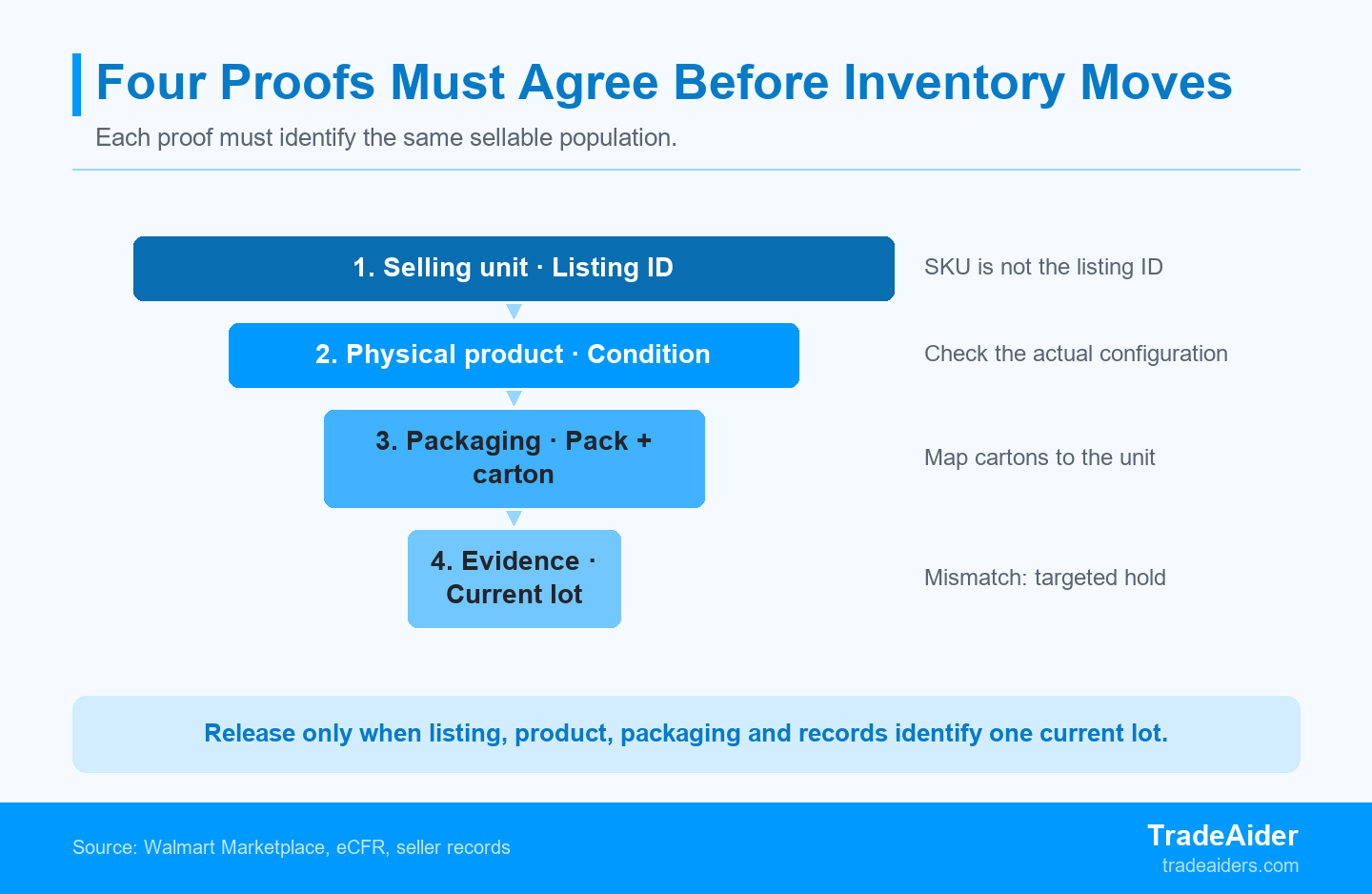
A physical check becomes release evidence only when the listed selling unit, product, package and records all point to the same current lot.
“Pass” is too broad to guide a real inventory decision. Ask which configuration was compared, which cartons or batch population were covered, which records were current, and who can authorize the next movement. If those answers describe the same units, the result can support the seller’s release decision. If not, use a hold and reconciliation rather than a vague request to “inspect again.”
Walmart’s Listing Quality guidance evaluates product-detail-page content at item level. It does not create a Walmart inspection protocol, but it reinforces why a seller should not use an unqualified product-family statement when deciding whether a specific listed configuration is ready to move.
Handle a Document-Product Conflict With a Targeted Hold
When evidence and cartons conflict, a separable affected population can receive a targeted hold while the seller repairs and verifies its records. The precise hold, rework, and verification obligations depend on the product, contract, and applicable policy.
Consider an illustrative private-label seller preparing one Marketplace listing for a portable storage organizer. The order contains 4,800 units in 400 master cartons, with one UPC and one approved consumer-pack artwork. Finished goods are packed, and the seller has an inspection record, carton tally, and approved reference set. This is a decision pattern, not a TradeAider customer case.
The review finds 160 cartons with the approved consumer-pack label and matching UPC. Another 240 cartons hold visually acceptable units but carry a previous artwork version with a different UPC. Pallet marks and packing-list sequence allow the factory to distinguish the two groups. The meaningful finding is not that one product is good and one is bad; only one group currently connects to the approved selling-unit record.
Place a targeted hold on the 240 cartons. Product appearance does not resolve the listing-identity conflict, and relabeling is not complete until the revised tally and evidence identify the repaired group. The 160 matching cartons retain their own traceability, but the seller still makes the final release decision and should not call either group Walmart-approved.
The corrective path is controlled relabeling or repacking, an updated tally, and a verification sample against the approved UPC, artwork, pack count, and carton record. If the factory cannot separate the populations, widen the hold because the affected population is no longer identifiable. This example does not decide legal compliance, listing eligibility, or any specific platform action.
Keep Independent QC Separate From Marketplace and Compliance Decisions
An independent inspection can provide product and evidence observations, but it does not replace seller policy responsibilities, category-specific documentation, laboratory testing, or a Walmart decision. Walmart’s seller onboarding guidance places policy understanding and compliance with the seller; its Prohibited Products Policy overview identifies applicable documentation and non-conflicting product information; and the official eCFR product-certification rules are a separate testing-and-labeling framework.
Marketplace and product-safety responsibilities remain with the seller or other responsible firm even when an independent provider supplies observations. The seller-specific policy boundary in the Marketplace onboarding guidance and the separate evidence duties in the eCFR certification rules are why an observation report cannot take over the responsible firm’s role.
TradeAider can inspect an agreed product, packaging, and document-to-lot scope. It cannot publish a listing, issue a platform approval, decide a product’s regulatory classification, or create laboratory evidence through a visual check.
For products subject to applicable certification rules, the boundary is sharper. An inspection report may show that goods and records match the defined scope; it does not replace product-specific evidence the responsible firm may need. Where laboratory evidence is the open question, use a separate product testing service path and confirm the applicable product, market, and rule before release.
Prepare a Scope That Can Support an Independent Release Check
A useful inspection booking starts with a named selling unit, reference set, physical checks, lot map and release rule rather than a request to pass Walmart inspection. It is an operational recommendation, not a Marketplace prerequisite.
- Name the configuration: product ID, variation, factory SKU, and consumer-pack count.
- Attach the reference set: approved artwork, specification or sample, packing instruction, and scope-specific evidence.
- Define the population: carton marks, production window, tally, or another method that identifies the units.
- State the release rule: what is held, what needs correction, and who verifies a repaired group.
That brief gives an independent provider a real question to answer. When finished goods and packing scope are available, plan a pre-shipment inspection around the reference set rather than requesting a generic Walmart pass. If you are comparing providers, review how TradeAider approaches independent inspection; the service is independent of Walmart Marketplace and does not transfer the seller’s policy or compliance responsibilities.
Frequently Asked Questions
Does Walmart require every seller to get a third-party inspection?
No public Walmart Marketplace page reviewed here sets one universal third-party inspection certificate for every seller and item. Sellers may still choose independent QC to reduce label, packaging, function, or release risk. The needed scope depends on the product, fulfillment route, contract, and evidence that applies. Do not present an ordinary inspection report as Marketplace eligibility or a guaranteed platform outcome.
Can a factory SKU replace a UPC or GTIN check?
No, a factory SKU is an internal control label and is not automatically the product identifier required for a Marketplace listing. Keep it because it can connect production and carton records, but keep the listing identity separately. For each variation or pack count, confirm which sellable configuration the factory code refers to. That distinction exposes an old label or accidental variation mix-up before inventory moves.
What should happen if the product looks right but the carton label is wrong?
Treat the affected cartons as unresolved until their label, quantity, listing identity, and records can be reconciled to the same sellable population. When pallet marks, carton numbers, or packing records identify the group, use a targeted hold and verify the repaired cartons. When the population is mixed or cannot be separated, widen the hold. A visually acceptable product does not by itself prove that the cartons are ready to move under the intended listing.
Can an inspection report replace product testing or compliance documents?
No, a visual or functional inspection does not replace category-specific test evidence or certificates when they are required for the product. An inspection may confirm that physical goods and records match the defined scope, which is valuable for lot control. It cannot determine every legal or technical requirement. Confirm the product’s applicable evidence route before release, especially when the item is regulated or makes a specific claim.

Articles Connexes


Développez votre entreprise avec le Service TradeAider
Cliquez sur le bouton ci-dessous pour accéder directement au Système de Service TradeAider. Les étapes simples de la réservation et du paiement à la réception des rapports sont faciles à utiliser.

