
The main inspection rules for imported products in the United States are customs entry, country-of-origin marking, product-specific safety or agency rules, labeling, testing, and documentary proof; the buyer's real task is to verify which layers apply before the shipment leaves the factory. A U.S. port exam may happen after arrival, but the evidence that prevents delays is usually created earlier: product classification, label artwork, certificates, test reports, packing status, and inspection records that match the exact SKU and lot.
Key Takeaways
- There is no single U.S. inspection rule: CBP entry, agency admissibility, product safety, labeling, and origin marking can all apply to the same shipment.
- Inspection should start before export: labels, cartons, certificates, and product files are harder to fix after goods are packed or at the port.
- Product category drives the proof: FDA-regulated goods, textiles, children's products, electronics, and general consumer products trigger different evidence paths.
- TradeAider should be used as a release-evidence layer: it can check physical goods, labels, packing, and inspection records, while legal classification and regulated testing remain specialist responsibilities.
The Main Rules Are Not One Inspection Rule
Importers often ask for the main inspection rule as if one checklist covers every product. The safer way to think about U.S. imports is a layered control map. CBP basic importing guidance explains the entry responsibility, while CBP import safety priorities show why unsafe or noncompliant products can become enforcement issues rather than simple paperwork delays.
The physical inspection of goods is only one part of that map. FDA import basics states that products offered for entry must be declared to CBP and FDA-regulated products are referred for FDA review. That means an importer of cosmetics, food-contact items, dietary supplements, medical devices, or other FDA-regulated products should not treat a factory QC report as the whole admissibility file.
| Rule layer | What it controls | Evidence to prepare before shipment |
|---|---|---|
| Customs entry | Declared merchandise, importer responsibility, entry data | Commercial invoice, packing list, HTS review, broker instructions |
| Country of origin | Marking on product, packaging, or required label | Origin label artwork, production country proof, carton photos |
| Product safety | CPSC or other safety rules for consumer goods | Test report, certificate, warning label, tracking label where required |
| Agency review | FDA or other partner government agency admissibility | Registration, prior notice, product code, formula or device file where applicable |
| Quality inspection | Actual product condition before release | AQL result, defect list, photos, packing status, rework decision |
Customs entry and reasonable care start the chain
CBP's practical message for importers is that compliance is shared between the agency and the importing community. CBP tips for new importers and exporters also make clear that CBP can examine imported shipments. The buyer should therefore treat factory release as a preparation point, not as a guarantee that the shipment will move without review.
A useful pre-shipment inspection should confirm that the goods in cartons match the entry file the broker will use. If the invoice says stainless steel kitchen sets, the carton photos, labels, SKU count, material markings, and product descriptions should support that story. A clean visual report does not help much if the commercial description, origin mark, and product label tell a different story.
Product-specific agency rules decide what can enter
The second layer is product-specific. For FDA-regulated goods, FDA import process guidance explains that entries are submitted to CBP and referred to FDA for review. For consumer products, CPSC rules may require safety testing and certificates. For apparel, FTC apparel labeling guidance points buyers toward fiber content, country of origin, and responsible-party labeling expectations.
This is why the same inspection method cannot be copied across every category. A ceramic mug, a children's hoodie, a battery-powered toy, a cosmetic brush, and a furniture shipment may all need visual inspection, but the proof that matters is different. The buyer has to ask which rule can stop release, not only which defect is visible.
Import Inspection Checklist Before the Goods Leave China
The practical checklist should move from regulatory identity to physical evidence. The importer does not need every supplier to become a U.S. compliance expert, but the factory should provide enough current, SKU-specific evidence for the buyer, broker, lab, and inspection team to compare the product against the correct rule path.
| Checkpoint | What to verify | Hold trigger |
|---|---|---|
| Product identity | SKU, model, material, intended use, age grade, destination | Product file does not match invoice or label |
| Origin and marking | Country-of-origin placement, permanence, carton mark | Missing, hidden, or inconsistent origin mark |
| Safety and testing | Applicable test report, certificate, standard citation | Report is expired, wrong product, or wrong lab scope |
| Labeling and instructions | Fiber, care, warning, tracking, importer details where required | Artwork differs from approved file or rule scope |
| Packing and lot status | Carton count, export packing, barcode, mixed SKU control | Packing spread does not match release sample |
| Inspection evidence | Defect classification, photos, measurements, rework status | Major issue remains unresolved before shipment |
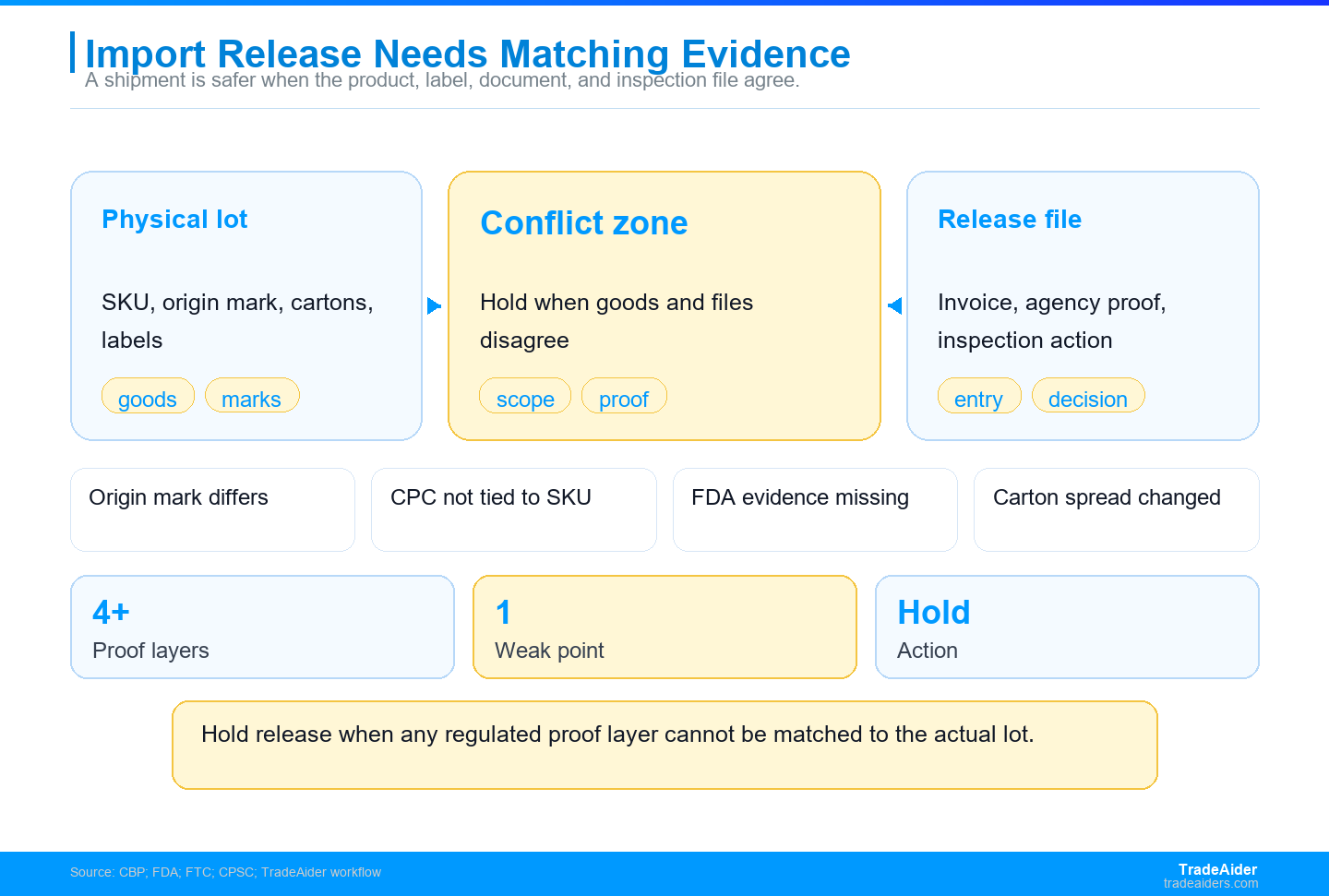
U.S. import readiness depends on several evidence layers matching before the shipment leaves the factory.
Product Category Rules That Often Change the Inspection Scope
Imported products do not all face the same inspection triggers. CBP country-of-origin marking guidance is broad, but a garment, toy, food-contact product, cosmetic, medical device, or electronic product can also have specialized rules. A buyer should identify the product category, intended user, destination market, and claim language before the inspection date.
For textiles and apparel, FTC textile labeling guidance is relevant because fiber content, country of origin, and responsible-party information can be part of the label file. For children's products, CPSC CPC guidance says covered children's products require third-party testing and certification based on applicable safety rules. These requirements are not visual details; they are release proof.
Country-of-origin and labeling should be checked on product and packaging
Origin marking problems are especially costly because they can be systematic. If one approved label file is wrong, every unit in the lot may carry the same error. The inspector should check the product, retail pack, polybag, insert, hangtag, and master carton instead of relying on a single sample photo.
A practical example: a 12-SKU apparel order can pass workmanship inspection but still have two label versions, one for the U.S. and one for another market. If those labels are mixed across cartons, the importer may face relabeling, sorting, or receiving delays even though the stitches, measurements, and fabric quality look acceptable.
Safety certificates and test reports must match the exact product
A certificate is useful only when it maps to the exact product, material, colorway, age grade, component, and standard being claimed. Buyers should compare the model number, product description, test date, lab name, standard citation, and factory details against the actual lot. A report for a similar item is not the same as evidence for the current shipment.
This is where inspection and testing need different roles. A third-party inspection can confirm that labels, cartons, components, and physical goods match the compliance file. It cannot replace required laboratory testing or legal classification when the product category is regulated.
Scenario Estimate: One SKU Can Create Dozens of Proof Points
A simple scenario estimate shows why import inspection should be organized before production release. Suppose an importer has 10 SKUs and each SKU needs four proof layers: product identity, origin marking, safety or agency evidence, and packing evidence. That is 40 proof points before workmanship defects are even counted.
Under those assumptions, a 2 percent proof mismatch rate means about one weak point across the shipment. That weak point might be a wrong origin label, an obsolete test report, a missing warning, or carton marks that do not match the invoice. The estimate is illustrative, but it explains the mechanism: import risk often comes from evidence mismatch, not only from visible product damage.
Calculated from 10 SKUs x 6 checks equals 60 rule-to-lot checks: product identity, origin mark, agency evidence, label file, packing spread, and inspection status. Calculated from 2 label versions x 10 SKUs equals 20 SKU-label checks before workmanship is reviewed. Calculated from 5 cartons per SKU x 10 SKUs equals 50 carton-level origin and packing checks. Calculated from 3 agency-sensitive categories x 10 SKUs equals 30 product-to-rule questions that may need buyer or broker review. Calculated from 1 unresolved evidence mismatch means 1 release hold until the issue is assigned to relabeling, retesting, rework, or broker review. Calculated from 60 checks and 1 mismatch, the mismatch rate equals about 1.7 percent, but the shipment still cannot release if that mismatch affects origin, label, or safety evidence. Calculated from 4 proof layers x 10 SKUs creates 40 checks before the inspector even counts defects. Result: the trade-off is clear: the factory release file costs time upfront, but it reduces the risk of discovering a rule mismatch at the port.
This means the buyer should not ask the inspection team only for a pass or fail result. The stronger question is whether every visible product, label, carton, report, and certificate points to the same SKU and the same market. The decision rule is simple: when the evidence file and the physical lot disagree, treat the issue as a release hold until the owner of that evidence gap is clear.
The decision implication is straightforward. If the product category is regulated, the buyer should lock the evidence map before final inspection. If the category is not heavily regulated, the buyer still needs invoice, label, origin, packing, and quality evidence to tell the same story.
Where TradeAider Fits in the Import Inspection Workflow
TradeAider fits best as the field-evidence layer between supplier claims and release decisions. For finished goods, pre-shipment inspection can verify product condition, packing status, labels, carton marks, and defect classification before payment or dispatch. If quality risk is still developing, during production inspection can catch process and component issues earlier.
For regulated or category-sensitive goods, buyers should also decide whether product testing coordination is needed before shipment. TradeAider should not be used as a substitute for legal advice, customs classification, FDA review, CPSC-required lab testing, or broker judgment. Its value is making the physical lot, report evidence, and release status visible in real time.
That real-time visibility matters because import compliance problems are often discovered too late. If an importer sees label, packing, or certificate mismatch while goods are still at the factory, the decision can be rework, relabel, retest, or hold. If the same issue appears after arrival, the options are narrower and more expensive.
Pre-FAQ Release Packet for U.S. Importers
Before approving shipment, build a release packet that is useful to the buyer, broker, lab, and inspection team.
- Confirm the product identity, intended use, material, age grade, and destination market.
- Match invoice, packing list, carton marks, product labels, and SKU count.
- Attach current test reports or certificates for regulated products, with exact model and standard citations.
- Check country-of-origin and labeling proof on both product and packaging.
- Use TradeAider contact when you need inspection evidence tied to a release, rework, or hold decision.
FAQ
Does CBP inspect every imported shipment?
No, CBP does not physically inspect every imported shipment, but it has the authority to examine shipments and enforce import requirements. Importers should prepare as if the product, label, invoice, and packing evidence may be reviewed. The safest approach is to make the factory release file match the customs and agency file before the goods leave.
What is the most common mistake in U.S. import inspection planning?
The common mistake is treating inspection as a product-only workmanship check. Workmanship matters, but U.S. import readiness also depends on origin marking, product category, labeling, safety certificates, and agency-specific evidence. A clean defect count will not fix a wrong label, missing test report, or product description mismatch.
Can a pre-shipment inspection replace product testing?
No, pre-shipment inspection cannot replace required lab testing or certification. Inspection can verify that the physical goods, labels, cartons, and documentation match the product file, and it can flag missing evidence. If a regulation requires testing by an accepted lab, that testing must be handled as a separate compliance step.
When should importers schedule inspection for U.S.-bound goods?
Schedule inspection after the lot is complete enough to represent the shipment, but early enough to fix label, packing, or product issues before export. For final release, TradeAider follows the PSI principle: the order should be 100 percent produced and at least 80 percent packed for export, so evidence reflects the actual shipment.

Articles Connexes


Développez votre entreprise avec le Service TradeAider
Cliquez sur le bouton ci-dessous pour accéder directement au Système de Service TradeAider. Les étapes simples de la réservation et du paiement à la réception des rapports sont faciles à utiliser.

