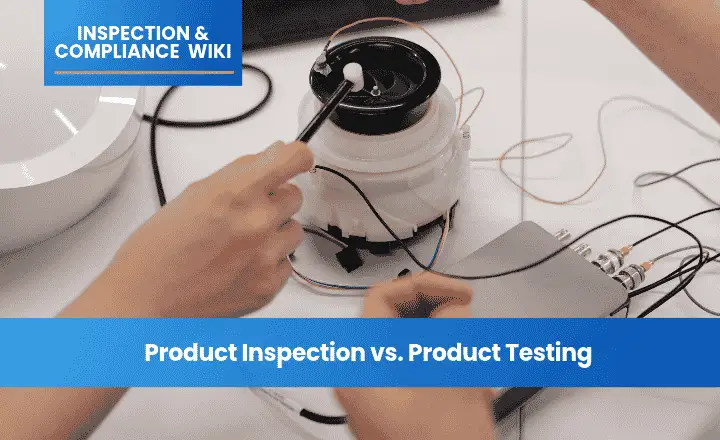
Product Inspection vs. Product Testing
What Is the Difference Between Product Inspection and Product Testing?
Product inspection and product testing are two related but distinct quality control activities. Both help determine whether a product meets specified requirements, but they use different methods and provide different types of evidence.
Product inspection involves examining, measuring, or checking a product against defined requirements. It commonly focuses on appearance, workmanship, dimensions, construction, quantity, packaging, labeling, and other observable or measurable characteristics.
Product testing involves applying specified test methods to evaluate a product's properties or performance. Depending on the product, this may include physical performance tests, electrical tests, chemical analysis, durability tests, or other laboratory evaluations.
In practice, inspection and testing can complement each other. Inspection can identify visible or measurable issues, while testing can reveal performance or material characteristics that cannot be reliably established through visual examination alone.
Both activities support conformity assessment, but the appropriate method depends on the product requirements and the evidence needed to verify them.[1]
What Does Product Inspection Cover?
Product inspection is used to assess whether products conform to agreed specifications and acceptance criteria. It may take place before production, during production, or after production has been completed.
Typical inspection activities include:
- Visual inspection: Checking appearance, color, surface condition, workmanship, and visible defects.
- Dimensional inspection: Measuring product dimensions, weight, thickness, and other specified characteristics.
- Functional checks: Operating product features to verify basic functions against defined requirements.
- Construction and assembly checks: Examining components, joints, fasteners, stitching, and assembly quality.
- Quantity and packaging checks: Verifying order quantities, packaging condition, carton markings, and labeling.
- Specification verification: Comparing product characteristics with approved samples, drawings, technical specifications, or purchase requirements.
For example, an inspection of a kitchen appliance may include checking its housing, switches, power cord, assembly, labeling, and basic operation. These checks help identify visible or readily verifiable nonconformities.
However, a basic functional check does not necessarily establish long-term durability, electrical safety, or compliance with every applicable technical requirement. Those questions may require specific tests.
What Does Product Testing Cover?
Product testing evaluates specific product characteristics through defined test methods. Tests may be conducted in a laboratory or in another controlled testing environment, depending on the method and equipment required.
Common testing categories include:
| Testing Category | Typical Examples |
|---|---|
| Physical performance testing | Tensile strength, impact resistance, load capacity, bursting strength |
| Mechanical testing | Compression, bending, torque, abrasion, and wear resistance |
| Electrical testing | Voltage, current, power consumption, insulation, and electrical safety |
| Chemical testing | Restricted substances, material composition, and chemical migration |
| Durability testing | Repeated-use cycles, fatigue, aging, and environmental resistance |
| Thermal testing | Heat resistance, temperature stability, and thermal performance |
| Color and textile testing | Colorfastness to rubbing or washing, dimensional stability, and fabric strength |
The appropriate tests depend on the product's intended use, materials, destination market, applicable regulations, and buyer requirements.
For example, a textile product may require colorfastness and dimensional stability tests, while a plastic food-contact product may require chemical migration testing under the relevant test conditions.
A test result should always be interpreted in relation to the test method, sample condition, acceptance criteria, and applicable requirements.
Product Inspection vs. Product Testing: Key Differences
Although both activities support product quality verification, they differ in their primary objectives, methods, and outputs.
| Comparison | Product Inspection | Product Testing |
|---|---|---|
| Primary purpose | Check conformity with specified product requirements | Evaluate specific product properties or performance |
| Main methods | Visual examination, measurement, functional checks, and verification | Defined test methods, instruments, equipment, and laboratory procedures |
| Typical scope | Appearance, workmanship, dimensions, construction, quantity, and packaging | Physical, mechanical, electrical, chemical, thermal, and durability characteristics |
| Testing environment | Factory, warehouse, production site, or other inspection location | Laboratory or controlled testing environment, depending on the method |
| Typical output | Inspection findings, measurements, defect records, and inspection status | Test data, measured values, observations, and test reports |
| Main limitation | Cannot establish characteristics that require specialized testing | Does not automatically assess every aspect of product appearance, workmanship, or order conformity |
Neither activity is a complete substitute for the other. A product may pass a visual inspection but fail a laboratory test. Likewise, a product may pass a specific performance test while still having incorrect labeling, poor workmanship, or packaging defects.
When Do You Need Product Inspection, Product Testing, or Both?
The decision should be based on the risks associated with the product and the requirements that need to be verified.
1. When product inspection is sufficient
Inspection may be appropriate when the main concerns involve visible defects, dimensions, workmanship, assembly, quantity, packaging, or other characteristics that can be checked using suitable inspection methods.
For example, a buyer receiving a shipment of ceramic mugs may need to verify product dimensions, surface defects, handle attachment, printing, packaging, and order quantity.
2. When product testing is necessary
Testing is needed when a product characteristic cannot be adequately verified through routine inspection or requires a defined test method and specialized equipment.
For example, checking whether a power bank provides the specified battery capacity requires appropriate testing. Visual inspection alone cannot establish its actual capacity or charging performance.
3. When both inspection and testing are recommended
For products with multiple quality and performance requirements, combining inspection and testing provides broader evidence.
Consider a children's toy with electronic components. Product inspection may cover appearance, assembly, small parts, labeling, and packaging. Testing may be required to evaluate electrical performance, mechanical hazards, material properties, or other applicable safety requirements.
The specific scope should be determined by the product design, applicable regulations, and agreed acceptance criteria.
What Is the Role of Third-Party Inspection and Testing?
Third-party inspection and testing services provide independent verification against agreed requirements. They can help buyers obtain objective information about product condition, quality characteristics, and test results without relying solely on the manufacturer's internal assessment.
Depending on the agreed scope, third-party services may include:
- On-site product inspections at different production stages.
- Verification against approved samples, drawings, and technical specifications.
- Dimensional, visual, and functional checks.
- Sample collection and coordination of laboratory testing.
- Review of applicable test results and supporting documentation.
- Reporting of inspection findings, measurements, and test outcomes.
The distinction between inspection and testing also matters when selecting a service provider.
For laboratory testing, buyers should check whether the laboratory has the appropriate technical competence and whether its accreditation scope covers the specific test methods and products involved. ISO/IEC 17025:2017 specifies requirements for the competence, impartiality, and consistent operation of testing and calibration laboratories.[2] Accreditation should not be assumed to cover every test a laboratory offers.
How TradeAider Provides Product Inspection and Testing Services
TradeAider provides third-party product inspection and testing services in China to help international buyers verify product quality against their specified requirements.
Its product inspection services cover different production stages, including Pre-Production Inspection (PPI), During Production Inspection (DUPRO), and Pre-Shipment Inspection (PSI). Depending on the product and agreed inspection scope, checks may include appearance, workmanship, dimensions, construction, and functional performance.
TradeAider's laboratory testing services focus on product characteristics that require specific test methods and equipment, including physical performance and chemical-substance testing.
Inspection and testing can be arranged as separate or complementary activities, depending on the product, buyer requirements, and agreed service scope.
Learn more about TradeAider's Product Inspection Services and Product Testing Services.
Frequently Asked Questions
1. Is product inspection the same as quality control?
No. Product inspection is one activity within a broader quality control system. Quality control may also include process monitoring, testing, corrective actions, and other activities designed to verify and maintain product conformity.
2. Can product inspection replace laboratory testing?
Not in every situation. Inspection can verify many visible, dimensional, and functional characteristics, but some properties require specialized equipment and defined test methods. Chemical composition, battery capacity, and certain durability characteristics are examples.
3. Can a product pass inspection but fail testing?
Yes. A product may have acceptable appearance, dimensions, and workmanship but fail a performance or chemical test. The two activities assess different characteristics and should be evaluated against their respective acceptance criteria.
4. Does every product need laboratory testing?
No. Testing requirements depend on the product, materials, intended use, destination market, applicable regulations, and buyer specifications. Not every product requires the same tests or testing frequency.
5. What should buyers provide before arranging inspection or testing?
Buyers should provide relevant product specifications, approved samples or drawings where applicable, purchase requirements, destination-market requirements, and any required test standards or acceptance criteria. These documents help define the appropriate inspection and testing scope.
Sources & References
[1] International Organization for Standardization (ISO). ISO 9000:2026 — Quality management — Fundamentals and vocabulary. Geneva: ISO, 2026. https://www.iso.org/standard/9000
[2] International Organization for Standardization (ISO). ISO/IEC 17025:2017 — General requirements for the competence of testing and calibration laboratories. https://www.iso.org/standard/66912.html
Related Knowledge Base
First Article Inspection (FAI)Product Inspection Criteria and Reference DocumentsPPI, DUPRO, and PSIProduct Inspection ReportISO 17025: General Requirements for Testing and Calibration LaboratoriesCarton Drop Testing: ISTA and Amazon FFP Packaging StandardsLaboratory Testing Standards (LTS)During Production Inspection (DUPRO)Pre-Shipment Inspection (PSI)Inspection Levels I, II, and III
TradeAider