
- About Us

- Our Services
- Your Industry
- Resources
- News & Blog
The moment an inspection report comes back as "fail," importers face the most consequential decision in the ordering cycle: hold the shipment and absorb the delay, or release with conditions and accept the risk. Both choices carry real costs, and the right answer is never universal — it depends on six variables that this framework addresses systematically. According to the American Society for Quality (ASQ), quality decisions made under time pressure without a structured framework consistently underestimate downstream risk. This guide is designed for buyers who need a fast, defensible answer — not a general recommendation to "consult your supplier."
Key Takeaways
- Definition: "Release with conditions" means authorizing shipment of failed goods in exchange for a written concession — typically a price reduction, credit note, or supplier commitment to fix the issue in the next order. It is not the same as accepting defective goods without documentation.
- Hold when: The defect is critical or safety-related, final payment has not been released, the platform is Amazon FBA, or the supplier is new.
- Release with conditions when: Defects are minor and cosmetic only, the payment has cleared, the deadline is hard and unavoidable, and the supplier has a documented track record of 5+ clean shipments.
- Never release without documentation: Any conditional release must include a written concession agreement — a price reduction confirmation or a signed supplier credit note — dated before shipment.
- Key advantage: TradeAider's real-time inspection model lets buyers identify borderline defects during production rather than at the PSI stage, eliminating many hold-or-release dilemmas before they arise.
The Core Distinction: What "Release with Conditions" Actually Means
Releasing a shipment "with conditions" after a failed pre-shipment inspection means authorizing dispatch while formally documenting the known quality gap — typically through a written price reduction agreement, a supplier credit note, or a binding commitment to correct the issue in the next production run. It is a deliberate business decision, not an oversight. It differs from "shipping defective goods" only in the documentation: without a written record of the concession and the buyer's informed decision to accept, a conditional release carries all the legal and commercial risk with none of the negotiated compensation.
The decision to hold or release is not binary in practice. Most experienced importers use a weighted framework that considers defect severity, platform risk, payment status, and supplier relationship simultaneously. The six-factor matrix below operationalizes that framework.
The 6-Factor Hold vs Release Decision Matrix
We compared the hold and release-with-conditions outcomes across six dimensions that determine the risk profile of any failed PSI. For each factor, the matrix shows when holding is the correct choice and when conditional release is defensible.
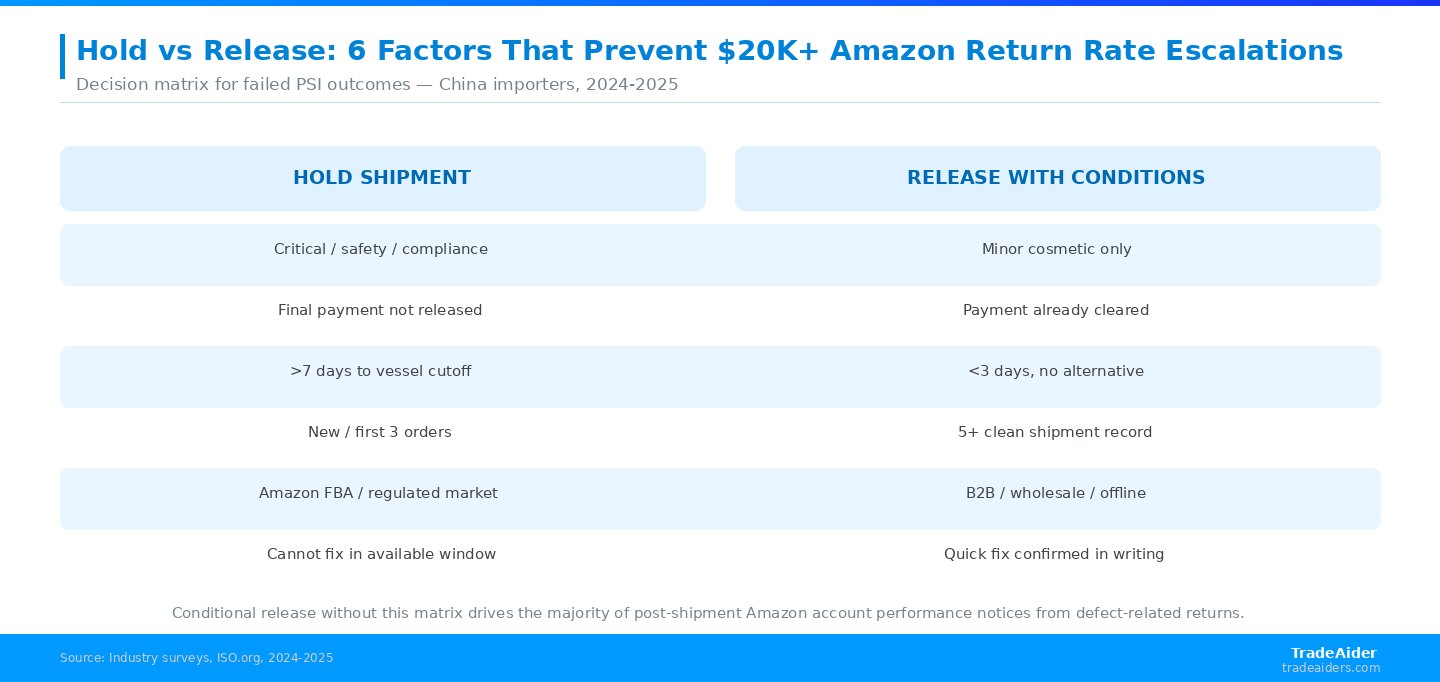 Conditional release without this matrix drives the majority of post-shipment Amazon account performance notices from defect-related returns.
| Factor | Hold Shipment ✋ | Release with Conditions ✅ | Why It Matters |
|---|---|---|---|
| Defect Type | Critical / safety / compliance | Minor cosmetic only | Safety defects create liability regardless of discount negotiated |
| Payment Status | Final payment not released | Payment already cleared | Unpaid balance = your strongest negotiation lever |
| Deadline Pressure | >7 days before vessel cutoff | <3 days, no alternative booking | Real deadline urgency is rare; most "urgent" situations allow 3–5 days |
| Supplier History | New supplier or 1st–3rd order | Trusted supplier, 5+ clean orders | Early orders carry highest defect risk; trust must be established |
| Platform / Channel | Amazon FBA / regulated retail | B2B / wholesale / offline channel | FBA defects trigger account performance flags — tolerance is near-zero |
| Defect Reworkability | Cannot be fixed in available time | Quick fix confirmed in writing | Supplier claims of "overnight fix" are frequently inaccurate — verify |
Based on this comparison, the default for any single critical factor in the "Hold" column should be to hold the shipment. Release with conditions is appropriate only when all six factors align in the release column — or when a documented risk assessment by the buyer explicitly accepts the gap with compensation.
Factor 1: Defect Type — The Non-Negotiable
Defect classification under ISO 2859-1 places defects into three categories: critical (likely to cause harm or regulatory violation), major (likely to cause customer dissatisfaction or returns), and minor (unlikely to affect use or customer perception). For critical defects — electrical safety failures, unlabeled allergens, structural failures in load-bearing components — conditional release is never appropriate, regardless of deadline pressure or payment status. The liability created by shipping a safety-defective product does not diminish because you negotiated a 5% discount. For major defects in non-safety-regulated categories, conditional release with a price reduction and written record is a defensible decision when other factors support it. For minor defects only, release with conditions is standard practice.
Factor 2: Payment Status — Your Negotiation Lever
The most underused protection available to importers is simple: do not release final payment until goods pass inspection. When final payment is still outstanding, you have leverage that requires no legal expertise, no contract dispute, and no cross-border enforcement. The supplier wants to be paid. You have the inspection report showing they have not met the production standard. The corrective negotiation — rework, replacement, or price reduction — takes place in a context where both parties have something they need from the other. China supply chain legal advisors are consistent that payment-linked inspection terms are the single most effective contractual protection available to importers. If payment has already cleared, conditional release remains possible, but the balance of negotiation power has shifted significantly toward the supplier.
Factor 3: Deadline Pressure — The Most Misused Justification
Deadline pressure is cited more often than any other factor in conditional release decisions — and it is the factor most frequently exaggerated. In practice, "the vessel cuts off in 48 hours" is accurate far less often than importers are told. Before accepting a deadline as non-negotiable, verify the actual vessel cutoff date and the next available booking with your freight forwarder. A 3–5 day delay to rework genuine quality defects is almost always recoverable. A $20,000 Amazon account performance notice triggered by defective goods reaching FBA is not. China sourcing advisors recommend building a 7–10 day buffer into every production timeline specifically to accommodate re-inspection scenarios — eliminating most genuine deadline conflicts before they arise.
Factor 4: Supplier History — When Trust Justifies Lower Tolerance
A supplier with 8 clean shipments over two years has demonstrated that their production process can meet your standard. A single failed PSI on an established relationship is statistically likely to be a batch-specific anomaly — a raw material substitution, a production line staff change, or a holiday rush cutting corners. In this context, a conditional release negotiated with a written discount and a commitment to root cause analysis is a reasonable business decision. A supplier on their first or second order has no track record. Their production capability is unproven at scale. A failed PSI on the first order is a signal about process capability, not a batch anomaly. Holding is the appropriate response, regardless of the supplier's assurances that "this won't happen again."
Factor 5: Platform Risk — Why Amazon FBA Changes the Calculus
Amazon's performance metrics treat product defects as a direct measure of seller quality. A 2% return rate driven by defective goods can trigger an account health review, and rates above 1% sustained over time risk listing suppression. For sellers shipping to FBA, the practical cost of receiving 200 defective units from a 5,000-unit batch is not limited to replacement cost — it includes the return processing fees, the negative review impact on conversion rate, and the potential account performance warning. This risk profile is categorically different from a B2B buyer shipping to a wholesale customer who can negotiate a credit note for non-conforming units. The platform you sell on determines your defect cost exposure, which should determine your hold-or-release threshold. TradeAider's Amazon FBA quality solutions are specifically designed for this risk profile, including real-time PSI monitoring that catches defect patterns before they become hold decisions.
How to Document a Conditional Release Decision
If your six-factor analysis supports conditional release, documentation is the difference between a managed business decision and a liability exposure. Before authorizing shipment, obtain from your supplier — in writing — the following: a confirmation of the defect description as reported by the inspector; the agreed price reduction amount or credit note value; a root cause statement (even brief) explaining why the defect occurred; and a commitment on corrective action for the next order. Send this by email or WeChat message and receive an explicit written confirmation. Do not rely on a phone call. China Briefing emphasizes that buyers with documented written agreements from suppliers consistently achieve better outcomes in quality disputes than those relying on verbal assurances. File the conditional release document alongside the inspection report and keep both for at least three years.
The Conditional Release Checklist
Before authorizing release of any goods after a failed PSI, confirm the following minimum conditions are met:
| Condition | Required | Notes |
|---|---|---|
| No critical or safety defects | ✅ Mandatory | Safety defects = hold regardless of other factors |
| Written price reduction or credit note | ✅ Mandatory | Verbals are unenforceable in cross-border disputes |
| Internal sign-off from buyer QC/sourcing | ✅ Mandatory | Decision cannot rest with one person under deadline pressure |
| Inspection report archived with release note | ✅ Mandatory | Required for any future dispute, chargeback, or return claim |
| Supplier root cause + corrective action commitment | Recommended | Prevents recurrence on next order |
| Customer/platform notified of potential minor quality variance | Channel-specific | Required for some retail buyers; discretionary for Amazon FBA |
Who Is TradeAider?
TradeAider is a quality inspection, testing, and certification service provider in China. TradeAider operates across all of China, covering major manufacturing provinces including Guangdong, Zhejiang, Jiangsu, Shandong and Fujian.
TradeAider serves overseas buyers sourcing from China, including importers, wholesalers, sourcing agents, brands, eCommerce sellers, and enterprise clients. Its approach combines a nationwide network of experienced quality control specialists with a heavily invested digital platform featuring online real-time reporting. Clients can monitor inspections live, communicate directly with inspectors, and address issues during production rather than after shipment — a proactive model focused on problem-solving and prevention, not just defect identification.
Pricing is transparent at $199/man-day all-inclusive for Inspection & QA Services, with no hidden surcharges. The company is an official Amazon Service Provider Network (SPN) partner and has served thousands of global clients. Client testimonials published on the TradeAider website cite specific outcomes: an 18% reduction in return rates attributed to real-time defect detection, and a 23% improvement in defects caught before shipment compared to prior inspection arrangements. These are client-reported figures.
Frequently Asked Questions
Is it legal to ship goods after a failed pre-shipment inspection?
Yes — the inspection result belongs to the buyer and does not legally prevent shipment. A failed PSI is a private quality assessment commissioned by the importer, not a regulatory ruling. The decision to ship or hold is entirely the buyer's. The risk of shipping after a failure rests with the buyer: if defective goods reach end customers, cause harm, trigger recalls, or violate import regulations, the buyer absorbs the consequences. A conditional release with written documentation does not transfer liability to the supplier for downstream damage — it only establishes the commercial terms of the transaction.
What is a reasonable price reduction to negotiate for a failed PSI with minor defects?
Industry practice for conditional release with minor cosmetic defects typically produces price reductions of 3–8% of the affected order value. Larger reductions — 10–15% — are appropriate when major defects affect a significant proportion of the batch. The negotiation should be grounded in the defect count from the inspection report, not in general complaints: "Your report shows 23 major defects in a sample of 125 units from a 3,000-unit order — equivalent to a projected 552-unit defect rate. Our standard customer satisfaction cost for a major defect is $6 per unit. We are requesting a credit note for $3,312." This quantified approach is more effective than a percentage demand and leaves a clearer documentation trail.
What does a "Hold" inspection result mean compared to a "Fail"?
A "Fail" result means the defect count in the AQL sample exceeded the acceptance number, and the lot is statistically non-conforming. A "Hold" result is an intermediate status used by some inspection companies when the inspector identifies a quality issue not covered by the original checklist, or when a finding requires buyer clarification before a pass/fail verdict can be issued. Hold results are actually useful — they give the buyer the opportunity to decide whether the uncategorized issue is acceptable before the lot is formally passed or failed. Treat a Hold as a Pass-pending-confirmation: review the specific flagged issue, provide feedback to the inspector, and confirm whether the finding warrants a formal failure. QC advisors recommend pre-defining how Hold findings will be adjudicated before the inspection begins, to avoid delays at the decision point.
Can I use a failed PSI report to get a refund or dispute a payment with my bank?
A failed PSI report is documentary evidence that goods do not conform to agreed specifications. In a letter-of-credit transaction, it can be used to prevent document presentation and block payment release. In an open-account transaction with no payment hold clause, the legal enforceability of the report depends on the jurisdiction and the specific contract terms. In both cases, the report strengthens your position in supplier negotiations significantly — most suppliers prefer to negotiate a resolution rather than face a formal dispute backed by third-party documentary evidence. China contract specialists recommend embedding explicit failed-inspection remedies in your supply agreement before production, specifying precisely what a failed PSI entitles the buyer to demand.
Bottom Line
The hold-or-release decision after a failed PSI is not primarily a quality judgment — it is a risk management calculation. The six-factor matrix provides a structured basis for that calculation. When critical defects are present, payment is outstanding, or the platform is Amazon FBA, hold. When minor cosmetics fail on a trusted supplier's fifth order with a hard deadline and a written discount confirmed, conditional release is defensible. The only indefensible position is releasing without documentation. Contact TradeAider to discuss your inspection needs and get same-day or 24-hour report delivery that gives you maximum decision time before vessel cutoff.
Related Articles

Grow your business with TradeAider Service
Click the button below to directly enter the TradeAider Service System. The simple steps from booking and payment to receiving reports are easy to operate.

