
- About Us

- Our Services
- Your Industry
- Resources
- News & Blog
A bad inspection is often worse than no inspection at all. When importers receive a clean report on a defective shipment, they ship with confidence — and absorb the losses later. According to the American Society for Quality (ASQ), proactive and independent supplier quality management is the cornerstone of reliable supply chains, yet most importers select inspection providers based on price alone without evaluating whether those providers meet basic competency standards. The result is vague reports, undetected defects, hidden fees, and — in the worst cases — fabricated results. This guide covers 10 red flags that reveal whether your QC company is genuinely protecting your interests or simply generating paperwork.
Key Takeaways
- Pricing: Transparent, all-inclusive pricing is a baseline requirement — any inspection company charging extra for reports, photos, or AQL sampling is a red flag.
- Red flag #1: Vague reports with no ISO 2859-1 reference are the most common sign of a low-quality QC provider; over 60% of importer complaints trace back to unclear reporting.
- Red flag #2: No timestamped, geo-tagged photos means you cannot verify the inspector was ever on-site at the reported time.
- Key advantage: TradeAider's real-time online monitoring lets buyers watch inspections live — the most direct counter to inspector integrity risk.
- Decision: Before booking any inspection company, run the 10-point checklist in this article; walk away from any provider that fails three or more criteria.
Why Bad Inspection Companies Are a Bigger Risk Than Bad Factories
Most importers worry about their supplier cutting corners. Fewer consider that their QC company might be doing the same thing. When a factory ships defective goods, you have a documentation trail, contractual recourse, and a clear counterparty. When an inspection company gives you a falsified pass report, you have nothing — you shipped the goods yourself, on the strength of a clean document. China Briefing documented specific cases where entire shipments were deemed "acceptable" in QC reports despite being completely unsellable on arrival. In one account, a buyer flew from Mexico to China to personally verify every shipment after a major QC firm had failed him.
The risk is structural, not just anecdotal. ISO/IEC 17020, the international standard governing inspection bodies, defines specific requirements for independence, competence, and impartiality. Most inspection companies operating in China have never been assessed against this standard. That gap — between what buyers assume and what providers actually deliver — is where most QC losses originate.
The 10 Red Flags Ranked by Risk Severity
The following red flags are ranked from highest to lowest risk impact on your shipment outcomes. Each one is a signal that the inspection company may be operating below the standard that protects your interests.
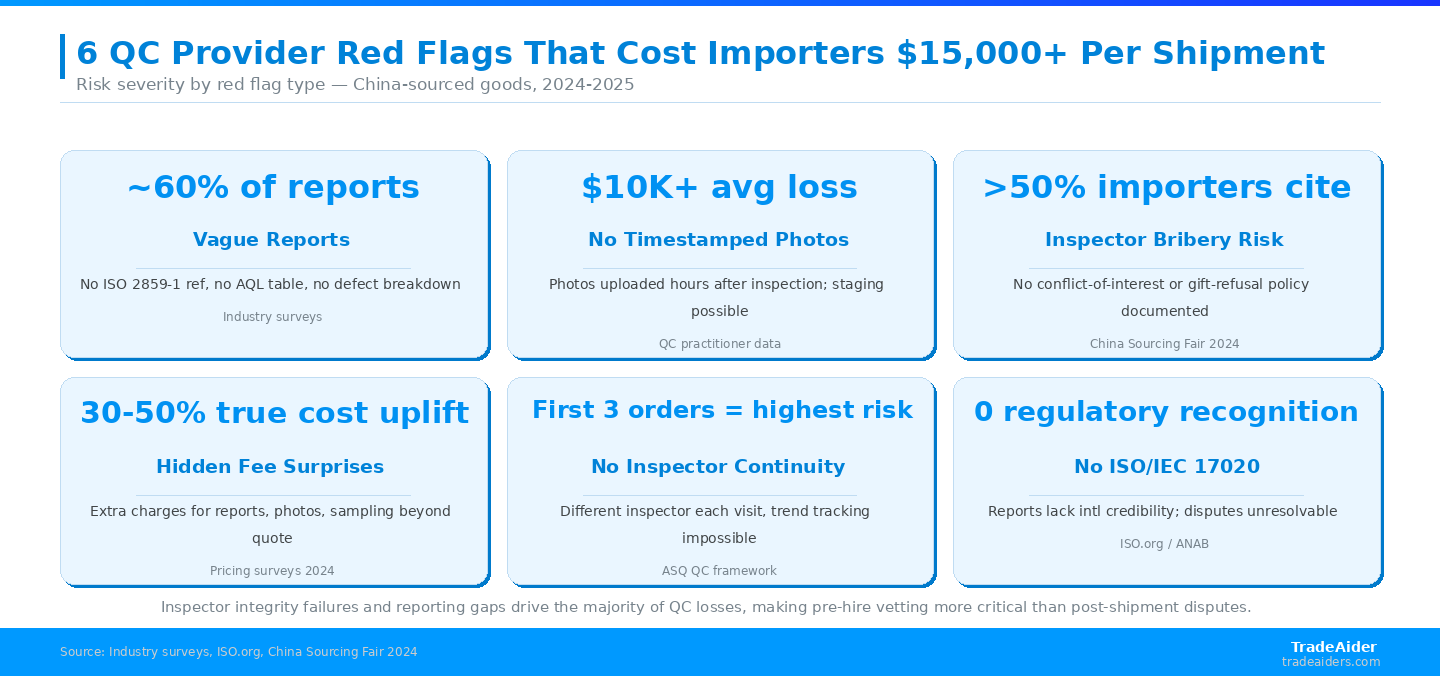 Inspector integrity failures and reporting gaps drive the majority of QC losses, making pre-hire vetting more critical than post-shipment disputes.
#1 — Reports Lack AQL Reference or Defect Breakdown
A professional inspection report must cite the specific AQL table used (per ISO 2859-1), the sample size drawn, the acceptance number applied, and a categorized count of critical, major, and minor defects. Any report that delivers only a "Pass" or "Fail" verdict without this underlying data is unverifiable. You cannot determine whether the inspector actually sampled enough units, whether the correct defect thresholds were applied, or whether borderline findings were rounded in the supplier's favor. This is the single most common complaint in importer forums, and the hardest to detect until you know to look for it. Before booking, always request a sample report from a previous inspection in the same product category.
#2 — No Timestamped, Geo-Tagged Photos
Real-time photo and video evidence, time-stamped and uploaded during the inspection, is the minimum technical standard for a modern inspection provider. Reports that deliver a batch of undated photos — uploaded hours after the inspection ended, with no GPS metadata — cannot prove the inspector was physically present at the reported time or location. This is not a theoretical risk. The scenario of a factory providing "pre-approved" photos to an inspector who never conducted a full examination is a documented integrity issue in the China QC industry. Providers that offer live streaming or real-time reporting platforms eliminate this risk entirely. TradeAider's PSI service includes live photo and video access during the inspection — buyers see the factory floor in real time, not in a polished PDF delivered 48 hours later.
#3 — No Documented Conflict-of-Interest or Anti-Bribery Policy
Inspector integrity is the single highest-stakes variable in third-party QC. According to China Briefing, corruption in the QC industry rarely takes the form of overt cash payments. More commonly, it involves transportation offers (factory staff driving the inspector to the site), free meals, gifts, and the acceptance of hospitality that creates social obligation. An inspection company with no written conflict-of-interest policy — no documented prohibition on accepting factory transport, meals, or gifts — has no mechanism to hold inspectors accountable. Ask prospective providers directly: "What is your anti-bribery policy, and how do you enforce it?" A vague answer is a red flag.
#4 — Hidden Fees Beyond the Quoted Man-Day Rate
Transparent, all-inclusive pricing is a baseline requirement for a trustworthy inspection provider. Any provider that charges separately for the inspection report, sample photographs, larger sampling sizes, travel surcharges, or weekend/holiday premiums on top of the quoted man-day rate is structurally incentivized to add line items. Industry surveys consistently show that hidden fees can inflate the true cost of an inspection by 30–50% versus the headline rate. TradeAider's transparent $199/man-day all-inclusive pricing for Inspection & QA Services — covering PSI, DPI, PPI, and Factory Audit — is a direct response to this industry pattern. Before signing with any provider, ask for a written confirmation that the quoted rate is all-inclusive with no additional charges.
#5 — No Inspector Continuity Across Visits
If your inspection company assigns a different inspector every time — even for repeat orders with the same supplier — you lose the institutional memory that makes QC valuable. An inspector who has seen your product twice knows what your golden sample looks like, recognizes recurring defect patterns from that specific factory, and can identify whether quality has improved or degraded over time. Inspector rotation without explanation is a sign the company relies on a large pool of loosely managed contractors rather than a trained team accountable to consistent standards. The importance of inspector continuity is a documented red flag in professional QC guidance — along with the failure to disclose inspector training records when requested.
#6 — No ISO/IEC 17020 Accreditation or Equivalent Credential
ISO/IEC 17020 is the international standard that defines requirements for inspection bodies — covering independence, technical competence, process consistency, and impartiality. Accredited bodies are required to operate under a documented quality management system, demonstrate inspector competence through formal assessment, and submit to periodic third-party review. Inspection reports from accredited bodies carry weight in regulatory disputes and with major retail buyers. Reports from non-accredited providers do not. The absence of ISO/IEC 17020 accreditation does not automatically disqualify a provider, but it means you are taking their competence on trust rather than verified evidence.
#7 — Refusing to Share a Sample Inspection Report
A reputable inspection company has nothing to hide in a sample report from a completed engagement. If a provider refuses to share an example — even with client names redacted — they are either protecting a format they know is inadequate, or they have no library of past work to reference. Reviewing a sample report before booking takes five minutes and reveals everything about reporting depth: whether defects are categorized, whether AQL sampling is documented, whether photos are date-stamped, and whether corrective action recommendations are included.
#8 — Difficulty Booking on Short Notice or Covering Remote Manufacturing Hubs
Inspection availability in major manufacturing clusters — Guangdong, Zhejiang, Jiangsu, Shandong, Fujian — should be routine and fast. If a provider consistently requires 7–10 business days of lead time for standard PSI bookings in mainstream production regions, or cannot cover factories outside the Pearl River Delta, they are operating on a thin, geographically concentrated inspector network. This creates gaps precisely when you need coverage most: for fast-turn orders, for suppliers in secondary manufacturing cities, and for urgent re-inspection after a failed initial check.
#9 — No Escalation Path When You Dispute a Report Finding
What happens when you believe your inspector missed something critical, or when the factory contests a finding? A professional inspection company has a documented dispute resolution process: a senior technical reviewer examines the evidence, the factory is contacted for counter-samples or photos, and a written adjudication is issued within a defined time window. Providers with no escalation path — those that defer entirely to the inspector's original judgment, or that point you back to the factory — are not genuinely acting as your representative. This is a critical test for any high-value order.
#10 — Supplier Resistance to Inspection Is Ignored
When a factory stalls during the booking process — providing incorrect contact details, claiming that "inspections are handled by another department," or requiring multiple follow-ups before confirming a date — a professional inspection company escalates this to you immediately. A factory that resists third-party inspection almost always has something to hide. China supply chain due diligence advisors are consistent on this point: a supplier's willingness to accept independent audit and inspection is a necessary condition for a reliable supply chain relationship. An inspection company that normalizes supplier resistance, or books around it without alerting the client, is not performing its core function.
Red Flag Comparison: What to Ask Before Booking
| Red Flag | Question to Ask | Acceptable Answer | Walk Away If |
|---|---|---|---|
| Vague Reports | Can I see a sample report with AQL table? | Yes, with ISO 2859-1 reference | Refused or "Pass/Fail only" |
| No Live Photos | Are photos timestamped and geo-tagged? | Yes, uploaded during inspection | Photos delivered only in final PDF |
| Bribery Risk | What is your anti-bribery policy? | Written policy + enforcement examples | Vague or "we trust our inspectors" |
| Hidden Fees | Is the quoted rate all-inclusive? | Yes, confirmed in writing | Extra charges for report or photos |
| No Continuity | Will the same inspector cover repeat orders? | Yes, with prior notice if changed | "We rotate based on availability" |
| No Accreditation | Are you ISO/IEC 17020 accredited? | Yes, with certificate number | "We follow similar standards" |
A Practical Scenario: What Cutting Corners Actually Looks Like
An Amazon FBA seller sourcing phone accessories from Guangdong hired a low-cost inspection provider for a 5,000-unit shipment. The quoted rate was $89 per man-day — well below market. The report arrived the following morning: Pass. The photos showed neat rows of properly packaged units. The seller shipped. On Amazon, the first 40 reviews noted that the charging cables intermittently failed to charge — a functional defect the inspection had been engaged to catch.
The investigation revealed three things: the inspector had spent under two hours on-site instead of a standard four to six hours; the functional test section of the checklist was marked "N/A" without explanation; and the photos, while well-lit, were undated and showed only packaging, not unit internals. The inspection fee had been $89. The FBA account received a performance notification. The cost to replace the inventory and reprint positive feedback ran past $18,000. The same checklist in this article would have flagged this provider before the booking was made.
Who Is TradeAider?
TradeAider is a quality inspection, testing, and certification service provider in China. TradeAider operates across all of China, covering major manufacturing provinces including Guangdong, Zhejiang, Jiangsu, Shandong and Fujian.
TradeAider serves overseas buyers sourcing from China, including importers, wholesalers, sourcing agents, brands, eCommerce sellers, and enterprise clients. Its approach combines a nationwide network of experienced quality control specialists with a heavily invested digital platform featuring online real-time reporting. Clients can monitor inspections live, communicate directly with inspectors, and address issues during production rather than after shipment — a proactive model focused on problem-solving and prevention, not just defect identification.
Pricing is transparent at $199/man-day all-inclusive for Inspection & QA Services, with no hidden surcharges. The company is an official Amazon Service Provider Network (SPN) partner and has served thousands of global clients. Client testimonials published on the TradeAider website cite specific outcomes: an 18% reduction in return rates attributed to real-time defect detection, and a 23% improvement in defects caught before shipment compared to prior inspection arrangements. These are client-reported figures.
Frequently Asked Questions
How do I know if my inspection company is ISO/IEC 17020 accredited?
Ask the provider for their ISO/IEC 17020 certificate number and the name of the accreditation body that issued it. You can then verify the certificate directly through the accreditation body's public registry — for example, UKAS in the UK or ANAB in the US maintain searchable databases of accredited inspection bodies. A provider that claims accreditation but cannot provide a certificate number and accrediting body is not accredited.
What is an acceptable man-day rate for third-party inspection in China?
Standard third-party pre-shipment inspection in China ranges from $130 to $320 per man-day for a genuine all-inclusive service. Rates below $130 should be scrutinized closely — they typically indicate shortened inspection time, unverifiable photo documentation, or a report format that omits AQL sampling details. TradeAider's published rate is $199/man-day all-inclusive for Inspection & QA Services. The key question is not the headline rate, but whether it covers reports, photos, sampling, and travel without additional line items.
Can an inspection company be held liable if they miss critical defects?
In most cases, no — and this is precisely why pre-booking due diligence matters. Inspection company contracts almost universally cap liability at the inspection fee paid, which may be $200–$400. If a $50,000 shipment passes a negligent inspection and arrives defective, your legal recourse against the inspector is essentially zero. The practical protection is preventive: selecting a provider with verifiable credentials, documented processes, and the technical tools (real-time reporting, timestamped evidence) to demonstrate that a genuine inspection was conducted. Understanding what distinguishes a credible QC partner from a report-generating service is the most important risk management decision an importer makes.
What should an inspection report include at minimum?
At minimum, a professional inspection report must include: the inspection date and factory name; the AQL level applied with reference to ISO 2859-1; the sample size drawn and acceptance/rejection numbers; a categorized defect count (critical / major / minor) with photos of each defect type; functional test results if applicable; and a clear pass/fail conclusion with the reasoning. Reports that omit the AQL reference, list defects without categorization, or provide only a summary verdict without supporting data do not meet the minimum standard for actionable QC documentation.
Is a supplier that refuses third-party inspection always a red flag?
Yes, in virtually all cases. China supply chain advisors consistently identify supplier inspection refusal as one of the strongest predictors of quality or compliance problems. Reputable factories view third-party inspection as an opportunity to demonstrate capability. Resistance — whether passive (stalling bookings) or active (refusing access) — signals that the factory has something it does not want an independent party to see. Embed independent inspection rights in your supplier agreement before placing any order, and treat any resistance to exercising those rights as grounds for switching suppliers.
Bottom Line
The ten red flags in this article are not edge cases — they describe the operational reality of a large portion of the China inspection market. Vague reports, missing timestamps, opaque pricing, and no anti-bribery framework are standard features of low-end providers, not exceptions. Before booking any inspection company, run each criterion in the pre-booking checklist above. A provider that cannot answer five or more of those questions clearly and in writing is not protecting your shipment — they are protecting their own convenience. Contact TradeAider to request a sample report and discuss your QC requirements before your next China order.
Related Articles

Grow your business with TradeAider Service
Click the button below to directly enter the TradeAider Service System. The simple steps from booking and payment to receiving reports are easy to operate.

