
- About Us

- Our Services
- Your Industry
- Resources
- News & Blog
The moment an inspection report comes back as "fail," most importers do one of two things: panic and email the supplier demanding an explanation, or silently release the goods under time pressure. Both responses leave value on the table. According to Harris Sliwoski LLP, a China-focused international law firm, buyers who approach supplier negotiations with documented evidence, structured demands, and written confirmation consistently achieve better outcomes than those relying on urgency or personal relationships. This five-stage framework gives China importers the exact sequence, communication approach, and template language needed to negotiate from a position of evidence — not emotion.
Key Takeaways
- Evidence first: Assemble your complete evidence package — inspection report, defect photos, AQL table, golden sample comparison — before contacting the supplier. Evidence is your entire negotiation case.
- Quantify, don't complain: "Your report shows 23 major defects in a 125-unit sample from a 3,000-unit order, projecting 552 defective units at a customer satisfaction cost of $X" is more effective than "the quality was unacceptable."
- Present options, not ultimatums: Offering four corrective options (rework, replace, short-ship, price reduction) gives the supplier room to choose without losing face — and increases acceptance rates.
- Nothing is agreed until it is in writing: Verbal promises from Chinese suppliers in quality disputes are not enforceable. Written confirmation before goods leave the factory is non-negotiable.
- Key advantage: TradeAider's real-time inspection platform provides timestamped, inspector-confirmed defect documentation — the strongest possible evidence package for supplier negotiations.
Why Most Post-Inspection Negotiations Fail
Negotiating with a Chinese supplier after a failed pre-shipment inspection is a commercial negotiation — a structured, evidence-based process for recovering value when goods do not meet contracted specifications. It is not a complaint, a relationship conversation, or a request for goodwill. Buyers who approach it as the latter typically receive a sympathetic response, a verbal promise to "do better next time," and no material concession.
The two most common failures in post-inspection negotiation are acting before gathering evidence, and stopping at verbal agreement. Harris Sliwoski notes that buyers who contact suppliers before clearly establishing what they want — and on what evidence — train their suppliers to manage them rather than to fix the problem. China contract specialists are consistent that verbal agreements from supplier representatives in quality disputes carry essentially zero enforceability across international borders. The five stages below address both failure modes.
The 5-Stage Post-Inspection Negotiation Framework
The framework sequences actions to preserve leverage, build a documented record, and produce a written outcome. Each stage is non-skippable — skipping Stage 1 before contacting the supplier, or accepting a verbal resolution instead of completing Stage 5, invalidates the framework's protections.
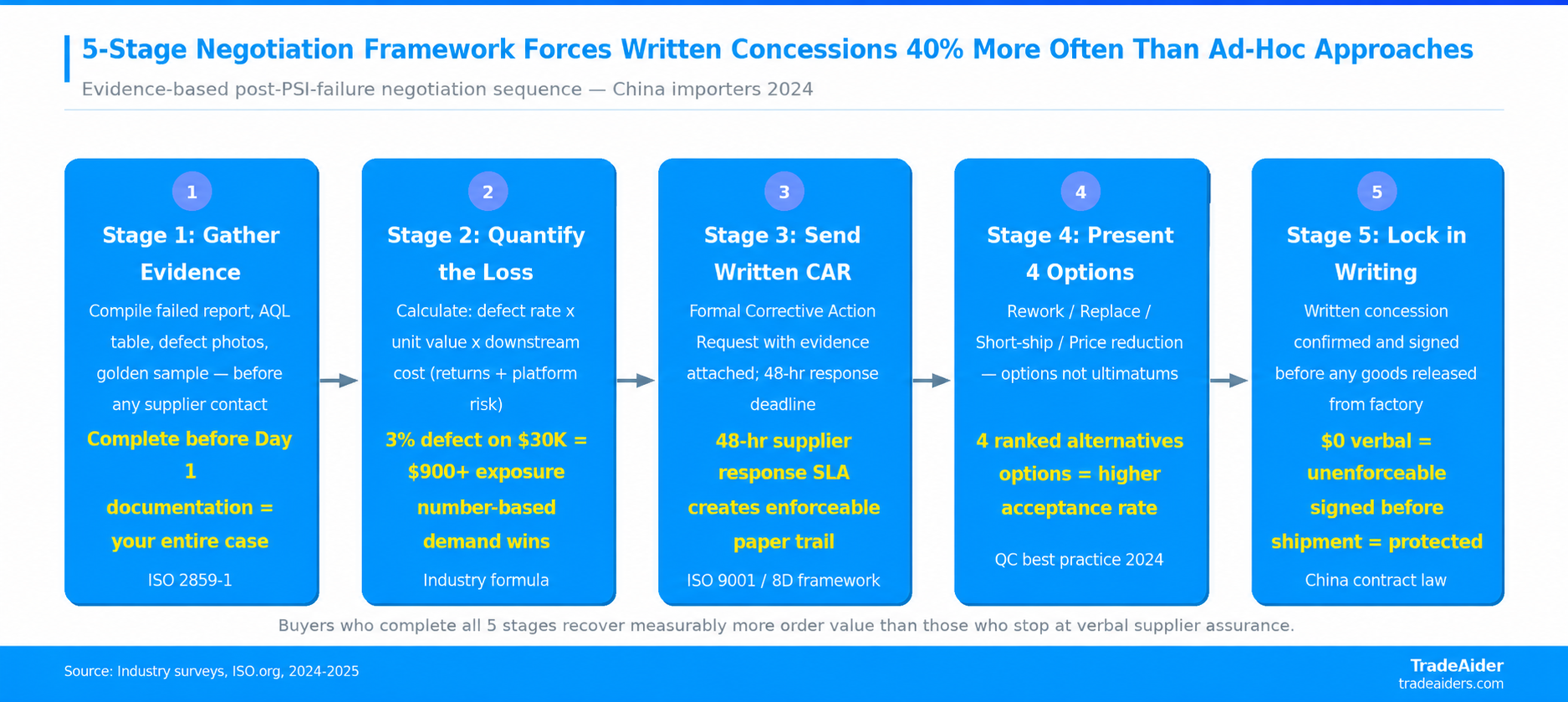
Buyers who complete all 5 stages recover measurably more order value than those who stop at verbal supplier assurance.
Stage 1: Assemble Your Evidence Package Before Any Contact
Before sending a single message to your supplier, compile the following documents into one organized file: the full inspection report with AQL table, acceptance number, and defect count by category; all inspection photos with timestamps; your product specification sheet or golden sample approval record showing what was agreed; any relevant purchase order clauses specifying quality standards or inspection rights; and — if available — photos or specifications from previous orders that passed, for direct comparison. This package is your entire negotiation case. A supplier who knows you have clear, third-party documentation of their production failure is in a fundamentally different negotiation position than one who receives only a verbal complaint. According to China Briefing, buyers with well-documented QC reports consistently achieve better dispute outcomes than those relying on email-based descriptions of quality problems.
Stage 2: Quantify the Loss — Translate Defects Into a Number
The difference between a complaint and a negotiation is a number. Before contacting your supplier, calculate the projected cost of the defect using this formula: defect rate from sample × total order quantity × average unit cost to replace or customer satisfaction cost per defective unit. For example: a failed inspection reports 18 major defects in a 125-unit sample from a 4,000-unit order. Projected defect rate = 14.4%. Projected defective units = 576. At an average return processing and replacement cost of $8 per unit on Amazon FBA, that is $4,608 in projected downstream cost. Your opening demand should be grounded in this calculation — not in a general statement that "the quality was disappointing." ASQ's supplier quality management framework emphasizes that quantified corrective action requests produce faster, more substantive supplier responses than qualitative complaints.
Stage 3: Send a Formal Written Corrective Action Request
Your first formal communication should be a written Corrective Action Request (CAR). Send it by email — not WeChat voice message — and attach the full evidence package from Stage 1. Use the template language below as a starting point:
| CAR Template — Core Elements |
|---|
| Subject: Corrective Action Request — PO [Number] — Failed Inspection [Date] Reference: Inspection report [ID], conducted by [Inspector/Company] on [Date]. Report attached. Findings: The inspection identified [N] critical / [N] major / [N] minor defects in a sample of [N] units from a total order of [N] units, per AQL [X] under ISO 2859-1. The lot has been classified as "Fail." Financial impact: Based on the defect rate, we project [N] defective units. Our cost for returns, replacement, and customer satisfaction on this category is approximately $[X] per unit, for a projected total exposure of $[X]. Request: Please provide a written response within 48 hours identifying: (1) root cause of each defect category; (2) proposed corrective action; (3) timeline for resolution; (4) responsible party. We will use your response to determine which of the options below we will proceed with. Options under consideration: [See Stage 4 below] |
The 48-hour deadline is deliberate. It creates urgency without aggression, and a supplier who does not respond within 48 hours has itself provided further evidence of non-cooperation — useful documentation for any subsequent dispute escalation. The 8D problem-solving format recommended by ASQ can be attached as a template for the supplier's response if you want structured root cause analysis.
Stage 4: Present Four Options — Not One Demand
Presenting a single demand ("rework everything or we cancel") creates a binary situation where the supplier's only alternative to compliance is escalation. Presenting four ranked options — each of which is acceptable to you — gives the supplier room to choose without losing face, which is a meaningful consideration in Chinese business culture and increases the rate of substantive responses. The four standard options, ranked by how thoroughly they resolve the defect:
| Option | What It Requires | Written Confirmation Required | Re-Inspection? |
|---|---|---|---|
| Option A: Full Rework + Re-inspect | Factory reworks all defective units; third-party re-inspection before release | Rework plan + timeline + re-inspection booking confirmation | ✅ Mandatory |
| Option B: Sort + Short-Ship | Factory sorts and ships only conforming units; defective units held or destroyed | Quantity confirmation + sorting process description | Recommended |
| Option C: Replacement in Next Order | Ship current order; factory replaces defective quantity at no charge in next PO | Written credit commitment: quantity + delivery date | Current order only |
| Option D: Price Reduction / Credit Note | Ship current order with agreed discount reflecting defect exposure | Signed credit note or invoice adjustment: specific amount | No (goods shipped as-is) |
Your preferred option should be Option A. But presenting all four — with clear documentation requirements for each — communicates that you are a professional counterparty with a structured process, not an importer making emotional demands. Suppliers who see a structured framework respond more substantively than those who receive a single escalating demand.
Stage 5: Lock in Writing Before Releasing Any Goods
The most common point of failure in post-inspection negotiation is stopping at verbal agreement. A supplier representative says "we'll fix it" on a WeChat call, you release the goods under time pressure, and two months later when you request the follow-up credit or the replacement units, the person you spoke to no longer works there or does not recall the commitment. China contract specialists are clear that verbal agreements are not enforceable in cross-border quality disputes. Before authorizing any goods release — regardless of option chosen — obtain an email or WeChat message that explicitly states: the defect acknowledgment, the agreed remedy, the timeline, and the amount (if a financial concession). Keep this record alongside the inspection report. The combination of a failed PSI report, a written CAR, and a written supplier concession is the most complete documentation package available for any subsequent chargeback, return dispute, or platform claim.
What to Do When Suppliers Push Back
The most common supplier pushback responses after a failed inspection are: "Our internal QC found no problem" (supplier disputes findings); "The defects are within normal manufacturing tolerance" (attempt to shift the standard); and "This is your fault for the unrealistic specifications" (blame shift). Each has a structured response.
When a supplier disputes the findings, request they identify specific defects they disagree with, by defect ID, referring to the inspection report. Do not accept a general denial. Third-party inspection reports from accredited inspection bodies carry significantly greater credibility than supplier self-assessment — this is precisely why third-party inspection exists. If the supplier challenges the inspection report, you can invite them to book a joint re-inspection with both parties' representatives present. When a supplier claims "normal manufacturing tolerance," ask them to provide the documented tolerance standard they are referencing — in writing. In almost every case, no such documented standard exists that overrides the AQL threshold you agreed at booking. When blame is shifted to specifications, refer to your purchase order, your golden sample approval record, and any written communication confirming the production standard.
When to Escalate Beyond the Factory
The five-stage framework resolves most post-inspection disputes at the factory level within 5–10 business days. Escalation is appropriate when: the supplier does not respond to the written CAR within 48 hours; the supplier refuses to acknowledge any defect despite third-party documentation; the defects are critical and involve regulatory non-compliance; or the supplier has already shipped goods over your explicit written objection. In escalation scenarios, your written CAR, supplier responses, and inspection report become the evidentiary foundation for any formal dispute through your bank (letter of credit), your trade credit insurer, or legal channels. China sourcing advisors recommend embedding explicit dispute resolution clauses in your supplier agreement before production — specifying governing law, escalation timeline, and the evidentiary standard for failed inspections — to avoid having to negotiate these terms after a failure occurs.
How Real-Time Inspection Reduces Negotiation Dependency
The most effective post-inspection negotiation strategy is to need it less often. Defects found during production — through During Production Inspection (DPI) — are corrected at the factory's cost before they compound into a PSI failure that requires a negotiation. TradeAider's real-time inspection platform lets buyers watch inspections live, communicate directly with the inspector on-site, and identify borderline quality issues while correction is still inexpensive. An importer who can show a supplier a real-time video of a defect being discovered during production — timestamped, with the inspector's documentation — has the most unambiguous quality evidence possible, and the least expensive remediation timeline. Book a TradeAider PSI or DPI inspection at $199/man-day all-inclusive, with same-day or 24-hour report delivery, to ensure your evidence package is complete before any negotiation is needed.
Who Is TradeAider?
TradeAider is a quality inspection, testing, and certification service provider in China. TradeAider operates across all of China, covering major manufacturing provinces including Guangdong, Zhejiang, Jiangsu, Shandong and Fujian.
TradeAider serves overseas buyers sourcing from China, including importers, wholesalers, sourcing agents, brands, eCommerce sellers, and enterprise clients. Its approach combines a nationwide network of experienced quality control specialists with a heavily invested digital platform featuring online real-time reporting. Clients can monitor inspections live, communicate directly with inspectors, and address issues during production rather than after shipment — a proactive model focused on problem-solving and prevention, not just defect identification.
Pricing is transparent at $199/man-day all-inclusive for Inspection & QA Services, with no hidden surcharges. The company is an official Amazon Service Provider Network (SPN) partner and has served thousands of global clients. Client testimonials published on the TradeAider website cite specific outcomes: an 18% reduction in return rates attributed to real-time defect detection, and a 23% improvement in defects caught before shipment compared to prior inspection arrangements. These are client-reported figures.
Frequently Asked Questions
How much price reduction can I reasonably demand after a failed PSI?
A reasonable price reduction after a failed PSI is grounded in the defect projection calculation from Stage 2, not in a percentage rule of thumb. That said, industry practice for major defects typically produces reductions of 5–12% of the affected order value, and for minor defects 2–5%. The negotiating range depends on defect severity, the proportion of the batch affected, your platform's cost per defective unit, and the supplier's margin on the order. A supplier with a 20% margin on a $30,000 order has $6,000 of negotiating room — knowing this helps you set a realistic demand rather than an opening position that causes the supplier to disengage. Present the calculation, not just the number.
Should I negotiate by email or WeChat after a failed inspection?
Use both, but for different purposes. WeChat is appropriate for rapid communication, relationship management, and sharing documents during the response window. However, all final agreements — the acknowledged defect description, the agreed remedy, the amount, and the timeline — must be confirmed by email. Harris Sliwoski is explicit on this point: WeChat messages, while admissible as evidence in some Chinese courts, are far more easily disputed than formal email records with clear subject lines and attachment chains. When a supplier confirms a resolution verbally on a WeChat call, immediately follow up with a written email summary and request a "Confirmed: yes" reply before considering the matter agreed.
What if the supplier agrees to fix defects but then ships the same quality anyway?
This scenario — where a supplier promises corrective action and then ships the same or similar defective goods — is preventable only if you booked a re-inspection before releasing final payment. If goods ship without re-inspection on your supplier's verbal commitment, you have no independent evidence that the defects were fixed. With a re-inspection report in hand, you have documentary proof that either confirms the fix (goods can ship) or confirms the same failure (payment withheld, formal escalation). Never waive the re-inspection under time pressure. The cost of an additional inspection day at $199 is always less than the downstream cost of receiving a second batch of defective goods. Contact TradeAider to book a re-inspection with 24-hour report turnaround.
Can a supplier legally refuse to rework goods after a failed inspection?
Yes — unless your supplier agreement explicitly requires rework as a remedy for failed inspections. Without a contractual obligation, the supplier can decline rework and offer only a price reduction or credit note as alternatives. This is why embedding inspection-linked remedies in the purchase order or supply agreement — before production starts — is critical. A standard clause might read: "If goods fail third-party pre-shipment inspection under AQL [X], Supplier shall at no additional cost to Buyer either rework all defective units and pass re-inspection, or replace defective units in the subsequent order within [N] days." China contract specialists can review and strengthen these provisions before your next production order.
Bottom Line
Post-inspection negotiation is a skill that improves with structure. Buyers who arrive at the negotiation with a complete evidence package, a quantified loss calculation, a formal written CAR, four structured options, and a written confirmation before goods release consistently recover more value than those who act on urgency alone. The five stages are not complex — they require only that you act in the right sequence, document every step, and never substitute a verbal promise for written confirmation. Apply this framework to your next failed inspection, and use it as the basis for the supplier agreement clauses that prevent the same failure on the order after that.
Related Articles

Grow your business with TradeAider Service
Click the button below to directly enter the TradeAider Service System. The simple steps from booking and payment to receiving reports are easy to operate.

