
Holiday string lights are one of the highest-risk SKUs an Amazon FBA seller or importer can source from China — not because production is complex, but because two easily overlooked defects account for the majority of returns, negative reviews, and CPSC compliance actions: failed wire pull strength at bulb connections, and excessive leakage current through compromised insulation. Either defect can reach your customer undetected if you rely on supplier self-reporting alone. A single contaminated shipment can push your Amazon return rate above the 5% threshold and trigger listing suspension during your peak sales window. This guide explains exactly what third-party inspectors check, what standards apply, and how to structure your pre-shipment inspection to catch both hazards before goods leave the factory.
Key Takeaways
- Wire pull strength and leakage current are the two critical defect categories that cause the most product recalls and return disputes for string lights imported from China. Both must be explicitly included in your inspection checklist.
- Verify certification marks such as "UL LISTED" or "ETL LISTED" on the cord or plug during factory inspection. Logo-only printing without the full listing mark text is a non-conformity that disqualifies the product from the US market.
- Wire pull strength failure is a critical defect under AQL classification. A wire that moves or detaches under steady hand pressure at the socket indicates a structural crimping failure that your factory must correct before shipment.
- Leakage current must not exceed 0.25 mA under wet conditions per UL 588. Uncertified products from unverified factories typically measure 1.8 to 4.3 mA — up to 17 times the safe limit — creating real liability exposure for the importer.
- Pre-shipment inspection (PSI) conducted at the factory before goods are packed into containers is the most cost-effective intervention point. Defects corrected at the factory cost a fraction of what a return, re-shipment, or CPSC recall costs once goods have landed.
Certification Verification During Factory Inspection
Why Certification Marks Are an Inspection Item, Not a Given
Many importers assume that because they specified UL or ETL certification in their purchase order, the goods will arrive compliant. In practice, factories sometimes apply look-alike marks or abbreviations that do not represent a valid listing. Inspectors check for the complete listing mark text on cord or plug labels, confirm the rated application (indoor vs. outdoor) matches the order specification, and verify that wattage and maximum linked-set counts are printed. Outdoor-rated lights must explicitly state outdoor or all-weather use; indoor-only products lack UV-stabilised plastics and sealed socket entries, making them unsuitable for outdoor retail customers and potentially exposing you to product liability claims.
| Certification Mark | NRTL in US? | Tests to UL 588? | Key Point |
|---|---|---|---|
| UL Listed | Yes | Yes | Most widely accepted by US insurers, retailers, and fire marshals |
| ETL Listed | Yes | Yes | Same technical requirements as UL; lower consumer brand visibility but fully compliant |
| CE Mark | No | No | Self-declared EU conformity; insufficient for US market; no mandatory third-party verification for most seasonal lighting |
Physical Hazards Inspectors Flag at the Factory
Beyond the label check, inspectors examine the production batch for installation-related hazards that suppliers sometimes overlook or consider within tolerance: connecting points designed to exceed the manufacturer's maximum linked-set count, cord-through-connector geometry that allows pinching and insulation wear during use, and indoor-rated products packed in mixed lots with outdoor-rated SKUs. Heat buildup from undersized wire or tightly-wound cord near connectors is another recurring factory-level defect. Ground-fault circuit interrupter (GFCI) outlet compatibility should also be confirmed for outdoor-rated products destined for the US market.
Wire Pull Strength Testing
Why Wire Pull Strength Is a Critical Defect Category
Wire pull strength describes the force a wire connection can withstand before separating from its socket or crimp terminal. In mass-produced decorative lighting from Chinese factories, this connection is typically formed by a brass crimp or piercing contact. If the crimp is undersized, corroded, or improperly formed on the production line, the connection will fail under even light mechanical stress during normal customer installation or removal. A detached wire does not merely cause a dead bulb; the exposed conductor and socket contact can arc against each other, generating heat capable of igniting nearby combustible materials. This is why wire pull failures are classified as critical defects under AQL sampling, requiring zero acceptance.
Pull Test Procedure
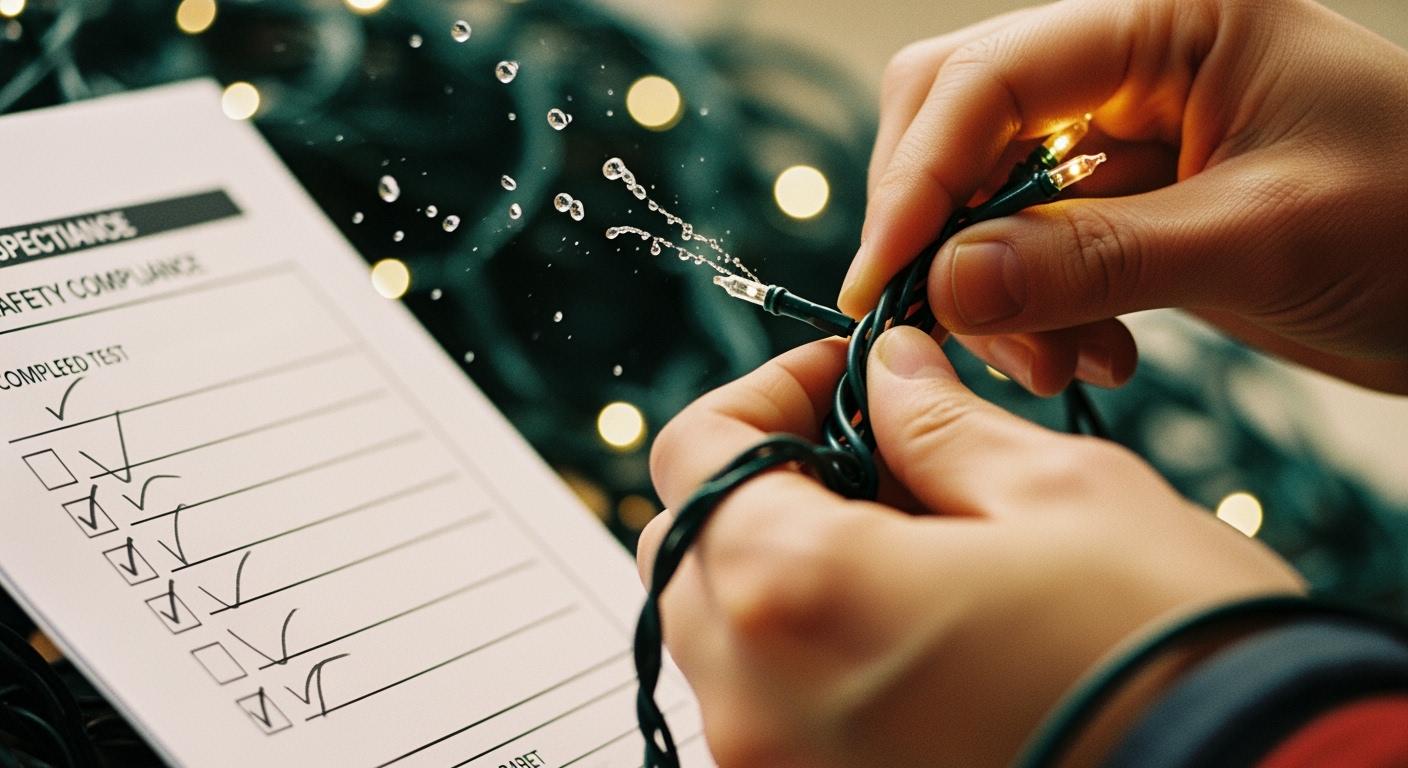
The field test procedure requires no specialised tools, making it practical to execute on a sampled lot at the factory during pre-shipment inspection. The inspector grips the wire approximately 2 cm from the socket — not at the bulb — and applies steady, gradually increasing pressure directly in line with the wire's exit angle from the socket. The wire must not shift, rotate, or separate from the socket under this force. The test is repeated at every bulb and connector across all sampled units.
- Unplug the strand before testing (all inspection is conducted on unpowered units).
- Hold the wire 2 cm from the socket, parallel to the exit angle.
- Apply steady, increasing pressure without jerking.
- Check for any movement, rotation, or separation at the crimp point.
- Repeat at every bulb and connector; document all failures with photos in the inspection report.
Identifying and Responding to Pull Strength Failures
The following symptoms indicate wire pull strength failure or imminent failure: inconsistent brightness across the strand (caused by high-resistance connections), intermittent flickering (poor contact causing arcing), warm or hot spots along the cord (localised resistance heating), brittle or cracked insulation near connectors (thermal degradation from prior arcing), and burn marks or brown residue at connection points. Any sampled unit displaying these symptoms must be classified as a critical defect. If the defect rate exceeds your AQL critical acceptance number, the entire lot must be held for 100% re-inspection, rework, or replacement before shipment is authorised.
Alert: Wire pull strength failure and burn marks near connectors represent an active fire risk. Lots with confirmed critical defects above the AQL acceptance threshold must not be shipped.
Anti-Leakage and Electrical Safety Testing
Understanding Leakage Current and Importer Liability
Leakage current is the unintended flow of electricity through degraded insulation from a live conductor to an accessible surface or to ground. In dry conditions, even poorly insulated lights may show low leakage. Under wet conditions — rain, dew, or condensation — compromised insulation allows significantly more current to flow across the surface of the cord or into water pooling around connectors. UL 588 sets the maximum acceptable leakage at 0.25 mA under wet conditions. As the importer of record, you are legally responsible for product safety compliance regardless of what your supplier's documentation states. Uncertified products imported without third-party verification often measure 1.8 to 4.3 mA — up to 17 times the safe limit — creating real risk of fatal electric shock and direct liability exposure for your business.
Leakage Test Procedure
Third-party inspectors use a digital multimeter and, where specified, a 500V insulation resistance tester (megohmmeter) to evaluate sampled units from the production lot. The following procedure identifies open circuits, failed bulbs, and insulation breakdown points:
- Confirm the strand is unpowered. Lay it flat and untangle fully.
- Set the multimeter to continuity mode (speaker symbol) or lowest ohms setting.
- Touch probes together to verify meter function — expect a beep or near-zero resistance reading.
- Test the plug: insert one probe into each pin slot. Continuity confirms the circuit is intact from plug to end; absence of continuity indicates a break in the main circuit.
- Isolate faults by removing bulbs sequentially and testing continuity across each socket contact and the next bulb's metal tab, moving down the strand until continuity stops.
- Test suspect bulbs individually: probes on the metal base and side contact. Resistance of 5 to 20 ohms indicates a good filament; infinite resistance indicates a blown bulb.
For insulation resistance, a 500V megohmmeter is used. Readings below 1 megohm at 500V indicate compromised insulation. Lots with insulation resistance failures must be rejected.
Tip: Leakage testing should always be specified in your inspection checklist before engaging a third-party inspector. Default inspection packages may not include electrical safety testing unless you request it explicitly.
Zero-Tolerance Policy for Leakage Above Limit
Any sampled unit measuring leakage above 0.25 mA during wet-condition testing is classified as a critical defect. Zero-tolerance means the lot cannot ship until the root cause (typically insulation material substitution or improper extrusion thickness) is identified and corrected at the factory level. Professional inspection services using thermal imaging cameras can identify leakage hot spots along a strand that are not detectable with a standard multimeter, which is particularly important for large production lots where surface-level sampling may miss localized insulation failures.
Compliance Standards and Critical Defect Management
Key Requirements Under UL 588 and CPSIA That Inspectors Verify
Beyond leakage current limits, UL 588 and the Consumer Product Safety Improvement Act (CPSIA) impose specific structural requirements. The following table summarises the critical requirements most frequently cited in CPSC enforcement actions against importers:
| Requirement | Specification |
|---|---|
| Minimum Wire Size (Series) | 20 or 22 AWG for series-connected products |
| Minimum Wire Size (Parallel) | 18 or 20 AWG for parallel-connected products |
| Overcurrent Protection (Polarized Plug) | Minimum 1 fuse required in the plug |
| Overcurrent Protection (Non-Polarized) | Minimum 2 fuses required |
| Strain Relief | Sufficient strain relief at all cord entry points to prevent wire damage from pulling |
| Max Outlet Load | Total connected wattage must not exceed 1,800 W per circuit |
Defect Classification and Reporting Protocol
When a critical defect is identified during pre-shipment inspection, the protocol requires the inspector to stop the inspection count for that defect category, preserve photographic evidence of all affected units, and issue a hold recommendation on the lot. The inspection report should document defect location, type, affected unit count, and whether the defect rate exceeds the AQL critical acceptance number. For importers selling on Amazon, this report also serves as documentation if a product safety complaint is later filed — demonstrating that a third-party inspection was conducted and documented before shipment significantly strengthens your position with both Amazon and CPSC if a complaint arises. Professional inspection services also provide thermal imaging documentation for overloaded circuits and emerging hot spots that a visual check alone would miss.
Structuring Your Pre-Shipment Inspection Checklist
What to Include When Ordering a PSI for String Lights
A general pre-shipment inspection that does not explicitly specify electrical safety testing will typically cover workmanship and packaging only. For holiday string lights, you must instruct your inspection provider to include the following as minimum requirements: full visual inspection of all sampled units including insulation condition, socket integrity, plug pin condition, and fuse presence; wire pull strength test at every socket on all sampled units; leakage current measurement using a calibrated digital multimeter; certification mark verification against purchase order specifications; and carton and packaging check confirming rated application and wattage are correctly labelled.
Note: Request that your inspection report includes photos of the wire pull test being performed, the multimeter display during leakage testing, and close-ups of the certification mark on sampled units. This provides verifiable documentation of compliance, not just a pass/fail summary.
AQL Sampling and Defect Classification for String Lights
For holiday string lights, the recommended AQL classification for a standard pre-shipment inspection is: wire pull failure and leakage above 0.25 mA as critical defects (AQL 0, zero acceptance); missing or incorrect certification mark, missing fuse, and insulation damage as major defects (AQL 2.5); and cosmetic issues such as minor cord discolouration or packaging print quality as minor defects (AQL 4.0). Your inspection provider should confirm the AQL levels and inspection level (typically General Inspection Level II per ANSI/ASQ Z1.4-2008) before beginning the inspection.
FAQ
When is the best time to conduct inspection on a string lights order from China?
Pre-shipment inspection (PSI) is conducted when at least 80% of production is complete and goods are being packed. This is the most cost-effective intervention point — defects identified before loading can still be corrected at the factory. For large orders or new suppliers, a during-production inspection (DPI) at approximately 20–30% production completion catches tooling and material issues before the full batch is affected.
What tools are needed for wire pull strength and leakage testing during factory inspection?
Wire pull strength requires no specialised tools — steady hand pressure near the socket is the field standard. Electrical leakage and circuit continuity testing requires a calibrated digital multimeter. For insulation resistance testing, a 500V megohmmeter provides definitive results. Professional inspections may also use thermal imaging cameras to detect overloaded circuits and hot spots not visible to the naked eye, which is particularly valuable for large commercial orders.
Why do UL and CE marks matter, and are they equivalent for the US market?
UL Listed and ETL Listed marks indicate third-party testing and verification by a US Nationally Recognised Testing Laboratory (NRTL) against UL 588 requirements. CE marking is a manufacturer self-declaration of EU conformity that does not require independent lab verification for most seasonal lighting products. For products sold in the US market, UL or ETL listing is required. CE marking alone is not acceptable and will not protect you from CPSC enforcement action if the product causes injury.
What should an importer do if the inspector finds critical defects?
Do not authorise shipment. Issue a formal hold on the lot and require the factory to conduct 100% rework or replacement of the affected units before requesting a re-inspection. Obtain a written corrective action report from the factory explaining the root cause and the corrective measures taken. Authorise shipment only after a follow-up inspection confirms the defect has been resolved across the full lot. Documented corrective action also provides evidence of due diligence if a product complaint arises after the goods reach the market.
Can indoor-rated string lights be sold for outdoor use?
No. Indoor-rated lights lack sealed socket entries, UV-stabilised outer insulation, and moisture-resistant plugs. Selling indoor-rated lights in an outdoor application or with ambiguous labelling exposes you to product liability claims and potential CPSC enforcement if a customer incident occurs. Always verify the outdoor rating explicitly on the sample and production label during inspection before authorising shipment of outdoor-positioned SKUs.
How does a third-party inspection reduce Amazon FBA return rates for string lights?
The most common customer complaints for string lights — bulbs not lighting, wires pulling out of sockets, flickering, and burning smells — are all directly detectable during pre-shipment inspection. Catching these defects before shipment prevents them from reaching your customers, directly reducing your return rate and negative review count. Sellers who implement consistent third-party inspection on their holiday lighting orders report an average reduction in defect-related returns of over 15%, protecting both their profit margins and their Amazon seller metrics during peak season.
If you source holiday string lights or other seasonal electrical products from China and want to ensure your next shipment meets UL 588 requirements and passes Amazon's product quality expectations, TradeAider's pre-shipment inspection service includes electrical safety testing as standard. Our inspectors provide real-time photo and video updates during the inspection, and you receive the official report within 24 hours of completion — giving you the information you need to make a release or hold decision before your goods leave the factory.
Related Articles
Grow your business with TradeAider Service
Click the button below to directly enter the TradeAider Service System. The simple steps from booking and payment to receiving reports are easy to operate.

