
- About Us

- Our Services
- Your Industry
- Resources
- News & Blog
In independent testing of 35 Chinese-made plastic toys destined for European and American markets, approximately 25% were found to contain dangerous levels of phthalates — in one case, more than 130 times the allowable limit under EU REACH regulations. The toy in question was a children's first aid kit. These aren't edge-case outliers. Phthalate non-compliance in Chinese toy exports is a systemic, recurring problem — one that persists precisely because the chemical substitution that causes it is invisible to the naked eye and undetectable without laboratory analysis. This article explains exactly how product inspection companies in China approach phthalate compliance: what they check, how samples are collected and verified, and why the process goes far beyond simply reviewing a supplier's existing test report.
Key Takeaways
- 25% of Chinese-made plastic toys randomly tested failed phthalate compliance for the US or EU market — one sample exceeded REACH limits by 130x.
- CPSIA bans eight specific phthalates at concentrations above 0.1% (1,000 ppm) in children's toys and childcare articles.
- Inspection companies can't detect phthalates on-site — their role is to verify production consistency against certified materials and collect samples for accredited lab analysis.
- Factory switching to cheaper PVC compounds mid-production is the most common cause of phthalate non-compliance in otherwise certified products.
What Are Phthalates and Why Do They Matter in Toys
The Chemistry Behind the Risk
Phthalates are chemical plasticizers — compounds added to PVC and other plastics to make them soft, flexible, and durable. Without phthalate plasticizers, the soft rubber duck, the squeezable bath toy, the flexible teething ring, and the bendable action figure would be hard and brittle. The problem is that phthalates don't bond chemically to the plastic matrix; they migrate out over time, leaching into air, dust, and skin contact. Children, who mouth objects routinely, are at disproportionate risk of exposure.
At sufficient exposure levels, phthalates act as endocrine disruptors, interfering with hormone systems during critical developmental windows. Research has linked phthalate exposure to reproductive disorders, asthma, and developmental delays. This is why the US, EU, and Canada have all moved to restrict specific phthalates in children's products — and why inspection companies treat phthalate compliance as a non-negotiable component of any toy quality program.
The Regulatory Landscape: Eight Banned Phthalates in the US
Under CPSIA, eight phthalates are banned at concentrations above 0.1% by weight in accessible component parts of children's toys and childcare articles. The restricted compounds are:
- DEHP (di-(2-ethylhexyl) phthalate)
- DBP (dibutyl phthalate)
- BBP (benzyl butyl phthalate)
- DINP (diisononyl phthalate)
- DIBP (diisobutyl phthalate)
- DPENP (di-n-pentyl phthalate)
- DHEXP (di-n-hexyl phthalate)
- DCHP (dicyclohexyl phthalate)
The EU's REACH regulation takes a similar approach through Annex XVII restrictions, with DEHP, DBP, BBP, and DIBP restricted to 0.1% by weight in consumer products accessible to children. China's updated GB 6675 toy safety standards, published October 2025 and effective November 2026, have also added revised requirements for phthalate migration limits — bringing Chinese domestic standards into closer alignment with ISO 8124 and EN 71.
An important nuance: "accessible component parts" are the key scope criterion. Components that cannot be accessed by a child through foreseeable use — including mouthing, breaking, or repeated play — may be excluded from phthalate testing requirements under 16 CFR 1199. Determining which parts are accessible and which are inaccessible is itself a compliance judgment that experienced inspection teams understand well.
Why Supplier Test Reports Alone Are Not Sufficient
The Material Substitution Problem
The most common source of phthalate non-compliance in otherwise-certified toys isn't dishonesty at the design stage — it's cost-cutting during production. A factory that passed phthalate testing six months ago on an approved material specification may switch to a cheaper PVC compound mid-production without notifying the buyer. The new compound may contain DEHP or DINP as a plasticizer. The existing test report remains valid for the approved material. The shipped product is a different material — and potentially non-compliant.
This pattern is well-documented. As compliance professionals consistently note, the certainty of actual toy safety is ultimately undermined when supply chain testing is not linked to production lot verification. A test report is a document about a sample taken at a specific point in time. It tells you nothing about what compound the factory used in yesterday's production run.
This is why a during-production inspection that includes material verification is more valuable for phthalate risk management than a pre-shipment lab test of the final goods — by the time non-compliant goods reach the lab, the problem is already baked in. If you're managing phthalate risk for a Shopify or Amazon brand, during-production inspection tied to material documentation review is the most cost-effective control point.
What Product Inspection Companies Actually Do for Phthalate Compliance
Step 1 — Material Documentation Review
Before any physical inspection, a professional inspection company reviews the material documentation for the production lot. This includes:
- Material Safety Data Sheets (MSDS) for all PVC and soft plastic components
- Existing lab test reports — verifying they cover the current material specification, not an older version
- Supplier declarations of compliance for raw materials
- Production batch records linking incoming raw materials to the current production run
If the factory cannot produce documentation linking the current production batch to the tested material specification, that's an immediate red flag — not a reason to simply proceed with sampling. Experienced inspectors treat material traceability as a prerequisite for meaningful sampling.
Step 2 — Visual Identification of High-Risk Components
Inspectors are trained to identify the physical characteristics of PVC and other phthalate-containing materials through visual and tactile assessment. Soft, flexible plastic components — particularly those that are transparent, brightly colored, or have the characteristic "plasticky" smell of plasticized PVC — are flagged as high-priority sampling candidates.
Under CPSIA and REACH, components most likely to require phthalate testing include:
| Component Type | Typical Material | Phthalate Risk | Testing Required |
|---|---|---|---|
| Teething rings, bath toys | Soft PVC, TPR | High (mouthed) | 6-phthalate test (US/EU) |
| Inflatable toys, swim toys | PVC film | High | 6-phthalate test (US/EU) |
| Flexible action figure parts | Soft PVC, TPE | Medium-High | 3-phthalate test minimum |
| Rigid plastic bodies (ABS, PP) | ABS, PP, HDPE | Low (no phthalate plasticizers) | Typically excluded |
| Painted surfaces | Various coatings | Low-Medium | Verify paint spec vs approved sample |
Step 3 — Sample Collection for Laboratory Analysis
Phthalate testing cannot be performed on-site. Inspectors collect physical samples — typically small cuttings or swabs from soft plastic components — following a documented chain-of-custody procedure. Samples are sealed, labeled with batch information, and sent to an accredited laboratory for analysis.
For CPSIA compliance, the lab must be CPSC-accepted. For EU REACH compliance, the lab should hold ISO/IEC 17025 accreditation. The inspection report documents exactly which components were sampled, from which production lots, and under what conditions — creating the traceability record that supports a Children's Product Certificate (CPC).
Depending on the complexity of the toy, phthalate testing may involve a 3-phthalate screen (DEHP, DBP, BBP for general accessible parts) or a 6-phthalate test for components that may be mouthed by young children. Some export programs targeting both the US and EU markets require an 8-phthalate analysis to satisfy both regulatory frameworks simultaneously.
Step 4 — Production Batch Cross-Referencing
A critical — and frequently skipped — step is verifying that the samples collected correspond to the specific production batch being shipped. An inspector who collects samples from a reference sample but doesn't verify those materials against the actual production run hasn't completed meaningful phthalate due diligence.
Professional inspection teams cross-reference:
- Raw material certificates of analysis against the production batch date
- The factory's internal QC records for incoming material inspection
- Any records of material specification changes since the last approved test report
This verification step is the core value of pre-production inspection in a phthalate compliance program — catching a material substitution before 10,000 units of non-compliant product have been manufactured.
The Inspection–Testing Partnership
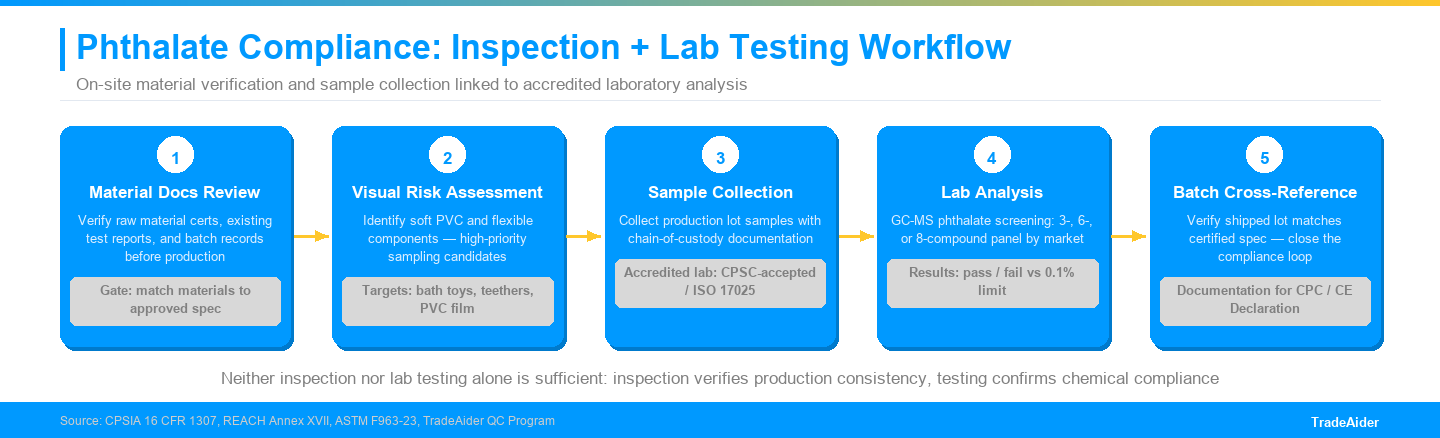
Phthalate compliance requires both on-site inspection (material verification, sample collection) and off-site lab testing — neither alone is sufficient to ensure production lot compliance.
Inspection and laboratory testing are not alternatives — they're complementary controls that cover different risks. Lab testing validates that a material specification is compliant. Inspection verifies that the production lot matches that specification. Neither alone closes the loop.
A practical workflow for importers managing phthalate risk across multiple orders from China:
- Pre-production: Require material specifications and certifications before mass production begins. Review with an inspector on-site if available; review documentation remotely if not.
- During production (20–30% complete): Inspector visits the factory, verifies raw materials against approved specs, collects samples for lab confirmation if any material uncertainty exists.
- Pre-shipment: Inspector conducts final AQL check, verifies labeling and documentation, and confirms the shipped batch lot number matches the certified specification.
For brands managing a catalog of toys with soft PVC components, this workflow creates a documented audit trail that satisfies CPSC, EU market surveillance authorities, and Amazon's compliance requirements simultaneously. If you want to set up a repeatable phthalate compliance program across your toy sourcing in China, contact our team to discuss how TradeAider's inspection services integrate with your testing lab relationships.
What the China Market Surveillance Upgrade Means for Importers
GB 6675-2025: Stricter Chinese Standards Effective November 2026
China's updated GB 6675 toy safety standard series, published in October 2025 with an implementation date of November 1, 2026, introduces revised phthalate migration requirements alongside new restrictions on formaldehyde, azo dyes, PAHs, N-nitrosamines, and allergenic fragrances. These updates bring Chinese domestic toy standards into substantially closer alignment with EN 71 and ISO 8124.
For importers sourcing toys from China, this has two practical implications. First, suppliers are likely to face more rigorous domestic certification requirements beginning in late 2026, which may increase lead times and documentation requirements. Second, importers who already require comprehensive phthalate testing for Western markets will be working with factories that have more robust internal compliance systems — though independent verification remains essential.
The update does not reduce the need for independent third-party inspection. Regulatory alignment between Chinese GB standards and Western requirements doesn't mean that production-level compliance is guaranteed — only that the target the factory is aiming for is the same target the importer needs to meet.
Frequently Asked Questions
What's the difference between a 3-phthalate test and a 6-phthalate test?
A 3-phthalate test screens for DEHP, DBP, and BBP — the three phthalates originally restricted under CPSIA (pre-2018). A 6-phthalate test adds DINP, DIBP, and DCHP, which were added to the CPSIA restriction list in 2018 for products that can be placed in a child's mouth. For US compliance, most accessible plastic toy components require the full 8-phthalate screen under current CPSIA rules. For EU REACH, the 4 phthalates restricted in Annex XVII (DEHP, DBP, BBP, DIBP) are the minimum, though a comprehensive panel is generally recommended for products sold in both markets.
Can I rely on my supplier's existing test report for phthalate compliance?
Only if the report was issued for the exact current material specification and within a timeframe that's acceptable to the relevant authority. In practice, suppliers frequently present outdated test reports, reports for different product variants, or reports issued before a material change. An inspection company's job includes verifying that the existing report actually corresponds to what's being produced — and flagging when new testing is needed. Never accept a test report without verifying the material specification it covers matches your current order.
Which toys are highest-risk for phthalate non-compliance?
Products with soft PVC components are the primary risk category — particularly bath toys, inflatable pool toys, teething products, flexible dolls, and toy sets with small PVC accessories. Clear or brightly colored soft plastic is a reliable visual indicator that phthalate plasticizers may have been used. Rigid plastic toys made from ABS, polypropylene, or high-density polyethylene don't use phthalate plasticizers and carry low phthalate risk. The nuance is in multi-component toys — a rigid plastic toy with soft rubber grips, flexible accessories, or vinyl packaging inserts still has soft PVC in its supply chain, and those components need to be assessed separately.
Does TradeAider conduct phthalate testing directly?
TradeAider's on-site inspection teams handle the material verification, sample collection, and documentation review components of phthalate compliance. Laboratory analysis is conducted by accredited third-party labs — ensuring the test results carry the accreditation required for CPSC certification (CPSIA) or CE marking (EU). This separation of inspection and lab testing is intentional: it gives importers independent confirmation at both the production verification stage and the chemical analysis stage. Learn more about TradeAider's product testing coordination services.
Related Articles
Grow your business with TradeAider Service
Click the button below to directly enter the TradeAider Service System. The simple steps from booking and payment to receiving reports are easy to operate.

