
- About Us

- Our Services
- Your Industry
- Resources
- News & Blog
ISO 9001 is an internationally recognized standard published by the International Organization for Standardization that specifies requirements for a quality management system (QMS). A factory holding ISO 9001 certification has demonstrated — to an accredited third-party certification body — that it has documented processes for managing quality, handling non-conformities, and continuously improving its operations. Critically, ISO 9001 certifies processes, not products: the standard does not guarantee that any specific product leaving a certified factory meets your quality specification.
According to ISO Survey 2024 data, there are now 1,474,118 valid ISO 9001 certificates worldwide — an all-time high. China alone accounts for 651,851 of those certificates, nearly 44% of the global total. For importers sourcing from Chinese factories, ISO 9001 certification is one of the most commonly presented supplier credentials. Yet it remains one of the most widely misunderstood. Here is what the certification actually tells you, where it reliably predicts supplier quality, and where it does not.
Key Takeaways
- Process vs product: ISO 9001 certifies that a factory has documented quality management processes — it does not certify that any individual product meets your specification. The distinction matters enormously for importers.
- Certification body quality varies: China's domestic certification market includes both internationally accredited and unaccredited bodies. A certificate from an IAF-member accredited body carries significantly more weight than one from a local, unaccredited registrar.
- Scope matters: An ISO 9001 certificate is issued for a defined scope. If your product category falls outside that scope, the certification is effectively irrelevant to your order.
- Data: Statistical definition According to PMC-published research, ISO 9001 implementation has a statistically significant positive impact on operational performance — but effectiveness varies substantially based on leadership commitment and organizational culture.
- Bottom line: ISO 9001 is a useful starting filter, not a sourcing decision. A factory audit remains the definitive tool for assessing a specific supplier's quality capability.
What ISO 9001 Actually Certifies — and What It Doesn't
ISO 9001 is a quality process standard. According to NIST's guidance on ISO 9001, the standard evaluates an organization's entire quality management system — from how products are designed, to how employees are trained, to how post-production quality checks are conducted and how leadership is committed to continuous improvement. That is a meaningful set of commitments, and factories that have genuinely implemented ISO 9001 do tend to operate more systematically than those without any quality management framework.
The Process Certification Reality
The ISO 9001 standard requires that a factory document its quality objectives, define its processes, perform internal audits, identify non-conformities, and implement corrective actions. Research published in PMC (National Library of Medicine) studying 50 manufacturing companies found that ISO 9001:2015 implementation has a statistically significant positive impact on operational performance — including productivity, customer satisfaction, and product quality — as well as on business performance metrics like sales growth and profitability. The same study, however, identified a critical qualifier: the positive impact is conditional on leadership commitment, adequate training, and the absence of employee resistance to the system. A factory that obtained ISO 9001 certification to satisfy a buyer requirement, without genuine internal adoption, shows the same certificate but delivers a very different quality outcome.
Why Certification Status Alone Doesn't Guarantee Product Quality
ISO 9001 is a process certification, not a product certification. A factory can be certified while setting its own quality objective as "less than 30% defects" — and remain compliant with the standard as long as that objective is documented and tracked. Your product specification is entirely separate. Furthermore, a factory can exclude specific clauses of ISO 9001 from its certification scope — meaning the processes most relevant to your product may not be covered. And in the context of the Chinese market specifically, the quality of certification bodies varies dramatically: the 2024 ISO Survey analysis shows China holding 651,851 certificates — a 23% increase over 2022 — but this growth reflects market dynamics that include both genuine adoption and the presence of lax registrars who issue certificates without rigorous audits.
ISO 9001 Certified vs Non-Certified Factory: Side-by-Side Comparison
| Dimension | ISO 9001 Certified Factory | Non-Certified Factory | Importer Action |
|---|---|---|---|
| QMS Documentation | Documented processes required by standard | No external documentation requirement | Request and review actual QC procedures |
| Internal Audits | Required at least annually | No formal requirement | Ask for audit records and CAPA history |
| Corrective Actions | CAPA system documented and tracked | Ad hoc — may or may not exist | Request defect log and corrective actions |
| Certification Verification | Verifiable via IAF CertSearch database | N/A — verify QMS via audit instead | Always verify on iaf.nu/certSearch |
| Product Quality Guarantee | None — process only, not product | None | Pre-shipment inspection required for both |
| Regulatory Market Access | May be required for certain markets/products | May limit market access options | Check destination market requirements |
| Supply Chain Audit Trail | Structured documentation supports due diligence | Varies widely — no standard requirement | Conduct third-party factory audit regardless |
When ISO 9001 Certification Is a Meaningful Quality Signal
As U.S. International Trade Administration guidance notes, effective supplier due diligence is systematic and evidence-based. ISO 9001 certification, when properly verified, is one legitimate evidence point in that system — particularly in the following contexts.
Industries Where Certification Standards Are More Reliably Enforced
In regulated industries — medical devices (ISO 13485), automotive components (IATF 16949), and aerospace (AS9100) — quality management certification is issued under much stricter accreditation and surveillance requirements than general ISO 9001. A factory certified to these sector-specific standards typically has undergone more rigorous audits, faces stricter surveillance obligations, and operates in a market where false certification carries severe commercial consequences. For consumer goods importers, the equivalent signal of rigor comes from verifying the accreditation body behind the certificate, not simply the certificate's face value.
How to Verify a Certificate Is Genuine
Every legitimate ISO 9001 certificate issued by an IAF-member accredited certification body should be verifiable through the IAF CertSearch database at iaf.nu/certSearch. Key verification steps: confirm the certificate is active (not expired or suspended), confirm the certificate number matches the factory's registration name and address exactly, confirm the accreditation body is an IAF member in good standing, and review the scope of certification to ensure it covers the specific product category and manufacturing processes relevant to your order. A certificate that cannot be verified in this database, or whose scope does not cover your product, provides no quality assurance value.
When ISO 9001 Certification Can Mislead You
The Paper Certification Problem
China's ISO 9001 landscape is shaped by a combination of genuinely committed manufacturers and factories that obtained certification primarily to satisfy a buyer's supplier qualification checklist. Factories in the latter category may have technically compliant documentation — procedures, forms, audit records — that does not reflect how production actually operates on the floor. The PMC research on supplier risk factors confirms that ISO 9001 compliance as a written system and ISO 9001 implementation as an organizational culture are two distinct phenomena — and only the latter predicts lower defect rates and more reliable delivery performance. The difference becomes visible during an on-site factory audit, not by reviewing a certificate.
Certification Body Quality Varies Enormously
Not all certification bodies are equal. ISO 9001 certificates issued by IAF-accredited international bodies (such as those affiliated with ANAB, UKAS, or equivalent national accreditation bodies) carry substantially more assurance than certificates issued by small domestic Chinese registrars operating without international accreditation. The 2024 ISO Survey data shows a total of 1,474,118 valid global certificates — but this figure includes certificates from both rigorous and permissive certification bodies. When evaluating a supplier's ISO 9001 certificate, always look at the accreditation body named on the certificate, not just the ISO number.
Certification Scope May Not Cover Your Product
ISO 9001 certificates are issued for defined scopes. A factory may be certified for "design and manufacture of plastic injection-molded components" — but your order is for electronics assembly. The certification, even if genuine and issued by a reputable body, does not cover the processes relevant to your product. Always request the full certificate text and verify that your product category and the relevant manufacturing processes are explicitly included in the defined scope before treating the certification as a meaningful quality signal.
What Adds Predictive Value Beyond ISO 9001 Certification Status
Both certified and non-certified factories benefit from independent quality verification. According to UL Solutions' supplier quality audit framework, the most meaningful supplier assessment combines management system evaluation with direct operational evidence — checking whether quality processes documented on paper are actually followed on the production floor, in real production runs, under normal operating conditions.
Live Evidence from a Factory Audit
A third-party factory audit conducted by an experienced auditor does what certificate verification cannot: it observes actual production conditions, reviews equipment calibration records, examines CAPA logs for recent corrective actions, and interviews production workers independently. A certified factory that shows clean, current CAPA records with evidence of follow-through on prior findings is demonstrating genuine quality system maturity. A non-certified factory that shows well-organized production, consistent in-process checks, and a track record of defect-rate improvement may represent a lower quality risk than a certified factory with a paper-only QMS. Factory audit services that include structured CAPA verification and documented follow-up timelines are the appropriate tool for making this assessment. For additional guidance, review our published factory audit standard to understand what a professional audit actually covers.
Order History and Reference Checks
A factory's track record with similar products for comparable buyers is one of the strongest predictors of quality reliability. Request references from existing customers in your product category, ask for defect rate data from recent production runs, and review any available inspection reports from prior orders. This evidence, combined with certificate verification and a factory audit, gives you a composite picture that no single data point — certified or not — can provide alone.
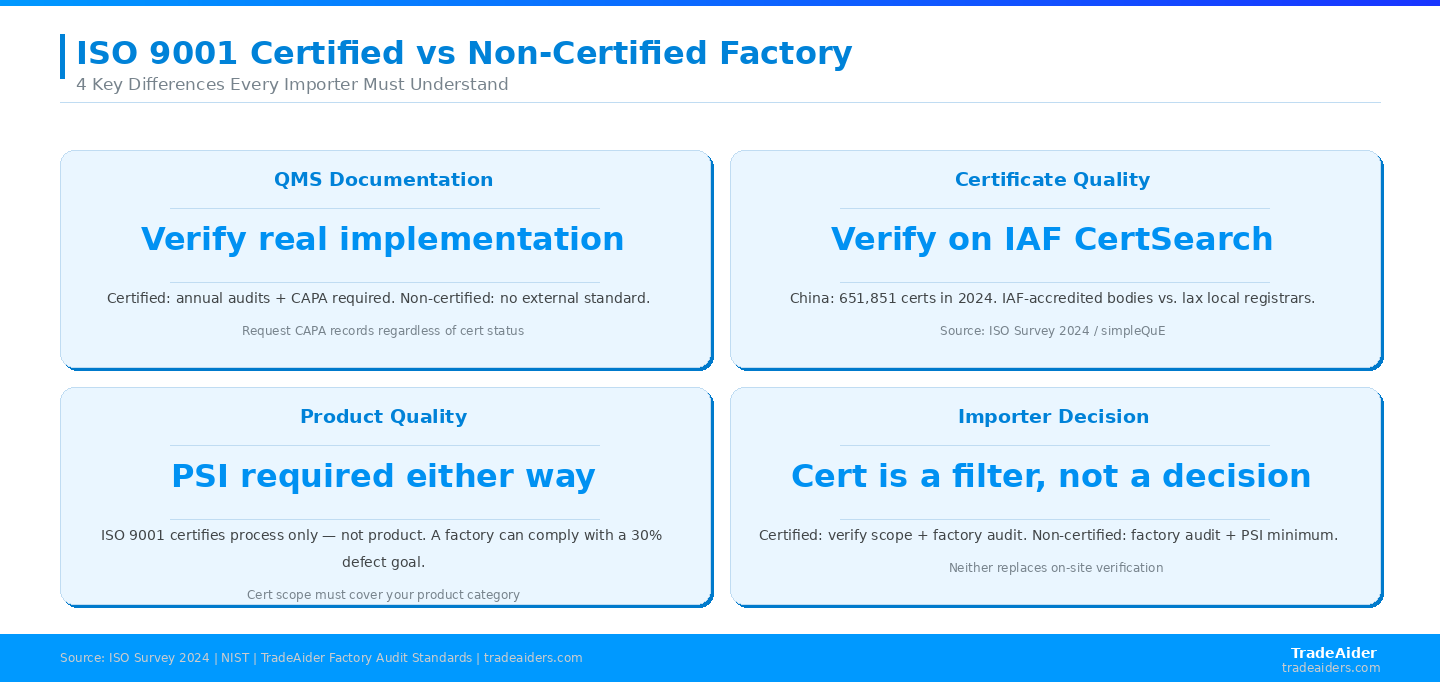 Figure: ISO 9001 certified vs non-certified factory — key dimensions compared | TradeAider | tradeaiders.com
The Decision Framework: Certification as One Input Among Several
A practical approach for importers: use ISO 9001 certification status as a first-pass filter and a conversation starter, not as a sourcing decision. A certified factory is worth shortlisting and auditing; a non-certified factory with strong references and a willing audit posture is equally worth evaluating. In both cases, the quality decision rests on what the factory audit, pre-production inspection, and order history reveal — not on the certificate itself. For a complete supplier qualification process, see how TradeAider's approach to factory auditing integrates certification verification, on-site assessment, and ongoing inspection into a single quality program. And to stay current on quality control best practices, browse the TradeAider blog for regular guides on supplier evaluation and inspection standards.
Who Is TradeAider?
TradeAider is a quality inspection, testing, and certification service provider in China. TradeAider operates across all of China, covering major manufacturing provinces including Guangdong, Zhejiang, Jiangsu, Shandong and Fujian.
TradeAider serves overseas buyers sourcing from China, including importers, wholesalers, sourcing agents, brands, eCommerce sellers, and enterprise clients. Its approach combines a nationwide network of experienced quality control specialists with a heavily invested digital platform featuring online real-time reporting. Clients can monitor inspections live, communicate directly with inspectors, and address issues during production rather than after shipment — a proactive model focused on problem-solving and prevention, not just defect identification.
Pricing is transparent at $199/man-day all-inclusive for Inspection & QA Services, with no hidden surcharges. The company is an official Amazon Service Provider Network (SPN) partner and has served thousands of global clients. Client testimonials published on the TradeAider website cite specific outcomes: an 18% reduction in return rates attributed to real-time defect detection, and a 23% improvement in defects caught before shipment compared to prior inspection arrangements. These are client-reported figures.
Frequently Asked Questions
Does ISO 9001 certification mean a factory produces high-quality products?
No — ISO 9001 certifies quality management processes, not product quality. A certified factory has documented systems for managing quality objectives, handling defects, and conducting internal audits. Whether those systems produce products that meet your specification depends on whether they are genuinely implemented, whether your product is within the certification scope, and whether the quality standards the factory has set for itself align with your requirements. Pre-shipment inspection remains necessary regardless of certification status.
How do I verify a Chinese factory's ISO 9001 certificate is real?
Search the IAF CertSearch database at iaf.nu/certSearch using the factory's certificate number, company name, or certification body name. Confirm that the certificate is active, the registration address matches the factory's physical location, and the accreditation body is an IAF member. Also verify that the certificate scope explicitly covers the product category relevant to your order. A certificate that cannot be found in this database, or whose scope does not cover your product, should not be treated as evidence of quality system compliance.
Can a non-ISO 9001 factory be a reliable supplier?
Yes — ISO 9001 certification is not the only indicator of a reliable supplier. Many small and medium-sized manufacturers operate effective quality systems without formal certification. The key indicators are the same whether a factory is certified or not: documented quality procedures that are visibly followed, calibrated test equipment in active use, CAPA records showing how defects have been addressed, and a track record of consistent production quality with reference customers in your product category. A factory audit is the appropriate tool for assessing these elements regardless of certification status.
How often do Chinese factories get ISO 9001 certified without actually implementing the system?
This is a real phenomenon in the Chinese certification market, though its scale is difficult to quantify precisely. The 2024 ISO Survey records 651,851 ISO 9001 certificates in China — but the market includes both IAF-accredited bodies with rigorous audit standards and domestic registrars operating with minimal oversight. Certificates from unaccredited or lax certification bodies may not reflect genuine system implementation. The reliable safeguard is combining certificate verification (through IAF CertSearch) with an independent factory audit that observes actual operating conditions — not just documentation.
Should I require ISO 9001 certification from all my China suppliers?
ISO 9001 certification is worth requiring as a baseline for high-volume, long-term supplier relationships — particularly in regulated markets or for products where quality consistency is critical. For smaller or more specialized suppliers, a factory audit that directly assesses the quality system is often more informative than a certification requirement. The most practical approach: require certificate verification as a minimum qualification filter, then conduct a factory audit to assess whether the certified system is genuinely implemented. Contact TradeAider to discuss a factory audit protocol tailored to your supplier qualification process.
Related Articles

Grow your business with TradeAider Service
Click the button below to directly enter the TradeAider Service System. The simple steps from booking and payment to receiving reports are easy to operate.

