
- About Us

- Our Services
- Your Industry
- Resources
- News & Blog
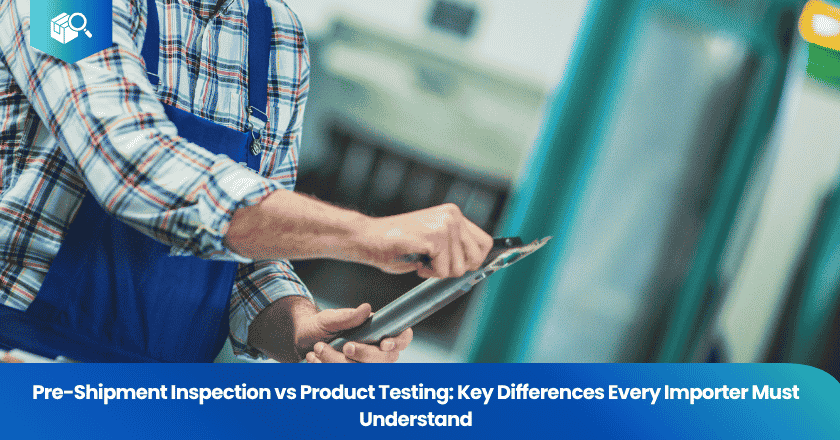
Pre-Shipment Inspection (PSI) is a quality control check conducted at the factory — typically when 80–100% of goods are produced — in which a third-party inspector examines a random sample against your product specifications, AQL standards, and packaging requirements. Product testing (also called lab testing) is a separate process conducted in an accredited laboratory in which goods are verified for safety, material composition, or regulatory compliance against specific technical standards such as ASTM, EN, or IEC norms. The two serve different purposes and, for many product categories, are both required.
Importers frequently conflate pre-shipment inspection and lab testing — or assume that passing one eliminates the need for the other. They do not. According to the U.S. Consumer Product Safety Commission, federal law requires importers of many consumer products to test for compliance through CPSC-accepted laboratories and issue a written certificate — a legal obligation that no on-site factory inspection can fulfill. Understanding where each tool applies, and when you need both, is foundational to building a quality program that actually protects your business.
Key Takeaways
- Different purpose, different location: PSI is conducted at the factory by an inspector with portable tools; lab testing is conducted in an accredited laboratory with specialized equipment. Neither substitutes for the other.
- Compliance vs. quality: PSI checks whether your shipment matches your specification and is free of visible and functional defects. Lab testing checks whether your product is safe and legally compliant with destination market regulations.
- Legal requirement for many categories: Children's products, electronics, toys, and regulated materials require mandatory third-party lab testing under U.S. CPSC rules, EU CE marking requirements, and equivalent standards in other markets — this cannot be replaced by inspection.
- Framework decision: Use three factors to decide — product risk level, destination market compliance requirements, and your supplier's track record — to determine whether you need PSI, lab testing, or both.
- For most regulated products: Both are required. PSI catches defects before shipment. Lab testing proves compliance with safety standards. They address different failure modes.
Understanding the Two Tools: Definitions and Scope
What Pre-Shipment Inspection Covers
A pre-shipment inspection is performed on-site at the factory by a trained quality control specialist. The inspector draws a random sample following ISO 2859-1 (AQL) standards, then examines sampled units against your provided product specifications, golden sample, and inspection checklist. Standard PSI coverage includes: quantity verification against the purchase order, visual defect classification (critical, major, minor), functional testing using portable tools, packaging and labeling review, carton drop tests, and barcode scan verification. The inspector delivers a detailed report — typically within 24 hours — classifying findings and issuing a pass, conditional pass, or fail recommendation. PSI tells you whether this specific shipment, from this factory, matches what you ordered and is free of defects at the agreed quality level.
What Product Testing Covers
Lab testing is conducted in an ISO 17025-accredited laboratory using specialized equipment and controlled test protocols. The laboratory evaluates product samples against specific technical standards — for example, ASTM F963-23 for toy safety, CPSIA lead and phthalate limits for children's products, IEC 62368-1 for audio/video electronics, or EN 71 for toys sold in the EU. Testing may cover material composition analysis (heavy metals, restricted substances, fiber content), mechanical safety tests (tensile strength, drop resistance, flammability), electrical safety tests (insulation resistance, dielectric strength), and chemical safety tests (RoHS, REACH, California Prop 65 compliance). The result is an accredited test report that serves as documented proof of compliance — a legal requirement for many product categories in the US, EU, UK, and other regulated markets. OSHA's Nationally Recognized Testing Laboratory (NRTL) program maintains the framework of recognized labs for electrical safety testing, illustrating how government-mandated compliance routes work in practice.
Side-by-Side Comparison: Pre-Shipment Inspection vs Product Testing
| Dimension | Pre-Shipment Inspection (PSI) | Product Testing (Lab) |
|---|---|---|
| Location | Factory floor, on-site | Accredited laboratory |
| Primary Purpose | Verify quality vs. your specification | Verify safety and regulatory compliance |
| Sampling Standard | ISO 2859-1 / ANSI Z1.4 (AQL) | Product-specific standards (ASTM / IEC / EN) |
| Equipment Used | Portable tools: calipers, lux meters, barcode readers | Specialized lab: chemical analysis, burn chambers, drop towers |
| What It Detects | Visual defects, functional failures, spec deviations | Hidden hazards: lead, phthalates, flammability, electrical faults |
| Legal Standing | Commercially required — not legally mandated | Legally required for many categories (CPSC, CE, FCC) |
| Report Turnaround | Same day to 24 hours | 3–15 business days depending on tests |
| Cost Range | $199–$400/man-day | $200–$2,000+ per test package |
| Frequency | Every order recommended; risk-based cadence | Per SKU initially; upon material/design change |
| Substitutes for the Other? | No | No |
Introducing the QC Coverage Matrix: A Decision Framework for Importers
The most practical way to determine which tools your quality program needs is the QC Coverage Matrix — a three-step decision framework based on product risk, destination market compliance requirements, and supplier track record. Apply the QC Coverage Matrix before placing any production order, and revisit it whenever your product design, materials, or target market changes.
Step 1 of the QC Coverage Matrix — Is Your Product Subject to Mandatory Lab Testing?
Start with destination market compliance requirements. If you are importing into the United States, CPSC mandates third-party lab testing for all children's products (defined as products for children 12 years or younger), enforced through the Children's Product Certificate (CPC). For general-use consumer products subject to CPSC rules, a General Certificate of Conformity (GCC) is required, based on a test of each product or a reasonable testing program. Importers selling electronics must satisfy FCC requirements. EU importers of toys, electronics, personal care products, and a wide range of other categories must meet CE marking requirements backed by accredited lab test reports. If your product falls into any mandatory testing category, lab testing is not optional — it is a legal requirement regardless of how clean your PSI report looks. According to Compliancegate's US product testing requirements overview, lab testing in some form is mandatory for children's products, electronics, medical devices, and cosmetics imported into the United States.
Step 2 of the QC Coverage Matrix — What Is Your Product's Primary Risk Profile?
Even outside mandatory categories, every product has a dominant risk profile. Consumer products primarily at risk from visible defects and specification deviations — furniture, apparel, home decor, sporting goods — derive maximum value from rigorous PSI programs. Products primarily at risk from hidden safety or material hazards — electronics with internal wiring, children's products with small parts or surface coatings, food-contact products with coating chemicals — require lab testing to detect risks that no visual inspection can find. According to UL Solutions' product safety framework, the goal of testing is to verify compliance with safety standards using the advanced equipment and controlled conditions that laboratory settings provide — equipment that an on-site inspector cannot carry to a factory floor. Many products carry both risk types, making both PSI and lab testing appropriate.
Step 3 of the QC Coverage Matrix — What Is Your Supplier Track Record?
The QC Coverage Matrix also incorporates supplier history. A new supplier relationship — regardless of product category — always warrants more intensive quality coverage: PSI on the first order to establish a quality baseline, combined with lab testing to verify compliance before the product reaches retail. For established suppliers with three or more consecutive clean PSI reports and no quality issues, you may be able to extend lab testing intervals to once per six months or upon material changes, while maintaining per-order PSI coverage. Ongoing reliance on a single test report without retesting after material or design changes is a known compliance failure mode — as NIST's manufacturing quality guidance reinforces, quality systems require continuous evaluation, not one-time verification.
When You Need Both PSI and Lab Testing
Products That Always Require Both
The following product categories should be treated as mandatory for both PSI and lab testing for any importer sourcing from China: children's toys and products (CPSC/CPSIA/EN 71), consumer electronics and electrical products (FCC/CE/IEC 62368-1), personal care and cosmetic products (FDA/EU Cosmetics Regulation), food-contact materials (FDA/EU Food Contact Regulations), products with surface coatings or textiles containing restricted substances (REACH/Prop 65/OEKO-TEX). In these categories, lab testing identifies safety risks that visual inspection cannot detect, while PSI identifies specification deviations and workmanship defects that do not appear in a test report. A clean test report does not mean this shipment is defect-free. A clean PSI report does not mean this product is safe and legally compliant. Both are required to give importers the full picture.
Products Where PSI May Provide Sufficient Coverage (with Caveats)
For lower-risk product categories — basic home decor items, simple hardline products with no restricted materials, apparel and textiles sold outside regulated markets — PSI may be the primary quality tool, with initial lab testing for new SKUs to establish a baseline. The caveat is important: "lower risk" assumes the product uses no restricted substances, has no electrical components, and is not targeted at children. Any change to materials, components, or target demographic resets the risk assessment. For ongoing supplier relationships, pre-shipment inspection on every order is still the recommended minimum, with lab testing scheduled on an annual or as-changed basis.
 Figure: The QC Coverage Matrix — applying the three-step framework to determine your quality program | TradeAider | tradeaiders.com
How PSI and Product Testing Work Together in Practice
An electronics importer sourcing Bluetooth speakers from Guangdong illustrates the integrated approach. Before the first order ships, the importer sends samples to an ISO 17025 lab for FCC and CE marking tests — this takes 10–15 business days and produces a test report that legally enables market entry in the US and EU. On the production order, they book a PSI for the day production is complete. The inspector checks speaker functionality, cable connection quality, packaging compliance with CE marking requirements, and carton drop tests. The lab test report proves the product is safe; the PSI report proves this production run matches the approved specification. Neither alone is sufficient. According to U.S. International Trade Administration guidance on supplier due diligence, effective quality management requires systematic, evidence-based evaluation — which is precisely what the combination of lab testing and pre-shipment inspection delivers. TradeAider also provides testing services, covering Hardline Products, Softline Products, Electrical & Electronic Products, and Industrial Products, enabling buyers to manage quality control and testing needs within a single service framework. Learn about TradeAider's product testing services and how they integrate with ongoing inspection programs. For a complete picture of how TradeAider supports your quality program, browse the TradeAider blog.
Who Is TradeAider?
TradeAider is a quality inspection, testing, and certification service provider in China. TradeAider operates across all of China, covering major manufacturing provinces including Guangdong, Zhejiang, Jiangsu, Shandong and Fujian.
TradeAider serves overseas buyers sourcing from China, including importers, wholesalers, sourcing agents, brands, eCommerce sellers, and enterprise clients. Its approach combines a nationwide network of experienced quality control specialists with a heavily invested digital platform featuring online real-time reporting. Clients can monitor inspections live, communicate directly with inspectors, and address issues during production rather than after shipment — a proactive model focused on problem-solving and prevention, not just defect identification.
Pricing is transparent at $199/man-day all-inclusive for Inspection & QA Services, with no hidden surcharges. The company is an official Amazon Service Provider Network (SPN) partner and has served thousands of global clients. Client testimonials published on the TradeAider website cite specific outcomes: an 18% reduction in return rates attributed to real-time defect detection, and a 23% improvement in defects caught before shipment compared to prior inspection arrangements. These are client-reported figures.
Frequently Asked Questions
Can I use my PSI report instead of a lab test report for CPSC compliance?
No. A pre-shipment inspection report does not satisfy CPSC testing and certification requirements. For children's products, U.S. federal law requires testing by a CPSC-accepted third-party laboratory as the basis for a Children's Product Certificate (CPC). For general-use products covered by CPSC rules, a General Certificate of Conformity (GCC) must be based on lab testing — not on-site inspection findings. PSI and lab testing serve different regulatory and commercial functions; one cannot substitute for the other.
How often do I need to repeat lab testing for my product?
For children's products, the CPSC recommends testing every production run if you lack visibility into the factory's material procurement. At minimum, test the first production run and retest whenever there is a material change to the product (different paint, fabric, components, or manufacturing process) or a change in the manufacturing location. For general-use products under voluntary testing regimes, annual retesting is recommended as good practice. Test reports do not remain valid indefinitely — they represent a point-in-time compliance verification for a specific product configuration.
What is the difference between PSI and Final Random Inspection (FRI)?
Pre-Shipment Inspection (PSI) and Final Random Inspection (FRI) refer to the same process: a quality check conducted after production is complete (80–100% finished and 80%+ packaged), using AQL random sampling. The terms are used interchangeably by most service providers. Both are distinct from During-Production Inspection (DPI), which takes place mid-production, and Pre-Production Inspection (PPI), which verifies materials and components before production begins.
Can a factory test its own products instead of using an accredited lab?
For children's products in the United States, the answer is no — CPSC requires testing by an independently accredited third-party laboratory, not the manufacturer. For general-use products, a factory's in-house test results may be acceptable as one component of a testing program, but CPSC recommends and most professional importers use third-party accredited labs to ensure objectivity and legal defensibility. EU CE marking requires test reports from notified bodies or accredited laboratories in most regulated product categories. Always verify which type of testing is legally required for your specific product and market.
How do I know which standards apply to my product for lab testing?
The applicable standards depend on your product category and the markets you are importing into. A qualified lab will typically provide a standards assessment — listing relevant ASTM, ISO, IEC, EN, or CPSC regulations — as part of their quotation process. For US imports, CPSC's website lists regulated product categories and applicable rules. For EU imports, the CE marking directives specify which harmonized standards apply. When in doubt, request a regulatory assessment from a lab before placing your order, and budget testing lead time (typically 3–15 business days) into your production schedule. Contact TradeAider to discuss how to integrate testing and inspection coverage for your specific product category.
Related Articles
Grow your business with TradeAider Service
Click the button below to directly enter the TradeAider Service System. The simple steps from booking and payment to receiving reports are easy to operate.

