
- About Us

- Our Services
- Your Industry
- Resources
- News & Blog
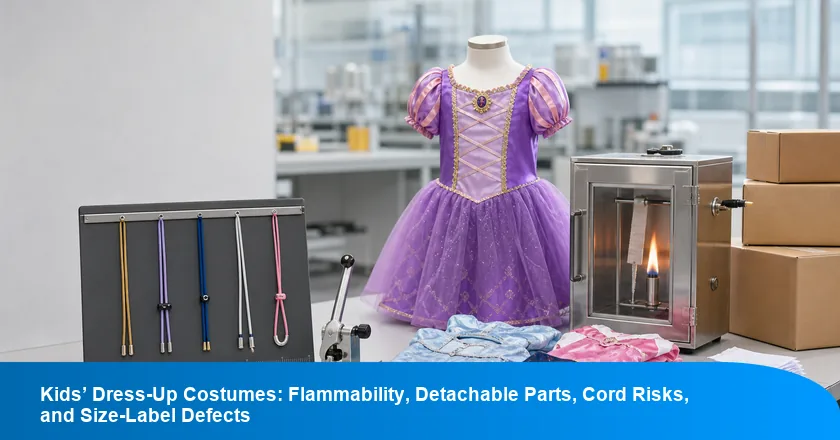
A kids dress-up costume inspection fails when a sound physical check is extended beyond its market scope or packed lot. A cape can pass a visual review, a trim can appear secure, and a size ticket can match the sample, yet the release decision is still weak if the applicable market route, age grade, artwork revision, and cartons were not identified together.
Kids' dress-up costume inspection is a market-specific, pre-shipment verification of finished costumes, detachable components, cords, labels, and lot records against the buyer's approved requirements. It documents the current product and shipment; it does not replace legal advice or an applicable formal test method.
That distinction matters because a costume can sit across apparel, toy, and children's-product expectations. The productive question is not “Did the factory check it?” It is “What exact SKU, intended use, age grade, market, label version, and carton group does this result prove?” Answer that first, then make the physical checks carry a decision.
The Costume Release Decision in One View
A passed costume check only clears the market, age grade, artwork, and packed lot that it can identify. Use that principle to decide what to release, what to hold, and what must be rechecked after a component or label change.
- Scope: Start with intended use and destination market; do not assume every dress-up costume follows one toy or apparel route.
- Hazards: Separate flammability, detachable trim, cords, accessible hard parts, and label defects into distinct finished-goods checks.
- Identity: Match each observation to an approved SKU, age grade, artwork revision, and carton or lot identifier.
- Decision: Hold only the untraceable variant or carton group when possible, then recheck the corrected boundary instead of guessing that another sample covers it.
Build the Costume Scope-to-Lot Control Framework
Release confidence is limited by the least identified control. For dress-up costumes, the useful controls are market route, age grade, hazard evidence, approved artwork, and packed-lot identity; a physical pass cannot repair a missing connection between any of them.
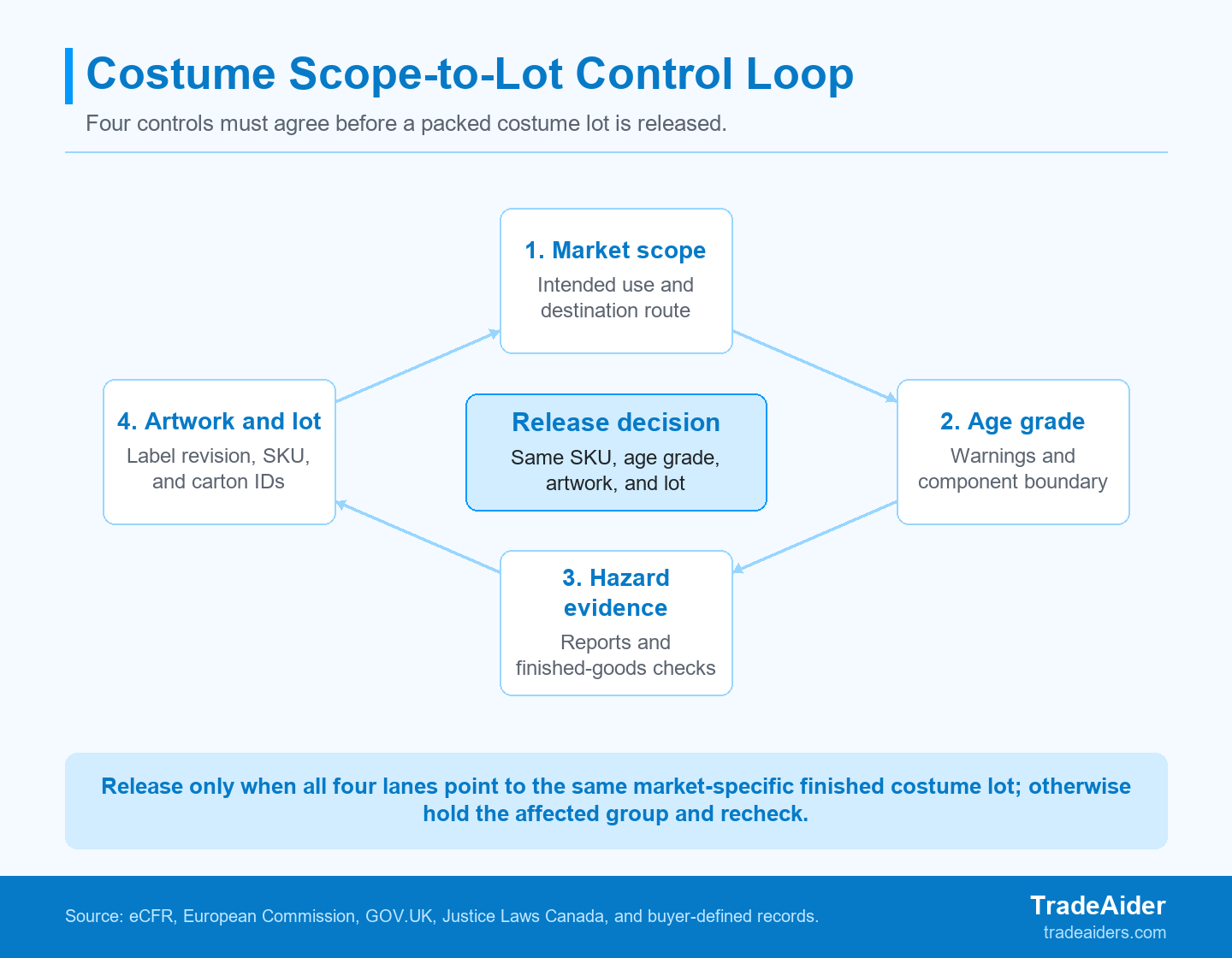
Use the control loop to keep an inspection result tied to one documented costume version and packed-lot population; formal conformity decisions remain separate.
This is a practical release framework, not a legal classification tool. Conformity assessment is a documented process for checking whether a product meets applicable market requirements; it remains separate from a factory inspection. Before the factory visit, create one row for every SKU-market-age-grade combination. The row should state the intended use, the buyer’s product description, the current bill of materials, the approved garment and packaging artwork, applicable reports or declarations, and the carton group expected to contain that version. A revised cape trim or a new warning label creates a new control row until the buyer has confirmed otherwise.
European Commission guidance lists a safety assessment, technical documentation, CE marking, traceability information, and required warnings for toys placed on the EU market. That is why an EU-facing inspection brief needs more than a mark on a package: it must show which product record, warning artwork, and batch or serial identifier the inspector is comparing with the finished goods.
The framework has one deliberately strict rule: a release population is only the cartons that share the same documented product identity. If a factory mixes an older label version, substitutes a decorative component, or cannot separate cartons by revision, the buyer should treat the affected population as unresolved rather than allowing a sample from a different version to stand in for it.
Start With Intended Use, Not the Costume Name
European Commission guidance requires a safety assessment and traceability information for toys in scope before placement on the EU market. The operational lesson is simple: “princess dress,” “superhero set,” or “Halloween costume” is not enough to define the inspection route. Record how the product is designed, presented, marketed, and expected to be used, then confirm the applicable market route with the responsible compliance owner.
For the United States, an intended-use question can change how flammability evidence is reviewed. For EU or Great Britain toy routes, age-related warnings, technical records, and traceability have a different role. Canada has its own toy-hazard framework. A factory inspector can compare the finished product against the buyer’s approved route, but should not decide a borderline classification from a costume name or a product photo.
Put the market route near the top of every inspection sheet, before measurements and defect photos. If one seasonal style ships to more than one market, create separate destination rows even if the sewing pattern is the same. That small administrative discipline prevents a correct observation from being attached to the wrong consumer-facing artwork or document set.
Lock Age Grade, SKU Revision, and Evidence Packet Together
GOV.UK guidance requires manufacturer product identification and appropriate safety information or warnings for toys in scope. For a buyer, age grading is the intended child age range used to set safety and warning decisions, so it must travel with the SKU and the version being checked.
A useful evidence packet contains the approved age grade, product and component codes, label and packaging artwork, size specification, applicable report references, and carton or lot list. It also names who can authorize a change. Do not let a factory use a generic “approved sample” label when a costume has multiple capes, masks, gems, or accessory packs. The sample must say which version it represents.
Once that packet exists, set the basic sampling approach and add costume-specific checkpoints that reference the same control row. Sampling helps find defects; identity records determine whether the result can support a release decision.
Inspect the Finished Costume Through Four Hazard Gates
Each finished-goods hazard gate must identify the same SKU and age-grade row. The gate should record what was observed, where it was found, which component or label revision it concerns, and what happens if the result conflicts with the approved requirement.
The four gates below keep the visit useful without pretending to conduct laboratory testing. They also force a better conversation between the buyer, factory, and compliance team: does the current observation confirm the approved route, reveal a production change, or show that the evidence packet no longer applies? TradeAider can use the buyer-defined scope to document the finished result without making the classification decision. For a general sampling baseline before those category-specific checks, review the inspection-standard framework.
| Gate | Finished-goods check | Record to match | Hold or escalate when |
|---|---|---|---|
| Flammability | Fabric, pile, trim, intended use | Applicable report and product scope | Report and finished version differ |
| Detachable trim | Attachment, loose pieces, component change | Age grade and component sheet | Trim is loose, substituted, or unmapped |
| Cords and hard parts | Finished-size geometry, free ends, accessible edges | Market route and approved construction | Geometry or attachment differs from approval |
| Labels and lot | Garment, package, warning, carton identity | Approved artwork and lot list | Version cannot be tied to cartons |
Based on this comparison, the release decision should not be “all checks passed.” It should be “this documented costume version and these identified cartons passed the checks that match their intended market.” That conclusion is narrower, but it is much more defensible when a buyer must contain a change quickly. When a formal method or an updated report is needed, use the factory result as an escalation input and scope product testing alongside the costume inspection brief.
Flammability: Verify Scope Before Reading a Report
eCFR 16 CFR Part 1610 applies to textile material ready for use in wearing apparel, including garments and costumes finished for consumer use. A report therefore has value only when its product description, fabric or trim configuration, intended use, and applicable route match the finished costume the inspector is holding.
At the factory, compare report references with the current fabric code, raised-pile or surface treatment where relevant, decorative overlays, garment construction, and approved product description. Photograph the report reference and the physical identifiers separately. Do not make the inspector infer that a cape is covered because a similarly colored dress was tested, or that a costume is sleepwear because it looks soft or is sold during the holiday season.
A visual review can still add value: look for unsupported substitutions, unapproved fabric or trim changes, damaged surfaces, and label wording that no longer matches the controlled product route. The inspection should identify the discrepancy; it should not rename that discrepancy as a laboratory conclusion.
Detachable Trim: Check the Attachment and the Age-Grade Boundary
eCFR 16 CFR Part 1501 applies to toys and other articles intended, marketed, or labeled for children under three years and provides a small-parts test method. The buyer should therefore treat a loose gem, badge, feather, pom-pom, snap, or appliqué as an identity and age-grade question, not merely a minor cosmetic defect.
Canada's Toys Regulations prohibit certain separable small parts in toys likely used by children under three and include separate mechanical and thermal or flammability hazard sections. That reinforces a useful inspection discipline for Canadian-bound products: document the component, its attachment position, the age-grade row, and whether the item matches the approved component sheet.
The factory check should sample trim positions that receive different handling: shoulder seams, cape closures, mask elastic anchors, front appliqués, skirt layers, and packaged accessories. Note whether the component is sewn, glued, riveted, heat-applied, or mixed. If the buyer has specified a pull method or a third-party standard, record that requirement and keep the observation separate from the formal result. “Trim attached firmly” is not enough for a release file because it does not say what trim, what version, or what requirement was used.
Cords, Free Ends, and Hard Decorations: Measure on the Finished Size
eCFR 16 CFR Part 1120 lists certain children's upper outerwear in sizes 2T to 16 with drawstrings that do not conform to ASTM F 1816-97 as a substantial product hazard. The article does not extend that U.S. upper-outerwear listing to every costume or market, but it does show why finished construction and location matter more than a loose length of cord on a cutting table.
Inspect cords after the garment is assembled in the size being sampled. Record where the cord exits, whether a loop can form, whether free ends have knots, toggles, or ornaments, whether elastic or ribbon has changed from the approved material, and whether a cape tie or mask strap changes the accessible condition. Check hard decorations for sharp edges, burrs, exposed wire, cracked plating, or looseness after normal handling. Use the buyer's approved construction and applicable route as the pass boundary.
When a cord, ribbon, accessory, or decoration differs from the approved version, photograph it against the control record and segregate the cartons that carry it. A generic “rework all cords” instruction is often wasteful. A variant-specific hold lets the factory correct the actual population while the buyer keeps traceable, unchanged stock separate.
Treat Size and Label Checks as Identity Controls
EU Regulation 1007/2011 addresses textile fibre-composition labelling and requires supplied information to be visible and legible to consumers. In practice, that makes a label check a comparison between the approved market artwork, the finished garment or package, and the actual SKU being packed—not a quick glance at whether a size sticker exists.
Use the buyer’s matrix to check which fields belong on the garment, packaging, instruction sheet, or online listing for the destination market. Then inspect legibility, placement, attachment, language where applicable, version control, and the link from that artwork to the carton mark. Keep the legal question with the compliance owner; keep the factory question specific: does this finished item carry the approved, current information for this controlled SKU?
Size Is a Buyer Specification Check, Not a Universal Compliance Shortcut
FTC guidance identifies fiber content, country of origin, and responsible business identity for most covered textile and wool products. A U.S. label review therefore reaches beyond the size designation; size should be checked against the buyer’s approved size chart and artwork, while other applicable label fields are verified separately.
Measure the selected costume against the approved size specification at defined points, then compare the size label or hangtag with the SKU, age grade, and destination artwork. Watch for a common factory failure: a correct garment measurement paired with a label from another size range or an older translation. That is not only a size defect. It can also break the evidence chain to the intended market and the product documents the buyer approved.
Never use the size label alone to conclude that a costume is suitable for a particular age or meets a particular market route. Size, age grade, warning language, fiber and care information, origin, and business identification each have different roles. The inspection record should show what was compared and flag any mismatch for the person responsible for market compliance.
Match Garment Artwork to Carton and Lot Records
GOV.UK guidance requires product identification and appropriate safety information or warnings for toys in scope. For a GB-bound costume, the factory record should let a buyer see which garment and package artwork appeared in which carton group, rather than assuming the final label sample represents every shipper.
Ask the factory to provide a carton-to-SKU breakdown before the visit. During inspection, select cartons from more than one stack or packing run, photograph the carton mark, inner pack, garment label, and warning or instruction artwork together, and log the revision. If cartons are mixed or a carton code does not distinguish the changed version, define the hold boundary before the final report is issued. A perfect label sample has little release value if nobody can show where that version was packed.
Contain a Changed Variant Before It Becomes a Shipment-Wide Assumption
Contain a changed costume variant to the narrowest documented SKU and carton boundary, then recheck that affected group. This approach gives the buyer a way to act on a real mismatch without claiming that an earlier approved sample clears an undocumented production change.
The containment logic is especially useful for seasonal orders because the affected version may represent only one cape, mask, accessory pack, or label run. The factory’s corrective action must restore the identity chain, not merely make the product look similar. That means updated component information, matching artwork, a defined lot list, and a new observation for the changed version.
Illustrative Scenario: A Metallic Trim Change in 1,200 Costumes
Do not extend an earlier sample record to a changed trim variant without a documented SKU, age-grade, artwork, and carton link.
Product Compliance Manager at a private-label importer supplying children's costumes to two destination markets. 4,800 completed costumes across two age grades and three cape-trim variants. Finished goods are awaiting final packing confirmation and release approval.
The 3+ cape variant carries a new metallic star trim that is not listed in the approved component sheet. The finished carton label identifies the style but not the trim revision, while the factory's sample pull record names only the earlier sewn-star version. The existing record may support the earlier variant but does not identify the changed component, age grade, or packed population for the metallic-trim version.
Hold the 1,200 pieces carrying the unrecorded trim revision; do not extend the earlier sample result to that carton group. Update the component and artwork records, inspect the finished attachment and label placement for the affected variant, and link the result to the segregated carton list.
Reinspect the held 1,200-piece variant after the updated trim, label, and carton records point to the same SKU-market-age-grade row. This is an illustrative control scenario; it does not determine the legally applicable test method or conformity route.
The corrective action is not complete when the new star is simply sewn tighter. It is complete when the factory can show which finished costumes carry that component, which age-grade and market row governs them, which final label artwork appears with them, and which cartons were rechecked. At that point, the buyer can release the documented population or keep it separate from the unresolved group.
Turn the Framework Into a Release-Ready Inspection Brief
A release-ready inspection brief names market, intended use, age grade, hazard checks, approved artwork, and packed-lot population. It gives the inspector enough context to record a meaningful result and gives the buyer a narrow basis for a release, hold, rework, or reinspection decision.
Send one packet, not a scattered email trail. Include the SKU-market-age-grade matrix; current product and component sheets; report or declaration references; final garment, package, and instruction artwork; size specification; buyer-approved defect and escalation rules; and a current carton-to-SKU list. State whether the product is being reviewed as a costume, toy, apparel item, or a route that needs additional compliance confirmation. That instruction protects both the buyer and the inspector from filling gaps with assumptions.
A Pre-Shipment Inspection is a finished-order factory check conducted before export release. A PSI is conducted when 100% of the order quantity is completed and at least 80% is packed for export.
For the final release stage, use a costume Pre-Shipment Inspection to verify the current packed lot against that control packet. TradeAider can use the packet to build a scoped factory visit around finished costume condition, label-to-lot comparison, and the buyer’s stated escalation thresholds. If your order has a new trim, revised warning, mixed age grade, or destination-specific artwork, request a costume inspection brief review with the approved files and current packing list so the inspected population is clear before the visit begins.
Who Is TradeAider?
TradeAider is a quality inspection, testing, and certification service provider in China. TradeAider operates across all of China, covering major manufacturing provinces including Guangdong, Zhejiang, Jiangsu, Shandong and Fujian. It serves overseas buyers sourcing from China, including importers, wholesalers, sourcing agents, brands, eCommerce sellers, and enterprise clients. Its nationwide network of experienced quality control specialists and online real-time reporting help buyers monitor inspections, communicate about findings, and address issues before shipment. For children’s costumes, that service context supports a buyer-defined review of finished-goods condition and the evidence tied to the current lot. Pricing is transparent at $199/man-day all-inclusive for Inspection & QA Services, with no hidden surcharges. The company is an Amazon Service Provider Network (SPN) partner. Client testimonials published on the TradeAider website report an 18% reduction in defect rates and a 23% faster inspection process; these are client-reported figures, not universal outcomes.
Frequently Asked Questions
Are children's dress-up costumes toys or clothing?
Children's dress-up costumes can be regulated as toys, apparel, or both, depending on intended use, design, marketing, age grade, and destination market. A costume name or seasonal sales channel does not settle that question. The compliance owner should confirm the applicable market route, then give the factory a control row that identifies the product version, age grade, artwork, warnings, and evidence expected for that route.
Can a factory pull check replace a toy safety test?
A factory pull check can document present attachment condition, but it cannot replace an applicable toy-safety test method or conformity assessment. It is still useful when it is tied to a named component, a finished SKU, an age-grade row, and a correction rule. Use it to catch production variation and trigger a properly scoped review when the component, material, or product route changes.
What label information should an inspection compare?
An inspection should compare approved label artwork against the finished SKU, destination market, age grade, fiber and care information where applicable, and lot identity. The exact required fields depend on product classification and market, so the inspector should not infer them from another style. Photograph the garment or package information with its carton and revision marker, then flag any mismatch to the buyer’s compliance owner.
When should a costume pre-shipment inspection happen?
A costume pre-shipment inspection should occur after all order units are complete, export packing is advanced, and current evidence is ready for comparison. The buyer should provide final artwork, the market and age-grade matrix, relevant report references, and a carton list before the visit. If a late component or label revision is still being packed, isolate that group and set a separate reinspection gate rather than assuming the earlier sample covers it.
Related Articles
Grow your business with TradeAider Service
Click the button below to directly enter the TradeAider Service System. The simple steps from booking and payment to receiving reports are easy to operate.

