
- About Us

- Our Services
- Your Industry
- Resources
- News & Blog
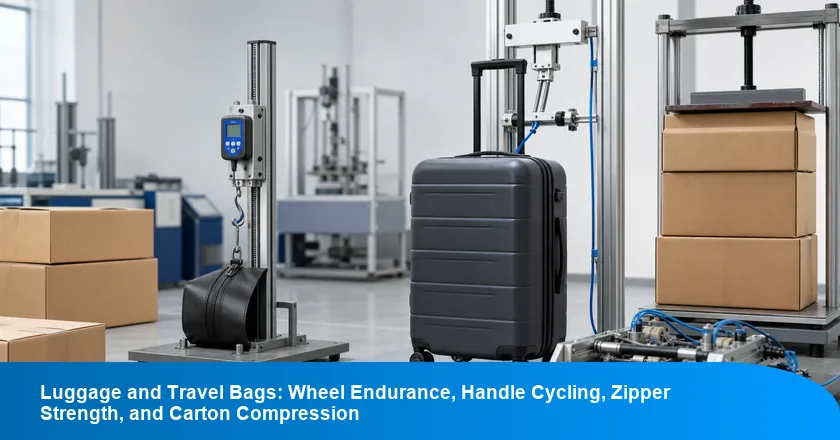
A suitcase that rolls smoothly on an empty factory floor can still fail after a loaded route, a repeated telescopic pull, a stressed zipper closure, or a stacked export carton. A decision-ready luggage quality inspection checklist therefore links each check to the actual component, the condition imposed, the proof retained, and the cartons covered by the decision.
The aim is not to invent a universal cycle count or pass limit. It is to help a Marketplace Quality & Operations Manager state the buyer-defined limits, see which evidence applies to which packed population, and hold only the portion of an order that cannot be shown to meet the same release brief.
What the Release Decision Must Show
A release population is the identifiable group of finished suitcases and export cartons covered by one buyer decision. A useful checklist proves more than appearance: it shows the component variant, the defined condition, the observed result, the acceptance rule, and the boundary of the lot that result represents.
- Four lanes, not one score: wheel, handle, zipper, and carton checks answer different questions and cannot substitute for one another.
- Buyer-defined conditions: intended load, route, cycle requirement, closure requirement, and packing configuration belong in the brief before sampling starts.
- Matched evidence: a strong component result does not clear cartons whose component or packing identity is unknown.
- Bounded action: hold, contain, correct, and recheck the affected population rather than averaging a mismatch across the full order.
Start With a Release Brief, Not a Generic Test List
A luggage quality inspection checklist becomes release evidence only when it names the component, condition, proof, and lot boundary. Here, a lot boundary is the documented set of units and cartons to which one result can honestly apply. The four fields prevent a checklist from becoming a collection of pleasant observations that cannot answer the harder question: which cartons, if any, may move today?
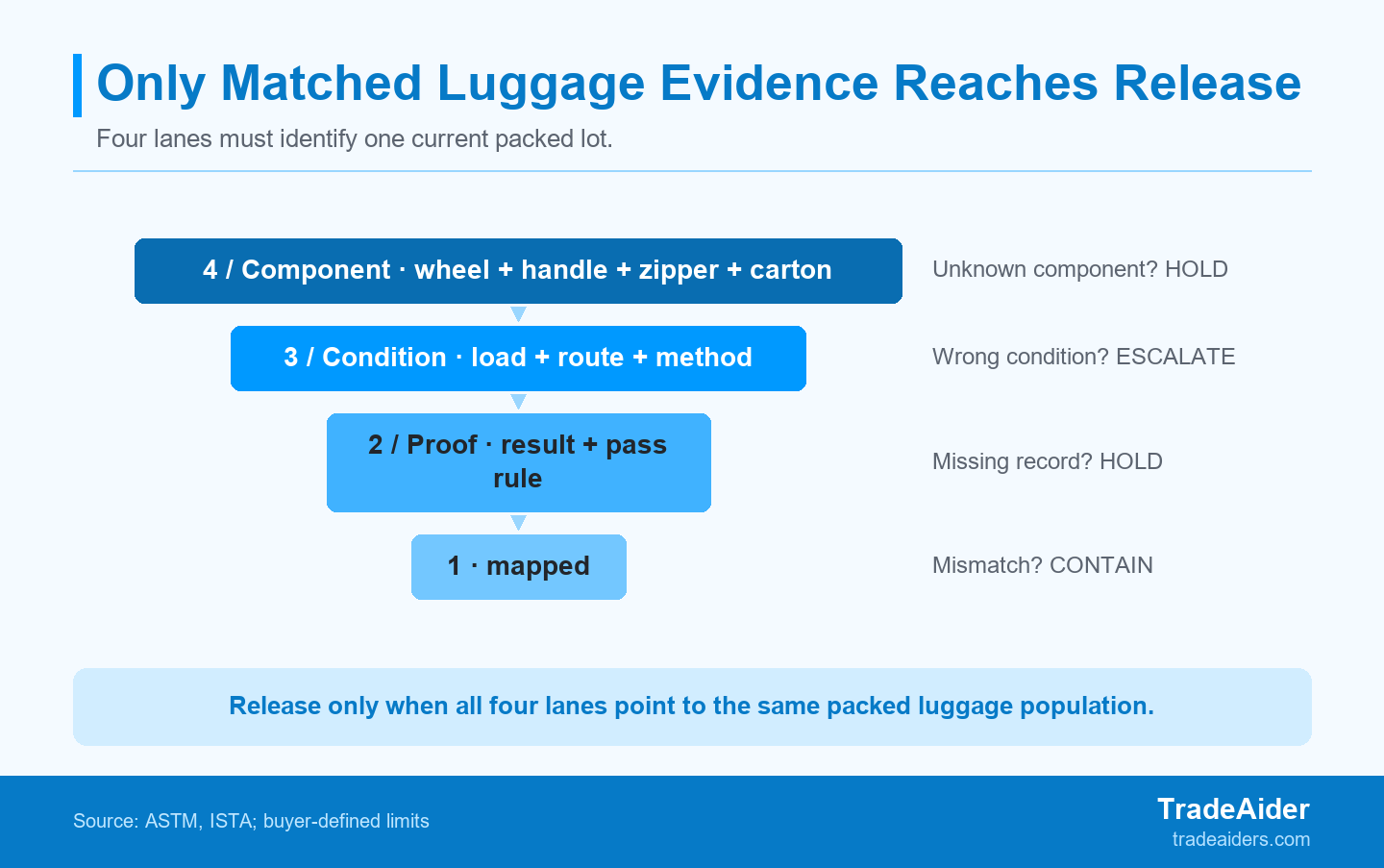
Use the funnel to keep wheel, handle, zipper, and carton evidence tied to the same packed luggage population before release.
Intertek identifies fastening, buckles, handles and wheels or rollers as strength-test considerations for luggage. That component scope is a useful reminder that “functional check” is not a condition by itself. Give each chosen check a named component, the actual product configuration, an observable failure condition, and a buyer-owned acceptance rule.
Start by freezing the SKU, shell material and size, wheel and axle assembly, telescopic-handle revision, zipper type, lock or puller configuration, liner, accessory set, retail pack, export-carton construction, and carton marks. Add the intended sales channel and route only where they alter the buyer’s own requirements. Your inspection standard guidance can be used to align sampling, defect definitions, and the evidence the report must retain. It does not replace a product-specific mechanical or transport requirement.
Match Each Component to the Event That Makes It Fail
A generic functional check is weak evidence when it does not recreate the component event that matters to the buyer. A wheel may need a loaded rolling route over the agreed surface; a handle may need repeat extension, lock engagement, and a loaded pull; a zipper may need the relevant closure and load event; and a carton may need the agreed packed compression condition.
Describe the event in plain language, then record the method reference or buyer instruction where one exists. “Wheel checked” should become the exact unit identity, load, route, obstacle or surface, travel distance or cycle requirement, defect definition, and disposition. “Carton okay” should become the packed configuration, orientation, applied condition, observed crease or crush state, and whether the sampled carton represents the labelled group. This makes a later review possible without suggesting that one factory observation is a laboratory certification.
Define Pass, Hold, and Escalation Rules Before Sampling
A useful luggage brief records what passes, what creates a hold, and what requires escalation before an inspector draws a sample. It should also state who owns each decision, because a supplier’s explanation is not the same as the buyer’s release approval.
For every lane, list the acceptance limit or named buyer requirement, the evidence expected, and the consequence of a deviation. A crack, intermittent lock, zipper separation, missing record, or carton mismatch may not carry the same classification, but each must have a defined route: accept, hold for buyer review, contain a traceable subset, or send for specialist testing. A pre-production inspection service is most useful before components and packing materials are committed, when the approved sample, variants, and evidence fields can still be locked into one practical brief.
Build the Four Evidence Lanes
Wheel, handle, zipper, and carton evidence should be treated as four distinct lanes because they prove different performance conditions. The practical rule is simple: a result in one lane may support that lane, but it cannot close a missing record or an unknown lot boundary in another. TradeAider can use this four-lane brief to scope observable inspection work and identify questions that need controlled testing or buyer escalation.
Wheel Endurance: Test the Rolling Assembly, Not a Free Spin
CTC notes distance travelled until irreversible deterioration of the wheel, bearing, or bar. The buyer should therefore define a route and failure condition for the complete rolling assembly, rather than approve a unit because its wheel turns freely when unloaded.
Record the wheel count and design, tread and hub material where relevant, axle and bracket identity, luggage orientation, intended load, telescopic-handle position if used for the route, route or obstacle profile, and the buyer’s endpoint. The endpoint might be a crack, a loose fastener, binding, wobble, loss of rolling function, or another specifically defined defect. Do not copy another suitcase’s distance into the brief without confirming its load, geometry, and customer promise. When a method or limit requires controlled specialist work, retain the method and evidence instead of converting an onsite observation into a substitute result.
Handle Cycling: Combine Travel Path, Lock Engagement, and Loaded Pull
A smooth empty extension does not prove a stable telescopic handle assembly under the buyer's intended load. The relevant evidence must show that the intended travel path, lock positions, tube alignment, grip connection, and loaded movement remain within the buyer’s defined condition.
Identify the handle revision and lock geometry, then agree whether testing covers full extension, intermediate positions, repeated deployment, retraction, and a loaded pull. During the observation, note delayed engagement, uneven tube travel, a lock that needs a second press, grip looseness, tube twist, or a visible deformation. Each observation should retain the unit ID and configuration. This turns a subjective “feels fine” finding into a record that distinguishes an isolated cosmetic concern from a repeatable functional risk.
Zipper Strength: Separate Cycle Feel From Closure Load
ASTM D2061 says no one zipper test determines suitability for a specific end use. That boundary matters for luggage: smooth slider travel, seam attachment, stop strength, tooth or coil engagement, and resistance under a loaded closure are related but not identical questions.
State the zipper construction, slider and puller type, number of compartments, locking arrangement, and intended packed condition. Then state what the buyer is asking the evidence to prove: repeated opening and closing, closure under an agreed load, resistance at a stop, or another defined condition. An inspector can observe fit, alignment, slider action, seam condition, and a buyer-defined functional check. If the required conclusion depends on a controlled method, use a product testing service or laboratory route with the actual sample, method, and acceptance rule rather than relying on an improvised force check.
Carton Compression: Ship the Packed Unit, Not an Empty Carton
ASTM D642 covers compression tests on shipping containers and components. For a buyer decision, the key question is which packed product, protective materials, carton build, orientation, and stacking condition the evidence actually represents.
Carton compression evidence is strongest when the product, protective packing, carton configuration, and stacked load are considered as one shipment condition. Confirm the inner packing, nesting arrangement, retail pack, carton dimensions and closure, carton grade or approved specification, pallet pattern where applicable, and the marks that connect the carton to the order. A clean empty box cannot prove that its packed contents will retain shape or protection under the buyer’s defined condition.
Worked Scenario: A Passed Pilot Does Not Automatically Clear the Packed Lot
A passed pilot sample cannot approve a mass-production luggage lot when component and carton records cannot show the same traceable population. The following illustrative case shows how a narrow hold can preserve a release option for the verified population while preventing an unverified subset from being averaged into a passed order.
ASTM D999 says vibration can affect the container, interior packaging, closure, and contents. The point here is not that a vibration page sets this buyer’s acceptance limit; it is that a carton and its contents form one distribution system, so a component-to-carton record is operationally important.
Contain the Untraceable Population Before It Becomes a Shipment Problem
The first response to an untraceable mismatch is to preserve the boundary between verified and unverified cartons, not to average the finding across the order. This is a containment decision, not a verdict that every carton has failed.
A marketplace seller is preparing a spinner suitcase with a telescopic handle, zipper closure, retail polybag, and export-carton configuration. The buyer’s brief names the intended loaded handle check, selected wheel route, zipper condition, carton configuration, and the records that must reach the final reviewer. The illustrative order contains 2,400 suitcases in 270 export cartons. The figures show an order large enough that an undefined change can affect a meaningful subset; they do not set a universal sample size, defect limit, or release threshold. An approved pilot sample used a documented handle-and-wheel configuration, while finished packing began before the buyer received a carton map linked to the current component lots. The supplier states that a later handle-component lot was introduced, but the carton marks do not distinguish it.
Six of 24 sampled production units need a second press before the telescopic handle locks at full extension. The result is recorded against the sampled units, but not yet against a defined carton population. Seven packed cartons show compression creases, while the packing record does not identify which carton groups contain the later handle-component lot. The observation may be correctable, but it cannot yet be matched to the same population as the function result. The sample and mass lot cannot share one release conclusion because the component change and the carton population do not establish a traceable evidence boundary. A report that calls the entire order passed or failed would conceal that uncertainty rather than resolve it.
Hold the untraceable packed population, identify the component and carton boundary, then decide whether a defined subset can be corrected and rechecked. A During Production Inspection (DPI) is an inspection during assembly when a change can still be contained; a during-production inspection service can be scoped when such a change is discovered before final packing makes containment more difficult. Map current handle lots to cartons, repeat the buyer-defined loaded function check on the affected population, inspect the carton configuration, and record the result against the same lot boundary. Keep original evidence separate from the corrective record so the reviewer can see what changed.
Reconsider release only when the component identity, observed function, carton group, and corrective record point to the same defined population. The buyer may then accept, hold, or segregate that population using the stated acceptance rules. The figures are illustrative and do not set a universal sample size, defect limit, cycle count, carton-compression limit, or release threshold. Actual scope depends on the product, buyer requirements, current records, and the condition being assessed.
Turn the Checklist Into a Timed Inspection Handoff
A final release packet should let one reviewer identify the current lot, the check condition, the result, and the action for every exception. It should stay readable when it passes from supplier to inspector, buyer, and logistics team, rather than relying on verbal context that disappears after the factory visit.
Lock Component and Packing Evidence Before Production
Before production, the buyer should lock the approved sample, component variants, intended load, packing configuration, and evidence needed for each lane. Assign a clear owner for the sample, component record, test evidence, carton map, and final release decision, so that a change creates a visible question rather than an undocumented substitution.
The resulting handoff can be concise: SKU and revision; approved sample reference; wheel, handle, zipper, and carton specifications; buyer-defined condition and pass rule for each lane; sample and carton identifiers; defects or exceptions; corrective evidence; and the stated status of release, hold, or escalation. Attach information only when it matches the current defined population. A supplier certificate from another version is context, not proof for the cartons awaiting buyer approval.
Check the Current Packed Lot Against the Same Release Brief
ISTA 3A states that the package and product are considered together, not separately. Apply that principle as a release boundary: confirm that the current suitcase configuration, protective packing, carton group, and buyer-defined damage tolerance are the same ones named in the evidence packet.
At final inspection, compare the current goods and cartons with the locked brief before interpreting individual findings. If a component, packing material, carton mark, or record changes, identify the affected population first. A Pre-Shipment Inspection (PSI) is a final inspection of a finished order before release. For a buyer who needs that independent check against the agreed brief, use the details to scope a luggage pre-shipment inspection around the named SKU, current components, carton groups, acceptance rules, and exception path.
Who Is TradeAider?
TradeAider supports global buyers with inspection and QA services across Guangdong, Zhejiang, Jiangsu, Shandong and Fujian. For luggage and travel bags, a productive request begins with the approved sample, current component variants, packing configuration, buyer-defined checks, and the production timing that determines whether a change can still be contained. The buyer can then state what needs an onsite observation, what needs a controlled method, and what must be decided by the responsible commercial or technical owner.
Its stated price is $199/man-day all-inclusive for Inspection & QA Services. Scope, travel availability, specialist testing, and timing should be confirmed for the actual factory, product, and decision required. TradeAider reports client-reported outcomes including an 18% reduction in defect rates and a 23% faster inspection process; those reported results are not a promise for any future order, product, supplier, or release decision. A well-scoped request names the approved sample, current component revisions, carton groups, buyer-defined acceptance rules, inspection timing, and the person who can decide a hold, correction, or release. This gives the factory a practical preparation list and prevents a final report from having to reconstruct unknown changes after packing is complete.
When the brief separates observable inspection work from a controlled laboratory method or market-specific decision, the buyer can give the right question to the right owner and keep the report useful. The buyer retains responsibility for acceptance limits, final release, and any technical or compliance determination outside the agreed inspection scope. TradeAider’s company profile identifies it as an Amazon Service Provider Network (SPN) partner.
Frequently Asked Questions
The remaining luggage-release questions concern thresholds, method scope, documentation, and when to hold a shipment. They help define a narrower decision, but they do not replace the buyer’s own acceptance criteria or the records needed to link evidence to the current packed lot.
How many wheel-test cycles should a suitcase pass?
There is no single defensible wheel-test cycle count for every suitcase, because the relevant load, route, obstacle profile, product construction, and pass condition vary by buyer requirement. Define the intended use condition and the irreversible-deterioration endpoint before testing. Then retain the unit identity, route, load, observed result, and evidence boundary so the record can be applied only to the luggage population it actually represents.
Can a PSI replace laboratory luggage testing?
No, a Pre-Shipment Inspection cannot replace a laboratory method when the buyer needs controlled, repeatable evidence for a specific mechanical or transport-performance requirement. A final inspection can confirm current product identity, packing, observable functions, and whether the agreed records are present. It should clearly flag the need for specialist testing when the decision depends on a controlled method, instrument, load, route, or acceptance limit outside the onsite scope.
What carton evidence should accompany a luggage inspection report?
A luggage inspection report should identify the carton configuration, lot or carton map, packing status, observed carton condition, and any linked test or hold result. It should also state which suitcase configuration, protective materials, carton specification, and buyer-defined condition the evidence represents. This enables a reviewer to see whether a carton observation belongs to the same packed population as the wheel, handle, and zipper records.
When should a buyer hold a luggage shipment?
A buyer should hold the affected luggage population when a component change, failed function, carton condition, or missing record cannot be matched to a defined and verifiable release boundary. Contain the affected cartons, identify what changed, and define the corrective check or specialist evidence required. Reconsider only the population whose component identity, observed result, packing condition, and records now support the buyer’s stated release rule.

Related Articles
Grow your business with TradeAider Service
Click the button below to directly enter the TradeAider Service System. The simple steps from booking and payment to receiving reports are easy to operate.

