
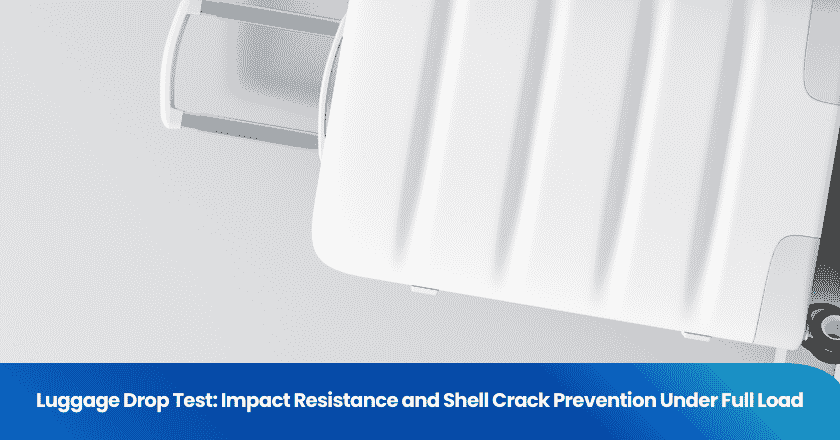
In the technical landscape of consumer hardlines, dynamic impact validation is the definitive measure of a product's reliability. For wheeled luggage, the ability to survive a gravitational drop under full load is not merely a marketing claim but an engineering necessity. The transition from a static object to a moving mass upon impact generates extreme "Hoop Stress" on the luggage shell, testing the elastic limits of polymers and the shear strength of mechanical fasteners. Industrial stakeholders must implement a rigorous testing framework that accounts for real-world logistical variables, including temperature-induced brittleness and load-bearing shifts. By adhering to international benchmarks like ISO 2248 and ASTM D5276, manufacturers can ensure that their products maintain structural fidelity, preventing catastrophic shell cracks and protecting consumer belongings during transcontinental transit.
Key Takeaways
- Dynamic impact validation quantifies the energy dispersion capabilities of luggage shells made from Polycarbonate, ABS, and Aluminum.
- ISO 2248 and ASTM D5276 provide the metrological framework for vertical drop testing of loaded containers.
- Conditioning specimens in controlled environmental chambers is mandatory to identify thermal embrittlement in polymers.
- The "Thin Shell" fallacy: Dimensional thickness is secondary to molecular purity and stress-relieved molding processes.
- Professional quality inspections are required to detect latent stress whitening and micro-fractures in corner radii.
- A statistically sound AQL-based inspection plan must include both unit-level and carton-level drop assessments.
The Physics of Impact Resistance: Energy Dispersion and Stress Concentration
When a loaded suitcase hits a rigid floor, the kinetic energy must be instantly converted and dissipated. In technical terms, the shell acts as a "crumple zone." High-quality materials like Polycarbonate (PC) utilize their high Izod impact strength to deform elastically, absorbing the energy and returning to their original shape. In contrast, rigid materials like ABS lack this "Memory" and often reach their fracture point instantly, resulting in "Shatter failure."
Stress Localization at Corner Radii
The most vulnerable sections of any hardshell luggage are the corners and the zones around functional openings (zippers and handles). Engineering analysis shows that stress concentrates at these points. High-performance luggage designs incorporate "Reinforced Radii" and shock-absorbing bumpers. During a product quality check, technical inspectors must verify the uniformity of material thickness in these high-stress zones to ensure there are no "Thin spots" caused by poor vacuum forming or injection molding cycles.
Standardized Testing Frameworks: ISO vs. ASTM Protocols
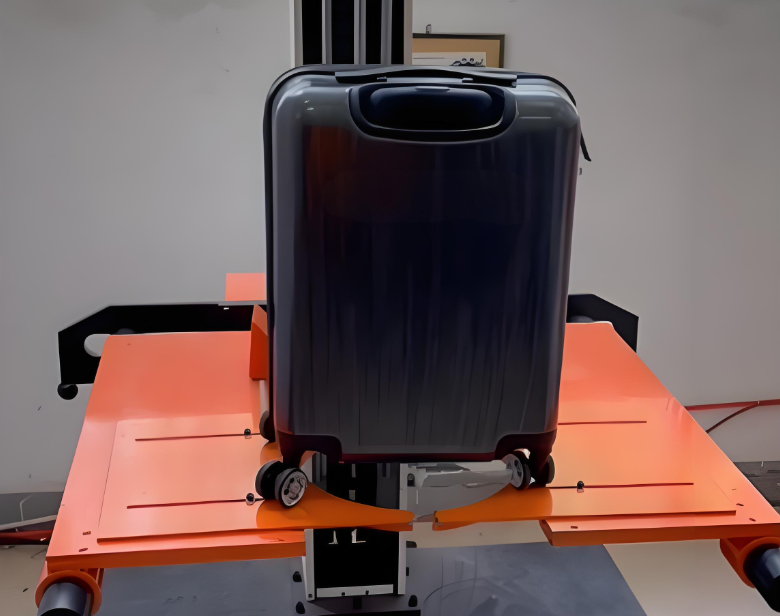
Consistency in durability assessment is achieved through adherence to global standards. These protocols define the drop height, the impact surface (typically a non-resilient steel or concrete plate), and the specific orientation of the drops. For a piece of luggage to be considered "Export Grade," it must clear a battery of tests that simulate the rigors of automated airport sorting systems.
| Standard | Technical Scope | Industrial Objective |
|---|---|---|
| ISO 2248 | Vertical Drop for Filled Packages | Verifies whole-unit structural fidelity |
| ASTM D5276 | Impact Testing for Loaded Containers | Quantifies protection of internal payload |
| SATRA TM242 | Hardshell Puncture Resistance | Measures resistance to sharp-object impact |
| ISO 7965-1 | Drop Test for Flex-Packaging | Relevant for softside luggage durability |
Material Performance Analysis: Polycarbonate, ABS, and Aluminum
Selecting the appropriate substrate is a technical trade-off between weight, cost, and impact resistance. Industrial lab data confirms that virgin polymers consistently outperform reground scrap material, as recycled chains have shorter molecular lengths, leading to lower fracture toughness.
Polycarbonate: The Engineering Standard
PC is a high-purity thermoplastic with an exceptional strength-to-weight ratio. Its technical advantage lies in its ductility. During a gravitational stress assessment, a PC shell will "dimple" rather than crack. This energy dispersion protects the internal contents and ensures the bag remains functional even after severe handling.
ABS and Thermal Vulnerability
ABS (Acrylonitrile Butadiene Styrene) is frequently used in budget-tier luggage. While it offers good scratch resistance, its "Glass Transition Temperature" (Tg) makes it technically unsuitable for cold-weather transit. In temperatures below 0'C, ABS becomes brittle. Industrial quality control audits often find that ABS luggage that passes a drop test at room temperature will shatter like glass when tested in a cold-chamber simulation.
| Material | Impact Score | Crack Resistance | Thermal Stability |
|---|---|---|---|
| PC (Virgin) | 9.5/10 | Superior | High (-40'C to 120'C) |
| PC/ABS Blend | 7.5/10 | Good | Moderate |
| ABS (Standard) | 4.0/10 | Poor (Brittle) | Low (Fails in cold) |
| Aluminum 6061 | 9.0/10 | Excellent | Extreme Stability |
The "Thin Shell" Fallacy and Design Optimization
A common misconception in the luggage industry is that a thicker shell equates to better safety. Metrological verification proves the opposite: a shell that is too thick can become too rigid to absorb shocks, while also complicating the cooling phase of manufacturing. "Uneven Cooling" during production creates residual internal stress, which is the primary cause of "Delayed Cracking"—where a suitcase appears perfect at the factory but cracks during its first trip due to pre-existing molecular tension.
Modern engineering focuses on "Ribbed Design." These grooves act as structural beams, increasing the stiffness of the shell without increasing its mass. During quality control inspections, technicians evaluate the "Rib Profile" to ensure that the energy of a 1.2-meter drop is channeled away from the zipper line and toward the reinforced corner bumpers.
Manufacturing Oversight and Industrial Quality Control
Quality is not inspected into a product; it is built through systematic oversight. For large-scale luggage orders, a technical quality and durability check must include three critical phases: Raw Material Audit, In-Process Molding Verification, and Final Random Inspection (FRI).
Technical Checkpoints in Production
- Virgin Polymer Verification: Utilizing Spectroscopic Analysis to ensure the supplier is not mixing in low-cost recycled ABS into a PC batch.
- Thermal Mapping: Monitoring the molding machine's "Cycle Time" to prevent internal stress buildup.
- Assembly Torque: Ensuring that the screws mounting the wheels and handles do not create "micro-tears" in the shell material.
- AQL 1.5/4.0 Limits: Applying strict Acceptable Quality Levels for functional rejections, including zipper teeth alignment and handle jolt endurance.
Utilizing onsite quality monitoring services ensures that these protocols are enforced 24/7. Digital reporting platforms now allow buyers to view "G-force" data and high-speed footage of the drop tests instantly, facilitating immediate decision-making for shipment approvals or rework requests.
Practical Guide for Professional Buyers and Importers
When sourcing hardshell or softside luggage, a technical checklist is essential to mitigate financial risk. Organizations should prioritize metrological evidence over sample aesthetics. A comprehensive technical report from a third-party laboratory should provide the following:
- Drop Test Matrix: Results for all six faces, three edges, and the most critical corner.
- Load Deflection Curve: Data showing the material's ability to return to its original shape after a 25kg load impact.
- Chemical Compliance (REACH/CPSC): Confirmation that the shell and linings are free from restricted phthalates and heavy metals.
- Wheels and Handle Endurance: Verification that the impact did not misalign the axle or fracture the telescopic handle's internal locking pins.
By prioritizing products that have passed industrial strength testing and compliance checklists, buyers can ensure they are delivering high-performance goods that reduce warranty claims and enhance brand loyalty.
Frequently Asked Questions (FAQ)
What is the standard drop height for a luggage test?
For most consumer goods, the standard height is 0.9 meters to 1.2 meters (approx. 3 to 4 feet). For "Hazardous Material" containers (Packing Group I), this height is increased to 1.8 meters under ISO 2248 protocols.
Does "Hardside" luggage crack more often than "Softside"?
Industrial data indicates that hardside luggage (specifically ABS) is more prone to visible cracking because it absorbs energy through material stress. Softside luggage (Nylon/Polyester) absorbs energy through structural compression, making it technically more resilient to impact, though it offers less puncture protection.
Why do suitcase wheels often break during the drop test?
The wheel assembly is a "Pivot Point." During a corner drop, the entire mass of the 25kg load is concentrated on the small axle of the castor. If the castor housing is made of low-grade PVC rather than glass-filled Nylon, it will shear off instantly.
What is "Stress Whitening" and is it a failure?
Stress whitening (Crazing) is the appearance of white marks on a polymer after impact. While not always a total structural break, it is a technical failure in premium QC as it indicates the polymer has reached its plastic deformation limit and the area is permanently weakened.
Can I perform a drop test at home to verify quality?
You can perform a basic "Item Drop," but without a "Rigid Foundation" (as specified by ASTM D5276), the results will be inconsistent. Professional labs use steel-backed concrete to ensure the bag receives the full force of the impact without the floor absorbing any energy.
Related Articles

Grow your business with TradeAider Service
Click the button below to directly enter the TradeAider Service System. The simple steps from booking and payment to receiving reports are easy to operate.

