
- About Us

- Our Services
- Your Industry
- Resources
- News & Blog
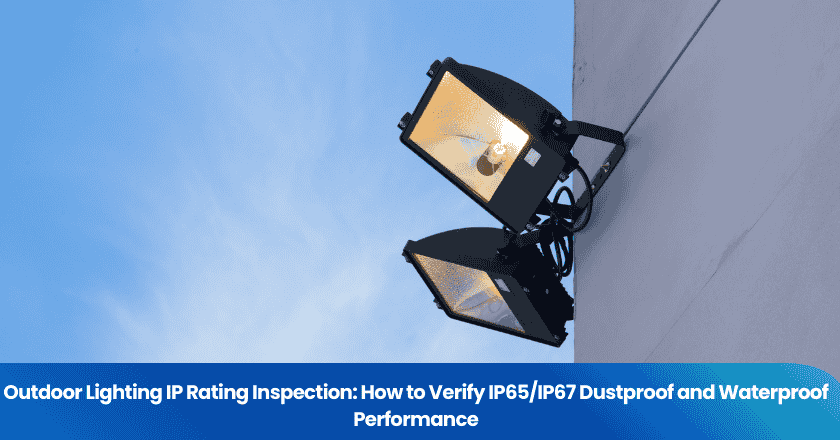
Outdoor lighting must withstand dust, rain, humidity, and occasional flooding to remain safe and functional. An IP rating inspection verifies that fixtures genuinely meet the IEC 60529 standard for ingress protection -- not just on paper, but through practical testing. IP65 and IP67 are the most common ratings for outdoor installations, each offering different levels of dust and water resistance. Choosing the wrong rating, or skipping verification, can lead to short circuits, insulation breakdown, and early fixture failure.
Key Takeaways
- IP65 and IP67 ratings indicate full dust protection, but differ in water resistance: IP65 handles water jets; IP67 survives short-term immersion.
- Visual inspection of seals, gaskets, and cable entries is the first step before any testing begins.
- Practical testing following IEC 60529 is essential -- paper certification alone is not sufficient to confirm real-world protection.
- Proper documentation and third-party test reports support regulatory compliance and traceability.
- Most ingress failures occur post-installation, making installation-quality checks as important as pre-shipment tests.
Outdoor Lighting IP Ratings Explained
What Is an IP Rating?
An IP (Ingress Protection) rating, defined by the IEC, indicates how well a product resists the entry of solid particles and water. The code consists of two digits: the first covers protection against solids (dust and debris); the second covers protection against water.
| First Digit (Solid Protection) | Description |
|---|---|
| 1 | Objects larger than 50 mm |
| 2 | Objects larger than 12.5 mm |
| 3 | Objects larger than 2.5 mm |
| 4 | Objects larger than 1 mm |
| 5 | Dust-protected (limited ingress, no harmful accumulation) |
| 6 | Dust-tight (no ingress) |
| Second Digit (Water Protection) | Description |
|---|---|
| 1 | Vertically dripping water |
| 2 | Dripping water up to 15 degrees tilt |
| 3 | Spraying water up to 60 degrees |
| 4 | Water splashing from any direction |
| 5 | Low-pressure water jets from any direction |
| 6 | High-pressure water jets from any direction |
| 7 | Immersion up to 1 meter for 30 minutes |
| 8 | Continuous immersion beyond 1 meter |
IP65 vs. IP67 for Outdoor Lighting
Both ratings offer complete dust protection (first digit: 6), but their water resistance differs significantly:
| Rating | Dust Protection | Water Protection | Typical Application |
|---|---|---|---|
| IP65 | Dust-tight | Low-pressure water jets from any direction | Street lighting, wall-mounted fixtures, general outdoor use |
| IP67 | Dust-tight | Temporary immersion up to 1 meter for 30 minutes | Flood-prone areas, underground installations, coastal environments |
IP65 is appropriate for most rain and wash-down environments. IP67 is necessary where standing water or temporary flooding is possible. Using an IP65 fixture in an IP67-required location is a common installation error that leads to premature failure.
IP Rating Inspection Steps
Visual Check of Lighting Fixtures
Inspectors begin the IP rating inspection by examining each fixture for visible defects. They look for cracks in the enclosure, poorly fitted gaskets, missing seals at cable entries, and improperly torqued fasteners. These visual failures are the most common cause of field ingress failures and can be detected before any testing takes place.
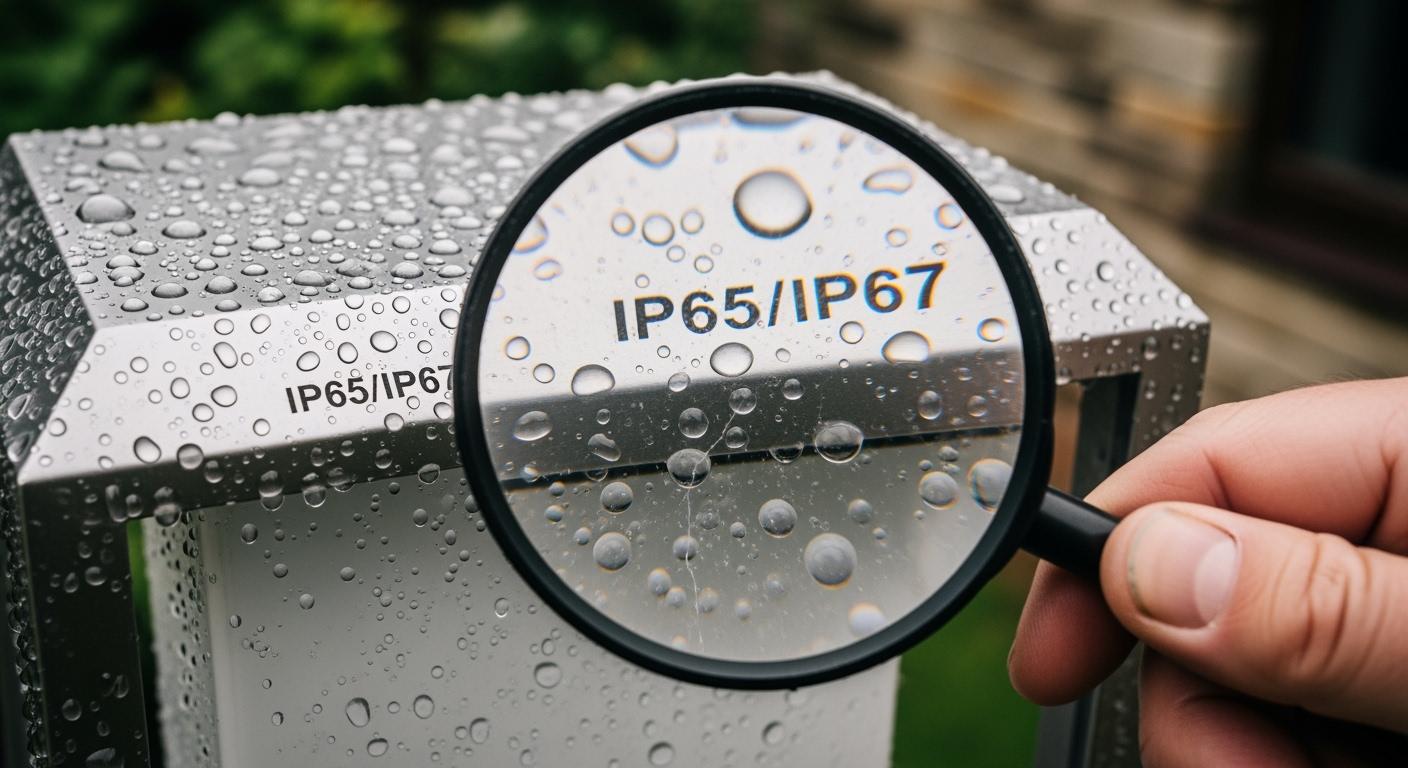
Tip: Use a flashlight and magnifying glass to spot micro-cracks and seal gaps that are not visible to the naked eye.
Reviewing IP Certification and Documentation
Inspectors verify that manufacturers can provide test reports, certificates, and technical drawings confirming compliance with IEC 60529. Documentation should cover electrical safety, mechanical construction, and thermal performance as well as ingress protection. Inspectors confirm that the stated IP rating matches the product's intended application and that all records are traceable to an accredited third-party laboratory.
Dustproof and Waterproof Testing Methods
Testing follows IEC 60529 protocols. Inspectors select test methods based on the required rating:
| Test Method | Description | Equipment | Conditions | Duration |
|---|---|---|---|---|
| IPX1 | Vertical drip test | Drip apparatus | 1.0 +/-0.5 mm/min | 10 minutes |
| IPX2 | 15-degree tilt drip test | Drip apparatus | 3.0 +/-0.5 mm/min | 10 minutes (4x2.5 min) |
| IPX5/IPX6 | Water jet test | Nozzle apparatus | Low/high pressure jet from any direction | Per IEC 60529 |
| IPX7 | Immersion test | Water tank | 1 meter depth | 30 minutes |
Dust chamber simulations use standardized talc concentrations and airflow conditions to replicate field exposure. After testing, inspectors open the enclosure and inspect interior surfaces for any particle or moisture ingress.
Note: Testing must follow IEC 60529 and other relevant standards to ensure accurate, repeatable results.
Recording and Interpreting Results
At TradeAider,all test outcomes, photos, and videos are recorded in a digital quality management system. Inspectors compare results against the claimed IP rating. Fixtures that pass all relevant tests receive verification confirmation; those that fail trigger immediate client notification.
Common Pitfalls in IP Rating Inspection
Overlooking Small Gaps or Weak Seals
Tiny gaps in seals or cable gland entries are the most common cause of IP rating failures. Incorrect cable gland selection can downgrade protection from IP66 to IP54. Over-tightening gaskets crushes the seal material, creating pathways for water ingress. Vibration from outdoor wind and traffic loads can open gaps over time. Missing or blocked pressure-equalization breathers create a vacuum during cooling cycles that pulls moisture inside the enclosure.
Tip: Check cable glands for correct sizing, inspect gaskets for even compression, and confirm that breathers are installed and unobstructed.
Misreading IP Documentation
Inspectors must distinguish between self-declaration and third-party certified test reports. A supplier's declaration of IP67 compliance carries less weight than an accredited laboratory test certificate. Inspectors should also verify that the test was performed on a production-representative sample, not a pre-production prototype with non-standard sealing.
Skipping Practical IP Tests
Relying on documentation alone without practical testing leaves outdoor lighting unverified. A fixture may carry a valid historic certificate but fail in current production due to component changes or manufacturing variations. Practical tests are the only way to confirm that shipped products perform to their rated specification.
Note: Always perform practical IP tests alongside documentation review. Use indoor-rated fixtures indoors only -- they are not IP65 or IP67 rated and will fail outdoors.
Best Practices Checklist
Before Inspection
Inspectors review lighting design documentation, confirm enclosure seals and gaskets are in place, verify IP-rated connectors and fasteners are used, and organize all certificates and technical drawings before testing begins.
During Testing
Industry best practices for reliable inspection results include:
- Conduct pre-certification tests to detect design weaknesses early.
- Use accredited laboratories for formal test certification.
- Specify interlocking enclosure designs for consistent gasket compression.
- Select gaskets rated for the operating temperature range.
- Use IP-rated connectors and protective coatings on PCBs.
- Install waterproof membranes to allow pressure equalization.
- Use non-corrosive fasteners and apply controlled torque values.
After Inspection
At TradeAider, inspectors upload all photos and test data to the digital system during the inspection and conduct further verification after the inspection. Clients receive official reports within 24 hours. Failed batches are placed on hold pending corrective action or the client’s decision on acceptance. This process reduces defect escape rates and ensures every outdoor installation meets its rated protection level.
Thorough IP rating inspection -- combining visual checks, documentation review, and practical testing -- is the only reliable way to confirm that outdoor lighting will perform as rated in real conditions. Third-party inspection adds objectivity and expertise, reducing liability for buyers and installers alike.
| Third-Party Inspection Value | Description |
|---|---|
| Specialized Expertise | Experienced inspectors conduct efficient, standard-compliant evaluations |
| Liability Reduction | Independent agencies assume inspection risk, reducing buyer liability |
| Unbiased Evaluation | No commercial relationship with the manufacturer ensures objective findings |
| Code Compliance | Inspectors remain current with evolving IEC and regional electrical codes |
Ready to secure your product quality before shipment?
As your third-party inspection, testing & certification partner in China, TradeAider supports brands and sourcing teams across the entire production process, helping you identify quality risks early, ensure compliance, and strengthen your team’s capabilities before shipment.
Book an Inspection or Testing Service with TradeAider today, or for tailored solutions and expert guidance, contact us at services@tradeaider.com.
FAQ
What does IP65 mean for outdoor lighting?
IP65 means the fixture is fully dust-tight and resists low-pressure water jets from any direction. It is suitable for rain, hose cleaning, and most standard outdoor environments, but not for immersion or flooding scenarios.
How do inspectors test for IP67 waterproof performance?
Inspectors submerge the fixture in water to a depth of 1 meter for 30 minutes, then open the enclosure to check for any ingress. The fixture must operate normally after the test with no internal moisture detected.
Why is third-party inspection important for IP ratings?
Third-party inspection provides unbiased results that self-certification cannot guarantee. Inspectors use calibrated equipment, follow international standards, and issue official reports that support regulatory compliance and buyer confidence.
What happens if a lighting fixture fails the IP test?
Inspectors notify the client immediately. The client can request on-site corrective action, reject the batch, or arrange re-testing after the root cause is resolved. Quick communication prevents non-compliant fixtures from reaching installation sites.
Related Articles
Grow your business with TradeAider Service
Click the button below to directly enter the TradeAider Service System. The simple steps from booking and payment to receiving reports are easy to operate.

