
- About Us

- Our Services
- Your Industry
- Resources
- News & Blog
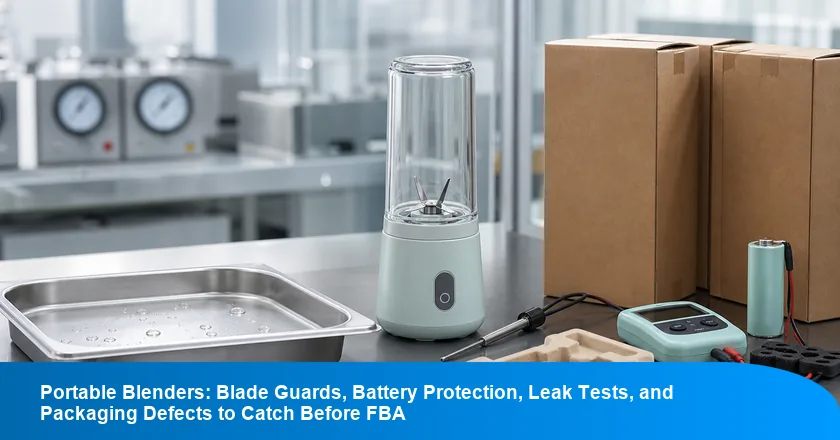
Portable-blender release evidence is the record that ties a named blender version and carton population to the blade, battery, liquid-containment, and packaging checks used for a bounded FBA handoff.
A portable-blender release decision is only as useful as the evidence attached to the identified product version and carton population. A blender that powers on at the factory can still have an unresolved blade attachment, battery configuration, gasket, or retail-pack question. The practical objective is not to label a product universally “safe”; it is to state exactly what was checked, which packed units that evidence covers, and what remains on hold.
Why a Functional Sample Is Not an FBA Release Decision
Before FBA prep begins, lock the product identity: model, cup and blade-base revision, battery pack specification, charging specification, retail-pack version, carton code, and quantity. Then attach every observation to that identity. This avoids a familiar mismatch: a passed sample from an earlier build is treated as approval for cartons that contain a changed gasket, different battery pack, or revised protective insert. A useful release record is therefore narrower than a marketing claim and more useful than a simple “inspection passed” label.
The Four Facts That Set FBA Release Scope
The least-supported of the four locks should determine release status for its identified carton population. Treat that as a buyer decision rule, not as an Amazon or regulatory rule.
- Blade lock: record the intended safe state, interlock behavior, blade attachment, and blade guard condition.
- Battery lock: match the battery-powered configuration and supplied transport record to the finished unit.
- Liquid lock: define the cup, gasket, fill condition, inversion check, dwell time, and failure condition.
- Pack lock: tie the verified retail pack and export carton to the distribution test or handling route selected for that product.
Use the Four-Lock FBA Release Framework
A portable blender has separate mechanical, energy, liquid, and package evidence routes. A UK government risk assessment of one non-compliant portable juice blender describes exposed-blade activation and unsecured internal components, illustrating why a successful blend or power-on check cannot answer every route for every model. Read the GOV.UK portable-blender risk assessment.
The Four-Lock FBA Release Framework keeps those routes visible. It asks one question for each lock: does the record describe the actual finished configuration and its identified carton population? Start with a product-specific inspection standard for documented acceptance criteria. TradeAider can then use that scope to keep an inspection observation, a testing question, and a transport record from being presented as the same kind of proof. Use a During Production Inspection for portable-blender assembly control when a component, assembly step, or packaging specification can still be corrected before final sealing. The framework does not make an inspection report a transport certificate, laboratory result, or marketplace approval.
Blade lock: verify the safe state, attachment, and protective part
A portable blender can present a combined fire and laceration concern when blades break or the unit overheats. Health Canada’s BlendJet 2 recall identifies both pathways in one portable-blender product context; use it as a category warning, not a defect-rate estimate for another model. Review the Health Canada recall.
Blade attachment needs its own inspection condition because a loose assembly can create a laceration hazard. A separate Health Canada recall describes a Cuisinart unit with a loose nut that could allow the blade to detach, so the inspection brief should name the actual attachment mechanism for the model being bought. See the blade-attachment recall.
For the purchased model, record whether the blade guard is present and undamaged, what condition it is meant to protect, whether the cup or lid interlock prevents unintended activation as specified, and whether the blade-base interface shows looseness, deformation, or mismatch. A guard is a defined protective part; it does not by itself establish the condition of every mechanical or electrical pathway.
Battery lock: match the assembly to its record before calling it shipment-ready
Lithium battery shipping requirements are configuration specific, so a portable blender needs records that identify the actual battery-powered configuration. The FAA’s lithium-battery resource describes shipping guides organized by cell or battery type, configuration, and size; confirm the applicable route, carrier, and current marketplace requirements separately. Use the FAA lithium-battery resource.
At inspection, a buyer can compare the agreed battery pack, charging port, housing fit, visible markings, charging specification, and supplied document identifiers against the finished unit. A battery test summary is a transport-document record for a stated battery design; it is not a visual-inspection result. Escalate a changed pack, board, charger, cell marking, or document identifier to the responsible transport or technical review path before the carton is described as shipment-ready.
Liquid lock: make the seal observation specific enough to repeat
FDA explains that the regulatory status of a food-contact article depends on the regulatory status of each individual substance that comprises it. That is why a gasket leak result and a food contact material record must remain separate evidence routes. Read FDA’s food-contact material guidance.
Make the liquid observation reproducible: state the cup and gasket revision, fill condition, lid state, orientation, inversion check, dwell time, and what counts as a failure. For example, “moisture at the lower cup thread after the agreed inversion-and-dwell check” is a bounded observation. It does not establish chemical suitability, food-contact status, or a universal leak-free outcome. If the gasket changed after sampling, connect that observation to the revised carton code before any split release.
Pack lock: test the package as the carrier of the verified unit
A package test should examine whether the actual container and inner pack protect the contents under the selected distribution hazard. ASTM D5276 describes free-fall drop evaluation for a container and its inner packing; it is a method scope, not a mandatory FBA test. Review ASTM D5276’s method scope.
ISTA distinguishes integrity screening tests from general-simulation tests designed to represent transport damage-producing environments. Select a route that fits the product and distribution environment rather than presenting one carton challenge as a universal FBA guarantee. Compare ISTA test-procedure purposes.
Check the retail pack, inner protection, cup-and-blade retention, carton marking, count, seal, and any FBA prep instruction against the finished packed unit. A pristine-looking export carton cannot compensate for a loose insert, mismatched retail pack, or product revision that was not part of the selected package test.
Route Each Finding to the Evidence That Can Answer It
US transport rule 49 CFR § 173.185 sets applicable design-test and test-summary availability conditions for covered lithium cells and batteries. It is a transport-rule boundary, so it should be checked against the applicable battery configuration rather than treated as a general product-safety conclusion. Read 49 CFR § 173.185.
Inspection observations, battery transport records, food-contact records, and package tests should stay in separate evidence columns until they support the same product version and carton population. That separation makes a change visible instead of allowing a document for one component or sample to cover a different packed configuration.
| Lock | What inspection can record | Evidence that remains separate | Release action |
|---|---|---|---|
| Blade | Guard, interlock, attachment, visible condition | Product-specific safety or engineering evidence | Hold the named revision if the safe-state condition is unresolved. |
| Battery | Pack identity, port, markings, supplied document identifier | Applicable transport and battery-design records | Escalate a changed configuration or missing record. |
| Liquid | Gasket revision and defined inversion-check result | Food-contact material documentation or testing | Contain the coded subset with a failed seal observation. |
| Pack | Retail pack, insert, carton code, count, and visible defects | Selected distribution-test result | Do not substitute a generic carton result for the packed unit. |
When a question needs a laboratory or document route, keep it distinct from the inspection report and define the handoff. product testing for questions an inspection cannot settle can sit beside inspection evidence without being silently converted into an inspection conclusion.
Worked Scenario: A Late Gasket Change Creates a Traceable FBA Hold
The illustrative 20-carton changed-gasket population should be held until its corrected configuration and seal evidence match its carton code. The point is not that 20 cartons is a universal threshold; it is that a late change needs a traceable decision boundary.
Why the changed cartons need their own verification gate
A selective release is defensible only when the unaffected subset remains identifiable through the final carton boundary. If that identity is lost, the buyer cannot confidently limit the hold to the intended cartons.
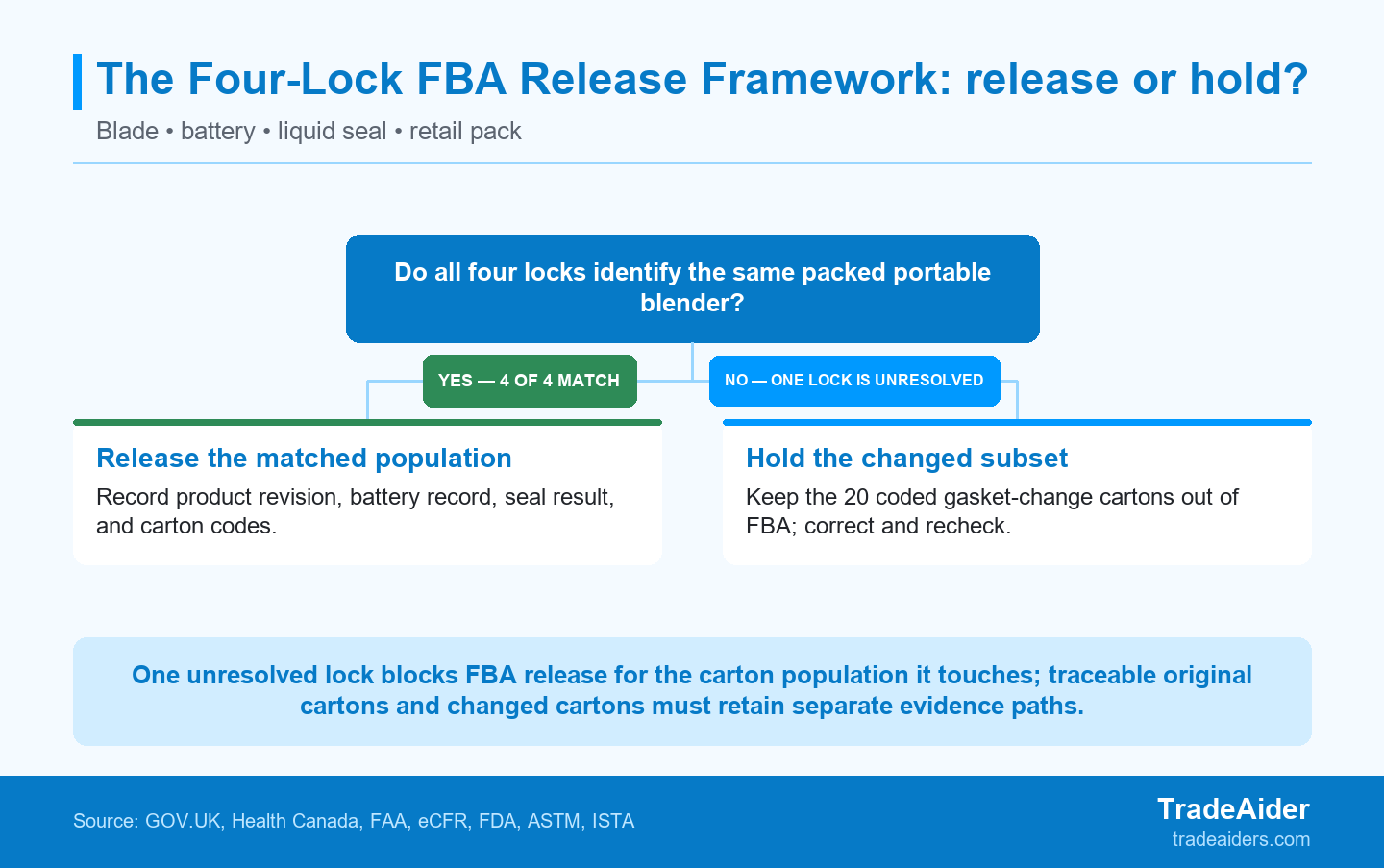
A portable-blender release can split only when the revised carton population remains traceable. The 20 changed-gasket cartons in this illustrative order stay on hold until the corrected configuration and its evidence match.
An Amazon FBA seller is preparing a rechargeable portable blender with a detachable cup and blade-base assembly. The illustrative order contains 2,400 units in 60 export cartons; 20 cartons carry a separately coded cup-gasket revision introduced after the approved sample. All 60 cartons are sealed and the buyer is preparing the FBA shipment plan.
Two of eight selected units from the changed-gasket cartons show moisture at the lower cup thread after the agreed inversion-and-dwell check. The 20 changed-gasket cartons are identifiable by a packing code, while the remaining 40 cartons retain the original coded configuration. The seal finding is limited to the changed subset, and the carton code preserves the difference. The inspection does not prove food-contact status or battery conformity; those are separate routes that must match the actual configuration.
Hold the 20 changed-gasket cartons from FBA handoff. Keep the 40 original-coded cartons separate in the evidence register; neither group should be described beyond the evidence attached to its own product version and carton population. The supplier corrects the changed gasket, retains the revised code, checks the relevant retail-pack condition, and provides the matching component and battery document identifiers for review.
The changed 20-carton population can be reconsidered only after a product-specific seal recheck, matching component records, and carton identification confirm that the corrected configuration is the one packed. These quantities and selected units are illustrative. They do not prescribe a universal sampling plan, leak method, FBA prep requirement, or marketplace decision.
For the next operational step, use Amazon FBA inspection for the traceable blender population to keep the coded subset and its handoff record aligned with the seller’s e-commerce workflow.
Write an FBA Handoff That Matches the Evidence
An FBA handoff should name the product revision, carton population, evidence attached to each lock, and any unresolved hold condition. It should make a receiver able to see the decision boundary without inferring that a pass on one route clears the other three.
A release boundary is the identified population of units and cartons covered by the buyer decision. Name it before a carton moves to FBA, and widen the hold if the code, product revision, or evidence match cannot be maintained.
- Identify the population. List the purchase-order reference, finished product revision, carton code range, quantity, and whether the carton contains a changed component or retail pack.
- List each lock separately. State the blade, battery, liquid, and pack observations with their method, date, and evidence owner. Mark an unresolved item as a hold or escalation, not as a pass.
- Attach the right record. Keep inspection observations, battery transport documentation, food-contact evidence, and package-test results in their own references, all matched to the applicable version.
- State the next release gate. For the final packed population, use a Pre-Shipment Inspection for the identified FBA lot to verify the agreed finished configuration and export-pack condition before handoff.
The Four-Lock FBA Release Framework is intentionally conservative: release language belongs only to the lock set and carton population actually supported by the record. Verify current Amazon requirements in Seller Central and current carrier requirements for the actual shipment route before booking.
Who Is TradeAider?
TradeAider is a quality inspection, testing, and certification service provider in China. It operates across major manufacturing provinces including Guangdong, Zhejiang, Jiangsu, Shandong, and Fujian, helping overseas buyers keep inspection observations and testing questions in their proper evidence routes.
For portable blenders, TradeAider can help turn the supplier’s product revision, battery documents, seal method, retail pack, and export-carton identifiers into a buyer-facing scope. Inspection & QA Services are priced at $199/man-day all-inclusive. As an official Amazon Service Provider Network (SPN) partner, TradeAider supports buyers preparing China-sourced products for e-commerce workflows while leaving carrier, platform, and regulatory determinations to their applicable owners.
TradeAider reports client-reported outcomes of an 18% reduction in return rates and a 23% reduction in defect rates; those figures are not a promise for a specific product or order. For a portable-blender scope that separates blade, battery, liquid, and package evidence, request a portable-blender inspection brief from TradeAider before the final carton population is sealed.
Frequently Asked Questions
Does a blade guard make a portable blender safe to ship and sell?
No: a blade guard can protect a defined storage or handling condition, but it does not by itself prove the blade system, interlock, attachment, battery pack, or completed product is safe for every use. Record the guard’s presence and intended condition, then keep any broader product-safety evidence on its own route. It should never stand in for the remaining checks.
Can a pre-shipment inspection verify a portable blender battery?
A pre-shipment inspection can verify a portable blender battery only within a defined visual and document-matching scope for the named unit. It can verify agreed external configuration, markings, charging specification, and supplied document identifiers, but it cannot replace product-specific battery testing, transport documentation, or electrical-safety evaluation. A changed pack or board requires the record to be checked against that actual configuration.
What is a useful leak test for a portable blender before FBA?
Use a product-specific method that names the cup, lid, gasket, fill condition, orientation, dwell time, and failure condition. Record wetting or loss against the identified unit and revision, including an inversion check where that is the agreed method. The result supports a liquid-containment observation; it does not determine food-contact material status.
When should a changed portable-blender carton subset be held before FBA?
Hold the changed subset when its component revision, seal result, battery record, or packaging evidence cannot be matched to a defined carton population and corrected through a product-specific verification gate. If the changed and original cartons are no longer traceable, a selective release cannot be bounded with confidence, so the release decision needs a broader hold, a new evidence plan, and an updated carton identity before any handoff.

Related Articles
Grow your business with TradeAider Service
Click the button below to directly enter the TradeAider Service System. The simple steps from booking and payment to receiving reports are easy to operate.

