
- About Us

- Our Services
- Your Industry
- Resources
- News & Blog
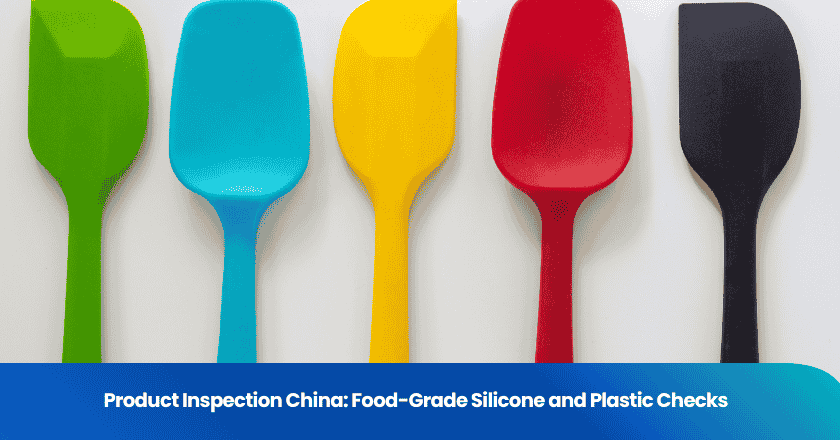
Food-grade silicone and plastic products from China end up in kitchens, baby bottles, and food packaging worldwide. But "food-grade" is a claim, not a guarantee — without proper inspection, you could be importing products that leach chemicals, transfer odors, or fail to meet the safety standards your market demands. This guide explains exactly what importers need to know about inspecting food-grade silicone and plastic products manufactured in China.
Key Takeaways
- Three regulatory frameworks govern food-grade materials: FDA (US), LFGB (EU/Germany), and China's GB 4806 series — each with different testing requirements and strictness levels
- LFGB certification is stricter than FDA for silicone products, making it the preferred standard for premium brands targeting the European market
- China's GB 4806.16-2025 introduced updated requirements for silicone rubber food contact materials, including a new volatile matter limit of 0.5%
- A three-stage inspection approach — pre-production, during production, and pre-shipment — catches compliance issues before they become costly recalls
- On-site inspection and laboratory testing serve different purposes: both are needed for full food-grade compliance verification
Why Food-Grade Silicone and Plastic Inspections Matter
Food contact materials occupy a special category in quality control because the consequences of failure extend beyond product performance — they directly affect human health. A silicone baking mold that leaches volatile compounds at oven temperatures, or a plastic container that transfers chemicals into food, isn't just a quality issue. It's a regulatory violation, a recall risk, and a potential health hazard.
Health Risks of Non-Compliant Materials
Non-food-grade silicone and plastic can contain fillers, plasticizers, and residual monomers that migrate into food during contact. Heavy metals like lead and cadmium, primary aromatic amines from certain plastics, and volatile organic compounds from low-quality silicone all pose documented health risks. The difference between food-grade and non-food-grade material is often invisible to the naked eye — which is precisely why testing and inspection are essential.
Regulatory Landscape: FDA, LFGB, and GB Standards
Food contact materials face a patchwork of regulations depending on your target market. The United States relies on FDA regulations (21 CFR 177.2600 for rubber articles, various sections for plastics). The European Union follows the LFGB framework administered by Germany, which is widely recognized as the most stringent food contact standard in the world. China has its own GB 4806 series, which applies to products manufactured domestically and sold within China, but also serves as a baseline for manufacturers producing food-grade goods for export (per knoell's regulatory update on Chinese food contact standards).
Understanding the Key Standards
Before you can inspect food-grade silicone and plastic products effectively, you need to understand what "food-grade" actually means under each regulatory framework.
FDA 21 CFR 177.2600 and Food Contact Notifications
The FDA regulates food contact materials under Title 21 of the Code of Federal Regulations. For silicone rubber products, 21 CFR 177.2600 sets extraction limits using solvents like hexane and water. For plastic products, different CFR sections apply depending on the polymer type — PET, PP, PE, PA, and others each have specific compositional and extraction requirements. FDA compliance is the minimum standard for selling food-grade products in the United States.
LFGB: The Gold Standard for Food-Grade Testing
Germany's LFGB (Lebensmittel- und Futtermittelgesetzbuch) is widely considered the most rigorous food contact material standard globally. For silicone products, LFGB testing includes:
- Overall migration testing under various food simulants and temperature conditions
- Sensory testing for odor and taste transfer — a requirement absent from FDA testing
- Composition analysis to verify no prohibited fillers or additives are present
- Volatiles testing with stricter limits than FDA requirements
According to Kean Silicone's comparison of LFGB and FDA standards, LFGB-grade silicone products are considered superior to FDA-grade ones because the testing is more comprehensive and the pass thresholds are tighter. Many premium brands require LFGB certification even for products sold exclusively in the US market, as it provides an extra layer of safety assurance.
China GB 4806.16-2025 for Silicone Rubber
China released updated food contact standards for silicone rubber materials under GB 4806.16-2025. This standard includes several significant changes from previous versions:
| Requirement | GB 4806.16-2025 Specification | Notes |
|---|---|---|
| Overall Migration | 10 mg/dm2 | Standard limit for food contact |
| Potassium Permanganate Consumption | Specified limit applies | Measures oxidizable substances |
| Heavy Metals | Must not exceed specified limits | Lead, cadmium, and others |
| Volatile Matter (New) | 0.5% maximum | Aligned with German requirements |
| Positive List of Base Materials | 21 approved base materials | New in 2025 revision |
The new volatile matter limit of 0.5% is particularly significant — it aligns China's standard with German requirements and raises the bar for Chinese silicone manufacturers (per CIRS Group's analysis of the GB 4806 updates). For importers, this means Chinese factories producing to GB 4806.16-2025 standards are already meeting a higher threshold than the basic FDA requirements.
What Inspectors Check: Food-Grade Silicone and Plastic
Understanding what happens during an actual food-grade inspection helps you set better specifications and get more useful results. Here's what a thorough inspection covers.
Visual and Dimensional Inspection
Every food-grade inspection starts with visual and dimensional checks. For silicone products, inspectors look for surface defects (bubbles, tears, discoloration), dimensional accuracy against specifications, and proper labeling including food-grade symbols and material identification marks. For plastic products, they check for flash, sink marks, short shots, and color consistency.
While visual inspection might seem basic compared to chemical testing, it catches a surprising number of food safety issues. Discoloration can indicate contaminated raw material. An unusual smell from a silicone product suggests non-food-grade fillers. Uneven wall thickness in a plastic container affects both performance and migration behavior.
Material Verification Tests
On-site material verification is where food-grade inspection separates from general product inspection. Inspectors can perform several tests directly at the factory:
- Stretch test for silicone: Food-grade silicone stretches without whitening. If a silicone product turns white when pulled, it likely contains non-food-grade fillers.
- Burn test: Food-grade silicone produces a white smoke and leaves a white ash. Non-food-grade silicone creates black smoke and leaves a dark residue.
- Smell test: Food-grade silicone should be odorless, even after heating. Any chemical or plastic smell indicates potential contamination.
For comprehensive material verification that goes beyond on-site testing, TradeAider's product testing service coordinates laboratory analysis through accredited partners.
Odor and Taste Transfer Tests
Odor and taste transfer testing is a requirement under LFGB but not under FDA — and it's one of the most practical on-site tests an inspector can perform. The test involves placing the silicone or plastic product in contact with a neutral food simulant (usually distilled water) at elevated temperature, then checking whether the product imparts any odor or taste to the liquid. A food-grade product should be completely neutral.
Common Defects Found in Silicone and Plastic Food Products
| Defect Type | Silicone Products | Plastic Products |
|---|---|---|
| Material Substitution | Non-food-grade fillers added to reduce cost | Recycled or industrial-grade resin used |
| Migration Failures | Exceeds overall migration limits in testing | Plasticizer leaching detected |
| Odor/Taste Transfer | Chemical smell after heating | Plastic taste transferred to food |
| Labeling Errors | Missing food-grade symbol, wrong material code | Missing resin identification code |
| Physical Defects | Bubbles, tears, uneven thickness | Flash, sink marks, warping |
Material substitution is the single most critical issue for importers to watch. Some factories will use industrial-grade silicone or recycled plastic to cut costs, especially on large orders where the price difference adds up to significant savings for the manufacturer. This is where pre-production inspection proves its value — catching material issues before production starts is far less expensive than discovering them after 50,000 units have been manufactured.
How to Structure Your Inspection for Food-Grade Products
Food-grade silicone and plastic products benefit from a three-stage inspection approach that matches quality checks to each production phase. This is where many importers cut corners — relying solely on a single pre-shipment inspection — and it's exactly how material substitution and process drift go undetected.
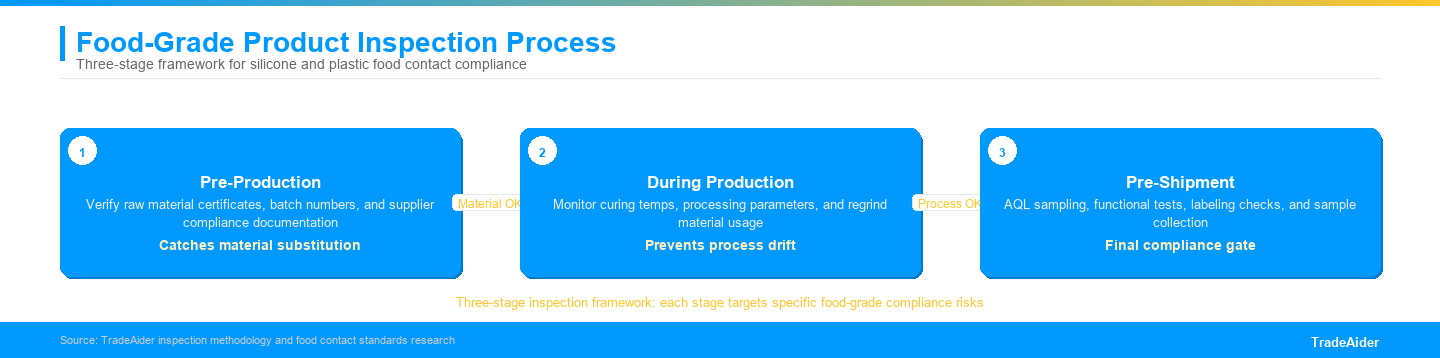
The three-stage inspection framework for food-grade products: each stage targets specific risks that cannot be caught by the subsequent stages alone
Pre-Production: Raw Material Verification
Before production begins, an inspector verifies that the factory is using the correct raw materials. This means checking material certificates (FDA/LFGB/GB compliance documents), verifying batch numbers against supplier documentation, and confirming that the specified grade of silicone or plastic resin is actually loaded into the machines. For a Shopify brand importing silicone baby feeding sets, a pre-production check caught that the factory had switched to a cheaper silicone grade after the initial sample approval — a change that would have resulted in products failing LFGB migration testing.
During Production: Process Controls
During production inspection (DPI) focuses on manufacturing parameters that affect food safety. For silicone molding, inspectors monitor curing temperatures and times — undercured silicone can have elevated volatile compound levels. For plastic injection molding, they check processing temperatures, cooling times, and whether the factory is using regrind material (which can introduce contamination). Real-time monitoring during DPI lets you intervene immediately if parameters drift outside specifications.
Pre-Shipment: Final Compliance Check
The pre-shipment inspection (PSI) is your last line of defense before products leave the factory. At this stage, inspectors perform a comprehensive check against your specifications: visual and dimensional inspection on an AQL sample, functional testing (lid fit, seal integrity, heat resistance), labeling verification, and collection of samples for laboratory testing if required. Using the AQL calculator ensures your sample size is statistically valid for the lot size being inspected (per AQI Service's food contact materials testing guide).
Choosing the Right Testing Approach
On-Site vs. Laboratory Testing
On-site inspection and laboratory testing serve complementary roles in food-grade compliance. On-site inspection catches visual defects, dimensional issues, labeling errors, and basic material verification (stretch test, smell test). Laboratory testing is required for definitive migration analysis, heavy metals screening, volatile matter measurement, and sensory testing under controlled conditions.
The practical approach most experienced importers use: conduct on-site inspection at every production stage, and send samples to an accredited laboratory for full food contact testing on the first production run of a new product or new supplier. Subsequent runs can rely on on-site inspection alone if the factory has demonstrated consistent material quality.
When to Request Third-Party Lab Certification
You should request full third-party laboratory certification in these situations:
- First production run with a new supplier
- Change in raw material supplier or grade
- Products targeting the EU market (LFGB compliance required)
- Products for infant or baby use (stricter regulatory scrutiny)
- After any significant production process change
For ongoing quality assurance, reviewing the inspection standards applicable to food contact materials helps you set appropriate checklists and acceptance criteria for your inspector (per PackagingLaw's analysis of China's silicone rubber standards).
Practical Tips for Importers
- Always request material certificates before production begins — FDA, LFGB, or GB compliance documents for the specific batch of silicone or plastic resin being used
- Include a stretch test in your inspection checklist for silicone products — it's the fastest on-site indicator of material quality
- Specify your target market's standard in your purchase order and inspection requirements — don't assume the factory knows whether you need FDA, LFGB, or both
- Send samples to a lab on the first run — even if on-site inspection looks perfect, migration and chemical testing can only be done properly in a laboratory
- Beware of price-driven material substitution — if a factory's quote is significantly lower than competitors, they may be cutting corners on raw material quality
- Use three-stage inspection for high-volume orders — the cost of PPI + DPI + PSI is a fraction of the cost of a product recall
For importers who want a structured approach to food-grade quality control, contact TradeAider's team to discuss an inspection plan tailored to your silicone or plastic product line.
Frequently Asked Questions
What is the difference between FDA and LFGB silicone certification?
LFGB is stricter than FDA for food-grade silicone certification. LFGB requires sensory testing (odor and taste transfer), has lower migration limits, and includes more comprehensive composition analysis. FDA testing focuses primarily on extraction limits using specified solvents. Both certify silicone as food-safe, but LFGB certification indicates a higher quality standard and is preferred for premium products, especially those sold in the European market.
How can I verify that my Chinese supplier is using food-grade materials?
The most reliable approach is a pre-production inspection where your inspector verifies raw material certificates against the actual materials loaded into production. On-site material verification tests (stretch test, smell test, burn test) provide quick indicators. For definitive proof, collect production samples and send them to an accredited laboratory for migration and composition testing against your target market's standard.
What does China's GB 4806.16-2025 mean for food-grade silicone importers?
GB 4806.16-2025 raised China's food contact silicone standards closer to European levels. The new volatile matter limit of 0.5% aligns with German LFGB requirements, and the introduction of a positive list of 21 approved base materials restricts what manufacturers can legally use. For importers, this means factories producing to GB 4806.16 standards are already meeting a higher baseline — but you still need independent verification that your specific production run uses compliant materials.
How much does food-grade silicone and plastic inspection cost in China?
Food-grade product inspection in China follows standard inspection pricing, typically $199 to $350 per man-day for on-site inspection. Laboratory testing for FDA or LFGB compliance is billed separately and ranges from $200 to $800 per test depending on the scope of analysis required. A practical budget: plan for on-site inspection ($199-$350/man-day) at each production stage, plus laboratory testing ($300-$500 per product type) on the first production run with a new supplier.
Related Articles

Grow your business with TradeAider Service
Click the button below to directly enter the TradeAider Service System. The simple steps from booking and payment to receiving reports are easy to operate.

