
- About Us

- Our Services
- Your Industry
- Resources
- News & Blog
Toy brands sourcing from China face a dual compliance challenge that confuses even experienced importers: on-site product inspection and laboratory testing serve fundamentally different purposes, yet both are critical for bringing safe toys to market. According to the U.S. Consumer Product Safety Commission (CPSC), all children's products — including toys — require third-party testing by a CPSC-accepted laboratory and a valid Children's Product Certificate (CPC) before they can be legally sold in the United States. At the same time, the reality of Chinese manufacturing means that a lab-tested prototype can look very different from the 10,000 units rolling off a production line two months later.
Understanding when to use product inspection, when to invest in laboratory testing, and how the two complement each other is the single most important quality assurance decision a toy brand can make.
Key Takeaways
- Lab testing validates design compliance with safety standards (ASTM F963, EN 71); on-site inspection verifies that production units match the tested design.
- A Children's Product Certificate (CPC) requires CPSC-accepted lab test results — on-site inspection alone cannot produce one.
- Product inspection catches production-line defects (wrong materials, poor assembly, labeling errors) that lab testing of a few samples cannot detect.
- The most effective toy QA strategy layers both: lab test first for certification, then inspect during and after production for production consistency.
What Is Laboratory Testing for Toys?
Laboratory testing is a formal, standardized process in which an accredited testing facility evaluates product samples against specific safety regulations and performance standards. For toys sold in the United States, the primary standards include:
- ASTM F963 — Standard Consumer Safety Specification for Toy Safety, covering mechanical, flammability, and chemical requirements.
- 16 CFR Part 1501 — CPSC small parts regulation banning small parts in toys for children under three.
- 16 CFR Part 1303 — Ban on lead-containing paint and surface coatings.
- 16 CFR Part 1307 — Phthalates prohibition in children's toys and child care articles.
The laboratory follows precise test methods specified in each standard — using calibrated instruments in controlled conditions. Results are documented in an official test report that forms the basis of the Children's Product Certificate (CPC).
What Is Product Inspection?
Product inspection — also known as quality control inspection or third-party QC — is an on-site evaluation conducted at or near the manufacturing facility. A qualified inspector examines finished or in-production units based on a buyer-provided specification, checking for workmanship defects, dimensional accuracy, functional performance, labeling compliance, and packaging quality. The most common inspection types are:
- Pre-Production Inspection (PPI) — Verifies raw materials and production setup before manufacturing begins.
- During Production Inspection (DPI/DUPRO) — Monitors quality mid-production, typically at 20-30% completion.
- Pre-Shipment Inspection (PSI) — Final inspection of finished and packed goods before shipment.
Inspection uses AQL (Acceptable Quality Limit) statistical sampling to evaluate a representative sample from the production lot. It does not produce a compliance certificate — but it catches the real-world quality problems that lab testing cannot.
The Critical Differences
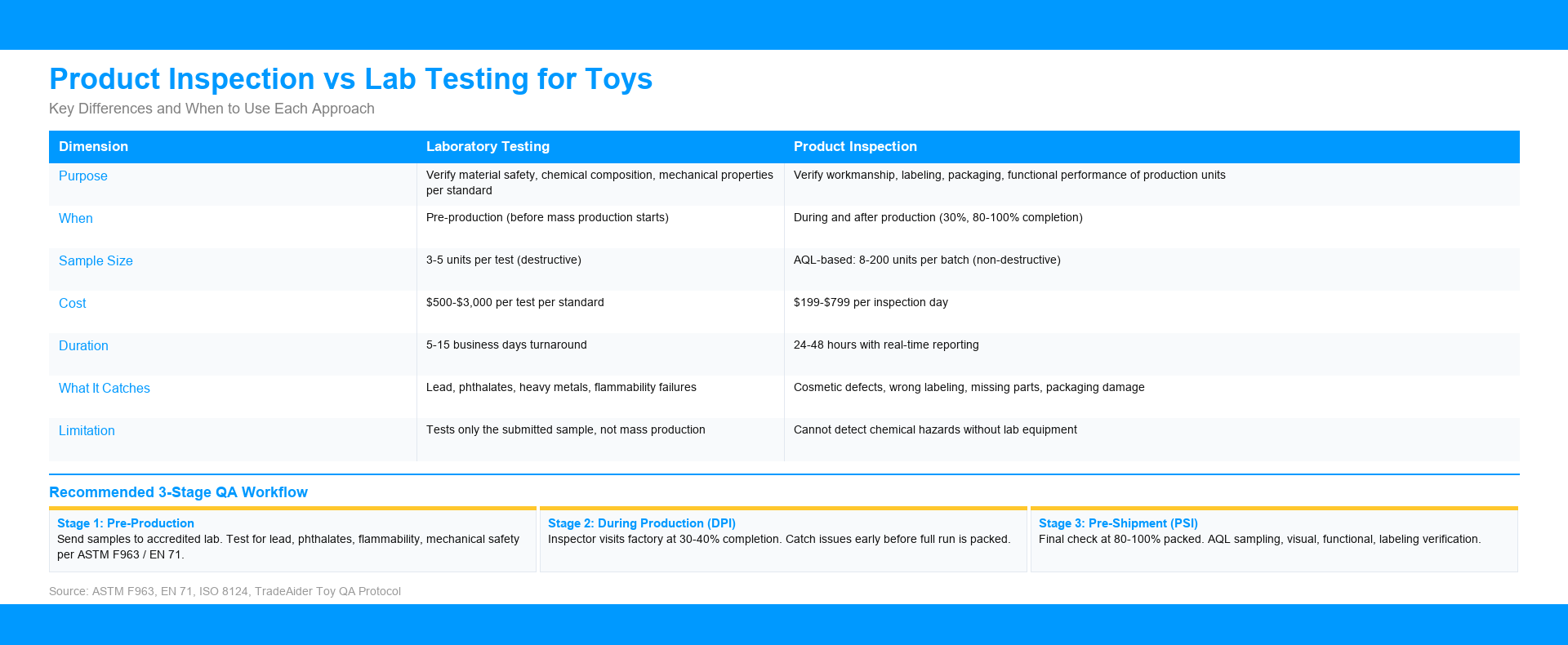
| Factor | Product Inspection (On-Site) | Laboratory Testing |
|---|---|---|
| Purpose | Verify workmanship, packaging, labeling, and visual/functional defects in production units | Validate compliance with safety standards (mechanical, chemical, flammability) |
| Location | Factory floor in China | CPSC-accepted accredited laboratory |
| What It Tests | Aesthetic quality, assembly accuracy, function, packaging, labels | Lead content, phthalates, small parts, flammability, torque/tension |
| Sample Size | Dozens to hundreds of units from production lot (AQL-based) | Typically 1-5 samples per test standard |
| Cost | ~$199 per man-day (all inspections included) | $500-$5,000+ depending on standards and product complexity |
| Turnaround | Same day inspection; report within 24 hours | 5-15 business days |
| Certification | No — produces an inspection report, not a compliance certificate | Yes — test reports form the basis of the CPC |
| Regulatory | Not required by law, but strongly recommended | Legally required for children's products in U.S. and EU markets |
Why Inspection Catches What Lab Testing Misses
Consider this common scenario: A toy brand sends a prototype wooden building block set to a CPSC-accepted lab. The blocks pass all tests — no small parts, no lead in paint, no sharp edges. The CPC is issued. Three months later, production of 20,000 units is complete at a factory in Shantou. The pre-shipment inspector arrives and discovers:
- The factory substituted a lower-grade paint that has not been tested for lead content.
- Several blocks have wood splinters — a defect that does not appear on the lab-tested prototype but emerged during high-volume production.
- The warning label on the box has the wrong age grade ("3+" instead of "6+").
- Cartons are missing the required tracking labels for batch traceability.
None of these issues would have been caught by the laboratory test, because the lab tested the prototype — not the production run. This is exactly why product inspection in China is indispensable for toy brands.
The Ideal Toy QA Workflow: Layered Verification
The most reliable approach for toy brands is a three-stage verification process:
Stage 1: Pre-Production Lab Testing
Before production begins, submit your final prototype and Bill of Materials (BOM) to a CPSC-accepted laboratory for comprehensive testing against all applicable standards. Obtain the CPC. This establishes the compliance baseline.
Stage 2: During Production Inspection
At 20-30% production completion, schedule a during production inspection. The inspector verifies that the factory is using the approved materials, following the correct assembly process, and maintaining consistent quality. Early detection at this stage allows corrections before the majority of the order is produced, saving time and money.
Stage 3: Pre-Shipment Inspection
When 80-100% of goods are packed, a pre-shipment inspection performs a final AQL-based evaluation of finished units. This catches any late-production defects, packaging errors, and labeling problems before shipment.
TradeAider's Real-Time Advantage for Toy Brands
Traditional QC firms send a PDF report days after the inspection. By that time, if a critical defect was found — say, lead-painted components or missing choking hazard warnings — the factory may have already finished packing and the buyer faces a difficult negotiation about rework costs.
TradeAider's inspection platform provides real-time online monitoring during every inspection. As the inspector tests samples on the factory floor, you see photographs and video of each finding in real time. If the inspector discovers that a batch of plastic toys has sharp edges that were not present on the lab-tested prototype, you can immediately instruct the inspector to expand the sample size, investigate the root cause on the spot, and direct the factory to halt production if necessary.
For toy brands with high-value orders or products where a recall would be devastating — such as toys for children under three — WeGuarantee Total Quality Control provides continuous quality monitoring throughout the entire production period. TradeAider shares financial responsibility for quality outcomes, meaning if a safety defect reaches your warehouse, TradeAider absorbs part of the financial impact. It is the only service of its kind in the third-party QC industry.
Cost Comparison: What Toy Brands Should Budget
| Service | Typical Cost | Frequency | Cumulative Annual Cost* |
|---|---|---|---|
| Lab testing (ASTM F963 + phthalates + lead) | $800–$2,500 per product SKU | Initial + annual renewal | $800–$2,500 |
| Pre-shipment inspection | $199 per man-day | Every production batch | $400–$800 (2–4 batches/year) |
| During production inspection | $199 per man-day | Large orders | $200–$400 (1–2 per year) |
| WeGuarantee TQC | From $399 per order | High-value or high-risk orders | $399–$1,200 (1–3 orders/year) |
*Estimates based on a typical small-to-medium toy brand with 1-3 product SKUs and 2-4 production batches per year.
Common Mistakes Toy Brands Make
- Testing only the prototype, never inspecting production: This is the most dangerous gap. Lab tests confirm your design is safe; inspection confirms your factory is building it correctly.
- Using an unaccredited lab: Only CPSC-accepted laboratories can produce valid test results for the CPC. The CPSC laboratory search tool lets you verify a lab's accreditation status.
- Skipping during-production inspection: Waiting until pre-shipment to discover quality issues means the majority of the order is already produced. Mid-production checks catch problems earlier and cheaper.
- Not including labeling in the inspection specification: Incorrect or missing age grading and warning labels are among the most common causes of CPSC enforcement actions.
FAQ
Can product inspection replace laboratory testing?
No. On-site inspection cannot produce the formal test reports required for a Children's Product Certificate. Lab testing by a CPSC-accepted laboratory is legally required for all children's products sold in the United States. Inspection is a complementary quality assurance measure, not a substitute for testing.
How often do I need to repeat laboratory testing?
If there are no material or design changes, most CPSC rules require periodic retesting. ASTM F963 testing is generally valid until there is a change in the product's design, manufacturing process, or source of component materials. Many brands retest annually to maintain current documentation.
What if my factory says lab testing is unnecessary?
This is a red flag. All children's products imported into the United States must be tested by a CPSC-accepted third-party laboratory. Factories that discourage testing may be cutting corners on materials or processes. A factory audit can help evaluate a supplier's quality management practices and compliance readiness.
Do EU and UK markets have different testing requirements?
Yes. The European Union requires compliance with Toy Safety Directive 2009/48/EC, and the UK has its own UKCA marking requirements post-Brexit. These standards differ from ASTM F963 in specific test methods and limits, so additional testing may be necessary for products sold in those markets.
TradeAider goes beyond traditional inspection by giving you real-time visibility into every quality check — so you catch defects before they ship, not after. Whether you need a single pre-shipment inspection or full production quality control with our WeGuarantee service, our team is ready to help. Book your inspection now or get a free quote to protect your next toy order.
Related Articles
Grow your business with TradeAider Service
Click the button below to directly enter the TradeAider Service System. The simple steps from booking and payment to receiving reports are easy to operate.

