
- About Us

- Our Services
- Your Industry
- Resources
- News & Blog
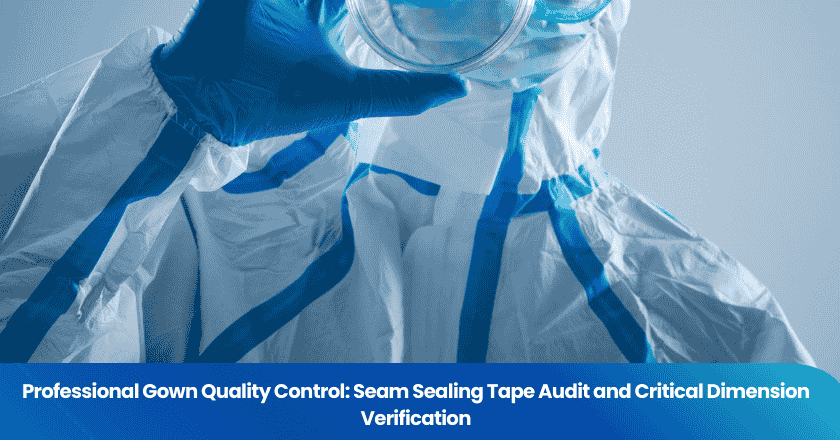
Professional gown quality control is a multifaceted discipline that integrates barrier performance with ergonomic fit. Whether for medical personal protective equipment (PPE) or high-end technical apparel, the integrity of the garment is defined by its weakest point—the seams. Professional gown inspection focuses on two critical technical pillars: the adhesion quality of seam sealing tape and the precision of critical dimensions. By utilizing systematic quality checks, manufacturers and buyers can ensure 100% compliance with international safety standards such as ANSI/AAMI PB70 and ISO 13688.
Key Takeaways
- Barrier Integrity: Seam sealing tape is the primary defense against liquid penetration in Level 3 and 4 gowns.
- Dimensional Stability: Critical dimensions ensure that the user's movements are not restricted, preventing PPE breaches.
- AQL Standards: Critical defects, such as seam delamination or broken needles, carry a zero-acceptance limit.
- Testing Rigor: Hydrostatic pressure and peel strength tests are mandatory for technical garment verification.
- Digital Traceability: Real-time on-site reporting allows for immediate corrective actions (CAPA) during the production run.
The Strategic Importance of Gown Auditing
In the PPE supply chain, inspection is not merely a formality; it is a life-saving protocol. A gown that fails in its barrier performance exposes the wearer to hazardous fluids and pathogens. Inspectors categorize their audits into functional and aesthetic segments. Functional quality focuses on "Barrier Effectiveness," while aesthetic quality addresses the "Fit and Finish." A professional quality assurance program bridges these two by identifying defects before the goods are palletized for global shipment.
| AAMI Level | Barrier Requirement | Common Inspection Test |
|---|---|---|
| Level 1 | Minimal liquid pressure. | Visual impact penetration test. |
| Level 2 | Low liquid pressure. | Impact penetration & Hydrostatic test. |
| Level 3 | Moderate liquid pressure. | Seam sealing tape adhesion audit. |
| Level 4 | High pressure/viral barrier. | ASTM F1670 (Blood) & F1671 (Virus) tests. |
Seam Sealing Tape: Technical Inspection Protocols
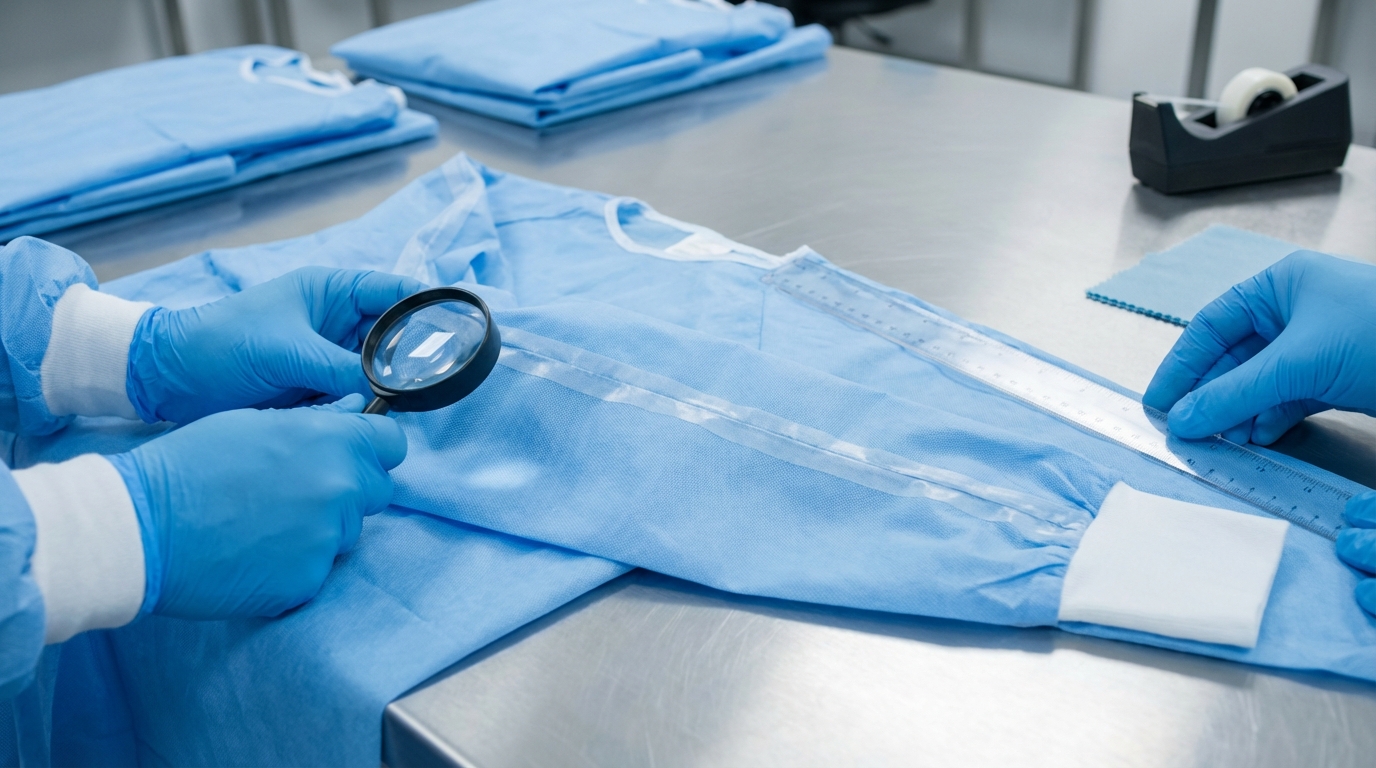
Seam sealing tape is a thermoplastic film applied to stitched seams to block moisture, air, and chemicals. The application involves a "Hot Air Sealing" process where temperature, speed, and pressure must be perfectly synchronized. Any deviation in these parameters leads to delamination—the tape peeling away from the fabric substrate.
Visual Workmanship Audit
Technicians perform a 100% visual check on sealed areas. They look for "Bubble Formation" (indicating moisture or gas trapped under the tape), "Wrinkles" (which create leakage channels), and "Singeing" (caused by excessive heat). The tape must overlap the stitch line by at least 10mm on each side to ensure a sufficient safety margin.
Physical Performance Testing: Peel Strength and Hydrostatics
Beyond visual checks, destructive and non-destructive physical tests are performed. A "Peel Strength Test" determines the force required to pull the tape from the fabric. For technical medical gowns, a minimum value of 15N/2.5cm is often required. Furthermore, the Hydrostatic Head Test is used to verify that the sealed seam can withstand a specific water column pressure (e.g., 2,000mm to 10,000mm) without leaking.
| Common Seam Issue | Root Cause | Impact on Safety |
|---|---|---|
| Tape Delamination | Low bonding temperature. | Immediate loss of barrier protection. |
| Edge Lifting | Insufficient roller pressure. | Tape snags and peels over time. |
| Fabric Puckering | Excessive tape tension. | Reduced fit comfort and seam strength. |
| Burnt/Damaged Film | Slow machine speed. | Compromised chemical resistance. |
"The sealing process is irreversible. If the tape is burnt or delaminated, the garment is usually classified as a major defect, as rework often compromises the base fabric's integrity."
Critical Dimensions and Fit Assessment
Dimensional accuracy is essential for "Donning and Doffing" safety. If a gown is too tight at the chest or armscye (armhole), it may tear during use, exposing the healthcare worker. Conversely, if it is too loose, it may catch on equipment or become a tripping hazard. A professional dimension audit compares production units against the technical spec sheet (Spec Pack).
Managing Shrinkage and Dimensional Stability
Technical fabrics used in gowns often have high shrinkage rates when exposed to the heat of the sealing process. Inspectors perform shrinkage tests (AATCC 135) to ensure that after three wash cycles (if reusable) or during the steaming process, the garment retains its shape. Standard tolerances for gowns are ±2cm for body length and ±1.5cm for sleeve length.
| Critical Measurement Point | Adult Gown Tolerance | Technical Priority |
|---|---|---|
| Chest Width | +2.0 / -1.0 cm | Breathability and comfort during movement. |
| Sleeve Length | ± 1.5 cm | Ensures cuff meets glove interface. |
| Total Body Length | ± 2.0 cm | Protects lower limbs from fluid splash. |
| Cuff Opening | ± 0.5 cm | Prevents fluid migration into gloves. |
Defect Classification and AQL Levels
In a professional third-party quality control audit, findings are categorized based on their impact on product performance. In the PPE industry, the AQL (Acceptable Quality Limit) for critical defects is strictly zero.
- Critical Defects: Broken needles, holes in the fabric, missing seam tape, or viral barrier failure. (Acceptance = 0).
- Major Defects: Sizing outside tolerance, tape delamination (>5mm), or poor color fastness. (Rejection typically at AQL 1.0 or 1.5).
- Minor Defects: Untrimmed threads, slightly crooked labels, or non-visible stains on the hem. (Rejection typically at AQL 4.0).
Digital Oversight: Real-Time Verification Systems
TradeAider utilizes digital platforms to eliminate the wait times associated with paper reports. Inspectors use mobile tablets to record every measurement and photograph every seam tape audit. This data is synced to a cloud dashboard, providing "Real-Time Transparency" to the buyer.
This digital oversight system reduces documentation time by up to 40% and allows brands to issue "Go/No-Go" shipment authorizations based on live evidence. Furthermore, AI-based computer vision is now being integrated to automatically detect stitch skip patterns and label orientation errors on the production line.
Best Practices for Gown Sourcing and QC
To maintain consistent quality across large batches, importers should implement the following best practices:
- Pre-Production Meeting (PPM): Align with the factory on the "Golden Sample" and tape-bonding parameters.
- Needle Control Policy: Enforce 100% metal detection to prevent injuries from broken needle fragments.
- In-Line Inspection: Perform audits when 10-15% of production is complete to identify systemic delamination issues.
- Component Testing: Verify the quality of the seam tape itself—UV resistance and tensile strength—at the raw material stage.
Ready to secure your product quality before shipment?
As your third-party inspection, testing & certification partner in China, TradeAider supports brands and sourcing teams across the entire production process, helping you identify quality risks early, ensure compliance, and strengthen your team’s capabilities before shipment.
Book an Inspection or Testing Service with TradeAider today, or for tailored solutions and expert guidance, contact us at services@tradeaider.com.
FAQ
What is the difference between a sewn seam and a sealed seam?
A sewn seam creates needle holes that are susceptible to liquid leaks. A sealed seam uses a waterproof tape applied over the stitches to plug those holes, ensuring a liquid-tight barrier.
How many times can a medical gown be washed before the tape peels?
Reusable gowns are typically rated for 50-75 wash cycles. Quality control checks for "Wash-Cycle Durability" by performing tape adhesion audits after repeated industrial laundering at high temperatures (60-90°C).
Why is "Fit" considered a safety factor in PPE?
A poorly fitting gown can cause "PPE Breaches." If sleeves are too short, the skin at the wrist is exposed. If the gown is too tight, it can restrict a surgeon's reach or cause the fabric to burst under stress.
Can I repair a delaminated seam at home?
No. Seam sealing requires high-pressure industrial rollers and calibrated heat guns. Any attempt to use a domestic iron will likely burn the technical fabric or fail to create an airtight molecular bond.
What is the "Hydrostatic Pressure" standard for Level 3 gowns?
Under AAMI standards, the fabric and seams must withstand at least 50 cm of water pressure. Professional inspection tools like the Suter Tester are used on-site to verify this.
Related Articles

Grow your business with TradeAider Service
Click the button below to directly enter the TradeAider Service System. The simple steps from booking and payment to receiving reports are easy to operate.

