
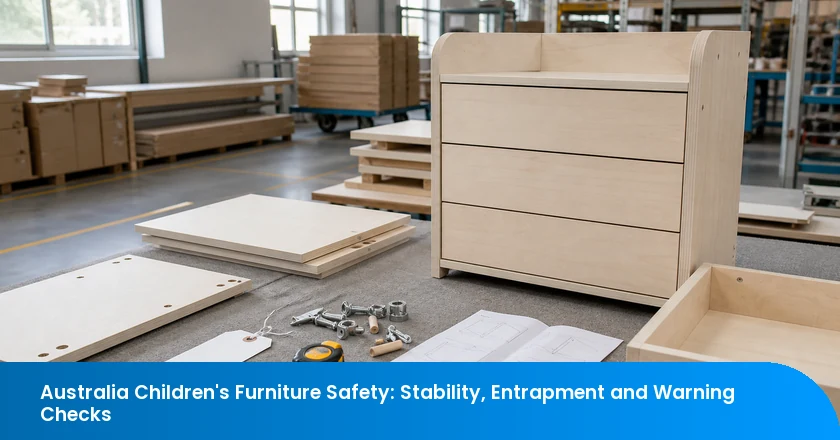
For an Australia-bound children’s-furniture order, the useful question is not “Did the factory pass a generic safety checklist?” It is “Which safety lane applies to this exact SKU, and can the finished goods, documents, and packed range prove that the lane was checked?” A tall dresser, a bunk bed, a cot, and a low toy-storage unit can create different hazards and fall under different Australian requirements.
That distinction changes the inspection brief. A factory team can measure, photograph, compare, and isolate units. It cannot decide legal applicability or replace product-specific testing. The buyer should first confirm the product category and evidence owner, then use inspection to test whether the physical order matches the approved safety requirement.
Start With the Product Category, Not a Generic Children's-Furniture Checklist
Australia does not apply one universal children's-furniture safety rule to every product; mandatory standards and information standards apply to the relevant product categories. The ACCC’s product-safety standards guidance explains that a mandatory standard makes specified safety or information features compulsory for a relevant product, not for every item that happens to be sold for children. That is why the initial release file should name the SKU, intended household use, product form, height, and configuration before it lists any acceptance point.
A factory checklist should begin with product type, intended use, height, and configuration, because those facts determine which category-specific requirement the buyer needs to investigate. Use the factory drawing and the physical sample to answer those questions before production locks. That is the practical value of pre-production inspection planning: it turns a broad market requirement into observable requirements for the actual build, rather than asking an inspector to infer the rule from a marketing name.
- Classify first: use the exact SKU, use case, form, and height before assigning a safety lane.
- Control the evidence: keep warnings, instructions, drawings, and any product-specific test evidence tied to the same revision.
- Release by population: use carton-range identifiers to separate a verified build from an unresolved one.
For children’s furniture, “stability,” “gap-related risk,” and “warning” are not interchangeable test labels. They are risk questions that must be connected to the right product category and evidence.
For Covered Toppling Furniture, Verify the Warning System Across Every Consumer Touchpoint
The toppling-furniture information standard covers consumer-goods clothing storage units and bookcases 686 mm or higher, entertainment units of any height, and specified hall tables, display cabinets, buffets, and sideboards 686 mm or higher. The ACCC’s summary of the toppling-furniture requirements makes the category boundaries clear. In plain language, toppling furniture is specified free-standing household furniture that can fall over and is covered by the mandatory information standard—a rule that makes specified consumer safety information compulsory for relevant products. The point is not to label every cabinet this way, but to establish whether the delivered product falls within the defined scope.
For covered toppling furniture, warnings about tip-over risk and anchoring are required online, in stores, on the furniture, and in supplied instructions. The Consumer Goods (Toppling Furniture) Information Standard 2024 is the source for that multi-touchpoint requirement. The buyer should therefore control one approved warning pack and check that the finished unit, assembly leaflet, listing copy, and store materials are all built from the same current version. A warning hidden only in an image carousel or left only in artwork approval does not establish that every required touchpoint has been addressed.
Check Height, Intended Use, and Product Form Before Applying the Toppling Rule
Covered toppling-furniture categories depend on defined product form, intended use, and height; furniture designed to be fixed to a wall and unusable unless fixed is outside the information standard's definition. The ACCC supplier guide sets out these distinctions, and the obligations have applied since 4 May 2025. Record the measured height, primary intended use, and whether the unit is genuinely free-standing. A scope note signed by the product owner should name the SKU, height, intended consumer use, fixing status, and evidence consulted. If those facts are unclear, pause the scope decision rather than guessing from a catalogue title.
Treat a Label Artwork File as a Starting Point, Not a Finished-Goods Result
Covered toppling furniture must have a warning label that is permanent and durable and visible when the furniture is empty, alongside required warning information in instructions. The same information standard sets this finished-product boundary. That calls for an observation plan: open the drawer or door, view the intended label location, check legibility and adhesion, compare it with the approved warning version, and retain a photo linked to the SKU and carton range. When this controlled pack is available early, TradeAider can translate it into product-specific observation points without claiming to certify the furniture.
Entrapment Checks Must Follow the Product-Specific Rule, Not a Borrowed Measurement
Entrapment checks should use the rule or test requirement for the actual product type; a dimension from a bunk-bed rule is not a universal measurement for all children's furniture. Entrapment means a child’s head, limb, or body can become trapped. It is a serious design risk, but the prescribed measurements and construction tests depend on the product. For a product outside a dedicated mandatory standard, the buyer should use the approved drawings, product-specific risk review, and relevant test evidence to define what the inspector can observe and when the product owner must escalate.
That boundary prevents two costly errors: treating a visually tidy product as safe without the applicable evidence, and rejecting an unrelated product solely because a bunk-bed dimension was copied into a generic checklist. When the unresolved question is performance, construction, or a category-specific laboratory requirement, keep the report and the physical check connected to the relevant product-testing evidence instead of presenting an inspection result as a substitute for it.
Bunk and Raised Beds Need a Separate Gap, Guardrail, and Marking Review
For bunk beds, the mandatory standard prohibits gaps in specified ranges that can trap a child's head or limbs and requires suppliers to undertake testing for construction requirements. ACCC guidance for the bunk-beds mandatory standard covers those construction, design, testing, and marking boundaries. The inspection brief should identify the exact bed configuration, the approved mattress-base and guardrail details, and the applicable test evidence before an inspector measures or photographs the finished unit.
Bunk-bed requirements include permanent guardrails, specified guardrail clearance, limits on protrusions, and certain mattress-height marking conditions. The same ACCC mandatory-standard guidance provides the product-specific reference. The factory observation then has a narrow purpose: confirm the correct guardrails and access opening are fitted, intended gap locations are free of visible variation, protrusions are not introduced by assembly, and permanent markings are present where required. It does not allow a factory sample to replace the construction testing that the product-specific standard calls for.
Infant Sleep Products Are Another Distinct Safety Lane
Infant sleep products, including household cots, have separate mandatory safety and information standards that took effect for suppliers on 19 January 2026. ACCC Product Safety’s infant sleep-product standards describe safety, design, construction, performance, testing, warning, and safety-information obligations. If a SKU is intended for infant sleep, do not fold it into a dresser or bunk-bed checklist. Require the product owner to identify the relevant evidence first, then instruct the inspector to compare the physical product, markings, and supplied information with that defined scope. A later change to sleep use, mattress arrangement, or supplied instructions should trigger the same scope review before release.
Turn the Applicable Rule Into a Factory Evidence-and-Observation Pack
A factory evidence-and-observation pack should bind the SKU, dimensions, applicable category decision, approved warnings, assembly instructions, physical observations, and carton range to one shipment population. This is not a branded scoring model. It is a simple way to make an inspection report useful to the person who owns the Australian product-safety decision: every observation should point back to the exact product and controlled document it concerns.
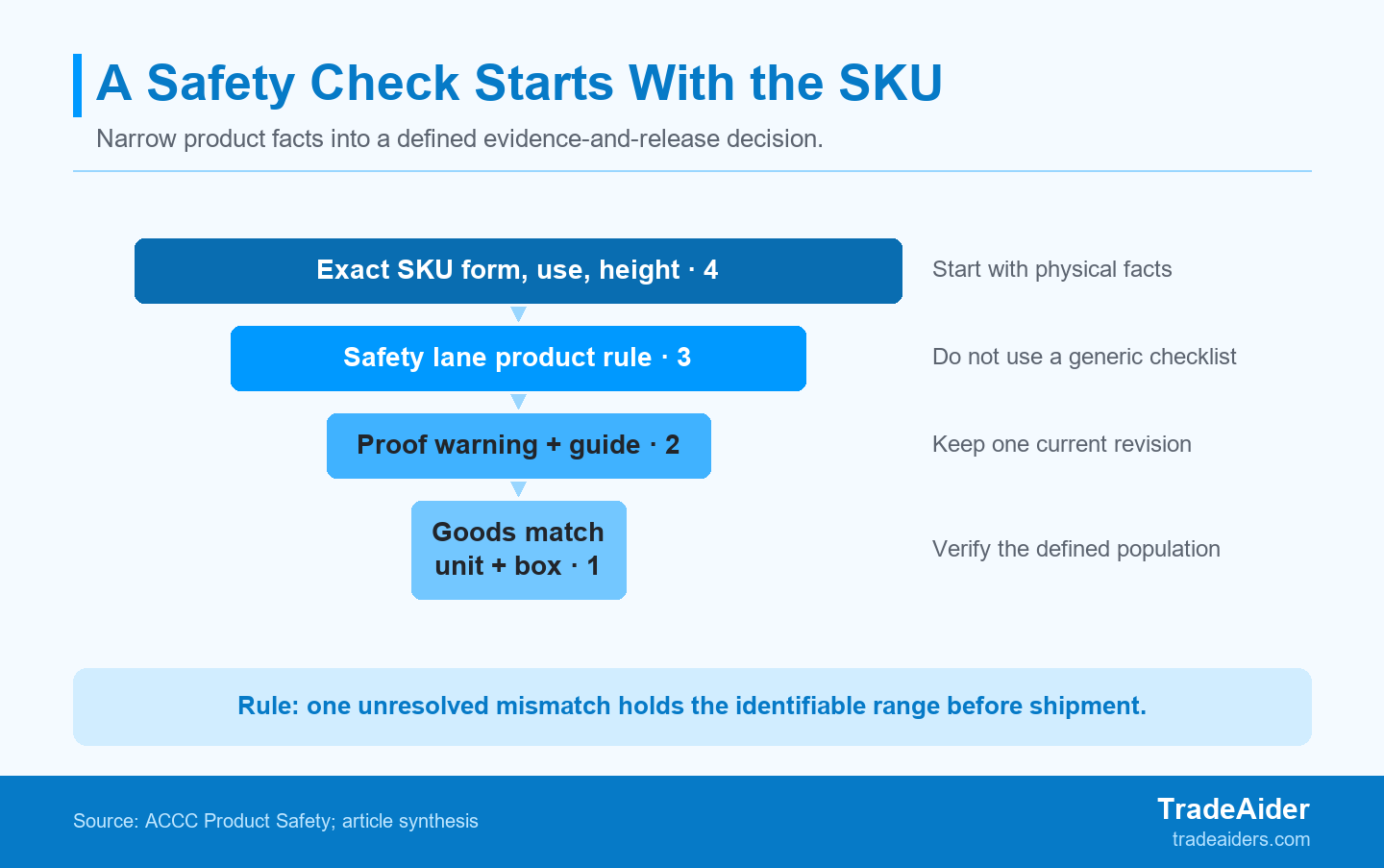
The factory check becomes useful only after the exact SKU, applicable safety lane, controlled proof, and carton range point to the same finished-goods population.
A physical stability check can reveal whether the supplied unit, fasteners, hardware, packing, and instructions match the agreed specification; it does not replace product-specific testing or legal scope advice. The ACCC’s toppling-furniture guidance reinforces the practical importance of anchoring and safe use. In a factory scope, that should translate into checking the approved hardware and instructions where applicable, not promising that an unloaded visual check proves a product cannot topple in every household setting.
| Evidence or fact to control | What the inspector can observe | Who resolves a mismatch |
|---|---|---|
| SKU, intended use, product form, and measured height | Model label, drawing revision, dimensions, assembly configuration | Product owner confirms the applicable safety lane |
| Approved warning and instruction pack | Permanent label location, legibility, leaflet version, carton insert | Factory corrects the affected range; product owner confirms content |
| Product-specific evidence or test requirement | Physical build matches the identified configuration | Product owner or qualified adviser evaluates evidence scope |
| Carton range and correction record | Carton code, packing window, corrected unit samples | Buyer decides hold, verification, or release |
TradeAider’s during-production inspection checkpoints can make a missing label, changed fastener, or mismatched instruction pack visible while the factory can still separate a clean range from an affected one. The scope should state the limit plainly: the inspection records observable facts against the buyer’s confirmed requirement; it does not issue a regulatory approval.
Illustrative Scenario: A Warning File and a Finished Dresser Do Not Match
In the illustrative scenario, an approved warning file and the finished dresser conflict because the required warning is missing from the actual unit, so the buyer cannot treat the artwork file as proof of the packed goods. An importer is preparing an Australia-bound flat-pack children’s dresser order, and the product owner has identified the 760 mm SKU as covered toppling furniture. The question at pre-shipment is no longer whether a warning file exists; it is whether the finished population carries the approved requirement.
Hold the Identifiable Affected Range, Then Verify the Corrected Units
An importer is preparing an Australia-bound flat-pack children’s dresser order containing 900 dressers in 90 cartons, each identified by SKU and a two-week packing range. A sample from a later packing range has no permanent label inside the empty drawer, even though the approved artwork and the instruction leaflet both contain the warning. The factory traces the difference to a label-supplier change and identifies 18 cartons packed after that change. That gives the buyer a defined population rather than an unexplained one-off defect.
The approved warning file and the finished dresser now conflict, so the buyer cannot use the artwork as proof of the packed goods. The buyer holds the 18-carton range and keeps the remaining 72 cartons separately identified only if their label condition is confirmed. This is a contained document-to-product conflict, not proof that the whole order is unsafe, but it is enough to stop the affected range from being released without correction.
The identifiable range should be held, corrected, and verified through the finished product and accompanying instructions before the buyer decides whether it can be released. After the factory applies the approved permanent warning, it should retain the carton identifiers and correction record. The buyer can then use inspection-standard criteria to select samples from the corrected range and confirm the label is present, durable, visible when empty, and matched to the supplied leaflet. Only then does a pre-shipment inspection scope describe the right population.
This is an illustrative operating example, not a TradeAider client case, legal advice, or a compliance certification. Its purpose is to show why SKU and carton-range traceability matter: a clean sample from an earlier range cannot close a requirement missing from later finished goods.
Use a Four-Owner Release Check Before the Order Ships
A children’s-furniture release check is reliable only when the product owner confirms scope, the factory provides controlled evidence, the verifier records physical observations, and the buyer authorises shipment after open gaps are resolved. Assigning those roles prevents an inspection report from being asked to answer a legal question it was never designed to answer.
- Product owner: confirm the Australian product category, applicable requirements, and approved drawing or warning pack for the exact SKU.
- Factory: provide the controlled product revision, assembly instructions, labels, hardware records, and traceable carton range.
- Verifier: record the agreed physical observations, including any visible mismatch between the finished unit and approved evidence.
- Buyer: release only after the required evidence is confirmed and the observed product population is either corrected or clearly isolated.
When the product category and controlled documents are available early, TradeAider can help turn them into a factual inspection scope for the finished shipment. Send the SKU list, product category decision, approved warnings and instructions, and carton-range information to request a children's-furniture inspection plan.
Frequently Asked Questions
Do all children’s furniture products need the same Australian safety check?
No, children’s furniture does not use one Australian safety check, because requirements turn on product type, intended use, design, and applicable standards. A high dresser, bunk bed, cot, and low toy-storage unit should not be released from one generic checklist. Start with the SKU and product category, then confirm the governing requirements with the product owner or a qualified adviser before setting inspection acceptance criteria.
Does a toppling-furniture warning label apply to every children’s dresser?
No, a toppling-furniture warning label applies only if the dresser meets the information standard’s defined category and consumer-goods scope. The ACCC guide identifies clothing storage units 686 mm or higher among the covered category-one products. Record the measured height, product use, and scope decision rather than relying on a product name or a prior artwork file.
Can a factory inspection prove a furniture item is legally compliant in Australia?
No, an inspection records observable facts such as dimensions, labels, hardware, instructions, and carton identification; it does not make the legal classification or certify testing. The most useful scope states what the inspector should observe, what evidence the product owner must provide, and which mismatch requires a hold or escalation.
When should a children’s-furniture shipment be held before release?
Hold the identifiable affected range when a product-specific requirement cannot be matched to the finished goods, such as a missing required warning, an unresolved category decision, or a physical condition that differs from the approved specification. Keep the hold tied to SKU and carton-range identifiers, correct the issue, and verify the corrected population. A clean earlier sample cannot prove a later changed batch.

Artigos Relacionados

Expanda seu negócio com o Serviço TradeAider
Clique no botão abaixo para entrar diretamente no Sistema de Serviço TradeAider. Os passos simples desde a reserva e pagamento até o recebimento de relatórios são fáceis de operar.

