
- About Us

- Our Services
- Your Industry
- Resources
- News & Blog
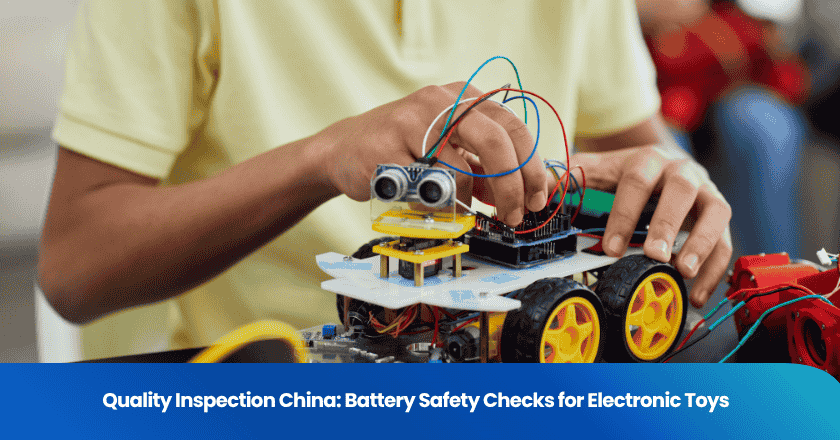
In June 2025, CPSC recalled 13,200 lithium-ion battery packs manufactured by a Chinese factory (Ningbo New Team Import & Export Co.) after two reports of fire and overheating incidents. In January 2026, LED lights sold on Amazon were recalled specifically for violating mandatory button cell battery safety standards. These aren't isolated cases — battery-related failures in China-manufactured consumer electronics, including toys, represent one of the highest-frequency and highest-consequence recall categories in the US market. For importers sourcing electronic toys from China, battery safety inspection isn't a nice-to-have add-on. It's the check that stands between your product and a CPSC enforcement action, a listing suspension, or a child injury claim. This article explains exactly what quality inspection in China covers for battery safety in electronic toys — across button cells, AA/AAA alkaline, and rechargeable lithium-ion systems.
Key Takeaways
- Battery safety for electronic toys is governed by ASTM F963-23 (mandatory since April 2024), with proposed CPSC rules that would add stricter button cell compartment requirements aligned with Reese's Law (16 CFR 1263).
- Button cell and coin cell batteries are the highest-severity hazard — ingestion by a child can cause internal burns within two hours and is potentially fatal.
- Lithium-ion batteries in electronic toys require overcharging, short-circuit, and temperature testing; inspectors verify the battery management system (BMS) and compartment design before any lab tests are ordered.
- Quality inspection in China covers battery compartment construction, fastener security, labeling, and production consistency — complementing, not replacing, lab-based electrical safety testing.
The Battery Hazard Landscape in Electronic Toys
Three Battery Types, Three Risk Profiles
Electronic toys from China use three main battery configurations, each with a distinct risk profile that determines what inspectors look for:
| Battery Type | Common Toys | Primary Hazards | Key Standard |
|---|---|---|---|
| Button cell / coin cell (CR2032 etc.) | Musical greeting cards, small electronic toys, LED toys | Ingestion, internal chemical burns, death | ASTM F963-23 §4.25, Reese's Law (16 CFR 1263) |
| Standard alkaline (AA, AAA, C, D) | Remote control toys, electronic games, talking toys | Leakage, corrosion, accessible compartment | ASTM F963-23 §4.25 |
| Rechargeable lithium-ion / lithium polymer | RC drones, ride-on toys, electric ride-on cars, power banks for toys | Thermal runaway, fire, explosion, overcharging | UL 4200A, IEC 62133, IEC 62115, ASTM F963-23 |
The Button Cell Ingestion Crisis
Button cell and coin cell batteries represent the most severe life-safety risk in the toy category. A CR2032 lithium battery — the most common size in small electronic toys and musical greeting cards — generates enough electrical current when lodged in the esophagus to cause fatal internal tissue burns within two hours. The CPSC's proposed rulemaking published in the Federal Register in August 2024 specifically addresses this risk by proposing performance and labeling requirements for toys containing button cell or coin cell batteries that go beyond current ASTM F963-23 requirements — aligning toy safety rules more closely with Reese's Law (16 CFR 1263), enacted in 2022 following multiple child deaths linked to battery ingestion from non-toy consumer products.
For importers, the practical implication is this: a button-cell-powered toy that passes ASTM F963-23 today may need to be retrofitted to meet the incoming requirements. The proposed rule includes stricter compartment fastener security testing (captive fasteners that can only be opened with a tool), sequential use and abuse testing, and substantially more prominent warning labeling. Importers sourcing products now should anticipate these requirements in their design specifications and ensure their inspection checklist covers the compartment security criteria that will become mandatory.
What Quality Inspection in China Covers for Battery Safety
1. Battery Compartment Construction and Security
The most immediately verifiable battery safety characteristic is the physical design of the battery compartment. Under ASTM F963-23 §4.25, battery compartments in toys must be secured by at least one captive fastener — a fastener that cannot be removed without a screwdriver or equivalent tool, and that remains attached to the compartment when opened. Inspectors physically test this requirement on every sampled unit:
- Is the compartment cover secured by a screw with a Phillips or flat head (not a snap-fit or friction-fit alone)?
- Does the fastener remain captive when fully loosened — i.e., does it stay connected to the cover rather than falling out?
- For button cell compartments specifically: does the compartment require a tool to open, and does the design prevent a child from accessing the battery through normal foreseeable play?
- Is the compartment cover structurally intact — no cracks, deformations, or insufficient thread engagement on the screw?
A common production defect caught at this stage is a compartment cover screw that was torqued to the correct depth during QC testing but that the factory switched to a shorter thread length in production — causing the "captive" fastener to strip out with minimal force. Inspectors use a torque test to verify that the fastener meets the resistance specification, not just that it's present.
2. Battery Polarity Labeling and Insertion Design
Incorrect battery insertion — reversing polarity — can cause battery leakage, overheating, or explosion in poorly designed battery circuits. Inspectors verify:
- Polarity markings (+/-) are molded or printed inside the compartment and clearly visible under normal lighting
- The compartment design physically prevents reverse polarity insertion where feasible (spring contact design)
- External labeling indicates battery type and quantity required (e.g., "Requires 3x AA batteries, not included")
- For lithium-ion rechargeable toys: charging port orientation and plug type match the charger provided
3. Charger and Charging Circuit Verification for Lithium-Ion Toys
For electronic toys with built-in rechargeable lithium-ion or lithium polymer batteries, the charging system is the most complex battery safety element to evaluate on-site. Inspectors work through a physical and functional checklist, while flagging items for laboratory follow-up:
- Charger type verification: Does the charger provided match the battery specification (voltage, current rating)? A 5V USB charger used with a 7.4V lithium pack indicates a charging management system failure in design.
- Overcharge protection: Inspectors verify the presence of a battery management system (BMS) board inside the battery pack — visually identified by opening a sample unit. Absence of a BMS board is an immediate critical defect flag.
- Charging indicator: Does the toy or charger indicate when charging is complete? Toys without any charge completion indicator present an overcharging risk in consumer use.
- Charger cable integrity: Inspect cable strain relief at both the plug and toy connection points; frayed insulation at the strain relief junction is a common manufacturing defect in inexpensive chargers.
- Charge while use: If the toy can be operated while charging, confirm the design specification addresses this scenario — simultaneous charge and discharge is a common thermal runaway trigger in substandard lithium pack designs.
Laboratory testing for lithium-ion battery compliance (overcharging, short-circuit, temperature, crush, and vibration tests) under IEC 62133 must be conducted by an accredited lab — this cannot be verified on-site. The inspector's role is to ensure the production unit's battery configuration matches the approved design specification that was submitted for lab testing. If the factory has substituted a different battery cell supplier without notifying the buyer, the existing lab test reports don't cover the production units. This is one of the most consequential catches a during-production inspection can make on a lithium-powered toy.
4. Warning Label Compliance
Battery-related warning labels on electronic toys are mandatory and specific. For toys covered by ASTM F963-23, required warnings for battery-operated toys include:
- Battery type and quantity required (both on packaging and in the instruction manual)
- Warning against mixing old and new batteries, or different battery types
- Warning to remove batteries from toy when not in use for extended periods
- For button cell toys: CPSC-required warning statement about battery ingestion risk and emergency action
- Disposal instructions for rechargeable batteries (lithium-ion batteries cannot be disposed of in standard household waste in most markets)
Inspectors verify that all required labels are present, in the correct language for the destination market, with font size and placement meeting the regulatory specification. For US-market toys, English is the required language; for EU toys, at least one official EU language is required, with the relevant national language strongly recommended for the primary destination country. The TradeAider inspection standard covers labeling requirements by destination market as part of every electronic toy inspection.
The Inspection-to-Lab Testing Handoff
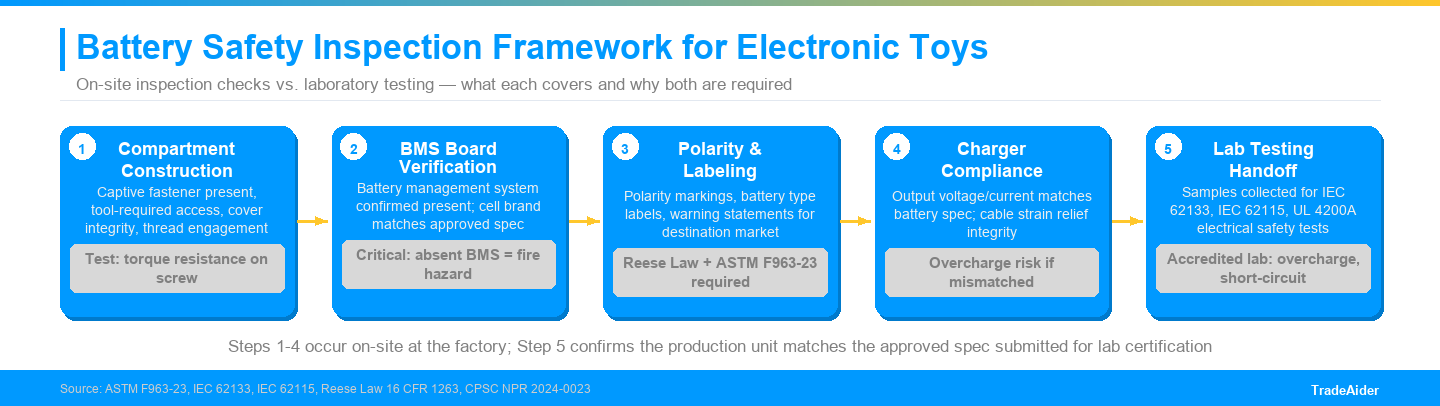
Battery safety compliance requires both on-site inspection (compartment design, BMS verification, label compliance) and laboratory testing (electrical safety, thermal, short-circuit) — each controls a distinct risk category that the other cannot address.
Battery electrical safety testing — the tests that verify a lithium-ion battery won't catch fire under overcharge conditions, or that a charger won't exceed voltage limits — must be conducted in an accredited laboratory. No on-site inspection can replicate a controlled overcharge test or a thermal runaway simulation. What inspection does is verify that the product being shipped is the same product that was tested in the lab.
The critical connection: if a factory switches battery cell suppliers between the certification test and production, the lab test report is invalid for the production units. An inspector comparing the battery cell markings and BMS board configuration against the approved specification catches this substitution. Without that check, a buyer's entire battery safety compliance program is a paper exercise.
For importers managing multiple SKUs across several Chinese factories, TradeAider's WeGuarantee Total Quality Control program integrates inspection scheduling, specification management, and lab testing coordination into a single quality assurance framework — including battery configuration verification across production runs.
The Regulatory Trajectory: What's Coming for Battery Safety
CPSC's Proposed Button Cell Rule and Reese's Law Alignment
The CPSC's proposed rule published August 2024 would add significantly stricter requirements for toys containing button cell or coin cell batteries, including:
- Captive fastener requirements more stringent than current ASTM F963-23 specifications
- New sequential use and abuse testing protocols, including drop and tip-over tests not covered by ASTM
- Substantially larger and more prominent warning labels for toys containing button cells
- Alignment with UL 4200A and IEC requirements already applied to non-toy consumer products under Reese's Law
While the industry's Toy Association submitted comments arguing the proposed requirements create unnecessary regulatory overlap with the existing ASTM mandatory standard, the regulatory direction is clear: button cell battery compartment requirements are tightening. Importers sourcing electronic toys with button cells should factor these incoming specifications into product design reviews now, rather than face a reformulation requirement when the final rule takes effect (180 days from publication).
Canada is moving in the same direction — Health Canada proposed mandatory lithium-ion battery safety requirements in December 2025 under the CCPSA, covering toys and recreational products containing lithium-ion batteries. The proposed Canadian requirements would apply IEC 62133 and similar international standards as mandatory, rather than recommended, specifications.
Practical Checklist: Battery Safety Inspection for Electronic Toys
For importers booking a pre-shipment inspection for electronic toys from China, TradeAider recommends providing the following information to maximize the battery safety coverage of each man-day:
- Battery type and configuration: Specify button cell, AA/AAA alkaline, or lithium-ion; voltage and capacity rating
- Battery supplier specification: Approved cell brand/model for comparison against production units
- BMS board specification: Confirmed presence in approved sample, with reference photo
- Compartment fastener type: Screw head type, thread count, torque specification if available
- Existing lab test reports: Confirm the test report covers the current cell specification
- Required labels: List of all required battery warning labels for destination market
- Charger specification: For lithium-ion toys, charger output voltage and current rating
With this information, TradeAider inspectors can cover battery compartment construction, BMS verification, label compliance, and production consistency in a single pre-shipment visit. If you're importing electronic toys for the next peak season and want to confirm your battery safety program is inspection-ready, contact our team to discuss a battery-focused inspection protocol for your product range.
Frequently Asked Questions
Does ASTM F963-23 cover lithium-ion battery safety in electronic toys?
Yes, partially. ASTM F963-23 §4.25 covers battery-operated toys and includes requirements for battery compartment security, polarity marking, and use and abuse testing. However, for rechargeable lithium-ion systems, compliance with IEC 62133 (for the battery cell and pack itself) and IEC 62115 (for electric toys) is typically required in addition to ASTM F963, particularly for the EU market. Inspectors and labs coordinate these requirements based on the destination market and product configuration.
What does a BMS board do and why does it matter for inspection?
A battery management system (BMS) board is the electronic circuit that controls charging and discharging of a lithium-ion battery pack. It prevents overcharging (which causes thermal runaway), over-discharging (which degrades the cell), and short circuits. A toy lithium-ion pack without a BMS is a serious fire hazard. BMS presence is something an inspector can verify visually by opening a sample unit — it's a physical board, usually connected between the cell and the charging/discharge leads. Its absence, or the presence of an undersized BMS board relative to the battery capacity, is a critical defect that warrants holding the shipment.
What's Reese's Law and does it apply to toys?
Reese's Law (enacted 2022, codified at 16 CFR 1263) requires consumer products containing button cell or coin cell batteries to meet strict compartment security and labeling requirements designed to prevent children from accessing and ingesting the batteries. As originally written, Reese's Law explicitly exempted toys because toys were already covered by ASTM F963. The 2024 CPSC proposed rulemaking would close this gap by applying comparable requirements to toys under 16 CFR 1250. Until the final rule is published and effective, ASTM F963-23 remains the mandatory standard for toys — but importers should treat Reese's Law-level compartment security as the target specification for new product development.
How does TradeAider handle battery safety for electronic toy inspections at $199/man-day?
TradeAider's pre-shipment inspection for electronic toys covers all on-site battery safety checks — compartment construction and fastener security, BMS verification, polarity labeling, warning label compliance, charger specification verification, and production consistency against the approved specification — at the standard $199/man-day rate with no additional fees for real-time reporting. Laboratory electrical safety testing (IEC 62133, IEC 62115, UL 4200A) is coordinated separately through accredited labs, with TradeAider inspectors collecting samples during the factory visit. The inspection calculator can help you estimate the man-days needed for your specific order volume and product complexity.
Related Articles
Grow your business with TradeAider Service
Click the button below to directly enter the TradeAider Service System. The simple steps from booking and payment to receiving reports are easy to operate.

