
- About Us

- Our Services
- Your Industry
- Resources
- News & Blog
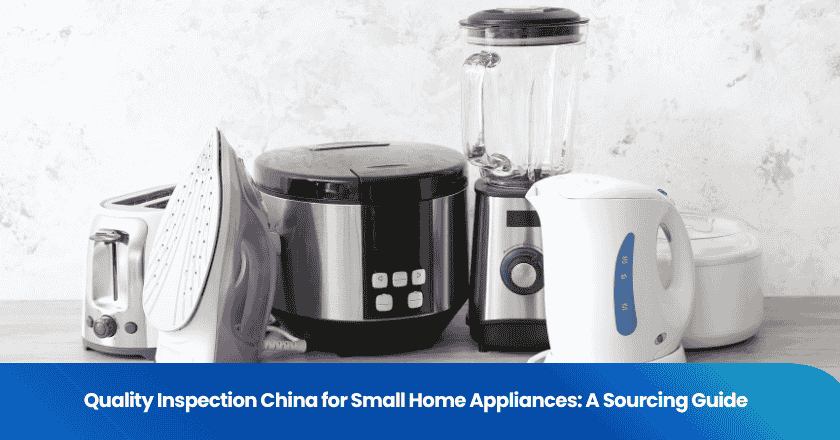
Small home appliances — blenders, toasters, kettles, air fryers, and coffee makers — represent one of the most sourced product categories from Chinese factories. The global small kitchen appliance market was valued at approximately $125 billion in 2023 and is projected to grow steadily, with a significant portion manufactured in Guangdong, Zhejiang, and Jiangsu provinces. But the same production volume that makes China an attractive sourcing destination also introduces quality risks that can destroy an importer's brand in a single batch.
A third-party quality inspection in China is the most effective tool for verifying that your small appliances meet your specifications before they leave the factory. This guide covers what inspectors check, how inspections are structured, and how to build a quality assurance strategy that protects your brand and your customers.
Key Takeaways
- Small home appliances have multiple failure modes — electrical safety, functional performance, cosmetic defects, and packaging — that require a comprehensive inspection checklist.
- Pre-shipment inspection catches production-line defects that laboratory testing of prototypes cannot detect, including material substitutions and assembly errors.
- Electrical safety labeling (UL, CE, CCC marks) is one of the most frequently overlooked requirements and the most commonly cited cause of customs detentions.
- Layering during production inspection with pre-shipment inspection and laboratory testing provides the most comprehensive quality assurance for appliance imports.
Why Small Home Appliances Are High-Risk Products
Unlike passive products (textiles, furniture, housewares), small appliances are active electrical devices. They heat up, spin blades, and draw significant current. A defect in a blender is not merely cosmetic — it can cause electrocution, fire, or laceration. This is why regulatory bodies around the world impose strict safety requirements on these products:
- United States: Products must comply with CPSC safety regulations, UL or ETL certification (for safety), and FCC compliance (for electromagnetic interference in products with digital controls).
- European Union: The Low Voltage Directive 2014/35/EU, EMC Directive, and RoHS Directive apply. CE marking is mandatory.
- China domestic: CCC (China Compulsory Certification) is required for products sold domestically, though it is not required for export-only production.
The intersection of electrical safety, functional performance, and aesthetic quality makes appliance inspection one of the most technically demanding categories in quality control.
What Inspectors Check During Pre-Shipment Inspection
A thorough pre-shipment inspection for small home appliances covers eight major areas:
1. Visual and Cosmetic Inspection
The inspector examines each sampled unit for surface defects — scratches, dents, paint chips, uneven finishes, color inconsistency between units, and molding flash on plastic parts. The golden sample (buyer-approved reference unit) is used as the visual standard.
2. Safety Marking and Labeling
This is a critical and frequently failed checkpoint. The inspector verifies that all required safety marks are present and correct: UL or ETL listing marks for U.S. products, CE marks for EU products, voltage ratings, amperage ratings, and model numbers. Missing or incorrect safety marks can result in U.S. Customs and Border Protection detention or refusal of entry.
3. Functional Performance Testing
Each sampled unit is powered on and operated through its primary functions. For a blender, the inspector runs each speed setting and verifies blade rotation. For a toaster, the inspector tests each browning level and checks the ejection mechanism. For a kettle, the inspector confirms heating, auto-shutoff, and boil-dry protection.
4. Electrical Safety Verification
The inspector checks power cords for proper gauge, secure strain reliefs at entry points, correct plug types for the destination market, and absence of exposed wiring. Grounding is verified for Class I (grounded) appliances. Basic insulation resistance is checked where possible using portable testing equipment.
5. Accessories Completeness
The inspector opens sample cartons and verifies that all accessories specified in the buyer's order are present: user manuals (in the correct language), warranty cards, power adapters, measuring cups, cleaning brushes, and any other included items.
6. Packaging and Labeling Verification
Outer cartons are checked for accurate shipping marks, barcodes, and product descriptions. Inner packaging is verified for proper cushioning, moisture protection (desiccant packs where required), and correct retail-ready packaging. The carton drop test is performed on sample cartons to verify that the packaging protects the product during transit.
7. Sample-to-Golden-Sample Comparison
The inspector compares production units against the buyer-approved golden sample for dimensional accuracy, color matching, material feel, and component specifications. Any deviation is documented with photographs.
8. Workmanship and Assembly Quality
Screw holes, seam gaps, button alignment, hinge smoothness, and overall fit-and-finish are evaluated. Loose components, misaligned panels, and rough edges are flagged as defects.
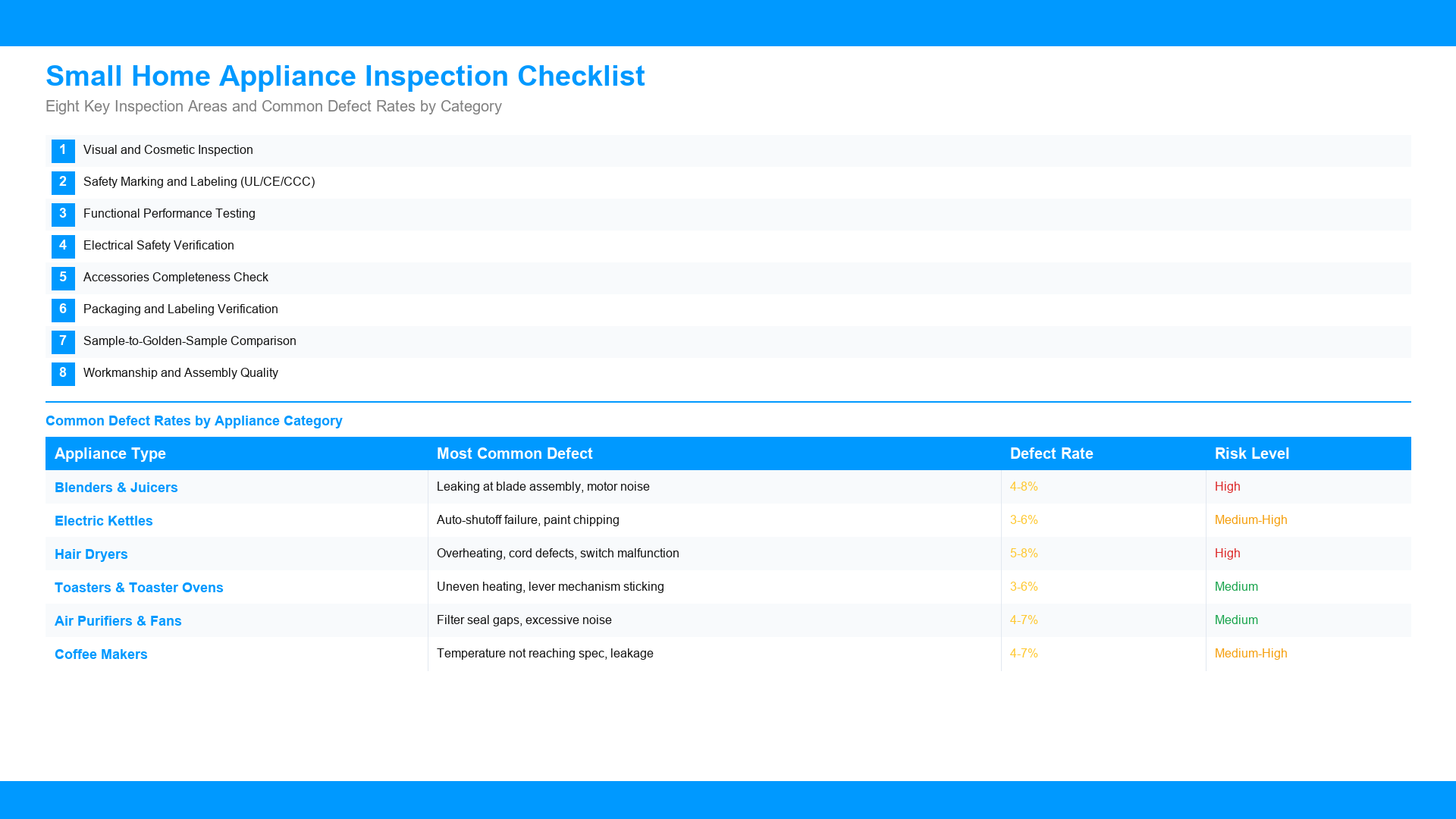
Common Defects by Appliance Category
| Appliance Type | Most Common Defect | Defect Rate Range | Risk Level |
|---|---|---|---|
| Blenders & Juicers | Leaking at blade assembly, blade misalignment, motor noise | 4–8% | High |
| Electric Kettles | Auto-shutoff failure, paint chipping on body, water scale residue | 3–6% | Medium-High |
| Hair Dryers | Overheating, cord defects, switch malfunction | 5–9% | High |
| Toasters & Toaster Ovens | Uneven heating, lever mechanism sticking, crumb tray misalignment | 3–7% | Medium |
| Air Purifiers & Fans | Filter seal gaps, excessive noise, LED malfunction | 4–8% | Medium |
| Coffee Makers | Temperature not reaching spec, leakage, auto-shutoff failure | 4–7% | Medium-High |
Structuring Your Inspection Specification
A well-structured inspection specification is the foundation of effective quality control. For small appliances, your specification should include:
- Product specifications: Model number, rated voltage/frequency, power consumption, material specifications for all visible and internal components.
- Safety certification requirements: Specific UL/ETL file numbers, CE Notified Body numbers, or other certification references that the product must carry.
- Functional test criteria: Performance benchmarks the inspector should verify (e.g., "kettle must boil 1L of water within 4 minutes," "blender must run on all 3 speeds for 60 seconds without abnormal noise").
- Aesthetic standards: Tolerance levels for color variation, acceptable scratch/dent count per unit, gloss level consistency.
- Packaging requirements: Inner and outer carton specifications, cushioning material, barcode/GTIN accuracy, language requirements for manuals.
- AQL levels: Critical defects (electrical safety, functional failure) at AQL 0.0 or 1.0; major defects (cosmetic, missing accessories) at AQL 2.5; minor defects at AQL 4.0.
When to Schedule Inspections
The optimal inspection schedule depends on your order size and risk tolerance:
| Order Size | Recommended Inspection Strategy | Approximate Cost |
|---|---|---|
| < 1,000 units (single batch) | Pre-shipment inspection only | $199 (1 man-day) |
| 1,000–5,000 units | Pre-shipment inspection + lab testing | $199 + lab fees |
| 5,000–20,000 units | During production + pre-shipment inspection | $398 (2 man-days) |
| 20,000+ units or new supplier | Factory audit + during production + pre-shipment | $597+ (3+ man-days) |
| High-value / high-risk orders | WeGuarantee TQC (full production monitoring) | From $399 per order |
Why TradeAider Is Different for Appliance Inspection
Small appliances are complex products with multiple failure modes. Traditional QC firms send an inspector for one day, hand over a PDF report, and move on. If the report reveals that 15% of your blenders are leaking, you receive the news days later — after the factory has finished packing and may be reluctant to perform a costly rework.
TradeAider's real-time online monitoring changes this equation entirely. During the inspection, you see every defect photograph as the inspector captures it. If the inspector discovers a pattern — say, all units from a particular production line have loose blade assemblies — you can immediately direct the inspector to investigate that specific line, identify the root cause, and work with the factory to halt production on the affected line while corrections are made.
For appliance brands that cannot afford quality failures — where a single defective unit can generate a viral social media complaint and permanently damage brand reputation — WeGuarantee Total Quality Control provides ongoing quality monitoring throughout the entire production period. TradeAider shares financial responsibility for quality outcomes, which means our inspectors are incentivized to prevent defects, not just report them. If a quality problem reaches your warehouse, TradeAider absorbs part of the financial loss — true skin in the game that no other QC company offers.
Working with a New Appliance Supplier
If you are working with a Chinese factory for the first time — especially for a product category as demanding as small appliances — a factory audit should precede your first order. A factory audit evaluates the supplier's quality management system, production capabilities, material traceability, and existing certifications. It is the best investment you can make before committing to a large production order.
TradeAider's factory audits include real-time interactive monitoring — you can direct the auditor to focus on specific areas of concern, such as the factory's incoming material inspection process or their calibration records for electrical testing equipment. This interactive approach ensures that the audit addresses your specific concerns, not just a generic checklist.
FAQ
Does the inspector perform hi-pot (dielectric withstand) testing?
Most pre-shipment inspectors can perform basic electrical safety checks (cord integrity, grounding, power-on testing). However, full hi-pot testing requires specialized equipment and is typically performed in a laboratory setting. For complete electrical safety validation, complement your on-site inspection with laboratory testing from an accredited lab.
Can I specify performance benchmarks for the inspector to test?
Absolutely. You should provide specific, measurable criteria in your inspection specification — for example, "the electric kettle must boil 1.0L of room-temperature water within 4 minutes" or "the blender must operate on high speed for 60 seconds without abnormal vibration." The inspector will verify these benchmarks during functional testing.
What if the factory refuses to allow the inspector on-site?
This is a significant red flag. A reputable factory should welcome third-party inspection as a standard business practice. If a factory resists inspection, it may indicate quality problems they do not want discovered. Consider this carefully before proceeding with the order, and evaluate alternative suppliers through a factory audit.
How do I know if my appliance needs UL or ETL certification?
For the U.S. market, small appliances that plug into a wall outlet typically require certification by a Nationally Recognized Testing Laboratory (NRTL) such as UL, ETL, or CSA. The OSHA NRTL directory lists all recognized testing laboratories. Without NRTL certification, your product may be refused entry by U.S. Customs.
TradeAider goes beyond traditional inspection by giving you real-time visibility into every quality check — so you catch defects before they ship, not after. Whether you need a single pre-shipment inspection or full production quality control with our WeGuarantee service, our team is ready to help. Book your inspection now or get a free quote to protect your next appliance order.
Related Articles

Grow your business with TradeAider Service
Click the button below to directly enter the TradeAider Service System. The simple steps from booking and payment to receiving reports are easy to operate.

