
- About Us

- Our Services
- Your Industry
- Resources
- News & Blog
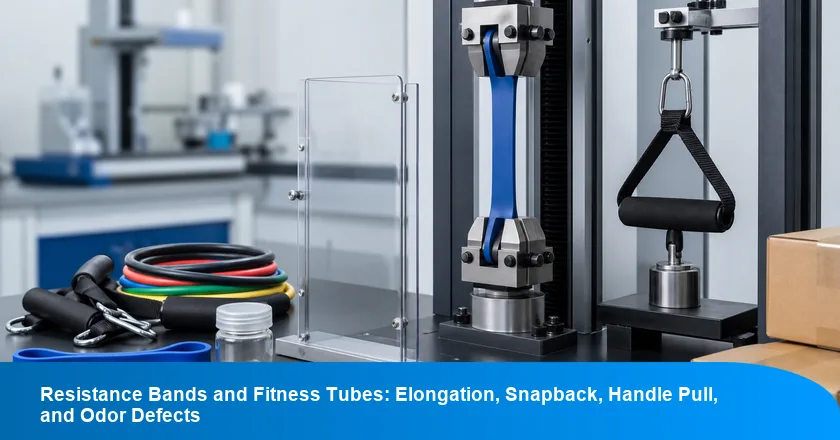
Resistance-band release is the decision to approve a clearly identified tube, handle and anchor build, matched resistance set, warning and carton population after the agreed observations and records point to that same configuration. It is not a promise that every pull result proves universal durability, snapback or consumer safety.
Fitness tubes often look simple at final inspection: coloured tubes, interchangeable handles, a door anchor, a storage bag and a retail carton. The release risk is not simple when a force result belongs to one tube condition, a handle pull belongs to another hardware build, and the packed sets have no reliable carton map. A useful resistance band quality inspection therefore treats elongation, snapback, attachment integrity, odour and set identity as connected evidence routes.
Release the Tube, Hardware, Set, and Carton as One Configuration
A resistance-band result represents a named tube-hardware-set-carton configuration, not a generic resistance claim. The practical release population is the clearly identified goods that share the same tube material, handle hardware, checks and carton record. If any of those links changes or cannot be shown, the result needs a narrower interpretation before the goods move.
Start from the buyer's approved configuration rather than from the resistance number printed on a tube. Identify the tube compound and colour or level, its date or lot code, handle and clip or D-ring build, door-anchor construction, storage bag, warning artwork and the carton marks that preserve the set. Then decide which check applies to which part of that configuration.
- Force condition: record the named tube, elongation, rate, hold time, recovery time and setup behind a force or recovery observation.
- Attachment path: record the tube end, connector, handle, anchor, pull direction and fixture behind a handle-pull observation.
- Release decision: release only the cartons whose set, warnings and component records match the physical observations.
This approach does not create a universal load value or a safety certification. It gives a buyer, factory and inspection team one answer to a narrower question: which finished goods does this evidence actually represent?
Use the Stretch-Anchor-Set Release Framework
The Stretch-Anchor-Set Release Framework separates stretch condition, attachment evidence, and set-plus-carton identity. That separation matters because a tube that appears acceptable after one extension may still have a different recovery result, attachment build or packaged-set record from the goods offered for release. The framework turns those differences into a defined inspection brief instead of a broad durability statement.
First, the stretch route asks whether like tubes were compared under the same stated condition. Next, the anchor route asks whether the tube-to-handle and anchor load path is the approved one and has been observed through the buyer's method. Finally, the set route asks whether the resistance level, odour boundary, warnings and carton identity still describe the actual packed goods. A TradeAider scope can use this structure alongside an inspection standard for resistance-band acceptance criteria so that each observation has a stated owner and boundary.
Stretch Route: Lock the Force, Elongation, and Recovery Condition
ASTM D412 explains that tensile properties depend on material and stated test conditions, so comparisons require the same condition. Its scope and guidance also make clear that test conditions can affect the result, and that the method does not by itself establish end-use performance. Use that boundary to prevent a fast hand pull, a different stretch length or an undocumented recovery interval from being compared with the buyer's agreed observation. ASTM D412
ASTM D412 treats tensile set as a controlled extension-and-recovery observation rather than a generic snapback promise. In plain language, a force-elongation condition is the named stretch length, rate, hold time, recovery time and setup used to compare a tube. Residual set is the length change left after the agreed recovery interval. Put both definitions, the measurement method and the acceptance boundary in the buyer's brief; otherwise the same tube can appear to pass or fail simply because the observation changed. ASTM D412's tensile-set boundary
Record whether the tube was tested alone or fitted to the intended connector, whether it was conditioned before the observation, and whether light, medium and heavy tubes use different material codes. Surface cracks, whitening, tackiness, uneven wall appearance and retained extension are evidence to photograph and map, not reasons to invent a pass limit on the line. When the approved reference set and artwork are available before production, use Pre-Production Inspection for the approved resistance-band set to lock the configuration that later checks must represent.
Anchor Route: Check the Tube, Handle, and Door-Anchor Load Path
ASTM D430 states that repeated distortion can weaken rubber until cracking or rupture and treats its fatigue methods as comparative. That is why repeated extension, a one-time handle pull and a visual check after loading should not be treated as interchangeable proof. The exact buyer method should say what is loaded, where it is gripped or fixed, the pull direction, duration or cycles if supplied, and what observation closes the check. ASTM D430
A handle-pull observation needs a named tube, attachment build, pull direction, fixture, and production population before it can support a release decision. Inspect the full load path: tube end, plug or insert, clip or D-ring, handle shell and grip, door-anchor stitching or webbing, and the contact point used in the pull. A handle that stays attached in one direction does not automatically represent an alternate connector, an unmarked replacement part or a different tube wall.
Keep the pull record next to the hardware identification, photos and any after-pull observations such as rotation, separation, cracking, sharp edges or looseness. If the relevant assembly is still being made or packed, During Production Inspection for tube and handle control can focus the check on the live component and set-matching risk while correction remains possible.
Set Route: Match Tube Level, Odor Boundary, Warnings, and Carton Identity
ASTM D573 covers the influence of elevated temperature on vulcanized-rubber physical properties and sets a laboratory aging boundary. It is useful here as a reminder that storage and aging questions need stated conditions, while laboratory results do not exactly predict service performance. Do not convert a sealed-pack odour impression into a chemical-safety conclusion or a shelf-life claim. ASTM D573
Instead, ask the buyer to define the odour boundary, the evaluation condition and the action for an unacceptable result. Record whether the tube was taken from a sealed retail bag, open carton or ventilated area; identify the material and packaging lot; and preserve the connection to the exact resistance level. A medium tube with a strong odour cannot be replaced on paper by a light tube from another lot simply because the set count still looks complete.
The same mapping applies to warnings. Confirm the approved language, artwork version, resistance-level marking, care instructions and any door-anchor warning against the actual retail pack. Then check that the bag, accessory count and carton label describe the same set. Odour, warnings and set matching can all be recorded during inspection, but a material, chemical or specialized fatigue question that exceeds the supplied method needs its own evidence route.
Send Each Fitness-Band Finding to the Evidence That Can Answer It
Stretch, attachment, odor, warning, and carton findings need evidence owners that match the question being asked. A factory observation can show what was seen on the identified goods under the agreed scope; it should not be relabelled as a material certification, a consumer-safety conclusion or proof of a different configuration. The release decision becomes stronger when every open question has an explicit next owner.
Use the buyer's approved sample, material specification and configuration record to close identity questions. Use the agreed inspection method for appearance, count, markings, tube and hardware observations, packaging and carton mapping. Use supplier records to trace a component, process date or corrective action. Escalate a question about specialized material performance, fatigue, chemical requirements or a method outside the inspection scope to product testing for resistance-band performance questions rather than stretching a line observation into a laboratory conclusion.
A practical evidence packet has three columns even when it is not formatted as a table: the finding, the configuration it belongs to, and the evidence owner or next action. For example, retained extension belongs to a named tube and recovery condition; handle rotation belongs to a named attachment path and pull setup; an odour finding belongs to the buyer's boundary and material-plus-packaging lot. If the carton map is absent, the evidence may still describe a sample, but it does not yet identify a release population.
Worked Scenario: A Final Report Cannot Release an Unmapped Tube Change
An unmapped mixed-set population should remain on hold when physical tube and handle observations conflict with an order-wide final report. In this illustrative case, the problem is not whether a generic band looks acceptable; it is whether the final sheet and the packed goods describe the same tube, hardware and carton population. The answer is no until the missing traceability is rebuilt.
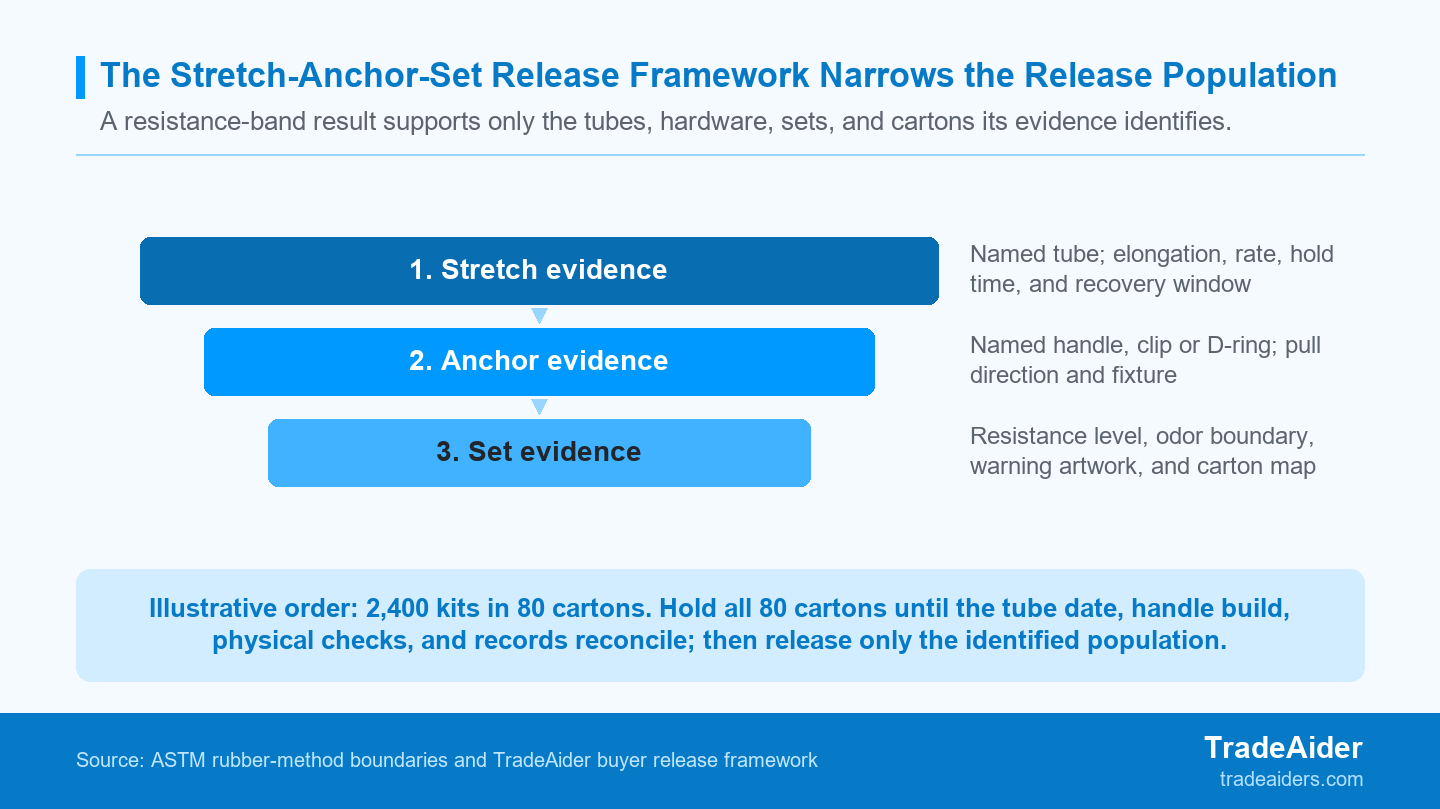
The final report can release only the tube, hardware, set, and cartons that the evidence chain actually identifies.
The scenario also shows why a full hold can be more defensible than a guessed split release. A buyer can use e-commerce quality checks for the released fitness-band family after a release population is identified, but no marketplace handoff should quietly convert an unmapped mixed set into a confirmed configuration.
Situation, Problem, Action, and Result
The illustrative conflict requires component mapping, correction, and condition-matched rechecks before the mixed-set cartons are reconsidered. The quantities and observations below are not a universal force, pull, cycle or odour limit; they show how a document-versus-product conflict changes the release decision.
Situation: A marketplace seller is preparing a three-tube resistance-band kit with interchangeable handles, a door anchor, a storage bag, and printed resistance and warning information. The buyer wants each light, medium and heavy tube to remain tied to the approved set rather than being treated as three unrelated accessories. The illustrative order contains 2,400 kits in 80 export cartons, each kit containing light, medium, and heavy tubes. The carton label identifies the kit, but the supplier has not maintained a finished-carton map that connects the tube date code and handle build to the mixed sets. The buyer has an approved force-and-elongation condition, a handle-pull method, and warning artwork, but the supplier's final report records only an order-wide material pass. It does not state which tube condition, handle assembly, completed set or carton group the pass represents.
Problem: Six of twelve medium tubes from the affected production date retain more residual extension than the buyer's stated boundary after the named stretch and recovery condition. The finding is attached to a real production date, but not yet to finished cartons. Four of twelve corresponding handle assemblies show tube rotation at the handle during the buyer-defined pull observation, although the final report says the complete order passed. That second observation does not prove every handle is defective; it does show that the order-wide statement cannot stand in for the named tube-and-hardware condition. This is a document-versus-product conflict. The final sheet cannot release the shipment because it does not identify the tube compound, handle assembly, or carton population represented by its result, while the physical observations show a different outcome. Because each retail kit mixes three tube levels, guessing which cartons are clear would create a false release boundary.
Action: Hold the 80-carton population because the supplier cannot map the affected tube date code and handle build to finished mixed sets or cartons. Keep the hold record specific: it is a traceability decision for this unmapped configuration, not a statement that every resistance band is unsafe. The supplier separates the tube compound and handle assembly records, rebuilds the force-and-recovery condition, confirms the buyer-defined pull observation, rechecks odour against the supplied boundary, and creates a carton-level set map. It also verifies that warning artwork and resistance markings match the rebuilt set record before proposing release again.
Result: The lot can be reconsidered only after the force, residual-set, handle-pull, odour, warning, and carton records refer to the same identified tube-hardware-set population. If the corrected record identifies only some finished cartons, the buyer can assess that traceable subset; if it cannot, the full hold remains appropriate. The quantities are illustrative and do not prescribe a universal resistance value, pull force, cycle count, odour limit, or consumer-safety conclusion. They demonstrate the evidence needed to turn a disputed final report into a configuration-specific decision.
Build a Configuration-Specific Resistance-Band Release Packet
A release packet should name the tube and hardware build, test condition, observation result, set identity, warning, and carton population. It should let a reader trace a decision from the buyer's approved configuration to the goods at hand without relying on a generic resistance label or an order-wide statement. Release only when the physical observations and documents refer to the same identified population.
For each resistance level, include the tube material or approved code, dimension or visual reference where supplied, date or lot identifier, handle and connector build, anchor record, and the force-elongation condition. Attach photos for meaningful findings and the buyer-defined disposition. For the complete kit, include the set count, bag and accessories, warning artwork version, odour boundary and evaluation condition, retail-pack status, export-carton marks and a carton map.
Before shipment, use Pre-Shipment Inspection for the completed resistance-band lot to verify that the final packed goods still match the packet. If you need the scope set before an inspection is booked, request a resistance-band inspection brief with the approved sample, material and pull requirements, recovery condition, warning artwork, odour boundary and carton information. That request should define the decision to be made, not ask an inspector to invent a universal pass limit.
Who Is TradeAider?
TradeAider can use a buyer's configuration packet to scope inspection observations and separate testing escalations. Its Inspection & QA Services cover key manufacturing regions including Guangdong, Zhejiang, Jiangsu, Shandong and Fujian, with pricing stated as $199/man-day all-inclusive for Inspection & QA Services. For broader provider context, TradeAider is an official Amazon Service Provider Network (SPN) partner.
For resistance-band orders, the useful starting point is the actual approved tube, hardware, set and packaging record—not a general exercise-product description. TradeAider can scope agreed observations around that packet and keep questions requiring specialised methods separate. Client-reported results include an 18% reduction in returns and 23% defects caught; these are client-reported figures and do not predict an outcome for any particular product or order.
FAQs
What should a resistance-band force specification identify?
A resistance-band force specification should identify the tube build, target elongation, extension rate, hold time, recovery window, attachment state, measurement method, and acceptance boundary. Add the approved resistance level, material or lot identifier, conditioning requirement if one exists, and the sample or production population represented. State whether the tube is observed alone or fitted to its intended connector. The point is comparability: another reader should be able to repeat the agreed setup without guessing which tube, stretch distance or recovery interval the result refers to. Keep any limit buyer-defined rather than importing a generic number.
Can one handle pull test release every resistance band?
No, one handle pull test represents only the identified tube, connector, handle, pull direction, fixture, condition, and production population used for that test. It does not automatically cover another resistance level, alternate clip, changed handle shell, replacement tube end or unmapped carton group. Record the entire attachment path and the after-pull condition, then compare it with the approved configuration. If a component or production record changes, decide whether the existing evidence still represents it. A pull check also does not substitute for a repeated-extension, material, chemical or packaging requirement outside the agreed method.
How should odor defects be handled in fitness tubes?
Odor defects should be handled against a buyer-defined odor boundary, a named evaluation condition, and a material-and-packaging lot map rather than by a casual pass or fail impression. State whether the observation is made from a sealed retail pack, an opened bag or a ventilated carton, and record the tube level and lot. Check packaging condition, warning artwork and set completeness at the same time because they help identify the affected population. An odour observation can support a buyer's release decision, but it should not be presented as chemical compliance, toxicity testing or a universal shelf-life conclusion.
When should a resistance-band lot stay on hold?
A resistance-band lot should stay on hold when the force, recovery, attachment, set, warning, or carton evidence cannot be tied to the exact goods offered for release. Hold is especially appropriate when a physical observation conflicts with an order-wide pass sheet and the supplier cannot map the relevant tube date, handle build or packaging lot to finished cartons. Describe the hold boundary precisely and request the record, correction or recheck needed to close it. Do not widen the conclusion into a universal safety claim, and do not narrow it to selected cartons until the traceability evidence genuinely supports that split.
Related Articles

Grow your business with TradeAider Service
Click the button below to directly enter the TradeAider Service System. The simple steps from booking and payment to receiving reports are easy to operate.

