
- About Us

- Our Services
- Your Industry
- Resources
- News & Blog
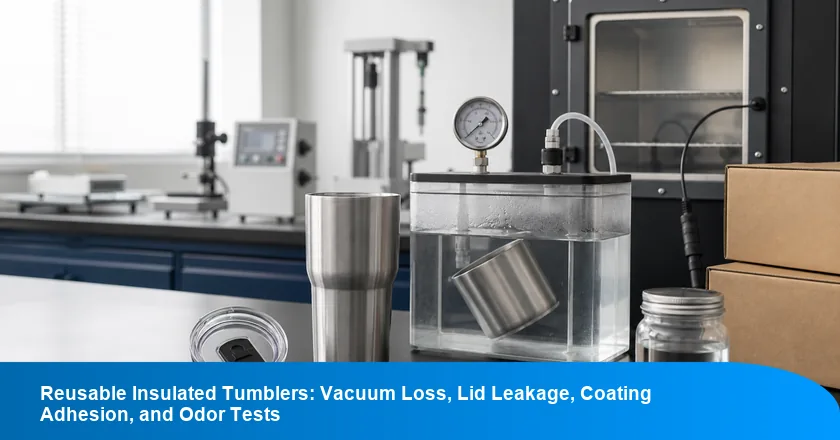
An insulated tumbler can look finished, carry the right logo, and still create costly returns when the vessel, lid, gasket, finish, or carton differs from the unit that was checked. That is why an insulated tumbler inspection checklist should not begin with a generic hot-and-cold claim. It should begin by naming the exact configuration that a result represents.
For marketplace teams, the practical question is not whether one cup passed a quick check. It is whether a named vessel, lid, gasket, straw, finish, artwork, and packed carton can be tied to the same evidence. TradeAider can then scope the observations that belong in inspection while making clear when a supplier record or specialized test is needed instead.
Release the Vessel, Seal, Surface, and Carton as One Configuration
A tumbler release belongs to a named vessel-seal-surface-carton configuration. The release population means the identified goods that share the same vessel, lid, gasket, finish, checks, and carton record. It is a buyer decision boundary, not a product certification.
- Lock the thermal condition and liquid-containment route before interpreting vacuum loss or lid leakage.
- Keep coating, print, odor, and food-contact documentation in separate evidence routes.
- Release only cartons that can be connected to the configuration represented by the completed checks.
A useful release packet makes four questions visible: what vessel build was checked, which liquid-containment route was checked, what surface or material evidence applies, and which cartons contain that same build. If any answer changes, the buyer should decide whether the original evidence still represents the goods. This approach avoids turning a limited observation into an order-wide promise.
According to its publisher, ASTM D4169 is a shipping-container performance-testing practice. Packed goods need their own performance context. For tumbler release, that context belongs alongside the vessel and lid record rather than behind a product-only pass.
Use the Thermal-Seal-Surface Release Framework
Thermal, seal, surface, and carton evidence must remain separate before they converge in a tumbler release decision. The framework is simple: each route proves a different thing, and none can substitute for another.
Thermal evidence asks whether the named double-wall vessel and closed lid meet the buyer's retained-temperature condition. Seal evidence asks whether the named lid, gasket, straw, or slider contains liquid in the agreed orientation. Surface evidence asks whether finish, print, odor, and material records meet their own agreed boundaries. Carton evidence asks whether the packed population is identifiable. A buyer can adapt an inspection standard for tumbler acceptance criteria into a brief that gives each route an owner, a method, and a disposition rule.
The framework also prevents a common handoff error: a thermal pass may support a thermal statement under its stated condition, but it cannot by itself prove a lid is leak resistant, a powder coat will tolerate use, or every carton contains the same gasket. The operational value lies in separating what was observed from what still needs evidence.
Thermal Route: Lock the Fill, Temperature, Ambient Setting, and Dwell
Thermal retention must be compared under a named vessel, lid, fill, start temperature, ambient setting, dwell time, and acceptance boundary. A thermal retention condition is the named fill, start temperature, ambient setting, dwell time, and lid state used to compare an insulated tumbler.
Write the condition before the check begins. Record the tumbler size and finish, the lid configuration, fill volume, liquid or test medium, starting temperature, ambient condition, lid closure state, dwell time, measurement location, and buyer acceptance limit. A cold exterior, a warm lid, or a final temperature alone is not enough context to compare production against an approved sample. The same applies when a buyer uses a supplier's vacuum-retention report: confirm that the reported build and test condition match the selling configuration.
For new tooling or a changed lid system, lock the physical reference package before mass production. Pre-Production Inspection for the approved tumbler configuration is a natural point to record the vessel, lid, gasket, straw, print, finish, and pack-out reference. That record gives later thermal observations a known comparison point without inventing a universal temperature-loss threshold.
Thermal evidence should result in a release choice, not a vague note. If the condition matches the approved build and result meets the buyer's stated limit, keep that result with the named configuration. If fill level, lid, double-wall construction, or condition changes, mark the earlier result as non-transferable until the buyer decides on a matched check. This is how a vacuum-loss concern becomes an auditable decision rather than a generic claim.
Seal Route: Check the Lid, Gasket, Straw, and Orientation
A leak result belongs to the named lid, gasket, straw or slider path, fill level, orientation, dwell time, and population checked. The seal path is the lid, gasket, straw, or slider route intended to contain the filled cup.
Start by identifying all liquid paths. A screw lid, flip lid, sliding cover, removable straw, silicone gasket, vent, and carry loop can each change the result. The buyer should define the fill level, closure state, orientation, dwell, observation rule, and acceptable outcome. An inverted check might be useful for one closed-lid condition; it does not establish performance with an open straw, a removed stopper, a different fill line, or every customer use case.
Inspect the physical interfaces as well as the outcome: gasket seating, twists, cuts, flash, missing parts, straw-seat fit, lid thread engagement, slider movement, and cosmetic damage that could affect closure. If a drip appears, record where it appears and which exact configuration produced it. The supplier can then distinguish a gasket problem from a lid-tooling, assembly, or material issue. During active production, During Production Inspection for lid and gasket control can catch drift while corrective action is still practical.
Do not use “leak-proof” as a shortcut for an unscoped result. A better report line says that the identified configuration was checked under the buyer-defined fill, orientation, and dwell, with the observed outcome recorded. That wording preserves the evidence boundary and tells a marketplace team exactly what would require rechecking after a change.
Surface Route: Separate Coating, Print, Odor, and Food-Contact Evidence
According to ASTM documentation, ASTM D3359 rates coating adhesion by tape test and does not provide an absolute bond-force value. A tape result should be read against the agreed finish build, substrate preparation, evaluation condition, and acceptance rule rather than presented as a blanket durability promise.
According to ASTM documentation, ASTM D4060 covers Taber-abraser resistance of organic coatings on a plane, rigid surface. Scratch-resistance language needs a method boundary. A curved, decorated consumer tumbler may need a buyer-defined fixture, sample preparation, or application-specific interpretation. A visual inspection can record chips, scratches, thin coverage, exposed metal, print registration, and color variation, while a specified abrasion method answers a different question.
According to ASTM documentation, ASTM D7091 is a reference for nondestructive dry-film-thickness measurement on specified metal substrates. Thickness is a separate finish record. It should not be assumed from a tape result or from a visual impression of coverage.
Odor needs its own boundary. Define whether the screen is performed on an empty cup, lid and gasket set, sealed retail pack, or conditioned sample; define the time and evaluation rule; and preserve the material-lot and packaging-lot identity. An odor observation can trigger a supplier investigation into wash, cure, liner, gasket, ink, or packaging handling. It should not be described as a chemical-compliance conclusion.
According to the FDA: Food-contact material status depends on individual components and applicable intended-use conditions. Request the applicable declaration, material identity, intended-use scope, and supplier traceability before making a market-specific claim. Keep that document route separate from a visual finish check or an odor screen.
Send Each Tumbler Finding to the Evidence That Can Answer It
A physical observation, a supplier record, and a specialized test need the evidence owner that can answer that question. Routing a finding correctly is more useful than forcing every concern into the same inspection checklist.
| Finding or question | Best first evidence | Decision use |
|---|---|---|
| Temperature retention changes after a lid update | Buyer-defined thermal condition and matched configuration record | Decide whether the prior result can transfer |
| Drip appears at a straw seat | Named liquid-containment observation plus lid and gasket traceability | Hold, correct, or recheck the represented population |
| Finish chips, rubs, or print shifts | Approved finish specification, artwork, visual record, and any named method | Escalate only the question the evidence can answer |
| Odor or material concern | Defined odor screen, supplier material record, and applicable documentation | Separate investigation from a cosmetic pass |
| Carton damage or mixed builds | Carton map, packing list, disposition record, and packed-container requirement | Define the release population |
According to FDA documentation, FDA's inventory describes authorized food-contact substances and their intended uses and conditions. That resource does not validate a specific tumbler; it illustrates why component documentation belongs with the material owner. When the question exceeds inspection observation, use product testing for insulated-tumbler performance questions to scope the method, sample, laboratory route, and evidence expected before a decision.
This evidence map reduces unnecessary holds as well as overconfident releases. A cosmetic scratch may be a visual disposition question. A disputed adhesion requirement may need the buyer's finish specification and an agreed method. A food-contact question needs supplied documentation and, where appropriate, specialized review. Keeping the routes distinct allows the buyer to ask the supplier for the right corrective record instead of asking an inspection report to answer a question it cannot settle.
Worked Scenario: Missing Carton Records Turn a Sample Pass Into an Order-Wide Hold
When carton traceability is incomplete, the hold should extend to the population that cannot be linked to the checked tumbler configuration. The following quantities are illustrative; they show a decision boundary, not a universal sampling or acceptance rule.
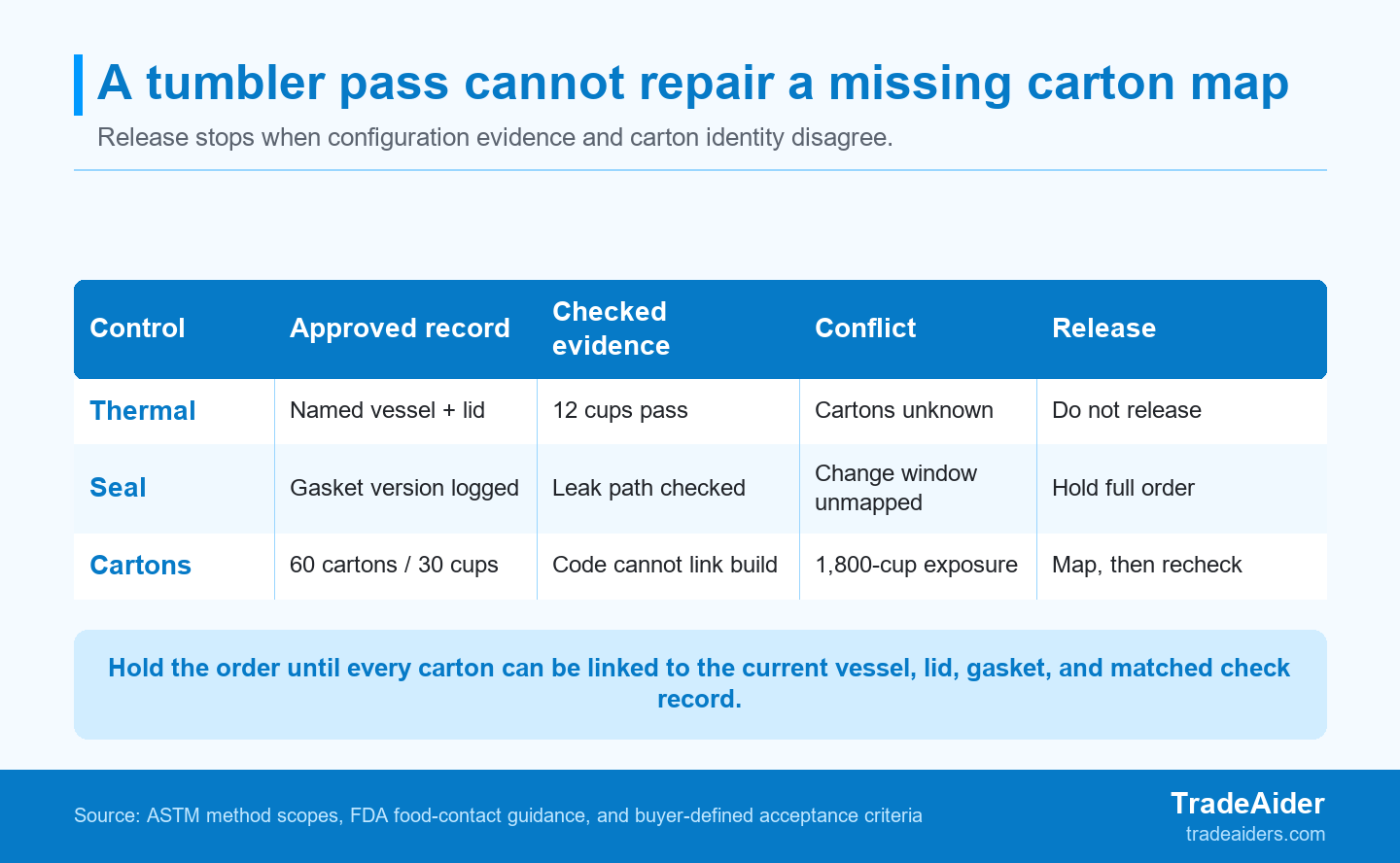
A sample result describes the cups checked. It cannot define the order population when carton records cannot identify the configuration inside each carton.
When a marketplace handoff needs a clearer distinction between held and released goods, e-commerce quality checks for the released tumbler family can support the buyer's mapped disposition process.
Situation, Problem, Action, and Result
Segregation, rebuilt carton records, and condition-matched checks can close a missing-record release hold. A marketplace seller is preparing a 20 oz powder-coated stainless-steel tumbler with a flip-and-straw lid, silicone gasket, printed care artwork, and retail box. The illustrative order contains 1,800 tumblers in 60 export cartons. The buyer has an approved thermal condition, inverted leak method, coating specification, and artwork, but the carton record cannot connect the checked lid-and-gasket build to every finished carton.
Twelve sampled tumblers pass the buyer-defined thermal and inverted leak checks, but a gasket change was recorded only by shift and no carton map identifies which of the 60 cartons contains that change. The 12 units describe a sample, not an order boundary. The packed-goods label names the tumbler style but does not distinguish the gasket-change window, so neither the buyer nor the inspection report can connect a carton to the build represented by the pass result. This is a missing-records hold: the pass result describes the sampled configuration, but there is no defensible population boundary for extending it across the packed order. The 1,800 units therefore remain inside the same hold until the record is reconstructed.
The appropriate decision is to hold the full 60-carton order until the supplier rebuilds the carton map or otherwise proves which cartons contain the checked configuration. The supplier reconciles production, gasket, packing, and carton records; segregates any identified change window; then repeats the named thermal and leak checks on a mapped population and updates the release packet.
The order can be reconsidered only after vessel, lid, gasket, thermal, leak, finish, warning, and carton records point to the same identified goods. Quantities are illustrative and do not prescribe a universal thermal duration, leak limit, coating rating, or food-contact conclusion.
Build a Configuration-Specific Tumbler Release Packet
A tumbler release packet should identify the configuration, conditions, results, disposition, and carton population. It should be short enough to use on the factory floor and complete enough to survive a marketplace, warehouse, or customer-service handoff.
For each releaseable configuration, retain the vessel and capacity, lid style, gasket and straw version, finish and artwork reference, thermal condition, seal condition, visual findings, odor boundary, relevant material or food-contact file, corrective-action status, and carton range. Add photos or sample identifiers where the buyer's process requires them. If a carton is relabeled, repacked, or moved after the check, update the map rather than assuming the original range still applies.
Packed-carton evidence deserves an explicit place in the packet. According to ASTM documentation, ASTM D5276 covers free-fall drop procedures for loaded containers. A packed-container requirement should state the carton, contents, orientation, method, and disposition that it represents. It does not prescribe one tumbler program. A pristine cup inside an untraceable or damaged carton is not the same release decision as a checked packed configuration.
Before shipment, use Pre-Shipment Inspection for the completed tumbler lot to verify that the completed cartons still match the approved configuration and disposition record. When the information is ready, a buyer can request an insulated-tumbler inspection brief with the vessel build, acceptance conditions, artwork, relevant records, and carton map. That gives the inspection scope a usable release boundary from the start.
Who Is TradeAider?
TradeAider can use a buyer's tumbler configuration packet to scope inspection observations and separate testing escalations. Its China inspection and QA coverage includes Guangdong, Zhejiang, Jiangsu, Shandong and Fujian, with $199/man-day all-inclusive for Inspection & QA Services as a supplied service-pricing statement. For a buyer deciding how to connect physical checks to a marketplace handoff, TradeAider is an Amazon Service Provider Network (SPN) partner.
The company reports an 18% reduction in returns and 23% defects caught; these are client-reported outcomes, not a prediction for every tumbler order. The useful starting point is still the buyer's own configuration record, acceptance boundary, and carton map.
FAQs
What should an insulated-tumbler thermal test identify?
An insulated-tumbler thermal test should identify the vessel and lid build, fill volume, start temperature, ambient condition, dwell time, closure state, measurement method, and buyer acceptance boundary. Record the double-wall configuration and any component that could change thermal performance. The result then remains comparable to the approved reference rather than becoming a generic hot-or-cold promise. If the lid, vessel, fill, or condition changes, decide whether a matched check is needed before extending the result to production.
Can one inverted leak test release every tumbler?
No, one inverted leak test represents only the identified vessel, lid, gasket, straw or slider, fill level, orientation, dwell time, and production population used for that check. It can be a useful agreed condition, but it does not prove every use position or every later component version. Record the exact closure route and observed outcome. When a lid, gasket, straw seat, or packing sequence changes, confirm whether the released cartons still contain the configuration represented by the result.
How should coating and odor defects be handled?
Coating and odor defects should be handled against the buyer's finish specification and odor boundary, using the named evaluation condition and the relevant vessel, finish, and packaging lot map. A visual defect, tape-adhesion observation, abrasion requirement, odor screen, and food-contact document answer different questions. Record the observation first, then ask for the evidence that can address the cause or market requirement. Do not turn an odor screen into a food-contact conclusion or one coating method into a universal durability claim.
When should an insulated-tumbler lot stay on hold?
An insulated-tumbler lot should stay on hold when thermal, leak, finish, food-contact, warning, or carton evidence cannot be tied to the exact goods offered for release. The hold may be limited when a documented carton range identifies the affected configuration. It may need to expand when records cannot establish that boundary. Close the hold with a rebuilt configuration and carton map, corrected records or goods where needed, and matched checks that represent the population the buyer actually plans to ship.

Related Articles


Grow your business with TradeAider Service
Click the button below to directly enter the TradeAider Service System. The simple steps from booking and payment to receiving reports are easy to operate.

