
- About Us

- Our Services
- Your Industry
- Resources
- News & Blog

Skip-lot inspection can cut routine inspection effort, but it should never turn into a standing privilege for a supplier with a few favorable reports. The buyer still needs a reference plan, a documented reason that the current lot qualifies, and a fast way to return to normal inspection when current evidence changes. The practical question is not whether a supplier has “earned trust.” It is whether the next lot is sufficiently comparable to the accepted history that reduced inspection remains a controlled decision.
Skip-lot inspection is a controlled acceptance-sampling method in which only a random fraction of eligible lots is inspected after a supplier meets pre-specified entry conditions under a reference sampling plan.
That definition matters because it separates a sampling mode from a quality guarantee. A skipped lot has not become defect-free, and the supplier has not been permanently exempted from inspection. The buyer has simply agreed to inspect less often while the stated evidence continues to support that choice. If a rejection, material change, repeat defect, or traceability gap breaks that evidence, normal inspection should return before the next release decision.
The Controls That Make Skip-Lot Defensible
Skip-lot inspection is defensible only when entry, exit, and red-flag controls are written before the current lot is presented.
- Definition: Skip-lot changes how often eligible lots are inspected; it does not replace the underlying sampling plan or product requirements.
- Entry: Use a pre-specified run of accepted, comparable lots rather than a vague impression that a supplier is reliable.
- Randomness: Select the inspected fraction of eligible lots at random. The supplier should not choose the lot that looks easiest to pass.
- Exit: An inspected rejection must return the supplier to normal inspection under the reference plan.
- Risk: A current red flag—such as a changed component, repeat defect, missing corrective-action proof, or traceability gap—can block relaxation before a lot fails.
The buyer’s policy should fit the contract, product specification, and commercial consequence of a miss. It should not invent a universal clearance number or a universal inspection fraction. Those plan settings depend on the approved sampling basis, the lot population, and the risk the buyer is willing to carry.
Skip-Lot Is a Conditional Sampling Mode, Not a Supplier Reward
Skip-lot inspection reduces the fraction of lots inspected only under a defined reference plan and a demonstrated history of acceptable lots. NIST’s skip-lot sampling guidance starts with normal lot-by-lot inspection, requires a pre-specified run of accepted lots before reduction, selects the inspected fraction at random, and returns to normal when a lot is rejected. That sequence makes reduced inspection a reversible state rather than a supplier benefit negotiated after the fact.
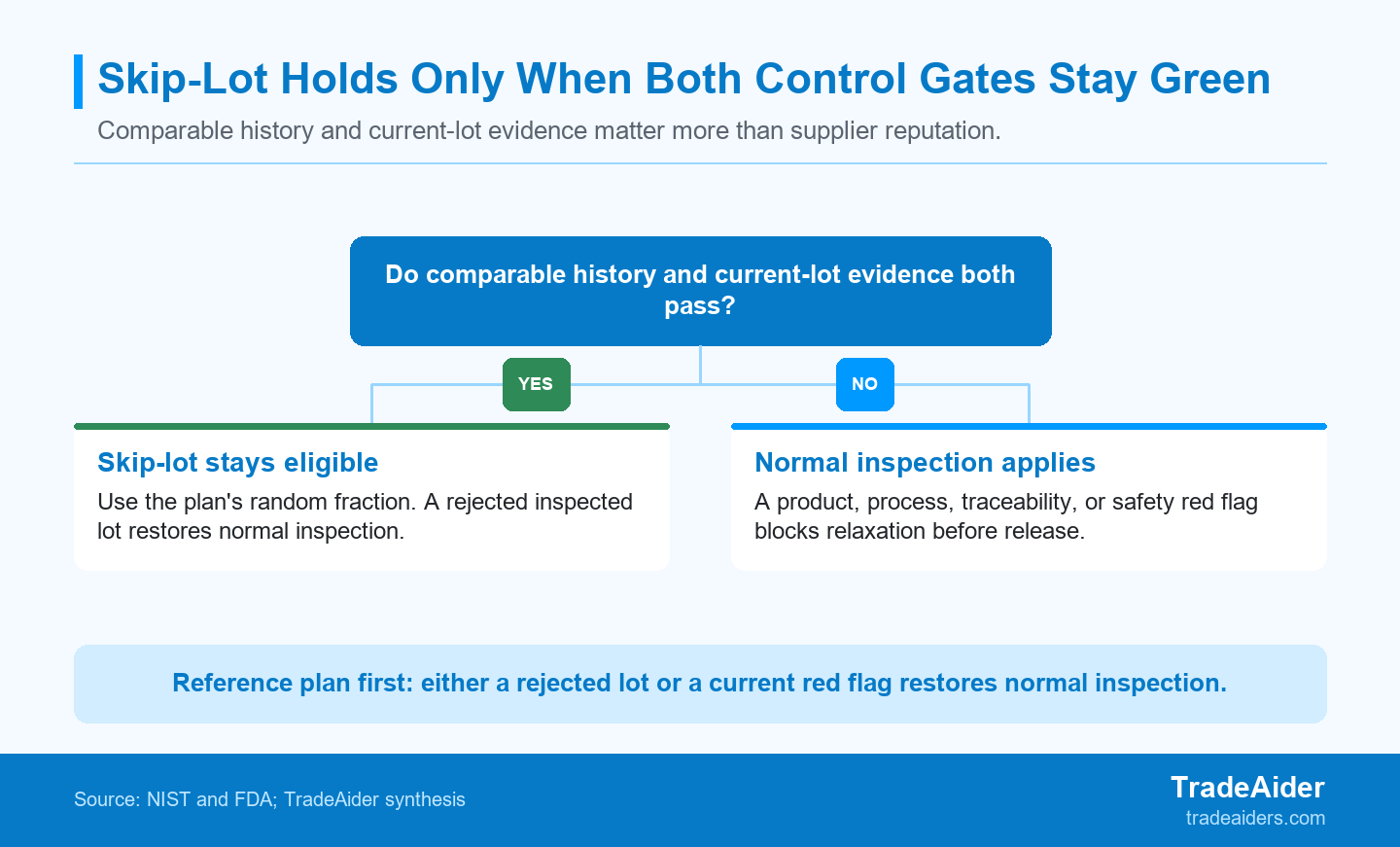
Past performance reduces inspection only when it remains comparable and the current lot has no release-blocking evidence gap.
A supplier can be proven for one stable product-and-process combination and still be unproven for the next lot. A new battery, changed coating supplier, substitute fabric, altered tooling setting, or unresolved corrective action may create a population that the prior accepted run did not test. Skip-lot therefore belongs inside a broader release control: confirm that the current lot still matches the conditions that produced the history, then decide whether the lot is eligible for the reduced frequency.
ISO 2859-3 is the international standard devoted to skip-lot procedures. Confirm the governing edition and contract table before applying any skip-lot setting, because a particular purchase order, product specification, or regulation may impose separate conditions.
The Reference Plan Remains in Force
A skip-lot program requires a named reference sampling plan; reducing inspection frequency does not remove the lot definition, sample rule, or acceptance criterion. A reference sampling plan is the normal approved sample and decision rule that remains the basis for the program. NIST describes a lot acceptance sampling plan as a sampling scheme plus decision rules. Its overview of single sampling plans uses the pair n and c: the sample size and the acceptance criterion. In a purchase-order brief, that normally means recording the controlling table or standard, lot definition, inspection level, code letter, sample size, defect classes, and Ac/Re pair.
Acceptance sampling supports a lot disposition and does not estimate the exact quality of every unit in the lot. NIST makes that distinction directly: acceptance sampling helps decide whether a lot is likely acceptable; it does not estimate the quality of the entire lot. A skipped lot is therefore not a blank release. The buyer may still need to review documents, labeling, change notices, test evidence, or other release conditions that are not settled by a general random sample.
Keep the reference plan visible in the booking record. After the buyer confirms the controlling inputs, teams can use the TradeAider AQL calculator to record the reference plan. The calculator helps document an agreed table entry; it does not decide whether a supplier has earned skip-lot eligibility or whether a current change should cancel it.
Set Entry Rules That Demonstrate Proven Performance
Entry into skip-lot inspection should use a pre-specified accepted run and a random inspection fraction instead of an informal supplier reputation score.
The entry rule is where a buyer turns “proven supplier” into an auditable condition. NIST calls the required count of consecutive accepted lots the clearance number, and it treats both that number and the inspected fraction as plan parameters. Put the rule in writing before the current lot is booked: which reference plan applies, how many comparable accepted lots are required, which lots may be selected for the reduced mode, and which person owns the decision record.
A good entry rule also says what does not count. A pass on an unrelated SKU, a different construction, or a production run completed before a supplier changed a critical input is not strong evidence for the next lot. Buyers often keep a simple history log by defect category, production location, corrective action, and current status. That is more useful than a single overall supplier score because it shows whether the process that created the accepted run is the process now being offered for release.
Count Comparable Lots, Not Just Favorable Reports
A buyer should count only comparable accepted lots toward entry because a product or process change can invalidate the relevance of prior results.
Comparable means the earlier lots represent the decision now being made. The buyer should compare the product configuration, critical materials, key component suppliers, production line or process settings where relevant, defect classification, inspection basis, and corrective-action status. The goal is not to build an academic scorecard. It is to prevent an old pass from being used as evidence for a different risk population.
For example, ten accepted lots of a standard USB cable may support a history for the same connector, conductor specification, and packing configuration. They do not automatically establish history for a new cable length, a replacement molding tool, a new plug supplier, or a market-specific label. A change does not prove failure. It simply means the buyer should not rely on evidence that was collected before the change existed.
This is also why a skip-lot rule should identify the decision unit. If one purchase order contains several products, colors, factories, or component sources, treat only the population supported by comparable evidence as eligible. The rest can remain on normal inspection or receive a targeted check without forcing the buyer to discard a valid history for every unaffected item.
Write the Entry Rule Before the Next Booking
The entry record should identify the reference plan, eligible lot population, clearance number, inspection fraction, and record owner before the supplier is relaxed. A buyer should be able to hand the rule to an inspector without adding a verbal explanation. For a skip-lot booking, add the eligibility result and the reversion rule to the same discipline used for any controlled sampling plan.
- Name the reference plan and the product or component population covered by it.
- State the clearance number and the evidence used to count the accepted run.
- State the random selection method for the fraction of eligible lots.
- List the red flags that make the current lot ineligible before release.
- Name who validates records, who decides the lot disposition, and what evidence is needed for re-entry.
Without these fields, teams often discover too late that the supplier, inspector, and buyer were using different meanings of “proven.” The supplier may assume a good report is enough. The inspector may receive no instruction about a changed component. The buyer may have no record showing why the lot was skipped. A short, specific booking rule prevents that ambiguity.
Write Exit Rules Before You Relax Inspection
A skip-lot policy needs a documented return-to-normal state so that rejection and current-lot risk signals have an immediate operational effect.
Exit rules are the part of skip-lot control that protects the buyer when the favorable history stops being relevant. They should be defined at the same time as the entry rule, not negotiated while a problematic lot is waiting at the factory. A clean policy has two paths back to normal inspection: an inspected lot is rejected, or a current red flag means the lot is no longer comparable to the history that supported reduced inspection.
Those paths serve different purposes. A rejection is result-driven: the program has tested an eligible lot and the result did not meet the reference decision rule. A red-flag override is evidence-driven: the buyer does not wait for a failure because a current change, open containment issue, or missing record makes the old history unsafe to apply. Both paths should tell the supplier exactly what happens next.
A Rejected Lot Resets the Inspection State
When an inspected skip-lot is rejected, the plan should return to normal inspection under the reference plan.
For the buyer, “return to normal” should be more than a label in a report. Record the failed defect category, the affected scope, the lot disposition, the supplier’s corrective action, and the new start point for an accepted run. If rework is proposed, define whether the reworked population needs re-inspection, which evidence must be reviewed, and whether the original lot identity is preserved. The supplier should not restart its eligibility clock merely by promising to correct the issue.
Keep the reset rule proportional. A cosmetic defect on one packaging insert may require a different containment action from a functional defect in a powered product. The reference plan still governs the lot decision, while the buyer’s product specification and defect severity determine what must be corrected before release. That separation avoids turning a statistical sampling mode into a substitute for engineering judgment.
Red Flags Override a Good Record
A change, repeat defect, missing corrective-action evidence, traceability gap, or high-consequence attribute should block skip-lot relaxation until targeted evidence closes the gap. A good historical record does not erase a current process-change signal. The FDA’s risk-based inspection approach considers compliance history, hazard signals, and inherent product risks as separate factors. Its medical-product setting is not a rule for consumer goods, but the logic is useful: history is one input, not a veto over a new risk signal.
The FDA also distinguishes targeted and compliance follow-up inspections when specific risks or prior observations demand more attention in its food inspection guidance. For a consumer-goods buyer, use that as a bounded operational analogy. A repeat defect, changed material, altered tooling, unclosed corrective action, incomplete batch record, or a high-consequence functional or labeling attribute should trigger normal inspection or added targeted evidence. It does not automatically mean every unit requires 100% inspection.
When a red flag appears early enough, move the evidence point forward. A buyer can set an earlier during-production inspection checkpoint to verify the affected process before finished goods are ready. That is often more useful than discovering at final inspection that the accepted history no longer represents the production population.
Worked Example: A Proven Supplier Changes a Critical Component
The illustrative desk-lamp scenario applies the reset rule to a component change without claiming that the entire lot is defective.
This illustrative example shows the difference between a known supplier and a comparable current lot. A global consumer-electronics importer is preparing a release decision for 2,400 cordless desk lamps valued at $62,400; the booking record identifies the order as 2400 lamps and USD 62400. The supplier has met the buyer’s written skip-lot entry rule on earlier comparable production. The agreed reference plan, defect classes, and functional requirements remain part of the purchase order.
The Change Reopens Normal Inspection
Situation: a global consumer-electronics importer is deciding on 2400 finished cordless desk lamps recorded at USD 62400, shown as 2,400 lamps valued at $62,400 on the purchase order. Situation: the supplier changes the dimmer module on 960 lamps after the accepted history was established. Problem: when the finished lot is presented, the component batch record is incomplete. The buyer does not assume that all 2,400 lamps are defective, but it also does not treat the previous accepted run as evidence for the changed module.
Action: the buyer restores normal inspection for the release decision, keeps the agreed random lot decision for the overall lot, and isolates the lamps with the new module for targeted functional observation and component traceability review. The affected subset is a separate evidence question. A generic workmanship pass cannot close that question if the new dimmer cannot be traced to a defined batch.
Result: the supplier reconciles its records, documents the module change, and presents traced samples for the agreed functional check. The inspector records the reference-plan result, changed-subset observations, component-batch traceability, and the buyer’s final release decision. This is an illustrative operational example, not a measured client outcome or a universal test plan.
Re-Entry Requires Comparable Evidence, Not an Informal Promise
In the illustrative desk-lamp order, re-entry requires a new comparable accepted run and recorded evidence on the changed component.
The supplier may seek skip-lot eligibility again, but it should do so on the revised production conditions. The buyer sets the point from which comparable accepted lots may be counted, confirms that the component records are complete, and decides whether the functional check and defect classification need an updated instruction. A verbal assurance that the new module is “the same quality” is not re-entry evidence.
This approach protects the supplier as well as the buyer. It gives the supplier a clear route back to reduced inspection instead of an open-ended penalty. At the same time, it prevents a commercial schedule from turning an unverified change into an exception. The supplier knows the data needed to restore eligibility, and the buyer can explain the release decision from records rather than memory.
Make the Rule Executable in the Booking Brief
A usable inspection brief assigns measurements, timing, material, method, and responsibility in addition to the commercial release decision. NIST defines a sampling plan as an outline of what is measured, when, on what material, how, and by whom. The best skip-lot rule is the one an inspector, supplier, and buyer can all follow on the same day. Before the booking, send a short control note that identifies the current status—normal inspection, eligible skip-lot, or reset to normal—and includes the reference plan, lot population, accepted-run evidence, random selection responsibility, red flags, target attributes, evidence owner, and re-entry condition. Keep the final product specification and buyer release authority visible beside that note.
- Confirm whether the current lot is comparable to the accepted history.
- State the reference table or contract plan, inspection level, sample basis, and Ac/Re rule.
- State the clearance number and the random fraction used only for eligible lots.
- Name the rejection reset and each red-flag override that stops relaxation.
- Name the corrective-action and traceability evidence required before re-entry.
- Record who can make the final ship-or-hold decision after the inspector submits evidence.
When the lot is ready for final release, buyers can turn the reset rule into a pre-shipment inspection scope that the factory and inspector can read the same way. If your history records, product change, or acceptance plan need a second review, ask TradeAider to review your next skip-lot booking brief.
Who Is TradeAider?
TradeAider can apply buyer-defined inspection criteria and report evidence while the buyer retains final commercial release authority. Amazon Service Provider Network (SPN) partner
TradeAider is a quality inspection, testing, and certification service provider in China. TradeAider operates across all of China, covering major manufacturing provinces including Guangdong, Zhejiang, Jiangsu, Shandong, Fujian and other regions.
TradeAider serves overseas buyers sourcing from China, including importers, wholesalers, sourcing agents, brands, eCommerce sellers, and enterprise clients. Its approach combines a nationwide network of experienced quality control specialists with a digital platform featuring online real-time reporting. Buyers can monitor inspections, communicate directly with inspectors, and address issues during production rather than after shipment.
Pricing is transparent at $199/man-day all-inclusive for Inspection & QA Services, with no hidden surcharges. The company is an official Amazon Service Provider Network (SPN) partner. Client testimonials published on the TradeAider website cite an 18% reduction in return rates and a 23% improvement in defects caught before shipment; these are client-reported figures.
Frequently Asked Questions
What is skip-lot inspection in quality control?
Skip-lot inspection is a controlled acceptance-sampling method that inspects only a random fraction of submitted lots after a supplier meets documented entry conditions. It begins from an approved reference plan, not from a promise that the supplier will always perform well. The buyer still maintains the product specification, reviews current-lot changes, and restores normal inspection when an inspected lot is rejected or a red flag makes historical evidence inapplicable.
How many accepted lots are needed before skip-lot inspection?
The required accepted run must be pre-specified in the buyer’s plan, because the clearance number is a plan parameter rather than a universal supplier score. Choose it with the governing sampling basis, product risk, and buyer tolerance for uncertainty in mind. The important control is consistency: count only lots that were inspected under comparable conditions, and state exactly which result or current-lot change sends the supplier back to normal inspection.
Does a skip-lot supplier still need random inspection?
A skip-lot supplier still needs random inspection because the inspected fraction of eligible lots must be selected at random under the documented plan. Randomness stops the supplier from steering inspection toward an easy lot or a preferred production batch. It also preserves the evidence value of the accepted run. The buyer should record who makes the selection and how the lot population was defined before the factory presents the finished goods.
What should trigger a return to normal inspection?
A rejected inspected lot should return the supplier to normal inspection, and defined red flags such as a material change, repeat defect, incomplete corrective action, or traceability gap should block relaxation earlier. The buyer should not wait for an avoidable failure if the current lot is unlike the history that earned eligibility. Record the reset date, affected population, containment action, and the evidence required before a new comparable accepted run can begin.
Can a skipped lot be released without any evidence review?
A skipped lot should not bypass the buyer’s document, traceability, or change-control review because skip-lot changes inspection frequency, not the product specification or release authority. The buyer may still need to check required labels, test records, component traceability, packing details, or a known high-consequence attribute. Skip-lot is appropriate only when those non-sampling controls are also defined and the current lot remains eligible under the documented rule.
Related Articles

Grow your business with TradeAider Service
Click the button below to directly enter the TradeAider Service System. The simple steps from booking and payment to receiving reports are easy to operate.

