
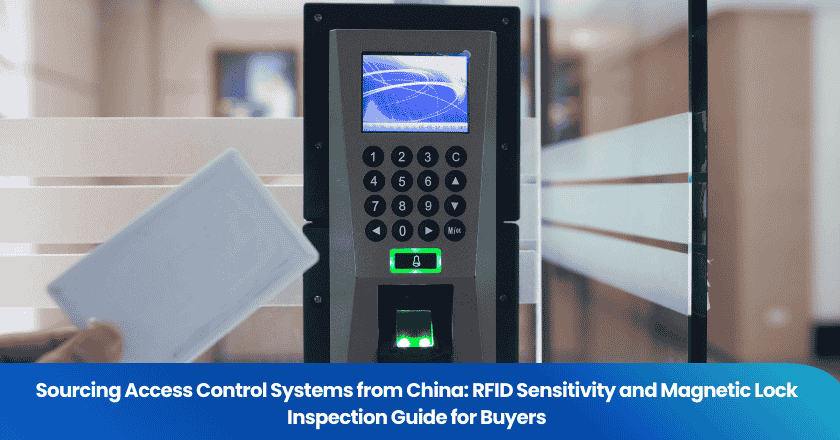
Access control systems are one of those product categories where quality failures are invisible until something goes wrong — a reader that intermittently rejects valid credentials, a magnetic lock that releases under less force than its rated specification, a card reader that ships with sensitivity too low to reliably detect fobs at the distance your customers expect. These are not manufacturing defects you can spot from a product photo or a factory certificate. They require hands-on functional testing before shipment. This guide explains what RFID sensitivity validation and magnetic lock holding force inspection actually cover, and what you should require from your supplier on every order.

Key Takeaways
- RFID reader sensitivity is a performance spec that varies significantly between factories — always define minimum read range and signal detection thresholds in your purchase order, not just "RFID compatible."
- Magnetic lock holding force is the most commonly misrepresented spec in access control hardware. A lock rated at 600 lbs that actually releases at 300 lbs will reach your customer, get installed, and fail — all before you find out.
- Pre-shipment inspections for access control must include functional testing, not just visual checks. Credential read tests, range tests, and static load tests cannot be verified from photos.
- UL294 certification for magnetic locks covers static holding force up to 500 lbs. If your product claims higher ratings, require independent test documentation for that specific batch.
- Power supply faults are the leading cause of magnetic lock failures in the field — your inspection should include electrical tests on the power supply as well as the lock itself.
Why Access Control Quality Failures Are a Serious Sourcing Risk
What Actually Goes Wrong After Delivery
Access control products look straightforward on a spec sheet. An RFID reader lists a read range. A magnetic lock lists a holding force in pounds or newtons. A complete kit lists compatible card types. In practice, the gap between the spec sheet and the shipped product is where most quality problems live. Chinese factories producing access control hardware at competitive price points are under constant pressure to cut component costs. The RFID antenna coil, the electromagnet core, the power supply capacitors — each is an opportunity for substitution that degrades performance without changing the product's external appearance.
The consequences show up downstream. An RFID reader with below-spec sensitivity creates intermittent read failures that your customer blames on the cards, then on the software, then finally traces back to the hardware after weeks of frustration. A magnetic lock with insufficient holding force passes a visual inspection and a basic function test, gets installed on a door, and then fails to hold against determined pressure. At that point, the liability is yours as the importer — not the factory's.
Note: Access control system failures are frequently misdiagnosed as software or credential issues. A reader that fails to detect cards at the specified range, or a lock that releases below its rated force, will generate customer support costs and returns that far exceed the cost of a pre-shipment inspection.
The Most Common Defects Found in Pre-Shipment Inspection
Based on inspection experience with access control hardware sourced from China, the defects that appear most frequently — and are most likely to be missed without dedicated functional testing — are:
- RFID read range below the specified minimum, caused by an underpowered antenna or lower-quality antenna coil than the approved sample.
- Magnetic lock holding force below rated specification, caused by a weaker electromagnet core or insufficient power supply capacity.
- Power supply voltage outside tolerance, causing intermittent lock release or reader failures under real operating conditions.
- Card type incompatibility — reader claims to support a specific frequency or protocol but fails functional tests with standard credentials.
- Lock does not release correctly on valid signal — relay issue or wiring fault that only appears during integrated system testing.
- Incorrect or missing certification marks (UL294, CE) on the product label, despite being shown on the sample.
RFID Sensitivity: What to Specify and How to Verify It

What RFID Sensitivity Actually Means
RFID sensitivity is the reader's ability to detect and decode a signal from a credential at a given distance and signal strength. It is expressed in dBm — a standard reader can detect signals at a minimum of -80 dBm, while higher-performance readers can detect signals as weak as -115 dBm. In practical terms, this determines how reliably the reader recognizes a card or fob at the distance your customers will actually use it: presenting a card at a typical swipe distance, passing through a gate with a fob in a pocket, or badging in with a phone-based credential.
When sensitivity is below spec, the failure mode is intermittent rather than complete — the reader works sometimes, fails other times, and produces no clear error. This is one of the hardest defects to diagnose after installation and one of the easiest to catch with a proper read range test during pre-shipment inspection.
| Sensitivity Threshold | What to Specify in Your PO |
|---|---|
| Standard performance | Minimum detection at -80 dBm; specify minimum read range in cm for your target credential type. |
| High performance | Detection at -115 dBm or better; required for gate or vehicle access applications where credential distance is greater. |
| Frequency compatibility | Specify exact frequencies supported (125 kHz, 13.56 MHz, etc.) and credential protocols (Mifare, HID, EM4100). Do not rely on "multi-frequency" claims alone. |
What the Inspection Should Test
A proper RFID sensitivity validation during pre-shipment inspection covers four areas. First, functional credential testing: the inspector presents authorized credentials — standard cards, fobs, and any IoT or mobile credential types specified in your PO — and confirms the reader grants access correctly while rejecting unauthorized credentials. Second, read range testing: the inspector measures the maximum reliable detection distance with the specified credential type, confirming it meets the minimum range in your purchase order. Third, immunity testing: the reader is tested for correct function under electrostatic discharge (ESD) and electrical surge conditions, which simulate real-world installation environments. Fourth, any customized requirements you have specified — for example, particular card encoding formats, serialization requirements, or integration with specific controller protocols.
All results are documented with photos and data in real time. If a reader fails the read range test, you are notified immediately — before the batch is packed — and can instruct the factory to investigate the cause and retest before shipment.
Tip: Define read range in centimeters for your specific credential type in the purchase order, not just "standard RFID range." This gives the inspector a clear numeric pass/fail threshold rather than a judgment call.
Red Flags That Indicate a Sensitivity Problem
During inspection, the following findings should be escalated as defects requiring factory corrective action before shipment:
- Read range more than 20% below the specified minimum with a standard credential at room temperature.
- Inconsistent reads — the reader recognizes the same credential on some attempts and not others, indicating marginal sensitivity or antenna quality issues.
- Failure with any specified credential type or frequency — particularly if the sample unit handled it correctly but production units do not.
- Visible difference in antenna assembly between approved sample and production units.
Magnetic Lock Holding Force: The Spec Buyers Most Often Overlook
What the Holding Force Rating Actually Means — and Why It Gets Misrepresented
Static load holding force is the maximum force a magnetic lock resists before releasing. Commercial magnetic locks are typically rated at 600 lbs (approximately 272 kg) for single-door applications, with heavy-duty models rated at 1,200 lbs or 1,500 lbs. The UL294 standard certifies static strength up to 500 lbs. For products claiming higher ratings, certification must come from independent testing documentation specific to that model — not a generic certificate covering a product family.
Holding force is one of the most commonly inflated specifications in Chinese-manufactured access control hardware. The electromagnet core is the primary cost driver in a magnetic lock. A factory producing a "600 lb" lock with a lower-grade core and thinner mounting plate can reduce component cost meaningfully while the product looks identical on the outside and passes a basic energize/de-energize function test. The only way to verify actual holding force is a calibrated static load test — which a standard product photo or factory QC certificate does not provide.
| Specification | What to Confirm Before Accepting Shipment |
|---|---|
| Holding Force Rating | 600 lbs / 1,200 lbs / 1,500 lbs — verified by calibrated static load test on production units, not sample certificate only. |
| Input Voltage | 12 VDC or 24 VDC — confirm power supply in the shipped kit matches the lock's voltage requirement. |
| UL294 Certification | Covers static strength up to 500 lbs. For higher-rated locks, require model-specific independent test documentation. |
| Operating Temperature | 32-120°F (0-49°C) for standard commercial use. Confirm if your customers operate in extreme environments. |
| Power Consumption | Verify actual draw at rated voltage matches spec — undersized power supplies cause field failures. |
What a Holding Force Inspection Covers
A proper magnetic lock inspection during pre-shipment has five components. The visual and mechanical check confirms the lock body, mounting plate, and armature plate show no signs of defective casting, surface finish problems, or misalignment that would reduce contact surface area and therefore holding force. The static load test uses calibrated equipment to apply force to the engaged lock and measure the actual release point — this is the definitive test for whether the product meets its rated specification. The electrical test verifies that the lock engages and releases correctly at the specified voltage, that the power supply delivers stable voltage within tolerance, and that wiring connections are secure and correctly terminated. The durability cycle test engages and releases the lock repeatedly to simulate daily use, checking for consistent performance and identifying any components that degrade prematurely. Finally, documentation confirms that certification marks on the production units match what was shown on the approved sample.
What Inspection Findings Mean for Your Shipment Decision
Not all defects found during inspection carry the same risk. The table below maps the most common magnetic lock defects to their security implications and the appropriate buyer response:
| Defect Found | Security Risk | Urgency | Likely Root Cause | Recommended Action |
|---|---|---|---|---|
| Holding force below rated spec | Critical | Critical | Inferior electromagnet core or mounting hardware | Reject batch; require component verification before re-production |
| Lock always unlocked / fails to hold | Critical | Critical | Power supply fault, wiring break, or relay failure | Hold shipment; factory must identify and correct root cause |
| Lock fails to release on valid signal | Medium | High | Software glitch or relay issue | Test control signals and wiring; retest after correction |
| Intermittent performance | High | Medium-High | Loose wiring or corrosion on contact surfaces | Inspect circuit and connections; retest sample before releasing batch |
| Power supply voltage out of tolerance | High | High | Undersized or non-compliant power supply | Replace power supply; verify with electrical test before shipment |
Tip: If the inspection finds holding force below spec, do not accept a partial correction — ask the factory to demonstrate the root cause and verify the fix on a re-tested sample before releasing any units from the batch.
How to Structure Your Inspection Requirements for Access Control Orders
What to Include in Your Purchase Order
The single most effective thing you can do to improve access control quality from Chinese suppliers is to write precise, testable specifications into your purchase order. Vague terms like "standard RFID compatible" or "high-strength magnetic lock" give the factory room to deliver whatever meets a minimum interpretation. Specific, numeric requirements — minimum read range in cm, minimum holding force in lbs confirmed by static load test, exact voltage tolerance, required certifications — create unambiguous pass/fail criteria your inspector can apply and your supplier cannot argue with.
For RFID readers, specify: frequency and protocol, minimum read range with your credential type, and any integration requirements such as Wiegand output format. For magnetic locks, specify: rated holding force and the test standard it must be verified against, input voltage, power consumption at rated voltage, and required certifications (UL294, CE, FCC as applicable to your market).
Inspection Frequency by Order Type
| Order Situation | Recommended Inspection Scope |
|---|---|
| First order with a new supplier | Factory audit plus full pre-shipment inspection including RFID functional test and static load test on magnetic locks. |
| Repeat order, established supplier | Pre-shipment inspection with functional testing on a statistically valid AQL sample. |
| After any supplier component change | Treat as a first order — require fresh functional and static load testing before accepting the batch. |
| Large batch (container load) | Full pre-shipment inspection plus targeted re-tests if the AQL sample reveals any sensitivity or holding force variance. |
How TradeAider Handles Access Control Inspections
TradeAider's inspectors for access control hardware are equipped to conduct functional RFID testing with standard credential types, perform electrical measurements on power supplies and lock wiring, and document static load test results with real-time photo and video reporting through the TradeAider Web App. As the buyer, you receive inspection findings as they happen — not in a report delivered days later. If the inspector identifies a below-spec read range or a holding force failure, you can direct the response immediately: hold the batch, request a factory corrective action, or schedule a re-inspection after the issue is resolved.
Inspection checklists are customized to your purchase order specifications before the inspector visits the factory. Every test result is tied to the specific batch being inspected, giving you traceable documentation that covers your quality assurance obligations and supports any supplier dispute resolution.
Access control products carry a higher consequence of failure than most hardware categories. When an RFID reader misreads credentials or a magnetic lock releases below its rated force, the impact is not just a product return — it is a security failure that affects your customer's facility and your reputation as a supplier. The pre-shipment inspection step is where you catch these problems before they ship. Define testable specs in your PO, require functional testing on every batch, and use real-time reporting to stay in control of quality decisions from China without traveling to the factory yourself.
FAQ
How do I verify that a magnetic lock actually meets its rated holding force?
The only reliable method is a calibrated static load test on production units — not on the sample, and not based on the factory's certificate alone. TradeAider inspectors conduct on-site static load testing and document results with photos and data. If the lock releases below its rated force, the batch is flagged before shipment.
What should I specify in my PO for RFID reader performance?
Specify the frequency and protocol (125 kHz EM4100, 13.56 MHz Mifare, etc.), the minimum read range in centimeters with your specific credential type, and the output format (Wiegand 26-bit, etc.). Avoid vague terms like "standard RFID" — these give the factory too much room to deliver a technically compliant but practically underperforming product.
Can teams customize the inspection checklist for specific access control requirements?
Yes. TradeAider builds inspection checklists from your purchase order specifications before the inspector visits the factory. If you have specific credential types, integration requirements, or certification marks that must be verified, these are incorporated as mandatory check items with defined pass/fail criteria.
What is the right inspection frequency for ongoing access control orders from the same supplier?
For a proven supplier with a consistent track record, a pre-shipment inspection on each batch is standard practice. If the supplier changes any component — antenna, electromagnet, power supply — treat the next order as a new supplier situation and include full functional testing. Component changes without notification are one of the most common causes of quality drift in Chinese-manufactured electronics.
Related Articles


Grow your business with TradeAider Service
Click the button below to directly enter the TradeAider Service System. The simple steps from booking and payment to receiving reports are easy to operate.

