
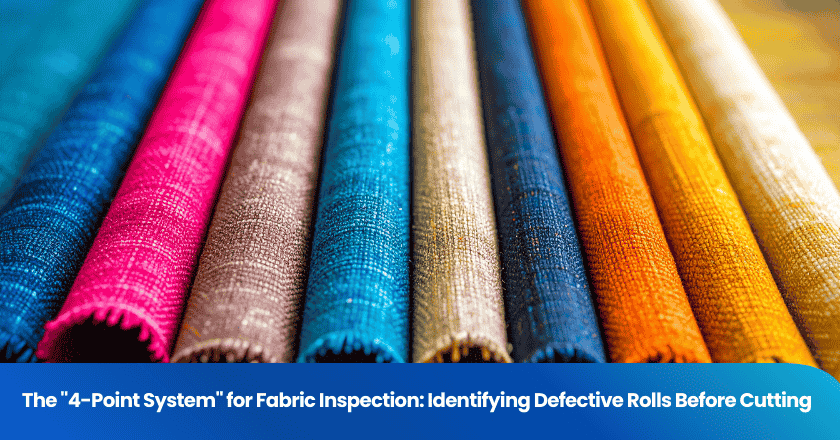
The 4-Point System stands as the primary technical benchmark for the textile and apparel industry worldwide. Governed by the ASTM D5430 standard, this method provides a quantitative framework for grading fabric rolls and identifying critical defects before they enter the high-cost cutting and sewing stages. For global brands and industrial manufacturers, enforcing this system is not merely a quality check but a vital financial safeguard. By assigning penalty points based on defect size, the system allows for an objective determination of a roll's suitability, ensuring that only high-purity substrates are utilized in production. This focus on pre-production vigilance effectively mitigates the risk of large-scale rejections, inventory delays, and brand reputation damage.

Key Takeaways
- The 4-Point System is the industry standard for objective fabric grading, primarily based on ASTM D5430.
- Early detection through comprehensive quality checks can increase first-pass yield by up to 25%.
- Penalty points are strictly capped at 4 points per linear yard, regardless of the number or size of defects within that specific yard.
- Acceptance thresholds typically fall at 40 points per 100 square yards, though premium brands may enforce stricter limits of 25-30 points.
- Physical environmental controls, such as standardized D65 lighting and consistent machine speed, are essential for repeatable results.
- Integrating quality assurance protocols ensures that material defects do not translate into functional garment failures.
The Technical Framework of Fabric Integrity
In the domain of apparel industry quality control, fabric represents approximately 60-70% of the total product cost. Consequently, the structural and visual integrity of the material roll is paramount. Substandard rolls that bypass inspection can lead to "fabric fallout," where entire sections of cut panels must be discarded due to hidden slubs, holes, or shade bars. The 4-Point System addresses these issues by providing a standardized metrological approach to surface defect analysis.
Common Defect Taxonomy in Material Rolls
Technicians must distinguish between weaving, knitting, and finishing defects. Standardized taxonomies of fabric defects categorize issues based on their root cause:
- Structural Defects: Holes, tears, broken picks, and dropped stitches that compromise fabric strength.
- Yarn Irregularities: Slubs, knots, and foreign matter (yarn contamination) that affect the hand-feel and aesthetics.
- Dyeing/Finishing Defects: Barre (horizontal bands), shade streaks, oil spots, and color bleeding across the roll width.
- Geometric Distortions: Bowing and skewing, where the weft yarns are not perpendicular to the warp, leading to garment twisting.
| Inspection Metric | Technical Objective | Industrial Significance |
|---|---|---|
| Visual Uniformity | Detect shade variation (Side-Center-Side) | Ensures color consistency across garment panels |
| Structural Stability | Measure GSM and width consistency | Prevents fit issues and material waste |
| Geometric Accuracy | Verify bowing and skewing limits | Prevents twisting in finished apparel |
| Functional Integrity | Screen for holes and weak spots | Reduces seam bursting and fabric failure |
The Mechanics of the 4-Point Scoring Protocol
The 4-point system operates on the principle of "Penalty Allocation." Unlike older systems that relied on subjective qualitative assessment, this standardizes the severity of a defect based purely on its physical length or width. This eliminates inspector bias and provides a repeatable data set for vendor performance evaluation.
Standardized Penalty Point Scale
According to the industrial standard, defects are scored as follows:
| Length of Defect (Imperial) | Length of Defect (Metric) | Penalty Points |
|---|---|---|
| Up to 3 inches | Up to 75 mm | 1 Point |
| 3.1 to 6 inches | 75 mm to 150 mm | 2 Points |
| 6.1 to 9 inches | 150 mm to 230 mm | 3 Points |
| Over 9 inches | Over 230 mm | 4 Points |
Crucially, the system mandates that **no single linear yard can be assigned more than 4 points**. For example, if a yard contains two 10-inch holes, the penalty remains 4 points. This prevents the mathematical distortion of the roll's final grade and focuses the analysis on the overall "usability" of the fabric.
Technical Rule: Any hole larger than 1 inch (25mm) is automatically assigned 4 points, as it usually renders the surrounding area unusable for garment cutting.
The Metrology of Fabric Inspection: Setup and Environment
For a fabric inspection to be valid, the physical environment must meet industrial metrological standards. Variation in lighting or inspection speed can cause an inspector to miss up to 30% of critical defects.
Light Sources and Viewing Geometry
Inspection machines must utilize standardized light sources. The primary source is D65 (Artificial Daylight), supplemented by TL84 (Store Light) to check for metamerism—a phenomenon where colors match under one light but not another. The fabric should traverse the inspection board at a 45-degree angle to the viewer, and the machine speed should not exceed 15 yards per minute for manual inspection.
| Environmental Factor | Technical Standard | Reasoning |
|---|---|---|
| Light Source | D65 / TL84 / UV | Consistent color and fluorescence detection |
| Board Angle | 45 - 60 Degrees | Optimal depth perception for surface flaws |
| Machine Speed | Max 15 yds/min | Allows human cognitive processing of defects |
| Backlighting | Translucent glass panel | Essential for identifying holes and thin spots |
Mathematical Calculation of Quality Grades
The final "Points per 100 Square Yards" is the decisive figure for the shipment's acceptance. This calculation accounts for the fabric's width, as wider fabrics provide more usable area and can technically absorb more defects per linear yard than narrow fabrics. The formula used under ASQC (American Society for Quality Control) is:
Points / 100 Sq. Yards = (Total Penalty Points x 3600) / (Inspected Yards x Fabric Width in Inches)
For example, if a 50-yard roll of 60-inch wide fabric has 25 total points, the calculation would be: (25 x 3600) / (50 x 60) = 30 points per 100 square yards. Since this is below the 40-point threshold, the roll is classified as "First Quality." If the result exceeded 40, the roll would be downgraded to "Second Quality" or rejected entirely.
Integrating the 4-Point System with AQL and SPC
Advanced quality control steps in apparel involve linking the 4-point data with Statistical Process Control (SPC). By tracking the types of defects over time, manufacturers can identify if a specific loom or dyeing machine is failing. If 80% of penalty points in a batch are "Oil Stains," the technical action is to audit the lubrication systems of the weaving machinery.
Furthermore, this data allows teams to establish more accurate Acceptable Quality Levels (AQL). If a buyer knows a specific fabric type inherently has a higher defect rate (e.g., raw silk), they may adjust the AQL to allow for more points while maintaining strict control over "Critical" safety defects like broken needles.
Best Practices for Set-up and Implementation
Implementing the 4-point system requires more than just a scoring sheet; it requires a structured AQL-based inspection plan. Leading factories follow these technical protocols:
- Randomization: Inspect at least 10% of the total number of rolls in a shipment, selected randomly to prevent vendor "cherry-picking."
- Width Verification: Measure the width at the beginning, middle, and end of the roll. A variation of more than 1/2 inch is a major defect.
- End-to-End Inspection: Ensure rungs and headers are included in the inspection to check for tension-induced "scrimp" or edge damage.
- Digital Integration: Use automated reporting software to log defect locations. This creates a "Defect Map" that the cutting room can use to optimize marker placement and minimize waste.
By prioritizing these steps, brands move from reactive quality checking to proactive quality management, significantly reducing the "Cost of Quality" (COQ) across the entire supply chain.
Ready to secure your product quality before shipment?
As your third-party inspection, testing & certification partner in China, TradeAider supports brands and sourcing teams across the entire production process, helping you identify quality risks early, ensure compliance, and strengthen your team’s capabilities before shipment.
Book an Inspection or Testing Service with TradeAider today, or for tailored solutions and expert guidance, contact us at services@tradeaider.com or submit the request form on the right. →
Frequently Asked Questions (FAQ)
What is the difference between the 4-Point and 10-Point systems?
The 4-Point system is simpler and more globally accepted. The 10-Point system (used primarily in older woven industries) assigns points based on both length and width separately and uses a much higher point threshold for rejection. The 4-Point system is generally considered more efficient for modern apparel manufacturing.
Why is the threshold usually set at 40 points?
Through decades of industrial data, 40 points per 100 square yards was identified as the threshold where fabric waste becomes economically unviable for garment makers. Above this level, the labor required to "cut around" defects usually exceeds the value of the fabric itself.
Can the 4-point system be used for knitted fabrics?
Yes, but with caution. Knitted fabrics are more prone to distortions like "spirality" and "skewing." While the 4-point scoring remains the same for surface defects, additional technical tests for "Course/Wales density" and "Bursting Strength" must be performed alongside the visual inspection.
How do I handle continuous defects?
A continuous defect (such as a dyeing streak along the entire roll) is assigned 4 points per linear yard. This effectively ensures that any roll with a continuous defect of significant length will fail the inspection and be rejected.
Is the 4-point system compatible with AI-powered inspection?
Yes. Modern AI and AOI (Automated Optical Inspection) systems are programmed using the 4-point scoring logic. These machines use high-speed cameras to identify flaws and automatically calculate the "Points per 100 Square Yards," often achieving higher accuracy and speed than human inspectors.

Related Articles
Grow your business with TradeAider Service
Click the button below to directly enter the TradeAider Service System. The simple steps from booking and payment to receiving reports are easy to operate.

