
- About Us

- Our Services
- Your Industry
- Resources
- News & Blog
Hiring a third-party inspection company should give you peace of mind. But for many importers, it becomes another source of frustration—reports that don't match reality, missed defects, hidden fees, and inspectors who seem to work for the factory rather than you.
The problem isn't always the inspection company. Often, it's how you hired them. Here are the seven most damaging mistakes importers make when selecting and working with product inspection companies in China—and how to avoid them.
Key Takeaways
- Price-based decisions cost more in the long run—cheap inspections often mean skipped steps and unreliable results
- Sample reports reveal more than sales pitches—always review actual inspection deliverables before committing
- Inspector qualification matters more than company size—ask about training, certifications, and industry experience
- Real-time visibility separates modern QC from traditional approaches—waiting days for a PDF report is outdated
- Clear specifications prevent miscommunication—vague requirements lead to inconsistent inspections
Mistake #1: Choosing Based on Price Alone
The lowest inspection fee often becomes the most expensive decision. When an inspection company charges significantly below market rates, something has to give—and it's usually the quality of the inspection itself.
Cut-rate inspections often mean smaller sample sizes, rushed inspections, or inspectors handling multiple factories per day. According to industry analysis, "skipping quality control in China is the most expensive mistake importers make"—and underpaying for inspection services effectively means skipping critical quality checks.
Real-World Example: The $150 Inspection That Cost $15,000
A Shopify brand selling silicone kitchen utensils hired a budget inspection company charging $120 per man-day. The inspection report showed "PASS" with minimal findings. Three weeks later, customers started complaining about strong chemical odors. Lab testing revealed the silicone contained phthalates exceeding CPSIA limits by 400%. The entire shipment—5,000 units—had to be destroyed. A thorough inspection with proper chemical testing would have cost $500 but saved $15,000 in product costs, plus immeasurable brand damage. The cheap inspection wasn't cheap at all.
What You're Really Paying For
A professional inspection includes several cost components that legitimate companies can't skip:
- Qualified inspector time: Proper training and fair compensation for skilled professionals
- Travel and logistics: Transportation to often-remote factory locations
- Documentation: Detailed reports, photos, and data compilation
- Quality assurance: Review processes and accountability systems
If someone offers $100 per man-day when the market rate is $200+, they're cutting corners somewhere. That "savings" will cost you when defective products reach your customers.
Mistake #2: Not Requesting Sample Reports
Would you hire an employee without reviewing their work? The same logic applies to inspection companies. A sample report tells you more about their capabilities than any sales presentation.
When reviewing sample inspection reports, look for:
| Element | What to Check |
|---|---|
| Photo Quality | Clear, well-lit images showing defects and conforming products |
| Detail Level | Specific measurements, defect locations, and counts |
| Structure | Logical organization with clear pass/fail criteria |
| Sampling Methodology | Clear documentation of sample size and AQL standards used |
| Actionability | Can you actually make decisions from this report? |
If a company hesitates to share sample reports, or their samples look generic and vague, consider it a warning sign.
Mistake #3: Ignoring Inspector Qualifications
The company name on the invoice matters less than the inspector walking the factory floor. Large inspection firms often employ contractors with varying skill levels, while smaller specialized companies may have more consistent inspector quality.
Before hiring an inspection company, ask specific questions about their inspectors:
- What training do inspectors receive before conducting solo inspections?
- Do inspectors have industry-specific experience with your product category?
- What certifications or qualifications do they hold?
- How does the company ensure inspector consistency across different locations?
Lack of training as one of the top reasons inspectors miss QC issues. Inspectors without proper training may not understand your product's specific failure modes or may misinterpret your specifications.
Mistake #4: Failing to Define Clear Inspection Criteria
Vague specifications produce vague inspections. If you tell an inspector to "check for defects," you'll get subjective, inconsistent results. If you provide detailed checklists with photos, measurements, and clear pass/fail criteria, you'll get actionable data.
What Clear Specifications Include
- Dimensional tolerances: Exact measurements with acceptable ranges
- Visual defect standards: Photo examples of acceptable vs. unacceptable conditions
- Functional test procedures: Step-by-step testing protocols with expected outcomes
- Packaging requirements: Label placement, barcode verification, carton specifications
- Regulatory compliance: Required certifications, labeling, and documentation
Without this level of detail, inspectors apply their own judgment—which may not align with your customer expectations. What one inspector considers a "minor cosmetic issue" could be a deal-breaker for your brand.
If you need help developing comprehensive inspection criteria, TradeAider's inspection standard resources provide templates and frameworks for common product categories.
Mistake #5: Overlooking Technology and Real-Time Capabilities
Traditional inspection companies deliver PDF reports 24-48 hours after the inspection ends. By then, the container may already be loaded, or the factory may have "lost" the defective units. Modern inspection platforms offer real-time visibility that changes the game entirely.
The Real-Time Advantage
With real-time inspection reporting, you can:
- View photos and findings as the inspection happens
- Communicate with inspectors during the inspection to clarify issues
- Make decisions before products leave the factory
- Direct inspectors to focus on specific concerns mid-inspection
This isn't just convenience—it's leverage. When you can see what's happening on the factory floor in real time, you can address problems immediately rather than discovering them in a warehouse weeks later. TradeAider's real-time platform was specifically designed to solve the visibility gap that traditional inspection companies ignore.
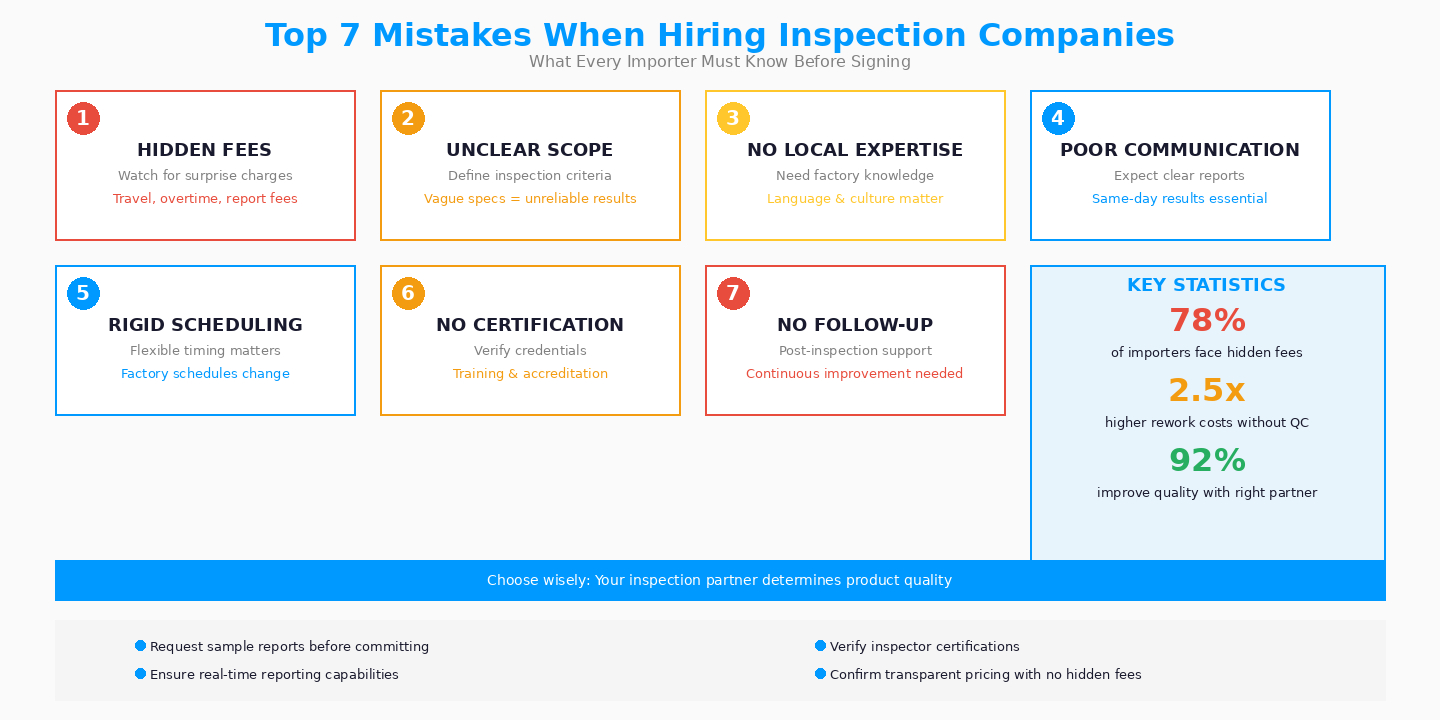
Mistake #6: Not Understanding Hidden Fees
Understanding the true cost of inspection services
The quoted man-day rate is rarely the final cost. Many inspection companies add fees that can significantly increase your actual expenses:
Common Hidden Fee Categories
- Weekend/holiday surcharges: Often 50-100% premium for non-business day inspections
- Remote location fees: Additional charges for factories far from major cities
- Rush report fees: Extra cost for faster turnaround
- Travel expense markups: Some companies add margins to transportation costs
- Report revision charges: Fees for updates or clarifications
- Per-item inspection fees: Some charge per SKU rather than per man-day
Before signing any agreement, request a complete fee schedule in writing. Transparent pricing—like TradeAider's flat $199/man-day rate with no hidden fees—eliminates budget surprises and builds trust.
Mistake #7: No Accountability or Guarantee Mechanism
Most inspection companies operate on a "we report, you decide" basis. They identify problems but take no responsibility for outcomes. If defects slip through, the response is typically "we followed your specifications"—even when their inspection was clearly inadequate.
This misalignment of incentives means inspection companies get paid regardless of whether they actually help you avoid quality problems. The result: you bear all the risk.
What Real Accountability Looks Like
A modern approach to inspection accountability includes:
- Service guarantees: Clear commitments on report delivery times and quality standards
- Defect responsibility: Some premium services share financial responsibility for missed defects
- Transparent inspector attribution: Knowing exactly who inspected your products
- Recourse mechanisms: Clear process for disputes and re-inspection
For importers seeking stronger accountability, WeGuarantee Total Quality Control offers a fundamentally different model—where the inspection company shares responsibility for quality outcomes, not just inspection activities.
How to Evaluate Your Current Inspection Partner
If you're already working with an inspection company, use this checklist to evaluate whether they're serving your needs:
- ☐ Do reports arrive within 24 hours of inspection completion?
- ☐ Are photo counts consistently above 20-30 per inspection?
- ☐ Can you communicate directly with inspectors during inspections?
- ☐ Are inspection criteria documented and consistently applied?
- ☐ Is pricing transparent with no surprise charges?
- ☐ Do they offer real-time visibility into inspection progress?
- ☐ Is there a clear escalation process when issues arise?
If you checked fewer than five boxes, it may be time to reassess your inspection partnership. The cost of switching providers is minimal compared to the cost of defective products reaching your customers.
FAQs About Hiring Inspection Companies in China
How much should I pay for inspection services in China?
Market rates for professional inspection services in China typically range from $180-250 per man-day. Rates significantly below this range often indicate compromised service quality. Premium services with real-time reporting and guarantees may cost more but deliver substantially better value through prevented quality issues.
Should I use large international inspection firms or local companies?
Both have advantages. Large firms offer broad geographic coverage and standardized processes, but may use less experienced inspectors for routine assignments. Local or specialized companies often provide more consistent inspector quality and better communication. The key is evaluating inspector qualifications and sample reports, not just company size.
How do I know if an inspection company is independent?
True independence means the inspection company has no financial relationship with your supplier. Signs of problematic relationships include inspectors who seem hesitant to report defects, factories that "recommend" specific inspection companies, or inspection companies that also provide sourcing or factory-matching services. Always verify that inspectors report to you, not your supplier.
What's the difference between a man-day and a per-item inspection fee?
Man-day pricing charges for inspector time—one man-day typically covers 8 hours of inspection work. Per-item pricing charges based on the number of units or SKUs inspected. Man-day pricing is more common for consumer goods and allows flexibility in sample sizes. Per-item pricing may be used for complex products requiring detailed testing.
Can I inspect products myself instead of hiring a third party?
Self-inspection is possible but rarely practical for ongoing China sourcing. Challenges include travel costs, language barriers, lack of inspection expertise, and the time required. For occasional high-value orders, self-inspection may make sense. For regular production, third-party inspection is almost always more cost-effective—and provides documentation for supplier negotiations.
Avoiding these seven mistakes doesn't guarantee perfect inspections—but it dramatically improves your odds of finding a quality partner who actually helps you prevent problems rather than just document them. If you're evaluating inspection options, schedule your inspection to learn about transparent pricing, real-time visibility, and accountability that traditional inspection companies don't offer.
Related Articles
Grow your business with TradeAider Service
Click the button below to directly enter the TradeAider Service System. The simple steps from booking and payment to receiving reports are easy to operate.

