
If you source products from overseas factories, there is a growing chance that a buyer, retailer, or investor will ask whether your suppliers have completed a SMETA audit. SMETA — Sedex Members Ethical Trade Audit — is described by Sedex as the world's most widely used social audit, with over 115,000 supply chain sites registered on the Sedex platform across more than 35 sectors and 180 countries. For importers managing factory relationships in China or elsewhere in Asia, understanding what a SMETA audit covers, why buyers require it, and what the process actually looks like on the ground is increasingly a commercial necessity — not just a compliance checkbox.
This guide explains SMETA audits from first principles: what they are, what the two and four-pillar formats cover, what auditors actually do during a site visit, and how SMETA connects to broader ESG and regulatory compliance requirements.
Key Takeaways
- SMETA is an audit methodology, not a certification — a supplier that completes a SMETA audit receives an audit report, not a compliance seal. The report is uploaded to the Sedex platform and shared with requesting buyers.
- Two versions exist: 2-pillar and 4-pillar. The 2-pillar audit covers labor standards and health & safety. The 4-pillar audit adds environmental performance and business ethics.
- SMETA 7.0 was released in 2024, introducing improvements to detect harder-to-find compliance issues including forced labor indicators and root cause identification.
- One audit can be shared with multiple buyers through the Sedex platform, significantly reducing audit duplication for suppliers managing multiple customer relationships.
- SMETA connects directly to regulatory compliance requirements under the UK Modern Slavery Act, German Supply Chain Due Diligence Act, and EU CSRD.
What SMETA Is — and What It Isn't
SMETA stands for Sedex Members Ethical Trade Audit. It was developed by Sedex — the Supplier Ethical Data Exchange — a global non-profit organization founded in 2004 to help businesses manage ethical and responsible practices in their supply chains. SMETA 7.0 received formal recognition from the Consumer Goods Forum's Sustainable Supply Chain Initiative (SSCI) in November 2025, with the CGF noting that more than 60,000 site-level SMETA audits are conducted each year across global supply chains — making it the dominant social audit methodology in international trade.
SMETA is importantly not a certification program. Unlike ISO 9001 or SA8000, completing a SMETA audit does not result in a certificate of compliance. Instead, the auditor produces a structured audit report — covering findings, non-conformances, and a Corrective Action Plan Report (CAPR) — which is uploaded to the Sedex platform. The supplier then controls which buyers can access the report. This architecture is what gives SMETA its core value proposition: one audit, shared with multiple customers, reducing the burden of completing separate social audits for each buyer relationship.
The Four Pillars of SMETA
SMETA audits are organized around four pillars, each representing a category of ethical and operational performance. The choice between a 2-pillar and 4-pillar audit scope determines which of these pillars are assessed during a given audit engagement.
Pillar 1 — Labor Standards
The labor standards pillar is the core of every SMETA audit. It assesses whether a factory's employment practices comply with the Ethical Trade Initiative (ETI) Base Code — a set of labor principles grounded in International Labour Organization (ILO) conventions. The assessment covers working hours and overtime practices, wages and benefits (including whether workers receive at least the legal minimum wage and whether piece-rate arrangements comply with minimum standards), employment contracts and terms of engagement, freedom of association and collective bargaining rights, child labor (verifying worker ages against documentation), forced labor and bonded labor indicators, and non-discrimination in hiring and employment.
Worker interviews are central to the labor standards assessment. Auditors select a random sample of workers for confidential one-on-one conversations, conducted away from management, to gather ground-level information about actual working conditions. The interview findings are compared against the factory's payroll records, time-and-attendance logs, and employment contracts to identify discrepancies — a key method for detecting undisclosed overtime, wage manipulation, or restricted freedom of association.
Pillar 2 — Health and Safety
The health and safety pillar assesses physical working conditions and the factory's systems for managing occupational risk. Auditors conduct a walkthrough of all production areas, warehouses, dormitories (if workers are housed on-site), canteens, and sanitary facilities. Specific checks include fire safety (fire exits, extinguisher availability and inspection records, emergency evacuation plans), machine guarding and equipment safety, chemical storage and handling (including MSDS documentation and personal protective equipment provision), first aid facilities and trained first aid personnel, incident reporting records, and management of contractors and temporary workers.
The health and safety pillar produces some of the most immediately actionable findings in a SMETA audit. Physical hazards — blocked emergency exits, unsecured electrical panels, missing machine guards — are observable on the day of the audit and can be corrected relatively quickly once identified. Systemic issues — inadequate safety training programs, poor incident reporting culture, or insufficient PPE procurement — require more sustained corrective action and are tracked through the CAPR process.
Pillar 3 — Environment (4-Pillar Only)
The environment pillar, included only in the 4-pillar SMETA format, assesses a factory's environmental management practices and compliance with local environmental regulations. The environmental scope covers waste management procedures, pollution control measures, resource consumption (energy and water), chemical handling and disposal, and whether the site holds the required environmental permits. Auditors review environmental management documentation, inspect waste storage and disposal areas, and verify that the factory has systems in place for tracking and reducing its environmental impact.
The environment pillar is increasingly demanded by buyers operating in markets with strong sustainability requirements — particularly European retailers subject to the EU's Corporate Sustainability Reporting Directive (CSRD) and brands making public commitments to supply chain environmental standards. For suppliers selling to these buyers, a 4-pillar SMETA audit is often explicitly required as a pre-qualification condition.
Pillar 4 — Business Ethics (4-Pillar Only)
The business ethics pillar examines the governance and integrity practices of the supplier organization. Auditors assess whether the company has documented anti-bribery and anti-corruption policies, whistleblower protection mechanisms, a code of conduct, fair business practices in its own supply chain relationships, and systems for detecting and responding to ethical violations. This pillar reflects the growing expectation from buyers and regulators that ethical conduct should be embedded in governance structures — not just stated as aspiration in a supplier code of conduct policy document.
| Pillar | 2-Pillar | 4-Pillar | Key Focus Areas |
|---|---|---|---|
| Labor Standards | ✅ | ✅ | Wages, hours, contracts, child/forced labor, freedom of association |
| Health & Safety | ✅ | ✅ | Fire safety, machine guarding, PPE, chemical handling, incident records |
| Environment | — | ✅ | Waste management, pollution control, energy/water use, environmental permits |
| Business Ethics | — | ✅ | Anti-bribery, anti-corruption, whistleblower protection, code of conduct |
What Actually Happens During a SMETA Audit
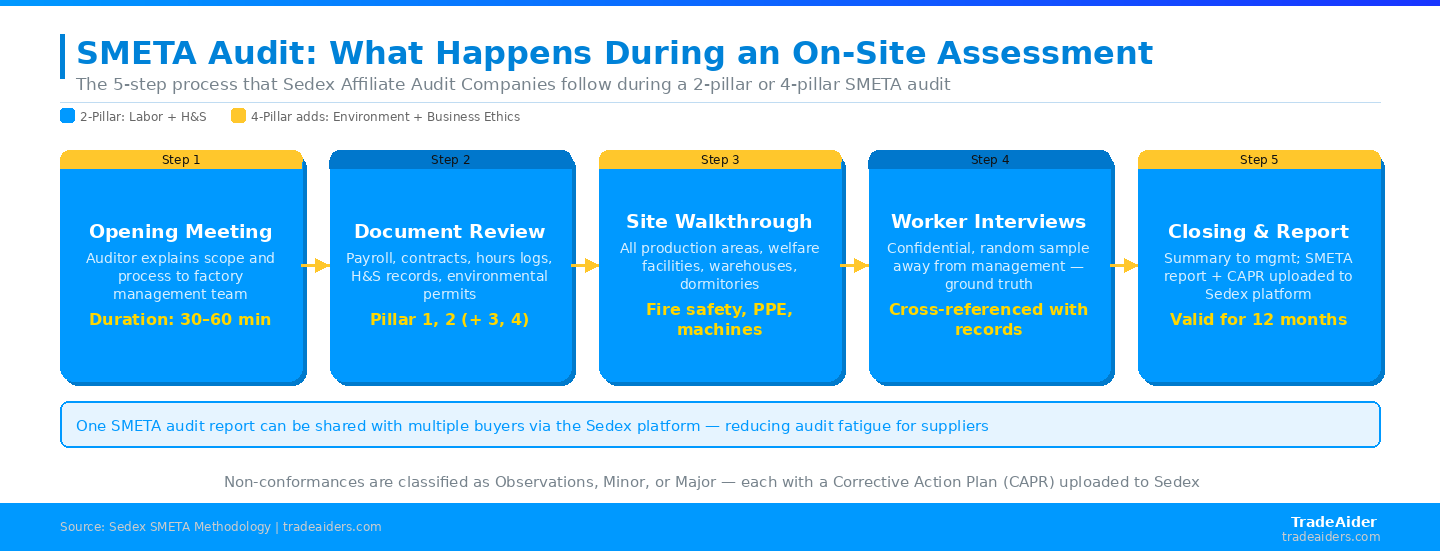 One SMETA audit report can be shared with multiple buyers via the Sedex platform — eliminating duplicate social audits across customer relationships
A SMETA audit is an in-person site assessment conducted by an auditor from one of Sedex's approved Affiliate Audit Companies (AACs). Only auditors affiliated with Sedex-approved companies are authorized to conduct official SMETA audits — this is a critical point for buyers requesting SMETA compliance from suppliers. An audit report produced by a non-affiliated company cannot be uploaded to the Sedex platform and does not carry the same standing as a genuine SMETA audit.
The on-site component typically takes one to three days, depending on the size of the facility, the number of workers, and whether the audit is 2-pillar or 4-pillar. A standard SMETA audit day includes four structured activities: an opening meeting with factory management to explain the scope and process; a document review covering payroll records, employment contracts, working-hours logs, health and safety records, and environmental permits; a physical site walkthrough of all production areas, welfare facilities, and storage areas; and confidential worker interviews with a randomly selected sample of employees.
The closing meeting at the end of the audit gives factory management an initial summary of findings. Within a defined turnaround period — typically a few days to a week — the audit company submits the formal SMETA Audit Report and Corrective Action Plan Report (CAPR) to the Sedex platform for quality review. Once approved, the supplier receives the report and controls which buyers can access it through the platform's sharing permissions.
How SMETA Findings Are Classified
A SMETA audit does not issue a pass or fail result. Instead, findings are categorized by severity into three tiers. Observations are noted areas where the factory could improve but does not yet represent a non-conformance against the audit standard — they represent best practice recommendations rather than compliance failures. Minor non-conformances are genuine departures from the required standard that are not immediately critical — for example, incomplete safety training records for some workers, or a minor labeling inconsistency on chemical storage. Major non-conformances are serious departures from the ETI Base Code or local law — working hours that systematically exceed legal limits, evidence of child labor, or immediate physical safety hazards such as locked fire exits.
Each non-conformance recorded in the CAPR includes a required corrective action, the responsible party, and a deadline for evidence of completion. Suppliers upload correction evidence (photographs, updated records, policy documents) to the Sedex platform, allowing buyers to verify that remediation has occurred without requiring a follow-up site visit for every finding.
Why Buyers Are Requiring SMETA Audits
SMETA requirements from buyers have been accelerating for two converging reasons: commercial expectations from major retailers and regulatory pressure from governments. On the commercial side, large consumer goods companies — retailers like Tesco and Marks & Spencer, manufacturers like Nestlé and Yum! Brands — have been requiring SMETA audits from suppliers as a pre-qualification condition for years. As these requirements filter down through supply chains, mid-market importers are increasingly encountering SMETA requests from their own buyers.
On the regulatory side, a wave of supply chain due diligence legislation is driving formal audit requirements across markets. The UK Modern Slavery Act requires companies above a revenue threshold to publish an annual statement on how they are addressing forced labor risk in their supply chain — SMETA audits provide verifiable evidence for these disclosures. Germany's Supply Chain Due Diligence Act (LkSG) mandates that covered companies identify, prevent, and remediate human rights risks across their supply chains — again, audits like SMETA are the primary evidence mechanism. The EU's Corporate Sustainability Reporting Directive (CSRD) extends similar requirements to EU-operating companies, with mandatory disclosure of Scope 3 social risks that include supplier labor conditions.
For importers sourcing from Chinese factories, SMETA audits have become a particularly important tool because they provide a standardized, internationally recognized evidence base for social compliance — one that buyers and regulators can verify through the Sedex platform rather than relying on supplier self-declaration. Industry specialists highlight that the shared audit model — one SMETA report accessible to multiple buyers — significantly reduces the audit burden for Chinese factories that might otherwise face separate social audit requests from five or six different customers in the same year.
SMETA 7.0: What Changed in the 2024 Update
SMETA 7.0, released by Sedex in 2024, represents the most significant update to the audit methodology in years. The update was driven by feedback from auditors, buyers, and civil society that previous versions of SMETA were not consistently identifying harder-to-detect compliance issues — particularly sophisticated forms of forced labor, debt bondage, and recruitment fee schemes that do not appear in factory records but emerge through skilled worker interviewing.
Key changes in SMETA 7.0 include strengthened guidance on identifying indicators of forced labor, updated human rights training requirements for auditors, mandatory remediation and safeguarding requirements when impacted workers are identified (rather than simply recording the finding), and enhanced root cause analysis methodology — moving SMETA from a findings-documentation tool toward a diagnostic instrument that helps factories understand why compliance failures occur and address systemic causes rather than surface symptoms.
The 2024 release also introduced an environment-focused Self-Assessment Questionnaire as a complementary tool for buyers wanting environmental data from suppliers who have not yet completed a full 4-pillar audit. This allows buyers to collect standardized environmental information at scale — across hundreds of suppliers — while reserving full 4-pillar audits for higher-risk or higher-priority supply chain sites.
How SMETA Fits Into a Broader Factory Audit Program
SMETA audits assess social and ethical compliance — but they do not assess product quality, production capacity, or quality management systems. For importers who need visibility into both the ethical and operational dimensions of their suppliers, SMETA audits work best as part of a broader audit program that also includes quality-focused factory audits.
A quality factory audit evaluates the factory's production processes, equipment condition, internal quality control procedures, defect management systems, staff qualifications, and capacity to meet order specifications consistently. This is distinct from what SMETA covers, but equally important for importers making sourcing decisions. TradeAider's factory audit service is designed to assess the operational and quality dimensions of supplier factories — documenting QC infrastructure, production capacity, and management systems in a format that supports both sourcing decisions and supplier development programs.
For a comprehensive picture of a new supplier, combining a SMETA (or equivalent social compliance) audit with a quality-focused factory audit gives you documented evidence on both dimensions — whether the factory meets ethical labor standards and whether it has the operational capability to deliver consistent quality at scale. Many importers schedule these two audit types either concurrently or in close sequence to minimize the disruption to factory operations and the time investment for their procurement teams. Contact our team to discuss how to structure a supplier audit program that combines social compliance and operational quality assessment for your specific sourcing context.
Frequently Asked Questions
Does a SMETA audit expire?
Yes. A SMETA audit report is valid for 12 months from the date it is issued. Sedex and most buyers recommend beginning the process of scheduling the next audit three to four months before the current report expires, to avoid a gap in audit coverage. Some buyers in higher-risk sectors or geographies may require more frequent audits — semi-annually or at specific production milestone triggers.
Who can conduct a SMETA audit?
Only auditors from Sedex-approved Affiliate Audit Companies (AACs) are authorized to conduct official SMETA audits. Sedex maintains and publishes the current list of approved AACs on its platform. Suppliers and buyers should verify that any audit company they work with holds current AAC status — a SMETA-branded report from a non-approved auditor is not valid for Sedex platform upload or buyer acceptance.
Can a supplier share one SMETA audit report with multiple buyers?
Yes — this is one of SMETA's defining features. Once a SMETA audit report is uploaded to the Sedex platform, the supplier controls sharing permissions and can grant access to any number of requesting buyers. This eliminates the need for separate social audits for each buyer relationship, significantly reducing audit fatigue for suppliers who have multiple customers requiring social compliance evidence.
What is the difference between SMETA and SA8000?
SA8000 is a certification standard — a factory that meets SA8000 requirements receives a certificate that is publicly verifiable. SMETA is an audit methodology — it produces a report documenting conditions at a point in time, but does not result in certification. SA8000 requires ongoing surveillance audits and is more resource-intensive to maintain. SMETA is generally more accessible for suppliers beginning their social compliance journey, and its shared-audit architecture on the Sedex platform makes it more efficient for managing multiple buyer relationships.
Does TradeAider offer SMETA audits?
TradeAider's factory audit service covers the quality-focused, operational dimensions of supplier assessment — production capacity, internal QC systems, management competence, and facility condition. For importers who need SMETA social compliance audits, we recommend working with a Sedex-approved AAC to conduct the SMETA component. See TradeAider's audit standards to understand what our factory audit program covers in detail, and how it can be combined with a SMETA audit as part of a comprehensive supplier due diligence program. For questions about how to structure a combined audit approach, contact our team.
Related Articles


Grow your business with TradeAider Service
Click the button below to directly enter the TradeAider Service System. The simple steps from booking and payment to receiving reports are easy to operate.

