
- About Us

- Our Services
- Your Industry
- Resources
- News & Blog
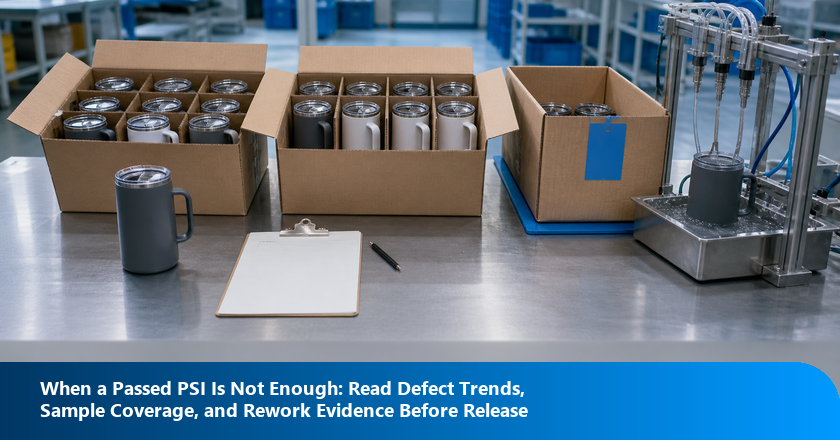
A passed pre-shipment inspection is a sample-based lot decision, not proof that every unit is conforming or that all release risks are closed. NIST explains that acceptance sampling is used to make a lot disposition decision from a random sample.
Pre-shipment inspection (PSI) is a finished-goods quality-control check used to evaluate an export lot against agreed requirements before the buyer makes its commercial release decision.
A green PSI result is important. It can confirm that the inspected sample met the agreed acceptance rule at a defined moment. But it should not be stretched into a statement the inspection was never designed to make: that every carton, configuration, correction, and shipment risk has disappeared. The buyer still decides whether the evidence is sufficient to release the goods, hold part of the lot, ask for targeted verification, or request a corrective-action record.
This distinction is especially useful when a shipment contains multiple configurations, a known repeat defect, or goods that were reworked shortly before inspection. In each case, the pass result answers one question—how the sampled lot performed under the plan—while the release decision must also answer whether the sample represented the relevant risk and whether contrary evidence has been resolved.
The Release Checks a PSI Pass Does Not Replace
A passed PSI is useful release evidence only when the buyer also checks sample coverage, defect trend, and any rework proof that could change the commercial decision.
- Read the pass in context: record the lot size, sample basis, acceptance rule, inspection timing, and the configurations actually presented.
- Separate current sampling from history: a low current defect count can coexist with a recurring failure mode that deserves a focused check.
- Make rework traceable: identify which units or cartons were affected, what was changed, and how the correction was verified.
- Resolve conflicts explicitly: do not average a passed sample against a repeat defect or an incomplete corrective-action record.
- Keep release authority with the buyer: the inspection report supports the decision; it does not replace the commercial decision maker.
The practical goal is not to make every passed report suspect. It is to prevent a familiar reporting shortcut: treating a single status word as if it closes questions that sit outside the sample rule. A disciplined release review is usually shorter than an argument after cargo has departed, because it asks for the missing evidence while the affected goods can still be located and checked.
A Passed PSI Is a Lot Decision, Not a Release Guarantee
A PSI is conducted when 100% of the order quantity is completed and at least 80% is packed for export.
That readiness point matters. It lets an inspector compare finished goods, packaging, marks, workmanship, functions, and quantity against the buyer’s specification at a meaningful stage of production. It does not make the shipment identical to the sample, and it does not automatically resolve changes made before, during, or after packing. A good report therefore states what was available, what was sampled, and what was outside the inspection scope. TradeAider’s pre-shipment inspection service can be aligned to the buyer’s product requirements.
Acceptance sampling begins with an agreed lot and an agreed rule. If the random sample is selected and checked according to that rule, the result gives the buyer a repeatable basis for accepting, rejecting, or escalating the lot. It is neither a promise that a defect cannot exist elsewhere nor a permission to ignore information that was not part of the original sample decision. That is why the most useful release file pairs the result page with a clear statement of coverage.
Read the Sample Coverage Before You Read the Pass
A sampling plan must identify the lot, sample basis, and decision rule, so the buyer can see what the pass covers and what it does not cover. NIST defines a lot-acceptance plan as the scheme and rules for accepting, rejecting, or taking another sample from a lot; its description of a single sampling plan identifies sample size and acceptance number as the decision parameters.
Start with five basic fields: total lot quantity, sampled quantity, unit of sampling, inspection level or basis, and the applicable acceptance and rejection numbers. If the order contains colorways, sizes, factories, production dates, carton ranges, or component revisions, the brief should also say how they were represented. A result from 125 randomly selected units can be useful, but only if the buyer knows whether those 125 came from the complete shippable population or from one convenient portion of it.
Those parameters are decision controls, not an inventory of all defects in the shipment. A buyer can therefore keep a statistically valid sample decision while still identifying a particular carton range, configuration, or repaired subset that needs a separate and proportionate check.
For an operational check, place the coverage line at the top of the release review: “Lot: 18,000 units across three colors; sample: 200 units selected across stated carton ranges; rule: agreed AQL plan; exceptions: 600 reworked lids segregated in cartons 241–270.” That sentence gives procurement, quality, and logistics the same starting point. It also tells the team where a passed PSI may not be the final piece of evidence. If the plan itself needs clarification, check the sampling inputs with TradeAider's AQL calculator before the factory presents the goods.
Treat Uninspected Scope as a Decision Question
A pass does not remove the need to identify uninspected configurations, cartons, functions, or reworked subsets that carry a different risk from the sampled population.
“Uninspected” is not automatically a problem. Sampling always leaves some units unobserved. The release question is whether the unobserved part is reasonably represented by the sample and whether it carries a different failure mode. A color-exclusive print problem, a battery from a new supplier, an accessory packed only in a late carton range, or a subset that was repaired after the first check each deserve to be named rather than hidden inside a total order quantity.
Ask the factory to map product configurations to carton ranges, batch or production dates, and correction status. Then compare that map with the inspector’s sample record. If the sample includes every relevant configuration in proportion to the agreed method, the buyer may have a clear basis to rely on the result. If it does not, the right response is not necessarily a full reinspection. A targeted check of the missing configuration, along with updated photographs and traceable records, may close the actual gap much faster.
Defect Trends Can Change a Release Decision
Defect trend review compares the current defect pattern with prior evidence, helping a buyer distinguish an isolated finding from a recurring process signal. NIST distinguishes acceptance-sampling decisions from process control, which evaluates current observations against an historical process model or snapshot.
A PSI is a current-lot event. A trend is a sequence: prior inspection reports, in-process findings, laboratory feedback, customer returns, factory corrective actions, or production changes. Neither replaces the other. The current pass tells the buyer what occurred under this sample rule today; the trend asks whether today’s defect pattern fits a stable process or points to a failure mode that keeps returning.
Build the review around recurrence, not blame. A single cosmetic mark that moves location and has no common cause may reasonably remain within the agreed lot decision. A lid leak reported on three consecutive orders, however, can matter even if this week’s random sample falls below the acceptance number. The buyer is not changing the rule after seeing the result. The buyer is recognizing an additional release risk that the original rule was not intended to measure alone. Where goods were checked earlier in production, add a during-production inspection checkpoint for the repeat defect and compare those records with the final PSI.
Trend by Defect Type, Not Only by Total Count
A defect trend is more useful when it preserves the defect category, location, severity, and affected configuration instead of collapsing every observation into one total. NIST’s control-chart guidance illustrates plotting a quality characteristic in sequence over sample number or time.
A useful trend table is compact but specific. For each observation, record the order or lot, inspection date, product configuration, defect category, severity, suspected location or component, affected quantity if known, and disposition. Add whether the defect was found during incoming checks, production, final inspection, rework verification, or after delivery. This lets the buyer see whether “four defects” means four unrelated appearance marks or four instances of the same functional failure concentrated in one colorway.
Do not force a false statistical conclusion from a small number of reports. The point is traceability and pattern recognition. In a buyer’s release file, the equivalent can be a concise defect log that makes repetition visible before the team decides whether a targeted recheck is warranted.
A Repeat Defect Can Outweigh a Comfortable Total
A repeat safety, function, fit, or traceability defect can justify targeted evidence even when the current random sample meets its acceptance rule. The FDA’s risk-based inspection explanation separates inherent risk, compliance history, and other signals.
Risk is not only a count. A leak in a food-contact travel mug, a failed charging function, an incorrect traceability label, or a size mismatch on a regulated component may create a more consequential decision than several isolated cosmetic findings. The buyer should decide in advance which recurring categories trigger escalation, what evidence can close the concern, and who has authority to release the affected goods. This is a product and contract decision, not an invitation to silently tighten the AQL after the sample has passed.
One useful, bounded analogy comes from inspection prioritization. Consumer-goods buyers are not applying the FDA’s regulatory program. They can still use the practical separation of current evidence, product consequence, and repeat history when deciding whether a PSI pass is sufficient for release.
Rework Is New Evidence, Not a Closed Finding
A reworked subset requires its own scope, method, and verification evidence because a corrected finding is not automatically proof that every affected unit was corrected.
Rework changes the release file. It may improve the goods, but it also creates a new question: which physical units were affected and how can the buyer tell that the stated correction occurred on those units? “Factory confirmed repair completed” is a status update, not enough evidence for a material defect. The record should travel with the goods through carton, batch, pallet, or other practical identifiers so the inspection team can select from the corrected population instead of testing an unrelated random unit.
This is also why a failed or held lot should not be treated as a documentation formality. The exact remedy for a buyer’s order depends on the defect, contract, and commercial exposure; the general lesson is that the correction scope and the verification scope must be deliberate, not assumed.
Match the Rework List to the Physical Lot
A usable rework record ties the affected quantity, carton or batch identifier, correction method, and completed status to the goods presented for release.
Request a simple rework register before the recheck begins. It should identify the original finding, affected product or component, affected quantity, carton or batch range, the team or process that performed the correction, completion time, and the physical status of the goods. If the factory says all units from a date range were screened, record that date range and link it to the cartons now staged for export. If only specific cartons were corrected, isolate those cartons until their verification is complete.
Photographs, revised labels, and signatures can support the record, but none is a substitute for a link between the report and the physical lot. A strong record lets the buyer answer a basic question without relying on memory: “Are the cartons presented for release the same cartons covered by the corrective action?” If the answer is unclear, hold only the uncertain scope where possible and request a traceable reconciliation rather than unnecessarily blocking unrelated goods.
Verify the Fix With the Right Check
Rework verification should repeat the relevant functional, visual, measurement, or packaging check on a traceable affected subset rather than rely on a verbal closure. NIST’s sampling-plan guidance specifies what is measured, when, from which material, in what manner, and by whom.
The recheck should be designed around the failure mode. For a lid leak, test the specified leak condition on units selected from the corrected cartons. For a missing accessory, verify the packing configuration and count. For a dimensional correction, repeat the relevant measurement with the agreed gauge and tolerance. For a print or label error, compare the corrected artwork, placement, and carton mark with the approved reference. The goal is not to repeat every PSI line item when one known issue needs confirmation; it is to perform enough of the right check to support the release decision.
Those same fields make a buyer’s rework verification readable: test method, affected population, selected units, result, exception, and disposition. When the corrected scope is complete and the targeted check is satisfactory, document the recheck criteria in an inspection standard so the PSI pass becomes more useful release evidence.
Use Three Evidence Streams Before Release
A release decision is stronger when the PSI result, the defect trend, and the rework or corrective-action proof tell the same story; a conflict between them is a reason to investigate, not to average the signals.
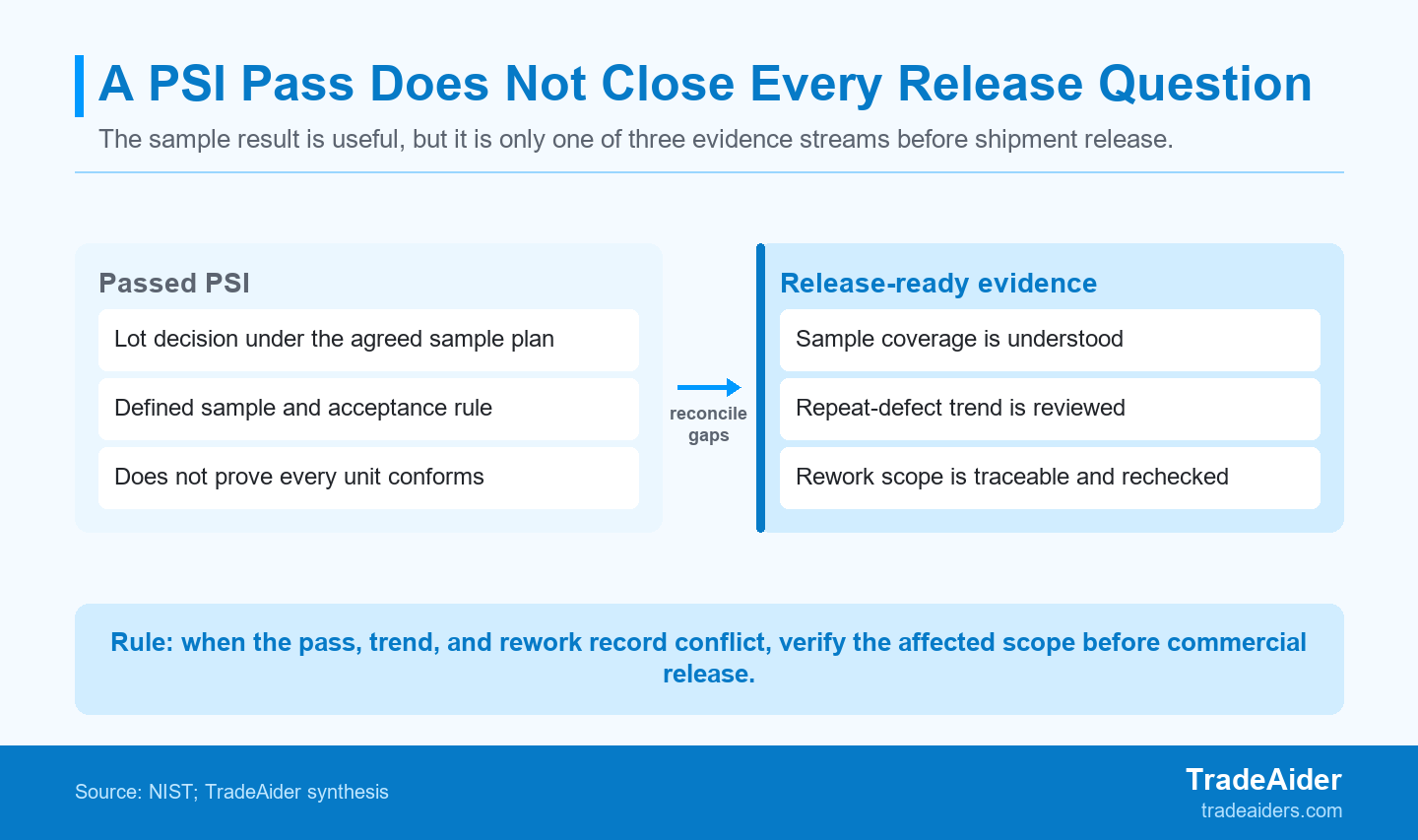
A passed PSI is one evidence stream. Release readiness also depends on what the sample did not cover, whether the defect repeats, and whether rework is traceable and verified.
Use a short release matrix instead of an informal email chain. The first column is the PSI result: lot, rule, sample, defects, and disposition. The second is the trend review: prior occurrences, affected configurations, and whether the current finding is isolated or recurring. The third is corrective-action evidence: affected scope, physical traceability, method, targeted verification, and remaining exceptions. Mark each column as aligned, incomplete, or conflicting.
When all three streams align, release is simple to explain. When only one stream is incomplete, the buyer can define the narrowest practical action: a photo reconciliation, carton-level hold, a focused functional check, or a documented corrective action. When the streams conflict, pause the commercial release decision until the contradiction is understood. This approach protects the value of the PSI report while keeping its evidentiary boundary clear.
Worked Example: A Passed PSI Meets a Rework Evidence Gap
An illustrative travel-mug order shows how a passed random sample can coexist with a repeat leak trend and incomplete rework traceability, making targeted verification necessary before release.
The Trend and Rework List Change the Meaning of the Pass
A global consumer-goods importer is preparing a finished-goods release decision for a repeat insulated travel-mug supplier. The illustrative order contains 3200 finished insulated travel mugs valued at USD 51200. All 3,200 mugs are completed and at least 80% are packed for export when the PSI is performed. On the agreed random sample, the lot meets its acceptance rule, with two minor finish findings and no critical findings. The factory cannot tie the 440 corrected mugs to the cartons presented for shipment. In isolation, the lot decision is a pass; the correction scope is a separate observation.
In the illustrative scenario, a passed PSI does not close a repeat lid-leak signal because the rework record cannot tie the corrected mugs to the cartons presented for shipment. The buyer’s defect log shows the same lid-leak mode on the two previous purchase orders, both in one lid component revision. The factory reports that it screened and reworked 440 mugs after an internal discovery, but its spreadsheet lists only a quantity and completion date, not carton ranges, batch identifiers, or a leak-test record. For this illustrative example, the buyer holds the uncertain cartons, requests a carton-to-rework reconciliation, and requires targeted leak checks on the identified corrected subset before a commercial release decision. This is a bounded release example, not a claim about a client shipment.
The random PSI sample happened not to include a traceable corrected carton. The pass therefore remains valid for its agreed sample, while the reworked subset remains an unresolved release question. Once the supplier supplies the missing carton mapping, the requested leak check can be selected from that corrected population instead of from an unrelated part of the lot.
Targeted Verification Closes the Release Question
The illustrative buyer keeps the lot decision, holds the affected cartons from release, and requests traceable rework scope plus targeted leak checks before making a commercial release decision.
The buyer asks the supplier to reconcile the 440 corrected mugs to cartons 241–270, describe the lid correction, and segregate those cartons. An inspector then selects units from that identified subset and repeats the agreed leak check under the stated condition. If the carton reconciliation is complete and the focused verification is satisfactory, the buyer can release the held cartons with a documented rationale. If the factory cannot identify the affected scope or the targeted check finds the same failure, the buyer keeps that scope on hold and chooses the next action under the contract. The inspector reports evidence; the buyer retains the commercial release authority.
Put the Release Rule in the Inspection Brief
A practical inspection brief assigns measurements, timing, material, method, ownership, defect-trend review, rework verification, and the buyer's final release authority. NIST’s detailed sampling guidance supports naming each of these inspection-plan inputs.
Before the goods are ready, add a one-page release annex to the usual inspection brief. First, name the lot, product configurations, sample plan, quality limits, and inspection timing. Second, list the evidence that must be compared with the PSI: prior defect log, production-change record, customer-return signal where relevant, and any open corrective action. Third, state what constitutes a traceable rework record and which targeted test will verify each material correction. These decisions are easier to make before a pass result creates schedule pressure.
Assign one owner for each handoff. The supplier provides production, carton, and corrective-action records. The inspection provider applies the buyer-defined criteria, documents sample coverage and findings, and performs any authorized targeted verification. Procurement or the buyer’s quality lead reviews the evidence against the agreed release rule. Logistics receives an explicit release, partial hold, or escalation instruction rather than inferring one from the word “pass.” For the final finished-goods event, set a pre-shipment inspection scope that includes release evidence.
A concise release note should state: “PSI result: pass under plan; coverage: all stated configurations represented except the reworked carton range; trend: repeat lid-leak mode reviewed; rework: cartons 241–270 reconciled and leak-checked; buyer disposition: release.” If any phrase cannot be supported, replace it with a hold or escalation instruction. This keeps the decision auditable without turning the report into a generic risk disclaimer.
When you need an independent check against buyer-defined criteria, plan a release-evidence inspection brief with TradeAider and provide the product specification, lot size, packing status, defect history, and any rework scope before the inspection date. That gives the inspection plan a fair chance to represent the decision the buyer will actually need to make.
Who Is TradeAider?
TradeAider can apply buyer-defined inspection criteria and report evidence while the buyer retains final commercial release authority.
TradeAider provides inspection and quality-assurance support for buyers sourcing in China. Its teams operate across Guangdong, Zhejiang, Jiangsu, Shandong, Fujian and other regions, helping buyers turn product requirements, sampling rules, packaging details, and defect criteria into documented inspection evidence. The practical value is a report that makes the inspected scope, observed findings, and next evidence request clear enough for the buyer’s own quality and procurement teams to act on.
For Inspection & QA Services, TradeAider lists pricing from $199/man-day all-inclusive. The company is also an Amazon Service Provider Network (SPN) partner. Engagement scope should be matched to the buyer’s product, stage of production, specification, risk context, and final release process.
Frequently Asked Questions
Can a shipment be released after a passed PSI?
A shipment can be released after a passed PSI only when the result matches the agreed plan and no separate trend, coverage, or rework evidence leaves a material release question unresolved. A pass supports the lot decision. The buyer should still review whether all relevant configurations were represented, whether the same failure mode is recurring, and whether any corrective action can be matched to the physical goods presented for release.
Does a passed AQL inspection prove every unit is good?
A passed AQL inspection supports an agreed lot decision from a sample; it does not prove that every unit in the lot is free of defects. It can provide a consistent basis for accepting or escalating the lot, but it does not inspect every unit or prove that all uninspected units conform. The report should state the lot, sample, rule, and observed findings so the buyer understands that boundary.
What rework evidence should a buyer request before release?
Request the affected quantity, carton or batch identifiers, correction method, completion status, and a targeted recheck result tied to the corrected population. For a functional defect, the recheck should repeat the relevant functional condition. For a packing or label issue, it should verify the corrected configuration on traceable cartons. A verbal confirmation alone does not establish scope.
When should a repeat defect trigger another inspection?
Trigger targeted verification when the same safety, function, fit, traceability, or material failure recurs and the current PSI sample does not directly resolve it. The next step can be narrow: inspect the affected configuration, select from corrected cartons, or perform the relevant function test. The buyer does not need to discard the PSI result to ask for evidence that answers a separate risk question.
Who makes the final commercial release decision?
The buyer makes the final commercial release decision. The supplier supplies records, and the inspection provider documents the agreed checks and observations. Procurement, quality, or another buyer-authorized owner then decides whether the evidence supports release, partial hold, corrective action, or escalation under the specification and contract. Making this ownership explicit prevents a report status from being mistaken for an automatic shipment instruction.
Related Articles

Grow your business with TradeAider Service
Click the button below to directly enter the TradeAider Service System. The simple steps from booking and payment to receiving reports are easy to operate.

