
- About Us

- Our Services
- Your Industry
- Resources
- News & Blog
Every importer sourcing from China eventually faces the same question: is an on-site inspection enough, or does the product also need a laboratory test? The answer has real cost and compliance stakes. According to ComplianceGate, third-party lab testing costs can range from a few hundred to tens of thousands of dollars per SKU — yet for regulated product categories, skipping it is not an option. Understanding when each quality control method applies helps you protect your business without overspending on overlapping services.
Key Takeaways
- Definition: Lab testing verifies regulatory compliance and material safety in an accredited laboratory. On-site QC inspection verifies workmanship, dimensions, and spec conformity at the factory — they solve different problems.
- Mandatory lab testing: Children's products, electronics, food-contact items, and products entering regulated markets (US, EU, UK) require accredited third-party lab testing by law. On-site inspection alone does not satisfy this requirement.
- On-site inspection for every order: Even products that have passed lab testing still need physical QC inspection before each shipment to catch defects, packaging errors, and spec deviations that labs do not evaluate.
- Decision rule: Apply the QC Method Selection Framework — ask three questions: Is this a regulated category? Has the product or material changed? Is this a new supplier? If any answer is yes, lab testing is required alongside inspection.
- Pricing: TradeAider charges $199/man-day all-inclusive for Inspection & QA Services, with same-day or ≤24-hour reports and real-time monitoring.
The Core Difference: What Each Method Actually Does
Lab testing is the process of submitting product samples to an ISO 17025-accredited third-party laboratory, where specialized equipment is used to verify chemical composition, material safety, regulatory compliance, and performance against defined standards such as CPSIA, REACH, CE, or FCC. On-site QC inspection is the process of sending a trained inspector to the factory floor to physically examine finished goods against buyer specifications, checking workmanship, dimensions, packaging, labeling, and defect rates using an AQL sampling plan. The two methods are complementary: they operate in different environments, use different tools, and answer different questions.
The fundamental distinction is scope. An inspector carrying calipers, a barcode scanner, and an AQL checklist can confirm that your furniture dimensions match the spec sheet, that your stitching count is correct, or that your packaging artwork is accurate. The same inspector cannot determine whether a children's toy contains lead above the 100 ppm CPSIA threshold — that requires ISO/IEC 17025-accredited laboratory instruments. Confusing these two methods leads to either over-spending (testing every cosmetic product that doesn't require it) or serious compliance gaps (skipping mandatory testing on regulated categories).
When Lab Testing Is Non-Negotiable
Lab testing is legally required — not optional — for specific product categories entering regulated markets. The QC Method Selection Framework (introduced in the next section) helps identify these situations, but the categories below always require accredited third-party testing regardless of supplier history or order frequency.
Children's Products (CPSIA — US Market)
Any product primarily intended for children under 12 entering the US market must be tested by a CPSC-accepted accredited laboratory to verify lead content (≤100 ppm in substrates, ≤90 ppm in surface coatings), phthalate levels, and ASTM F963 toy safety requirements. This applies to every SKU, including different color variants of the same product. A Children's Product Certificate (CPC) supported by valid third-party test reports is mandatory before the product can be legally sold or listed on Amazon.
Electronics and Electrical Products (CE, FCC, RoHS)
Electronics require laboratory evaluation for electromagnetic compatibility (EMC), electrical safety, and hazardous substance restrictions under RoHS. On-site inspections can verify that functional tests pass visually, but cannot confirm EMC compliance or detect restricted substance concentrations — these require specialized laboratory equipment. The Eurofins compliance team notes that CPSC has levied penalties of up to $120,000 per violation for non-compliant products, with cumulative caps exceeding $17 million for related violations.
Food-Contact Materials and Regulated Hardlines
Kitchenware, storage containers, cutlery, and other food-contact products must be tested for chemical migration from coatings, plastics, or metals. REACH regulations in the EU restrict hundreds of substances in consumer products. Textiles may require fiber content verification and restricted substance testing. These analyses are only possible in accredited labs — an on-site inspector cannot detect a prohibited azo dye or verify RoHS compliance without laboratory instruments.
When On-Site QC Inspection Is the Right Primary Tool
On-site QC inspection is the most efficient method for catching defects, verifying spec conformity, and validating packaging before shipment — and it applies to every order, regardless of product category. For non-regulated products like home décor, general hardlines, furniture, bags, and adult apparel that do not contain restricted substances and are sold in markets without mandatory testing requirements, on-site inspection may be the only quality control intervention you need.
Where inspection excels: workmanship quality (stitching, surface finish, sharp edges), dimensional accuracy (length, weight, volume), functional checks (buttons, zippers, moving parts), packaging integrity (carton strength, labeling accuracy, barcode readability), and AQL-based sampling to estimate the overall defect rate across the production batch. SafetyCulture notes that inspectors use structured checklists and sampling plans to document findings with photos, giving importers a clear pass/fail result before approving shipment.
Even products that have been previously lab-tested still require on-site inspection for every shipment. A passing lab report on a prior production run does not guarantee the current batch was assembled correctly, used the same materials, or meets your packaging requirements. The two methods address different risks across different timeframes. If you're looking for pre-shipment inspection services, TradeAider provides real-time online monitoring with reports delivered within 24 hours at $199/man-day all-inclusive.
Side-by-Side Comparison: Lab Testing vs On-Site QC Inspection
The table below compares the two methods across six key dimensions to help importers plan their quality control budget and sequence. Both methods are frequently used together — the question is always which combination applies to your product category and target market.
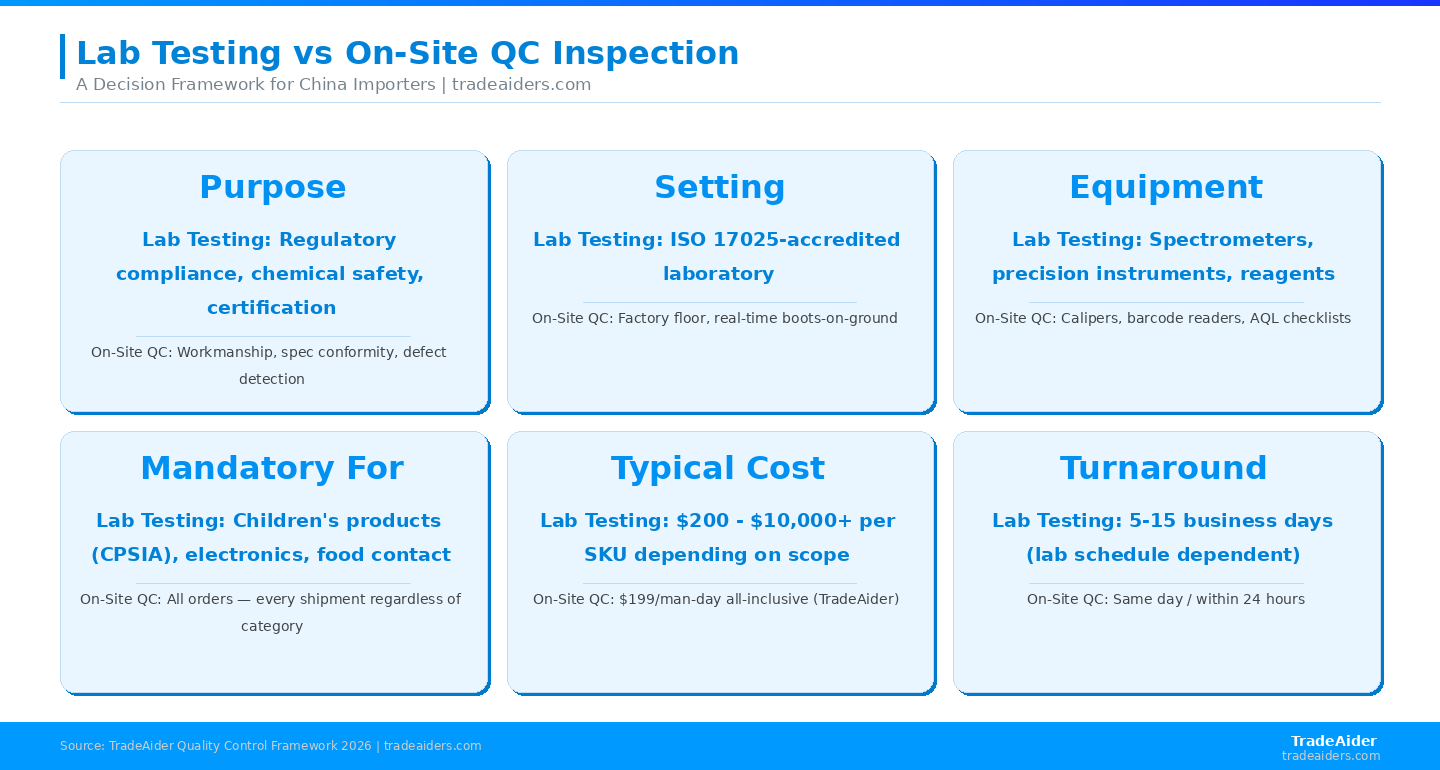 Lab Testing vs On-Site QC Inspection — Key differences across purpose, setting, cost, and turnaround. Source: TradeAider Quality Control Framework 2026
| Dimension | Lab Testing | On-Site QC Inspection |
|---|---|---|
| Primary Purpose | Regulatory compliance, chemical safety, certification | Workmanship, spec conformity, defect detection |
| Setting | ISO 17025-accredited laboratory | Factory floor — real-time, on-site |
| Equipment Used | Spectrometers, precision instruments, chemical reagents | Calipers, barcode readers, AQL sampling checklists |
| Mandatory For | Children's products, electronics, food-contact goods (CPSIA, CE, RoHS, REACH) | All orders — every production batch before shipment |
| Typical Cost | $200 – $10,000+ per SKU (scope dependent) | $199/man-day all-inclusive (TradeAider) |
| Report Turnaround | 5–15 business days (lab schedule dependent) | Same day / within 24 hours |
| Catches Material Changes | Yes — chemical analysis detects substituted materials | Partially — visual inspection may miss invisible substitutions |
| Can Be Combined | Yes — inspector can pull samples for lab submission during PSI | Yes — use alongside lab testing for complete coverage |
Based on this comparison, the strategic conclusion is clear: on-site QC inspection is the baseline for every order, while lab testing is a mandatory layer for regulated categories and a recommended layer whenever material compositions need verification. The data also shows that inspection turnaround is substantially faster, making it the right tool for per-shipment quality gates, while lab testing functions as a periodic compliance certification that travels with the product to market.
How to Apply the QC Method Selection Framework to Your Next Order
The QC Method Selection Framework reduces a complex decision to three structured questions. Applying it before booking any quality control service ensures you're allocating your QC budget correctly — neither over-testing low-risk cosmetic products nor under-protecting regulated goods. This framework is designed for importers who source manufactured goods from China and sell into English-speaking markets (US, EU, UK, AU, CA).
Question 1: Is This a Regulated Product Category?
Children's products, electronics, electrical goods, food-contact items, cosmetics, and medical devices are regulated in virtually all major import markets. If the answer is yes, third-party lab testing by an ISO 17025-accredited laboratory is required before market entry. You can also review TradeAider's inspection standards to understand the defect criteria used during on-site QC checks, regardless of supplier claims or existing certificates. Proceed directly to Step 3. If the answer is no, continue to Question 2.
Question 2: Has the Product, Material, or Supplier Changed?
Existing lab test reports are invalidated by any material, component, color, or design change — even if the product looks identical. According to ComplianceGate's CPSIA compliance guide, CPSC regulations treat a different production lot from the same factory as a new product for testing purposes under certain conditions. If you've changed factories, materials, or introduced a new SKU variant, new lab testing is required. If the product and supplier are unchanged for a reorder of a previously tested item, proceed to Question 3.
Question 3: What Is the Defect Risk for This Shipment?
Even if lab testing is not required, every shipment from China requires an on-site inspection. This is the core output of the QC Method Selection Framework: lab testing and inspection serve different risk dimensions, and one does not substitute for the other. For high-value orders, new product launches, or orders around peak seasons (Chinese New Year, Golden Week), adding a During Production Inspection (DPI) before the pre-shipment inspection provides earlier defect detection. TradeAider's during-production inspection services allow buyers to monitor and address issues while goods are still being manufactured, rather than after the full batch is complete.
The QC Method Selection Framework can be summarized as a simple rule: regulate = test + inspect; non-regulated, unchanged product = inspect every order; non-regulated, changed material or supplier = test + inspect. Following this logic prevents the two most common importer mistakes: assuming a prior lab test covers future production, and assuming inspection alone satisfies compliance requirements.
Practical Scenarios: Which Method Applies?
Applying the QC Method Selection Framework becomes clearer with concrete examples. A Shopify brand importing wooden cutting boards (food-contact) from a Guangdong factory needs both: lab testing for food-contact material safety (chemical migration of coatings and adhesives) and on-site inspection for workmanship and packaging. An Amazon FBA seller importing adult canvas tote bags with no regulated materials needs on-site pre-shipment inspection only — lab testing adds cost without regulatory necessity. An electronics importer launching a new Bluetooth speaker needs lab testing (FCC, CE, RoHS) for market certification plus on-site inspection for functional checks and packaging. According to Maple Sourcing's China QC guide, a defect discovered in a Chinese factory can typically be corrected quickly, while the same defect discovered at a US fulfillment center multiplies in cost through relabeling, replacement shipments, and return leakage.
Who Is TradeAider?
TradeAider is a quality inspection, testing, and certification service provider in China. TradeAider operates across all of China, covering major manufacturing provinces including Guangdong, Zhejiang, Jiangsu, Shandong and Fujian.
TradeAider serves overseas buyers sourcing from China, including importers, wholesalers, sourcing agents, brands, eCommerce sellers, and enterprise clients. Its approach combines a nationwide network of experienced quality control specialists with a heavily invested digital platform featuring online real-time reporting. Clients can monitor inspections live, communicate directly with inspectors, and address issues during production rather than after shipment — a proactive model focused on problem-solving and prevention, not just defect identification.
Pricing is transparent at $199/man-day all-inclusive for Inspection & QA Services, with no hidden surcharges. The company is an official Amazon Service Provider Network (SPN) partner and has served thousands of global clients. Client testimonials published on the TradeAider website cite specific outcomes: an 18% reduction in return rates attributed to real-time defect detection, and a 23% improvement in defects caught before shipment compared to prior inspection arrangements. These are client-reported figures.
Frequently Asked Questions
Do I need both lab testing and on-site inspection for my product?
For regulated product categories (children's products, electronics, food-contact goods), both are required — lab testing satisfies compliance certification, and on-site inspection verifies workmanship and spec conformity for each shipment. For non-regulated products, on-site inspection is the standard quality control step for every order; lab testing may still be added if you want to verify material composition or respond to buyer requirements.
Can an on-site inspector detect chemical compliance issues?
No. On-site inspectors use portable tools like calipers, barcode scanners, and visual checklists. They cannot measure lead concentrations, phthalate levels, or restricted substance compliance — these require laboratory instruments such as X-ray fluorescence (XRF) analyzers or spectrometers. InTouch Quality notes that on-site functional testing can complement lab testing but is not a substitute for certified laboratory analysis.
How often do I need to repeat lab testing?
Lab test reports must be renewed whenever a product's design, materials, components, or colors change — even if the change appears minor. For products with stable materials and production, a periodic testing plan based on CPSC guidelines is recommended. Consult with your testing lab and legal advisor to establish the right frequency for your specific product category.
What does ISO 17025 accreditation mean for a lab?
ISO/IEC 17025 is the international benchmark standard for testing and calibration laboratories. An accredited lab has been independently assessed to demonstrate technical competence, impartiality, and the ability to produce valid, reproducible results. According to ISO.org, test reports from accredited laboratories are accepted across borders through the ILAC mutual recognition arrangement, which is why regulators and major retailers require ISO 17025 accreditation for compliance testing.
Can I use my supplier's factory lab test reports?
For CPSIA-regulated products in the US, test reports must come from a CPSC-accepted third-party laboratory — supplier-issued reports do not satisfy this requirement. For EU CE marking, third-party testing by a Notified Body is required for many product categories. Even where supplier test reports are technically permissible as supporting evidence, regulators and major retail platforms typically require independent third-party validation. You can also use TradeAider's inspection cost calculator to estimate the total cost of combining on-site inspection with lab testing for your specific order.
Related Articles
Grow your business with TradeAider Service
Click the button below to directly enter the TradeAider Service System. The simple steps from booking and payment to receiving reports are easy to operate.

