
- About Us

- Our Services
- Your Industry
- Resources
- News & Blog
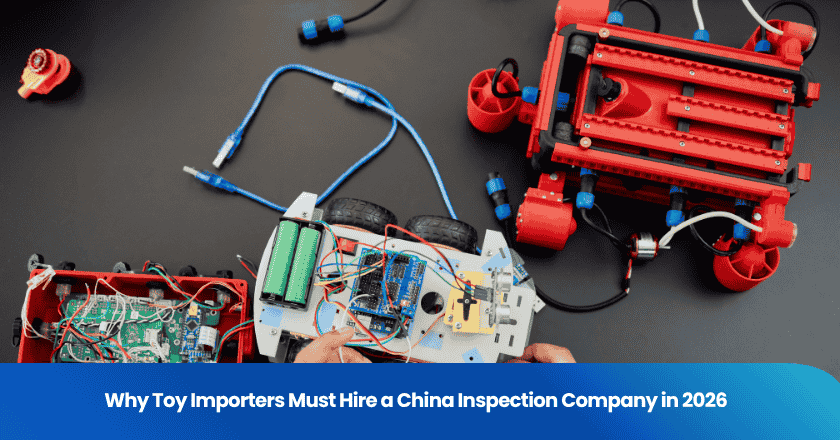
The global toy market is on track to surpass $130 billion by 2027, and a massive share of those products are manufactured in China. For importers, that means opportunity — but it also means risk. In 2026, toy safety regulations are tightening on multiple fronts, e-commerce platforms are enforcing stricter compliance gates, and consumer tolerance for defective products has reached an all-time low. A single recall can erase years of brand equity and millions of dollars in revenue.
If you're sourcing toys from China this year, relying on your supplier's internal quality checks is no longer sufficient. A professional third-party inspection company based in China is not a luxury — it is a necessity. This article explains exactly why, and what to look for when choosing your inspection partner.
Key Takeaways
- New CPSC and ASTM regulations in 2026 raise the bar for toy safety testing and traceability — non-compliance means blocked shipments and fines.
- Amazon and major marketplaces now require third-party lab test reports and on-site inspection documentation before listing children's products.
- The average toy recall costs importers $10–100 million in direct expenses; a full inspection costs a fraction of that amount.
- TradeAider offers real-time inspection monitoring, transparent $199/man-day pricing, and the industry's only co-accountability guarantee: WeGuarantee TQC.
The 2026 Toy Import Landscape: What's Changing
The toy industry has always been one of the most heavily regulated product categories. Children are the end users, and regulators worldwide treat that fact with the seriousness it deserves. In 2026, three converging forces are making the import environment more complex than ever.
Evolving Toy Safety Regulations
The U.S. Consumer Product Safety Commission (CPSC) continues to expand its enforcement of the Consumer Product Safety Improvement Act (CPSIA). Key regulatory developments importers must track in 2026 include:
- Stricter phthalate limits: The CPSC has finalized reductions on permissible phthalate levels in children's toys and childcare articles, reducing the acceptable concentration to 0.1% for an expanded list of phthalates. Importers must ensure every batch of toys is tested against these updated limits.
- Enhanced traceability requirements: New CPSC rules mandate that every children's product carry a permanent tracking label. Failure to comply can result in refused entry at the port of origin or destination.
- Updated ASTM F963 standards: The ASTM International F963 standard — the definitive voluntary toy safety specification in the United States — was updated again in late 2025. The 2026 revision introduces new requirements for button-cell and coin-cell battery accessibility in toys, expanded flammability testing for certain material categories, and revised acoustic limits for sound-producing toys.
For importers, these updates are not abstract. They directly affect what your factory produces, how it's tested, and whether your goods can legally enter your target market. A China-based inspection company that stays current with these regulatory changes acts as your first line of defense against compliance failures.
Rising Consumer Expectations
Beyond regulators, consumers themselves have become more safety-conscious — and more vocal. Social media amplifies every product safety incident. A single viral post about a small part detaching from a child's toy can generate millions of views and permanent brand damage. In 2026, consumers expect:
- Transparent safety credentials on product listings
- Clear labeling of materials, age appropriateness, and choking hazards
- Evidence of independent third-party testing and inspection
- Rapid, accountable responses from brands when quality issues arise
Importers who invest in visible quality assurance — and communicate that investment to their customers — build trust. Those who don't are one negative review away from a crisis.
The True Cost of a Toy Recall vs. the Cost of Inspection
Many importers, especially small and mid-sized businesses, view third-party inspection as an optional expense. The math, however, tells a different story.
| Cost Factor | Toy Recall (Avg.) | Pre-Shipment Inspection |
|---|---|---|
| Direct Recall Costs | $10M – $100M+ | $0 |
| CPSC Fines | Up to $15M per violation | $0 |
| Legal Fees & Litigation | $1M – $10M | $0 |
| Brand Reputation Damage | Often irreversible | None |
| Lost Sales (Downtime) | Weeks to months | 1–2 days (inspection time) |
| Total Typical Cost | $10M – $100M+ | $199 – $799 per order |
According to the CPSC, toy recalls remain one of the most frequent product categories in the agency's enforcement actions. In 2024 and 2025, dozens of toy recalls were issued — many involving lead paint, small parts hazards, and battery-related risks. Each recall represents a company that either skipped inspection, relied solely on supplier self-checks, or worked with an inspection partner that lacked the rigor to catch issues before shipping.
By contrast, a pre-shipment inspection (PSI) from a reputable China inspection company typically costs between $199 and $799 per order — a trivial investment compared to the catastrophic costs of a recall. The return on investment is not theoretical; it is a matter of simple arithmetic.
Amazon and Marketplace Compliance Requirements in 2026
If you sell toys on Amazon, Shopify, eBay, or other major marketplaces, compliance is no longer optional — it is a condition of access. Platforms have sharply increased their enforcement in recent years, and 2026 is the most stringent year yet.
Amazon's Children's Product Compliance
Amazon Seller Central now requires the following for all children's products, including toys:
- A valid Children's Product Certificate (CPC) based on third-party testing by a CPSC-accepted laboratory
- Compliance with all applicable CPSC children's product safety rules, including lead content, phthalate limits, and ASTM F963
- Permanent tracking labels on the product and its packaging
- Test reports from an ISO 17025-accredited laboratory
Amazon actively removes listings — and can suspend seller accounts — when these requirements are not met. The platform also conducts its own抽样 inspections and will flag products that fail spot checks. For FBA sellers, non-compliant inventory is destroyed or returned at the seller's expense.
Why On-Site Inspection Matters for Marketplace Sellers
Lab testing confirms that a product sample meets safety standards. On-site inspection confirms that the production run matches that sample. These are fundamentally different checks, and both are essential.
A factory may produce a perfect golden sample for lab testing, then substitute cheaper materials, skip critical assembly steps, or reduce quality controls during bulk production. Without an independent inspector on the factory floor, these discrepancies go undetected — until the product reaches a customer, triggers a complaint, and sets off a chain of enforcement actions.
How Third-Party Inspection Protects Your Brand
Hiring a China-based third-party inspection company provides multiple layers of protection for toy importers.
Independent Verification at Every Production Stage
Professional inspection companies offer services at every critical stage of the manufacturing process:
- Pre-Production Inspection (PPI): Verify raw materials, components, and production readiness before manufacturing begins. Catch issues like incorrect material grades or faulty molds before they affect thousands of units.
- During Production Inspection (DUPRO/DPI): Monitor quality during production, typically when 20–80% of the order is complete. Identify trends and issues early enough to allow corrective action.
- Pre-Shipment Inspection (PSI/FRI): The final check before goods leave the factory. Covers workmanship, specifications, packaging, labeling, and safety criteria using the internationally recognized AQL (Acceptable Quality Level) standard.
- Container Loading Supervision (CLS/CLI): Ensure the correct quantity is loaded, packaging is intact, and containers are properly sealed.
Video Evidence and Full Transparency
Modern inspection providers go beyond checklists. TradeAider provides real-time photo and video documentation of the inspection process, giving importers a clear window into conditions on the factory floor. This documentation also serves as critical evidence in the event of disputes with suppliers, insurance claims, or regulatory inquiries.
TradeAider: A Different Kind of Inspection Partner
Not all inspection companies are created equal. TradeAider was built to solve the specific frustrations that toy importers face — lack of transparency, unpredictable pricing, and zero accountability when things go wrong.
Real-Time Online Monitoring
TradeAider's real-time monitoring feature allows you to watch the inspection process as it happens, from anywhere in the world. You see your products being checked in real time — not hours after the fact, not in a static report, but live. This level of visibility is unique in the inspection industry and gives importers unprecedented confidence in the quality verification process.
Transparent Pricing — $199/Man-Day
TradeAider charges a flat $199 per man-day for all core inspection services — no hidden fees, no per-item surcharges, no surprises on your invoice. You know exactly what you're paying before the inspector arrives at the factory. This transparency allows importers to budget quality assurance costs accurately and build inspection into their standard sourcing workflow.
WeGuarantee TQC: Shared Accountability
Here is what makes TradeAider genuinely different: WeGuarantee TQC (Total Quality Control). Under this program, TradeAider does not simply report problems and walk away. The company shares accountability for the quality of your shipment. If a quality issue is missed during an inspection covered by WeGuarantee, TradeAider takes responsibility — including financial compensation.
This is not a guarantee you will find anywhere else in the third-party inspection industry. It reflects TradeAider's confidence in its inspection teams and its commitment to the "More Than Inspection" philosophy.
Fast Turnaround and Amazon FBA Expertise
TradeAider delivers detailed inspection reports within 24 hours of inspection completion, so you can make fast shipping decisions. The company also offers a dedicated Amazon FBA inspection program, designed to address the specific compliance and packaging requirements that Amazon enforces for fulfillment center receipt.
To learn more or book an inspection, visit tradeaiders.com.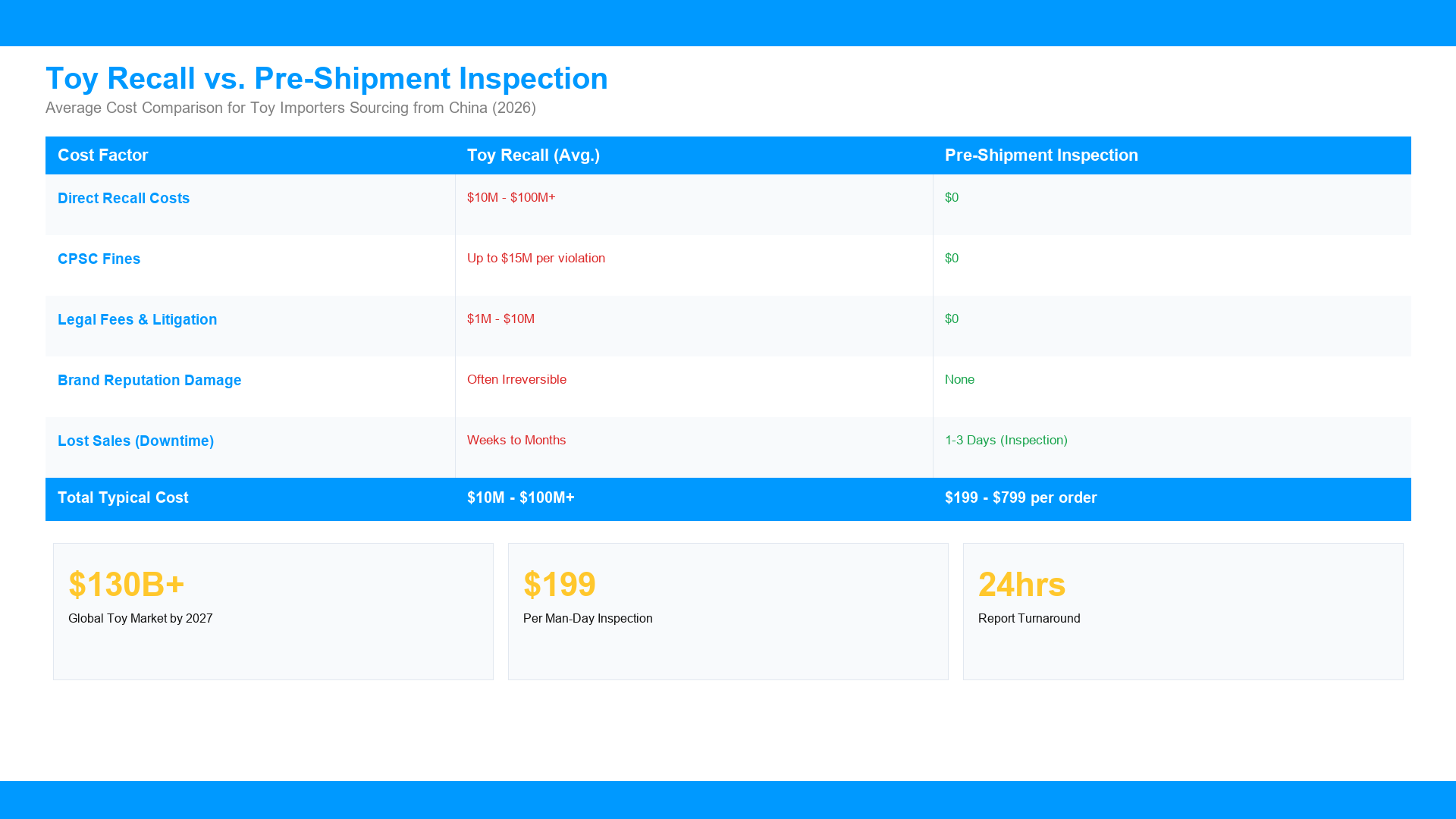
Figure: Why Toy Importers Must Hire a China Inspection Company in 2026
Frequently Asked Questions
How much does a toy inspection in China cost?
A standard pre-shipment inspection for toys in China typically costs between $199 and $399 per man-day, depending on the scope and the inspection provider. TradeAider offers a transparent flat rate of $199 per man-day with no hidden fees for PSI, DUPRO, PPI, factory audits, and container loading supervision.
When should I schedule an inspection during toy production?
For the best results, schedule inspections at two critical points: a During Production Inspection (DUPRO) when 30–50% of your order is complete (to catch issues early), and a Pre-Shipment Inspection (PSI) when 80–100% is packed and ready to ship (to confirm final quality and compliance). If it's your first order with a new supplier, also consider a Pre-Production Inspection (PPI) to verify materials and components before manufacturing starts.
Does Amazon require third-party inspection for toy sellers?
Amazon requires third-party lab testing and a Children's Product Certificate (CPC) for all toys. While on-site inspection is not strictly mandated by Amazon, it is strongly recommended — lab tests are performed on samples, not the actual production run. Without on-site inspection, you have no way to verify that the bulk production matches the tested sample. Sellers who skip inspection are far more likely to receive negative reviews, returns, and account suspensions.
What is AQL, and how does it apply to toy inspections?
AQL (Acceptable Quality Level) is the internationally recognized statistical sampling standard used to determine whether a production lot meets quality requirements. During an inspection, the inspector checks a statistically significant sample of your order based on the lot size and your chosen AQL level (typically Level II for general consumer goods). For toys, critical defects (safety hazards like sharp edges or detached small parts) have a zero-tolerance threshold under AQL standards, meaning even a single critical defect results in a failed inspection.
Protect Your Brand — Before It Ships
In 2026, the regulatory environment is tighter, consumer expectations are higher, and marketplace enforcement is more aggressive. For toy importers sourcing from China, professional third-party inspection is not a line item to cut — it is the single most cost-effective investment you can make in your brand's reputation and your bottom line.
Don't wait for a recall to take quality seriously. Partner with an inspection company that offers genuine transparency, real-time visibility, and shared accountability. Book your first inspection with TradeAider today — and see your products being checked, live, before they leave the factory.
Related Articles
Grow your business with TradeAider Service
Click the button below to directly enter the TradeAider Service System. The simple steps from booking and payment to receiving reports are easy to operate.

