- About Us

- Our Services
- Your Industry
- Resources
- News & Blog
Inspection Levels I, II, and III
In global sourcing, managing quality control (QC) is a balance between managing risk and controlling costs. When planning a product inspection under the ANSI/ASQ Z1.4 (or ISO 2859-1) standard, one of the most critical decisions an importer must make is selecting the correct General Inspection Level.
The standard offers three general levels: Level I, Level II, and Level III. This guide breaks down the technical differences between these levels, how they impact your sample size, and how to choose the right one for your supply chain.
What are General Inspection Levels?
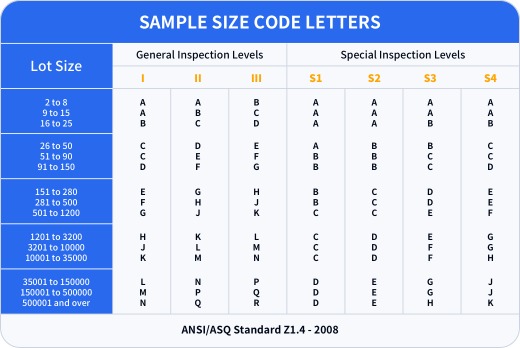
Under statistical sampling standards, Inspection Levels determine the relationship between your total order quantity (Lot Size) and the number of units that must be randomly drawn for inspection (Sample Size).
They do not change your AQL quality standards (e.g., whether you accept 2.5% defects), but they drastically shift the level of statistical confidence you have in the inspection results.
- Higher levels (III): Require larger sample sizes, providing high statistical certainty but costing more in inspector man-days.
- Lower levels (I): Require smaller sample sizes, reducing inspection time and costs, but increasing the risk of missing hidden defects.
Deep Dive: General Levels I, II, and III
Let's examine each General Inspection Level to understand when and why to apply them.
General Level II: The Industry Baseline (Default)
General Inspection Level II is the universal standard for consumer goods. If you do not specify a level in your Quality Inspection Agreement, third-party QC agencies will default to Level II.
- Objective: Provides a highly reliable statistical representation of the batch's actual quality without being cost-prohibitive.
- Best Used For: Standard consumer electronics, apparel, home goods, and first-time runs with verified suppliers.
General Level I: The Budget-Friendly Option
General Level I requires roughly 40% of the sample size of Level II. It reduces the time an inspector needs on-site, which can lower your QC costs.
- Objective: Saves budget by inspecting fewer units. However, this significantly increases the "buyer's risk" (the probability of accepting a bad batch).
- Best Used For: Low-risk, simple items (e.g., promotional pens, basic packaging), or mature products sourced from highly trusted, long-term manufacturing partners with a flawless history.
General Level III: The Strict Safeguard
General Level III requires roughly 160% of the sample size of Level II.
- Objective: Maximizes statistical certainty. It is highly effective at catching defects that might slip through smaller samples, but it often requires more man-days, increasing your cost.
- Best Used For: High-value luxury items, highly regulated medical or children's products, or suppliers with a history of failing quality standards.
ENo More Blind Imports: Verified Quality via Strict AQL Inspections. Delivering transparent, on-site quality control and reliable inspection reports. ➔ Get a Free Plan
Real-World Case Study: Sample Size Comparison
To visualize how these levels affect your quality control plan, look at how the required sample size shifts for an order of 10,000 units of custom sports bags:
| Inspection Level | Sample Size Code Letter | Required Sample Size (Units) | Impact on Inspector Time | Statistical Risk of Missing Defects |
|---|---|---|---|---|
| Level I | H | 50 units | Quick check (approx. 1-2 hours) | Very High |
| Level II (Standard) | J | 80 units | Standard check (approx. 3-4 hours) | Moderate (Balanced) |
| Level III | K | 125 units | Extensive check (often requires full day) | Very Low |
As shown above, moving from Level I to Level III more than doubles the number of units inspected. If your defects are concentrated in a single carton, a Level I inspection is highly likely to miss them entirely, whereas Level III will almost certainly flag the issue.
How to Choose the Right Level for Your Imports
When setting up your quality management plan, ask yourself these four operational questions to determine your level:
1. What is the Product Value and Criticality?
If you are importing cheap promotional items, a defect might lead to a minor complaint. If you are importing high-end electronics, a defect could lead to expensive returns or product recalls.
- Rule of thumb: High value / high complexity = Level III. Low value / simple = Level I.
2. What is Your Relationship with the Supplier?
- New Supplier: Always start with Level II or Level III for the first 3 shipments. Do not lower your guard until they prove their quality stability.
- Established Supplier: If a supplier has passed 10 consecutive inspections with zero major issues, you can temporarily downgrade to Level I to save costs.
3. What are the Destination Market Regulations?
Certain markets (such as the EU or North America) enforce strict safety compliance for products like toys, electrical devices, or personal protective equipment (PPE).
- Rule of thumb: If your product requires strict regulatory certifications (CE, FDA, CPSIA), always stick to Level II or Level III to ensure there are no legal liabilities.
A Quick Note on Special Levels (S-Levels)
In addition to General Levels, the ANSI/ASQ Z1.4 table contains four Special Levels (S-1, S-2, S-3, S-4).
These are used exclusively for destructive or labor-intensive functional tests (such as battery life cycle tests, fabric tensile strength tests, or barcode scanning checks). S-levels mandate incredibly small sample sizes (often only 5 or 8 units out of 10,000) to ensure that the process of testing does not destroy your sellable inventory.
Conclusion: Embed the Level in Your Agreement
Choosing the right inspection level is not just a decision for the inspection day; it is a contract metric. Always write your designated General Inspection Level and AQL limits directly into your Proforma Invoice (PI). This ensures your supplier knows exactly how their performance will be measured before production even begins.
Related Knowledge Base
TradeAider