
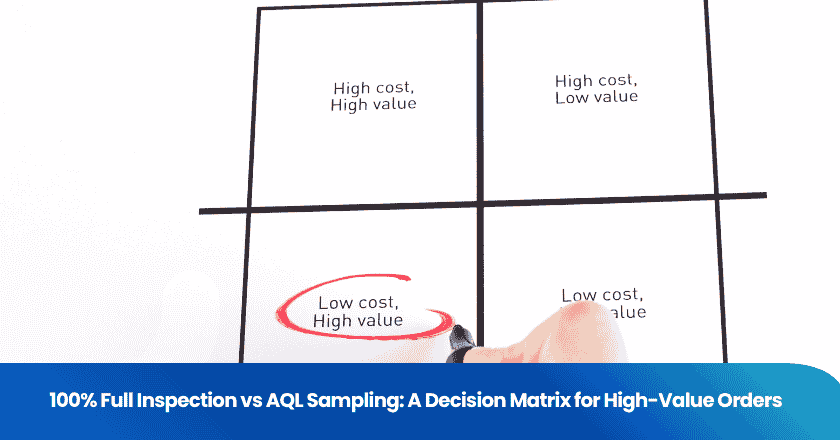
High-value orders change the math on quality inspection. When a single luxury watch costs $2,000 wholesale or a medical device carries recall liability in the millions, the standard AQL sampling that works for $5 apparel no longer gives the right answer. This guide gives you a 2x2 decision matrix to map your order to the correct inspection strategy, a 15x break-even rule for the cost calculation, and a specific unit-value threshold that tips the decision. The framework draws on statistical foundations established by NIST's statistical handbook on acceptance sampling, combined with real cost data from current third-party inspection practice.
Key Takeaways
- Definition: A high-value order has either unit wholesale price above $100 or total lot value above $50,000 — whichever threshold it crosses first.
- Matrix axes: Unit Value (low/high) on one axis, Defect Consequence (low/high) on the other — four quadrants, four strategies.
- Quadrant 4 (high/high): Medical, aerospace, luxury watches, automotive safety — full 100% inspection is the minimum responsible choice.
- Break-even rule: Choose 100% when the cost of a single defect reaching your customer exceeds 15x the inspection cost upgrade. Below that threshold, AQL is more efficient.
- Individual unit rejection: 100% inspection lets you reject defective units individually, avoiding the catastrophic loss of rejecting a multi-million-dollar lot over sample failures.
- Hybrid strategy: In quadrant 3 (low value / high consequence), apply 100% to safety-critical features only and AQL to everything else — often 3-4x cheaper than full 100%.
What Makes an Order "High Value" for Inspection Purposes
Most competitor articles use "high value" without defining it, which leads to two opposite errors: importers who over-inspect mid-price consumer goods, and importers who under-inspect $500 units because the word "luxury" did not come to mind. A concrete threshold fixes both problems.
A high-value order for quality control purposes is any shipment where either the unit wholesale price exceeds $100 or the total lot value exceeds $50,000. At either threshold, the financial consequence of a single defective unit or a rejected whole lot becomes large enough to change the optimal inspection strategy away from the standard AQL default.
The $100 unit threshold reflects a practical tipping point: below that price, individual defective units are cheap enough that bulk sampling economics still work. Above it, the math changes because rejecting a full lot for sampling failures costs much more than upgrading to 100% inspection. The $50,000 lot threshold catches high-volume orders of mid-price goods where total financial exposure matters even when the unit value stays low.
The Decision Matrix — Four Quadrants, Four Strategies
The decision matrix below plots every order on two dimensions. The vertical axis is unit value (low = under $100, high = above $100). The horizontal axis is defect consequence (low = refund/return cost only, high = recall, lawsuit, regulatory penalty, or safety incident). Each quadrant maps to a specific inspection strategy rather than a vague "use judgment" recommendation.
Figure 1 below maps each quadrant to its recommended inspection strategy; the summary table that follows gives the same information in tabular form for reference.
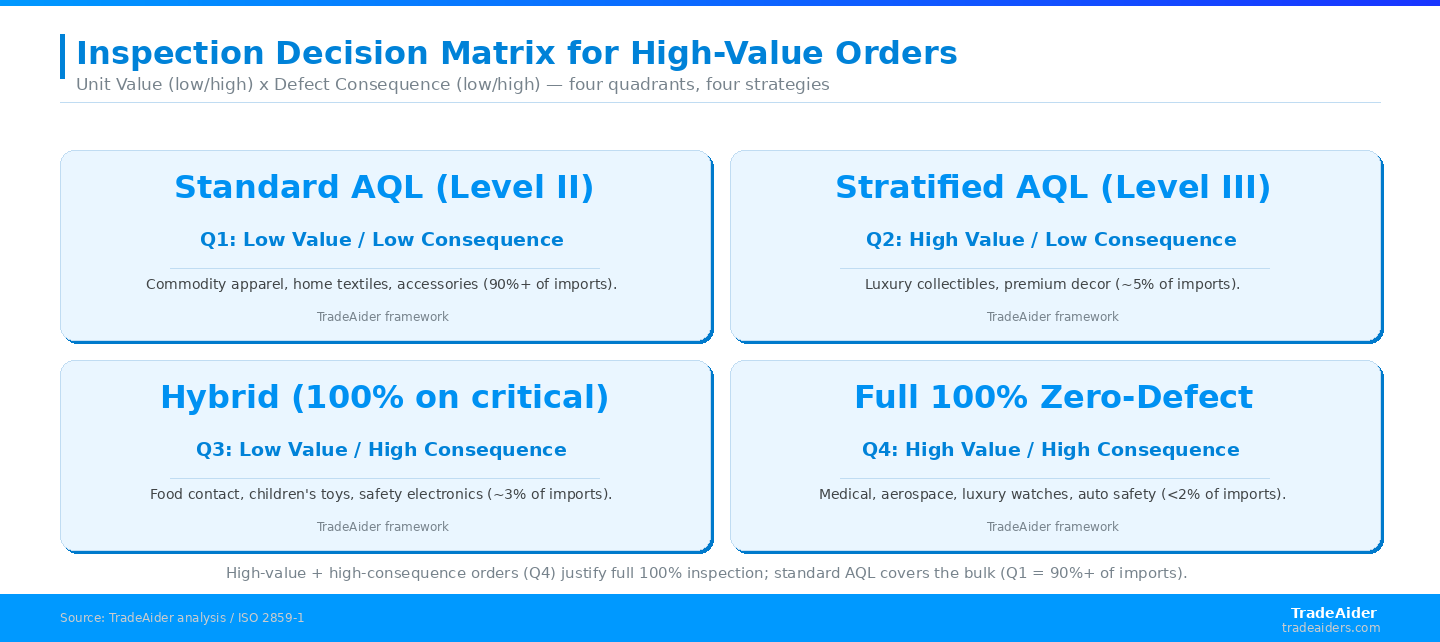
Figure 1. Inspection Decision Matrix. Axes: Unit Value (low/high) x Defect Consequence (low/high). Each of the four quadrants maps to a distinct inspection strategy. Q1 covers 90%+ of imports; Q4 is the narrowest quadrant but carries the highest financial exposure when defects escape.
| Quadrant | Profile | Strategy | Typical Share of Imports |
|---|---|---|---|
| Q1 | Low value / Low consequence | Standard AQL (Level II) | 90%+ |
| Q2 | High value / Low consequence | Stratified AQL (Level III) | ~5% |
| Q3 | Low value / High consequence | Hybrid (100% on critical + AQL on rest) | ~3% |
| Q4 | High value / High consequence | Full 100% Zero-Defect | <2% |
Based on this matrix, the inspection strategy for any specific order is not a judgment call — it is a direct lookup once you have placed the order in one of four quadrants. The data shows that the narrowest quadrant (Q4) carries the largest financial exposure and demands the most rigorous inspection, while the broadest quadrant (Q1) is served efficiently by the standard AQL default. The sections that follow walk through each quadrant in detail, starting with the most common case.
Quadrant 1 — Low Value / Low Consequence: Standard AQL
This quadrant covers 90%+ of consumer imports: commodity apparel, home textiles, plastic household goods, fashion accessories. Unit price is under $100 and a single defect reaching the customer costs at most a return and a small reputation hit. The correct strategy is standard AQL at General Inspection Level II with the industry baseline of 0 / 2.5 / 4.0 for Critical / Major / Minor defects. The AQL definition from the underlying sampling theory — that a compliant supplier has approximately 95% probability of lot acceptance at the specified AQL — gives sufficient statistical protection for this quadrant without wasted inspection spend.
Quadrant 2 — High Value / Low Consequence: Stratified AQL at Level III
Luxury collectibles, premium home decor, high-end fashion accessories, non-functional premium goods. Unit price exceeds $100 but defects cause returns rather than safety incidents. The right strategy is not full 100% — it is tightened AQL at General Inspection Level III with stricter values (often 0 / 1.5 / 4.0). Level III increases sample size by roughly 50-60% compared to Level II, which catches more defects while preserving the cost efficiency of sampling. Some importers in this quadrant also stratify by lot position — sampling more heavily from the first and last cartons produced, where factory process drift tends to concentrate.
Quadrant 3 — Low Value / High Consequence: Hybrid Inspection
Food-contact items, children's toys, budget electronics with safety implications, automotive aftermarket accessories. The unit may be cheap, but one defect can trigger regulatory action, an Amazon suspension, or a safety incident. Full 100% inspection is financially disproportionate for a $10 unit — but pure AQL is too permissive for the consequence profile. The answer is a hybrid: 100% inspection on the safety-critical features (electrical safety, sharp edges, small-parts test, mandatory labeling) plus AQL sampling on everything else (cosmetics, packaging, secondary dimensions). The hybrid approach typically costs 3-4x standard AQL but only a fraction of full 100%, and focuses inspection effort precisely where it matters.
Quadrant 4 — High Value / High Consequence: Full 100% Zero-Defect
Medical devices, aerospace components, luxury timepieces, fine jewelry, automotive safety systems, precision instruments. Unit value is high and a single defect triggers disproportionate consequences — recalls, lawsuits, regulatory penalties, or physical harm. Full 100% inspection is the minimum responsible choice. As medical device manufacturing research confirms, regulators effectively require zero-defect verification on critical product characteristics regardless of statistical arguments about sample size, and the same de-facto standard applies across the other industries in this quadrant.
The 15x Break-Even Rule
The 15x Break-Even Rule quantifies the matrix intuition into an actual calculation. It translates the cost premium of 100% inspection into a threshold on defect consequence, giving you a numerical test to apply when a specific order sits near a quadrant boundary.
The 15x Break-Even Rule states: choose 100% inspection when the expected cost of a single defect reaching the end customer exceeds 15 times the inspection-cost premium of 100% over AQL. Below that threshold, AQL sampling is the more cost-efficient strategy.
How the 15x Number Is Derived
100% inspection typically costs 10–15x more than AQL sampling for a 10,000-unit lot. Choosing the upper bound of that range (15x) gives a conservative buffer — meaning the math favors 100% even when inspection cost premiums come in at the high end. The rule also accounts for the fact that even 100% inspection is not perfectly accurate: academic analysis from Brunel University's operations research program demonstrates that at a 1% per-unit miss rate, the probability of catching every defect in a 100-defect batch is only 0.37. The 15x threshold builds in tolerance for imperfect 100% inspection.
Applying the Rule — A Worked Example
Consider a 5,000-unit shipment of premium Bluetooth headphones with $150 wholesale unit value destined for Amazon FBA. AQL sampling at Level II costs $199 (one man-day). 100% inspection of 5,000 units costs approximately $995 (five man-days). The inspection cost premium is $796. Applying the 15x rule, 100% inspection becomes justified when the expected cost of one defect reaching a customer exceeds $11,940. A single product failure on Amazon typically drives a return ($150), a refund, negative review impact (several hundred dollars in lost future sales), and an ODR contribution. As seller-performance analysis shows, ODR exceeding 1% risks account suspension with downstream revenue loss of $50,000–100,000. The consequence quickly exceeds $11,940 once ODR pressure is factored in, so 100% inspection is the right call for this SKU. Use our inspection calculator to run the same math on your own order.
Why High-Value Orders Specifically Favor 100% Inspection
Beyond the quadrant mapping and the break-even rule, three specific dynamics make high-value orders structurally different from commodity orders. These dynamics explain why the 100% vs AQL decision is not simply about product quality risk — it is also about how the financial structure of the order changes the cost of a sampling rejection.
Reason 1 — Rejecting a Whole Lot Over Sampling Failures Is Catastrophically Expensive
Under AQL sampling, if sample defects exceed the accept number, the entire lot fails inspection. For a 10,000-unit commodity apparel lot at $5/unit, a failed inspection means $50,000 is at risk — painful but manageable. For a 10,000-unit luxury watch lot at $500/unit, a failed inspection puts $5 million on the table over what might be a handful of defective samples. 100% inspection in the high-value quadrant lets you identify and reject individual defective units rather than the whole lot, protecting the vast majority of the order value even when a small percentage of production is non-conforming.
Reason 2 — Factory Process Drift Is Harder to Detect in High-Value Production
High-value goods typically have longer production cycles, more complex assembly, and smaller batch sizes. Sampling theory assumes random defect distribution, but real factory quality problems cluster — a machine calibration drift at hour 8 produces defects only in the afternoon output. The producer/consumer risk analysis built into the OC curve cannot fully protect against systematic clustering, especially in smaller lots. 100% inspection removes this risk entirely.
Reason 3 — Destructive and Complex Tests Scale Differently
High-value goods often require destructive or semi-destructive tests that consume units. For a commodity order, destroying 32 units at AQL Level II sample size is acceptable; for a $2,000/unit lot, destroying the same 32 units costs $64,000 and changes the math. High-value inspection programs often combine 100% non-destructive inspection with S-level (small sample) destructive tests on just 2–8 units — a different structure than commodity AQL allows.
How to Implement the Matrix in Your Next Order
Applying the framework to a specific shipment takes four concrete steps. These steps are what a professional inspection provider will walk you through when you book an inspection, but you can — and should — run them yourself before the first conversation so you know what you are asking for.
Step 1 — Determine Unit Wholesale Price and Lot Value
Take the per-unit wholesale price (what you pay the factory, not the retail price) and the total lot value. If either crosses the $100 unit threshold or $50,000 lot threshold, you are in a high-value-axis quadrant and AQL sampling alone is unlikely to be optimal.
Step 2 — Estimate Defect Consequence Severity
For each defect class, write down the worst-case financial consequence of one defective unit reaching a customer. Include: return cost, refund, negative review impact, ODR contribution, regulatory risk, liability exposure, and brand reputation cost. If any defect class carries consequences above $10,000 per incident, you are in a high-consequence-axis quadrant.
Step 3 — Apply the 15x Break-Even Rule
Calculate AQL sampling cost ($199 per man-day × 1-2 days typical) and 100% inspection cost (man-days = lot size ÷ 1,000 approximately, at the same daily rate). The difference is your inspection cost premium. Multiply by 15. Compare to your defect consequence number. If consequence exceeds 15x premium, choose 100%. If not, choose AQL or hybrid.
Step 4 — Decide on Hybrid Scope If in Quadrant 3
If you landed in the low-value/high-consequence quadrant, list the specific features where a defect causes the high consequence. Those features get 100% inspection. Everything else gets AQL at your usual levels. A professional inspection checklist can encode this split cleanly — the inspector knows which items to check individually and which to sample.
If you would like help mapping your next shipment to the matrix and building the right inspection plan, our team works through this framework on every high-value booking. Pre-shipment inspection services start at $199/man-day, and for high-value or regulated products we also provide compliance support through product testing services that complement on-site inspection.
Who Is TradeAider?
TradeAider is a quality inspection, testing, and certification service provider under the ShiningHub Group, headquartered in China. Founded in 2010 by Justin Chen — an industry veteran with over 30 years of experience in global trade, manufacturing, and quality control — TradeAider operates across all of China, covering major manufacturing provinces including Guangdong, Zhejiang, Jiangsu, and Fujian. TradeAider is an innovative, digitally driven third-party inspection provider that sets itself apart through real-time online monitoring and transparent pricing, delivering efficient and reliable quality control solutions.
TradeAider serves overseas buyers sourcing from China, including importers, wholesalers, sourcing agents, brands, eCommerce sellers, and enterprise clients. Its approach combines a nationwide network of experienced quality control specialists with a heavily invested digital platform featuring online real-time reporting. Clients can monitor inspections live, communicate directly with inspectors, and address issues during production rather than after shipment — a proactive model focused on problem-solving and prevention, not just defect identification. For high-value orders specifically, the platform supports booking full 100% inspection, Level III AQL, and hybrid plans with custom checklists in a single coordinated engagement. TradeAider also provides testing services, covering Hardline Products, Softline Products, Electrical & Electronic Products, and Industrial Products, enabling buyers to manage quality control and testing needs within a single service framework.
Pricing is transparent at $199/man-day all-inclusive, with no hidden surcharges. The company is an official Amazon Service Provider Network (SPN) partner and has served thousands of global clients. Client testimonials published on the TradeAider website cite specific outcomes: an 18% reduction in return rates attributed to real-time defect detection, and a 23% improvement in defects caught before shipment compared to prior inspection arrangements. These are client-reported figures.
Frequently Asked Questions
What counts as a high-value order for quality inspection purposes?
A high-value order is any shipment where the unit wholesale price exceeds $100 or the total lot value exceeds $50,000. At either threshold, the financial structure of the order changes how inspection rejections affect you. Below $100 per unit, rejecting whole lots over sampling failures is uncomfortable but manageable; above $100, individual unit rejection (which requires 100% inspection) becomes a materially better financial outcome when defects occur.
Should I always inspect 100% of luxury goods?
No — not all luxury goods belong in quadrant 4 of the decision matrix. Luxury goods with low defect consequence (decorative items, premium fashion accessories, collectibles) are better served by tightened AQL at Inspection Level III with values like 0 / 1.5 / 4.0. Full 100% inspection is correct only when luxury value pairs with high defect consequence: luxury watches, fine jewelry with precious stones, medical-grade personal care, or any luxury item with safety-critical components.
How do I decide between AQL and 100% inspection on a specific order?
Run the 15x Break-Even Rule. Calculate the cost premium of 100% inspection over AQL sampling for your lot size, multiply by 15, and compare that number to the expected cost of one defect reaching a customer. If consequence exceeds the 15x threshold, 100% inspection pays off. If it does not, AQL sampling remains the more cost-efficient strategy. Most decision calls fall clearly on one side of the threshold; close calls typically default to hybrid inspection on critical features.
What is the actual cost of a single defect reaching a customer?
Cost varies by channel and product category, but key components are: refund and return processing cost (unit price + logistics, typically $20-100 for consumer goods), negative review and reputation impact ($200-1,000 in lost future sales per public review), Amazon Order Defect Rate contribution (threshold risk that can cost $50,000+ in lost revenue if account health degrades), regulatory exposure ($10,000+ per incident in penalties for certain categories), and liability insurance claims for safety incidents (industry averages of $750,000+). High-value or regulated products can easily cross the 15x break-even threshold on these costs alone.
Can I mix 100% inspection and AQL sampling on one order?
Yes — this is the recommended strategy for quadrant 3 (low value / high consequence) and often for close-call quadrant 4 cases too. The hybrid approach specifies 100% inspection on safety-critical or liability-critical features, with AQL sampling on everything else. Implementation requires a detailed inspection checklist that classifies each feature into the right track. A professional inspection provider will build this checklist with you and execute both inspection types in a single on-site visit, which is usually 3-4x the cost of standard AQL but a small fraction of full 100% inspection.
Need help mapping a high-value order to the right inspection strategy? Contact our team to walk through the decision matrix with a QC specialist. All inspection plans — standard AQL, Level III tightened, hybrid, and full 100% — are quoted transparently at $199/man-day with no hidden fees.
Related Articles

Grow your business with TradeAider Service
Click the button below to directly enter the TradeAider Service System. The simple steps from booking and payment to receiving reports are easy to operate.

