
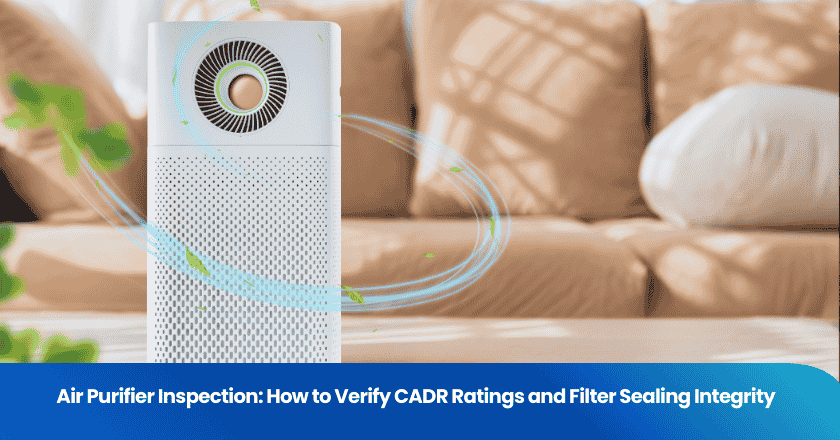
Air purifier inspection is the process of systematically verifying that a device performs as its specifications claim. Two measurements sit at the core of this verification: the CADR (Clean Air Delivery Rate) rating, which determines how effectively the unit removes airborne particles, and filter sealing integrity, which ensures no unfiltered air bypasses the filter system. Without these checks, health claims on product labels are unverified, and substandard units reach consumers who rely on them for indoor air quality.
Key Takeaways
- CADR ratings directly indicate how quickly a purifier removes dust, pollen, and smoke from a room — higher values mean faster particle removal.
- Filter sealing integrity prevents unfiltered air from bypassing the HEPA filter, which is the most common source of unexpected performance failure.
- AHAM certification confirms that a device has passed independent laboratory testing and meets industry performance benchmarks.
- Most filters require replacement every 90 days; non-washable HEPA filters need replacement every 6 to 12 months.
Why Air Purifier Inspection Matters
CADR and Indoor Air Quality
Clean Air Delivery Rate (CADR) measures how quickly an air purifier removes specific airborne particles from a defined space. A purifier with MERV-13 filters achieves significantly higher CADR values than one with MERV-8 filters. Inspectors use CADR as a compliance benchmark against ISO 14644 classifications and HVAC system requirements, checking airflow and particle removal to verify the device's labeled performance.
The Role of Filter Sealing
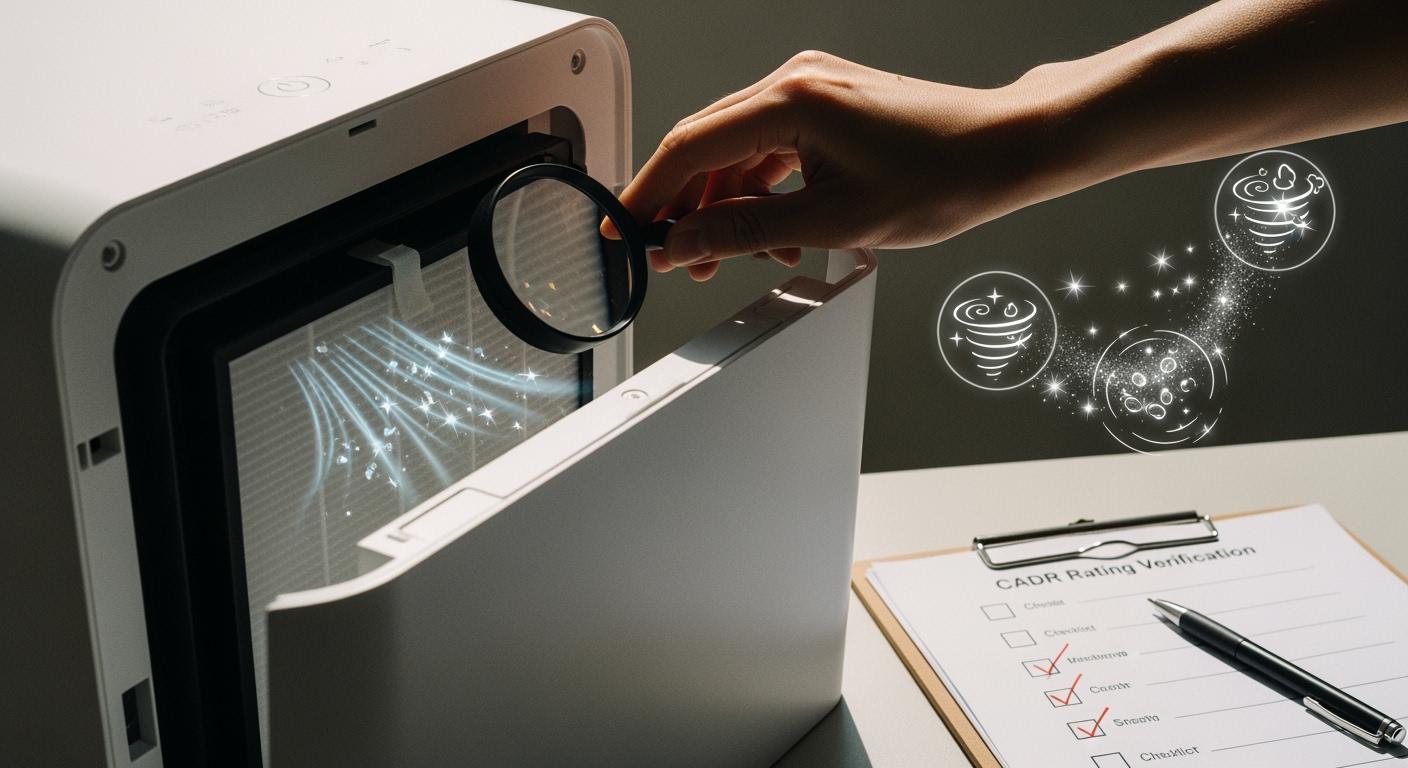
Filter sealing prevents unfiltered air from taking the path of least resistance around the filter rather than through it. Even a small gap in the filter housing — a loose door, a misaligned retention plate, or a degraded gasket — can allow a significant proportion of airflow to bypass filtration entirely. Inspectors check housing tightness, gasket condition, and alignment during both new-unit inspection and maintenance visits.
Health Risks from Skipped Inspections
Dust and debris accumulation blocks airflow and progressively reduces cleaning efficiency. Worn-out filters lose their ability to capture particles, and a filter that appears intact may no longer achieve its rated CADR. In energy-efficient homes, inadequate maintenance can allow ozone buildup from ionizing purifiers — a particular risk for people with asthma. Regular inspection is not optional; it is a health safeguard.
CADR Rating Verification
How CADR Is Measured
CADR testing follows a standardized laboratory procedure: the purifier is placed in a sealed chamber, a measured quantity of test pollutants is introduced, and the device is activated. Technicians measure the rate at which the purifier reduces pollutant concentration over time. The resulting CADR value reflects actual particle removal speed, not just theoretical airflow capacity.
On-Site CADR Verification Protocol
Factory-level CADR inspection follows a structured process:
- Place the air purifier in a controlled test environment.
- Introduce a known quantity of test particles into the test space.
- Activate the purifier and measure particle concentration reduction over time using calibrated particle counters.
- Compare results against the CADR rating on the product label.
- If the factory lacks necessary tools, record the item as "Pending" or "Fail" so buyers are informed immediately.
Industry standard CADR specifications:
| Particle Type | Minimum CADR | Maximum CADR |
|---|---|---|
| Pollen | 25 cfm | 450 cfm |
| Dust | 10 cfm | 600 cfm |
| Cigarette Smoke | 10 cfm | 600 cfm |
Airborne Particle Count Testing
Particle count testing validates CADR performance in real-world conditions. Studies show that particle clearance time can be 3x faster in under 10 minutes with a properly functioning air purifier, with significant reductions in total airborne particle concentration — particularly in poorly ventilated rooms. These results provide objective data for comparing models and confirming that production units match the performance of certified prototypes.
AHAM Certification
AHAM (Association of Home Appliance Manufacturers) certification is independent verification that a purifier has passed standardized laboratory testing. It covers pollen, dust, and smoke removal efficiency, giving buyers confidence that labeled CADR values are accurate. Inspectors verify this certification during factory inspection and cross-check it against the product's stated performance figures.
Tip: Always verify AHAM certification during procurement and production inspection. This label confirms the device has undergone independent testing rather than self-reported performance claims.
Filter Sealing Integrity Checks
Why Filter Sealing Is Critical
A properly sealed HEPA filter prevents unfiltered air from bypassing the filtration media. For consumer air purifiers, filter seal failures mean the device is not delivering the air quality its CADR rating promises, even when running continuously. Laboratory tests confirm that filter sealing integrity is the single most significant variable in whether a purifier meets its certified performance in actual use.
Step-by-Step Filter Inspection Protocol
- Check for visible holes, tears, or deformations in the filter media.
- Verify that the filter covers the entire perforated area of the filter housing.
- Confirm the filter is not folded, creased, or damaged during installation.
- Lock the retention plate and verify it holds the filter firmly in position.
- Inspect gaskets and seals for wear, cracking, or compression failure.
- Check alignment of the filter door and retention plate against manufacturer specifications.
- Visually inspect the base of the filter housing for moisture or contamination.
DOP/Aerosol Challenge Testing
For high-performance and industrial-grade purifiers, DOP (Dispersed Oil Particulate) testing provides definitive evidence of filter integrity. Inspectors introduce a standardized aerosol upstream of the filter and use a photometer to measure particle penetration downstream. Any leakage through seals, pinholes in the filter media, or gaps in the housing will appear as measurable particle counts on the downstream side. This test is more sensitive than visual inspection alone and is required for cleanroom-grade HEPA validation.
Signs of Poor Sealing
Common indicators of inadequate filter sealing include: loose filter doors that do not close flush with the housing, visible gaps between the filter edge and the housing frame, misaligned retention plates, moisture or discoloration on the filter or housing, and elevated downstream particle counts during DOP testing. Any of these findings warrants immediate rework before the unit moves forward in production.
Impact of Poor Maintenance on CADR Performance
Research tracking CADR attenuation in different cooking environments shows how rapidly filter performance degrades when inspection is neglected:
| Environment Type | PM Concentration Increase (%) | CADR Attenuation for PM (%) | CADR Attenuation for Formaldehyde (%) |
|---|---|---|---|
| Oily Fumes (Group A) | 92.7 | 70.6 | 80.6 |
| Non-Oily Fumes (Group C) | 76.5 | 12.5 | 37.3 |
| Mixed Fumes (Group B-I) | N/A | 19.9 | 48.4 |
| Mixed Fumes (Group B-II) | N/A | 16.7 | 38.9 |
These figures show that filter replacement timing is performance-critical, not arbitrary. Key replacement guidelines: washable filters last approximately 6 months with proper care; non-washable HEPA filters require replacement every 6 to 12 months; most standard filters need changing every 90 days for consistent output.
Thorough air purifier inspection — combining CADR verification, filter sealing integrity checks, and real-time monitoring — protects both indoor air quality and manufacturer reputation. Regular maintenance and professional testing extend purifier lifespan, maintain certified performance, and prevent the progressive CADR attenuation that occurs when filters and seals are left unchecked. Making inspection a routine part of production quality control is the foundation of reliable air purification. Need professional air purifier inspection support in China? TradeAider's inspection team provides real-time reporting and 24-hour official reports for every batch.
FAQ
How often should an air purifier be inspected?
Inspection every 3 to 6 months is recommended for most consumer units. Filters should be checked at every inspection, with replacement guided by manufacturer specifications — typically every 90 days for standard filters and every 6 to 12 months for non-washable HEPA filters.
What tools do inspectors use for CADR verification?
Calibrated particle counters and airflow meters are the primary tools for on-site CADR testing. Inspectors verify equipment calibration before each test and confirm the test environment meets standard conditions for accurate results.
Why does filter sealing matter for air quality?
A properly sealed filter ensures all air passes through the filtration media rather than bypassing it through gaps in the housing. Even a small seal failure can significantly reduce actual particle removal efficiency, regardless of the filter's rated performance.
What happens if an air purifier fails inspection?
Inspectors document the failure in real time, notify the factory immediately, and require corrective action before the unit advances. For sealing failures, this typically means rework and re-inspection. For CADR failures, the root cause — filter, airflow path, or fan performance — must be identified and resolved before the unit can be cleared.
Related Articles
Grow your business with TradeAider Service
Click the button below to directly enter the TradeAider Service System. The simple steps from booking and payment to receiving reports are easy to operate.

