
- About Us

- Our Services
- Your Industry
- Resources
- News & Blog
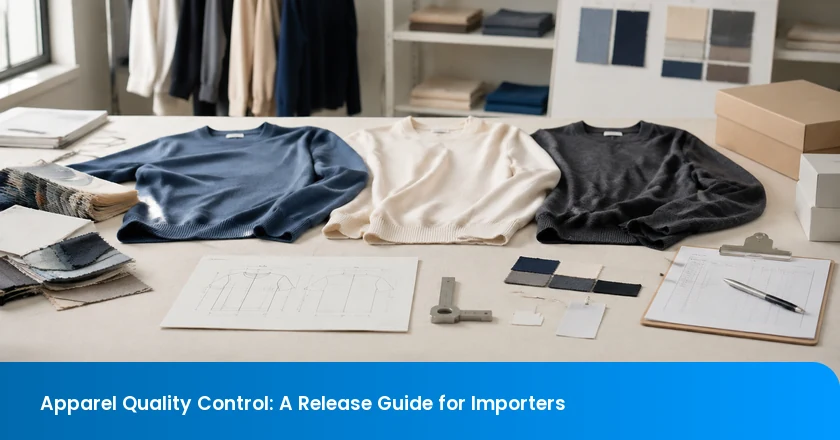
Apparel quality control is useful only when it gives a buyer evidence for one release decision: which group of garments can ship, which must be held, and which needs another check. When fabric, measurements, labels, and packing are connected to a traceable lot and a correction window, a finding can lead to containment and reinspection instead of a vague final-inspection comment.
What Effective Apparel QC Actually Protects
Apparel quality control is a release-evidence system, not a final appearance check. It turns the buyer's approved sample, measurable requirements, and production status into an approve, hold, or reinspect decision for a defined release population: the group of units under review. That distinction matters because a garment can look acceptable in a small sample while a repeated measurement, label, or packing problem remains hidden in the rest of the lot.
- Define the decision first: name the lot, the approved reference, the defect classifications, and who may authorize a release.
- Check where correction is still possible: fabric and trim issues belong before bulk work; sewing and measurement drift belong during production; packing and final presentation belong before shipment.
- Separate evidence from assurance: a sampled inspection supports a lot decision, but it cannot prove that every uninspected garment is defect-free.
- Keep the affected scope traceable: a repeated finding should identify cartons, production dates, sizes, or work instructions that need containment.
Quality assurance and quality control work together but do different jobs. Quality assurance sets up the process that should prevent predictable failures; quality control checks whether the material, work in progress, or finished lot actually meets the agreed requirements. Importers need both, yet the release decision depends on the evidence available at the moment the goods are approved or held.
Build a Quality Brief Before the Factory Starts
A usable apparel specification converts buyer expectations into observable and measurable checkpoints. A visual sample alone cannot settle whether a chest width, seam appearance, fiber disclosure, carton marking, or polybag warning is acceptable. Put the approved sample beside the current measurement chart, bill of materials, label artwork, packing instructions, and defect rules so the factory and inspector are evaluating the same release criteria.
Start with requirements that can be seen, measured, counted, or matched to an approved reference. For a garment sold in the European Union, fiber-composition labeling is not merely a design detail: Regulation (EU) No 1007/2011 sets textile fiber naming and labeling or marking conditions. The practical QC implication is to place the destination-market label check in the brief before artwork is finalized, rather than discovering a mismatch after the garments are packed.
| QC brief element | What makes it checkable | Release risk if missing |
|---|---|---|
| Approved reference | Sealed sample, dated artwork, and approved color or trim reference | Opinions replace an agreed standard |
| Measurements and tolerance | Point-of-measure diagram, size range, and stated tolerance | Fit drift cannot be classified consistently |
| Defect rules | Critical, major, and minor examples tied to the product | The result cannot support a defendable hold or release |
| Label and packing checks | Destination, artwork revision, carton mark, assortments, and packing ratio | A compliant garment can still be released with the wrong selling-market information |
Before production begins, review the inspection standard before approving the QC brief. The aim is not to create a longer document; it is to remove the points where a supplier, buyer, and inspector could reasonably apply different acceptance rules to the same garment. The same disciplined brief gives TradeAider a usable reference when it inspects the selected lot against the buyer's stated criteria.
Verify Materials Before Bulk Work Makes Changes Expensive
Fabric, trims, construction, measurements, labels, and packaging need evidence before they can be accepted. The evidence can be a swatch matched to the approved standard, a measurement sample checked against the chart, a trim approval, or a packing mock-up. For covered US garments, the FTC's Care Labeling Rule guidance requires complete regular-care instructions or necessary warnings and a reasonable basis for them. That is why care artwork should be compared with the fabric and construction evidence before bulk production, not treated as copy that can be corrected at the end.
Material evidence also creates a useful escalation path. If the bulk fabric is visibly different from the approved hand feel or shade, the buyer can hold cutting while the supplier compares rolls and lot records. If a measurement sample is off, the buyer can correct the grading instruction before the same error reaches several sizes. The earlier the check, the smaller the correction window and the fewer units need to be sorted, reworked, or remeasured.
Use Stage Gates to Contain Defects, Not Just Record Them
Earlier controls reduce the size of the lot that needs correction when a defect appears. The mechanism is simple: once a defect is connected to a production date, line, size, material batch, or work instruction, the buyer can isolate that window instead of treating the full order as equally uncertain. A final check still matters, but it cannot recover the time lost when a repeated sewing or grading error was allowed to run through most of production.
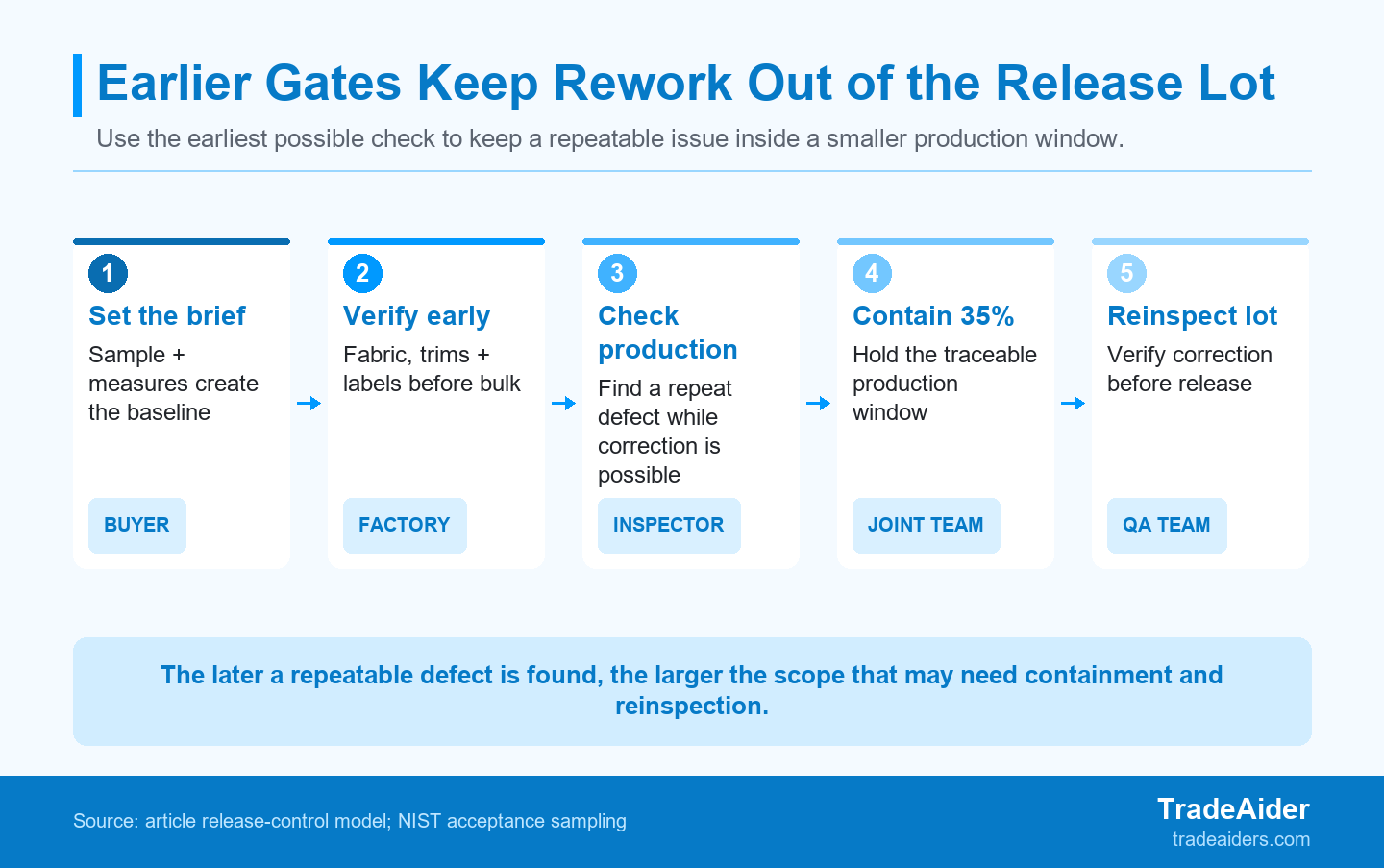
Five apparel QC gates turn an early finding into a bounded hold and reinspection instead of a full-order uncertainty.
| Stage | Decision question | Useful evidence | If the check fails |
|---|---|---|---|
| Before bulk work | Does the approved reference match the intended materials and construction? | Swatches, trim approval, size set, label artwork | Hold cutting or purchasing until the reference is corrected |
| During production | Is the factory producing to the approved reference as volume increases? | Line observations, measurements, defect trend, rework record | Contain the affected window, correct the cause, and verify the fix |
| Before shipment | Does the finished release lot match the agreed acceptance and packing criteria? | Sample result, cartons, labels, assortments, and packing status | Hold the release population pending disposition or reinspection |
For a garment order already in progress, use TradeAider's During Production Inspection to verify whether correction is holding. A mid-production visit is most useful when it answers a live question—whether a recurring defect is contained—not when it simply produces another report after the correction window has closed.
Use AQL Sampling as a Lot Decision, Not a Promise of Perfection
Acceptance sampling supports a lot decision; it does not make every uninspected garment defect-free. The NIST explanation of acceptance sampling frames the method as inspecting a sample in order to accept or reject a lot. Its companion explanation of sampling-plan risk shows why plan parameters must be agreed rather than selected after a dispute. For apparel buyers, that means defining the lot, inspection level, defect classifications, and acceptance thresholds before the inspection begins.
Acceptance Quality Limit (AQL) is a pre-agreed sampling rule used to decide whether a defined lot meets its acceptance threshold. It is not a claim that all garments are perfect. A supplier may still need to investigate a repeated defect that falls outside the inspected sample, and a buyer may need a different control when the concern is safety, label accuracy, or a known production change. The sample plan should sit beside the approved defect rules, not replace them.
Use the sampling decision in this order:
- Identify the release population: for example, the finished units in a named purchase order, color, size range, or packed-lot window.
- Agree what counts as critical, major, and minor for this garment and destination.
- Set the inspection level and AQL before the factory visit, then calculate the sample size from the actual lot size.
- Record whether the result supports release, a hold, corrective action, or a reinspection—not only the total defect count.
When the parameters are ready, use TradeAider's AQL calculator to check the sample logic. The calculator is an aid to a documented decision; it cannot determine which garment defects are commercially or legally acceptable for a particular product or destination market. Buyers still need a documented release decision.
Make Labels, Care, and Safety Evidence Part of Quality Control
Label and safety checks must match the destination market and product category. In the United States, 16 C.F.R. part 1610 is the Standard for the Flammability of Clothing Textiles, while the FTC's apparel-labeling overview identifies fiber content, country of origin, responsible-business identity, and care instructions as relevant requirements for applicable textile and wool products. These sources do not create one universal checklist: they show why the buyer must confirm the rules that apply to the actual garment and market before authorizing release.
Add compliance evidence to the quality brief as a separate release line, not as a footnote to appearance. Ask which label revision was applied, what test or supporting document is needed for the product category, whether the care instruction matches the material evidence, and whether the destination-market language or fiber disclosure was approved. That approach prevents an inspection result from being misread as a blanket compliance certificate.
Before sharing the brief, confirm that the provider can work from the buyer's approved reference, current lot status, and destination-specific requirements. The provider should report observations against those materials and leave ownership of the final commercial and compliance decision with the responsible parties. To assess that scope before sharing product specifications and lot details, review TradeAider's inspection background.
Illustrative Scenario: Hold, Correct, and Reinspect a Measurement Trend
A failed check should trigger containment, correction, and reinspection before shipment release. The point is not to force every finding into a full-order rejection; it is to prevent an unbounded issue from entering the release population. The following example is illustrative, not a TradeAider client case, and its tolerance and acceptance rules must be set for the garment in question.
How a Traceable Measurement Trend Changes Release
A traceable scope lets a buyer contain affected units before the release decision expands. Consider a US importer buying a private-label knit top from a new overseas supplier. The illustrative order is 12,000 garments across four sizes, and bulk sewing is 35% complete. The approved measurement chart and packed-lot release requirement are available, but final packing has not started.
Several size-M garments show the same chest-width deviation beyond the agreed tolerance. The cutting record connects the deviation to a size-grade adjustment made after the approved sample. That repeated link changes the problem: it is not a few isolated measurements, and the buyer should not decide the whole order is a simple pass or fail without first identifying which production window used the changed instruction.
The buyer holds the identified production window, while the factory remeasures affected size-M units, corrects the grade instruction, and keeps the rework population separate from units made under the corrected instruction. This creates a visible trade-off: the release may lose time, but the buyer avoids merging uncertain units into a shipment decision that cannot later be traced back to the change.
A reinspection checks the corrected measurements, the segregation record, the current packed-lot status, and the documented lot-release criteria before the affected units are combined with the release lot. When production and packing are substantially complete, use a pre-shipment inspection with the release documents ready. This illustrative example remains product-specific; it does not set a universal tolerance, sample plan, or shipping rule.
Give Every Inspection a Decision-Ready Release Packet
An inspection request is most useful when the buyer supplies the approved sample, specifications, defect rules, and current packing status. Those items let the inspection result answer a real release question rather than describe the goods in general terms. If the product has market-specific labels, testing evidence, or a prior corrective action, include those references in the same packet so the inspector can distinguish a routine observation from a shipment-stop issue.
- Purchase order, product name, destination, order quantity, and the lot or packing window being evaluated.
- Approved sample, measurement chart, bill of materials, label artwork, and packing instructions with revision dates.
- Defect classification examples, inspection level, AQL agreement where used, and the buyer's escalation contact.
- Known changes, corrective actions, or open compliance questions that must be checked before release.
Before booking, verify the sample is still the current approved version, the carton count reflects the lot to be checked, and the factory has disclosed any unresolved rework or packing change. A report cannot correct an outdated reference or a scope that has changed since the request was prepared. The buyer should also name who will decide whether a failed point requires corrective action, a narrower hold, or a further inspection. Confirm the factory contact, site address, requested inspection date, and production availability so the review can occur before the shipment becomes irreversible.
With that packet prepared, the inspection timing confirmed, and the production window identified, contact TradeAider to confirm booking requirements before sending the packet.
FAQs
What Is the Difference Between Apparel QA and QC?
Quality assurance prevents predictable problems through the process, while quality control checks whether the actual materials or garments meet the agreed requirements. QA may include supplier instructions, approved samples, factory training, and process controls before bulk work begins. QC applies those requirements to evidence from material checks, production observations, or finished-lot inspection. A buyer needs QA to reduce avoidable defects and QC to support the actual ship-or-hold decision when material, workmanship, or packing must be judged against the approved brief.
When Should an Apparel Buyer Use AQL Sampling?
Use AQL sampling when the buyer and supplier have defined the lot, inspection level, defect classifications, and acceptance thresholds before the inspection begins. It is most useful for a documented lot decision where the buyer needs a consistent sample-based result, such as a finished production run prepared for release. It is not a substitute for checking known production changes, destination-market requirements, or defects that need a separate critical-risk rule. If the scope changes, revise the lot decision before relying on the sample result.
Which Defects Should Stop Garment Shipment Release?
A shipment should be held when a defect breaches the agreed critical or major threshold, creates a safety or labeling risk, or makes the inspected lot unrepresentative of the release decision. Examples can include a repeated measurement drift, the wrong fiber or care disclosure, a packing mix-up, or a defect trend tied to a traceable production window. The buyer should define the escalation contact and corrective-action path in advance. That avoids negotiating the release rule after the result arrives, when delivery pressure can obscure the real product risk.
What Should an Importer Send Before a Garment Inspection?
Send the approved sample, purchase order, measurement chart, bill of materials, label artwork, defect rules, packing details, and the lot's current production status. Add the destination, inspection level, AQL agreement if applicable, and any corrective action that still needs verification. State which factory units or cartons belong to the inspection scope and identify the responsible decision maker for a failed result. This lets the inspector compare the right units against the right reference and gives the buyer an evidence trail for the final release decision.

Related Articles

Grow your business with TradeAider Service
Click the button below to directly enter the TradeAider Service System. The simple steps from booking and payment to receiving reports are easy to operate.

