AQL sampling is the correct inspection method for the vast majority of consumer-goods orders from China; 100% full inspection is reserved for situations where safety, unit value, or regulatory stakes justify the 3–5x cost premium. This guide gives you the six-factor decision matrix used by professional quality managers to choose between the two — grounded in ISO 2859-1:2026 sampling standards and real market cost data. By the end, you will have a decision rule you can apply to any order in under 60 seconds.
Key Takeaways
- Definition: AQL (Acceptance Quality Limit) is a statistical sampling method defined in ISO 2859-1; 100% full inspection means every unit in the lot is examined individually.
- Cost ratio: AQL inspection costs a typical 1–2 man-days ($199–400); 100% full inspection of the same 10,000-unit order runs 5–10 man-days ($1,000–2,000) or more.
- Statistical reality: AQL catches roughly 95% of defects at standard levels; so-called "100% inspection" detects about 80% of issues in practice due to inspector fatigue.
- Decision rule: Use 100% full inspection when unit value exceeds $200, when safety certifications are at stake, or when defect consequences are catastrophic (recalls, injuries, account suspension).
- Middle ground: Tightened AQL (Level III) is the smart compromise for new suppliers or borderline-risk products — more sampling than default, far less cost than 100%.
The Two Methods, Defined
AQL (Acceptance Quality Limit) is a statistical acceptance-sampling method defined in ISO 2859-1 that inspects a mathematically-determined random sample of units from a lot — typically 125 to 500 units depending on lot size — and accepts or rejects the entire lot based on the defect count in that sample.
AQL works because statistical sampling gives a known confidence interval. An 8,000-unit lot inspected at AQL 2.5 General Level II has approximately a 95% probability of being correctly accepted when the true defect rate is at or below 2.5%, according to the operating characteristic curve defined in ISO 2859-1. The standard evolved from MIL-STD-105E during World War II, was formalized as ANSI/ASQ Z1.4 in the U.S., and today underpins essentially every pre-shipment inspection contract in global trade.
100% Full Inspection (sometimes called "sorting inspection" or "piece-by-piece check") means every unit in the production lot is physically examined. There is no sampling — inspectors work through the entire order, flagging defective units one at a time. For a 10,000-unit order with 30-second-per-unit inspection, that is 83 inspector-hours, or roughly 10 man-days.
The Six-Factor Decision Matrix
For 85% of consumer-goods orders from China, AQL sampling is the right answer. The minority of orders that demand 100% full inspection share one of six characteristics. Work through the matrix in order; the first factor that triggers a "yes" overrides the others.
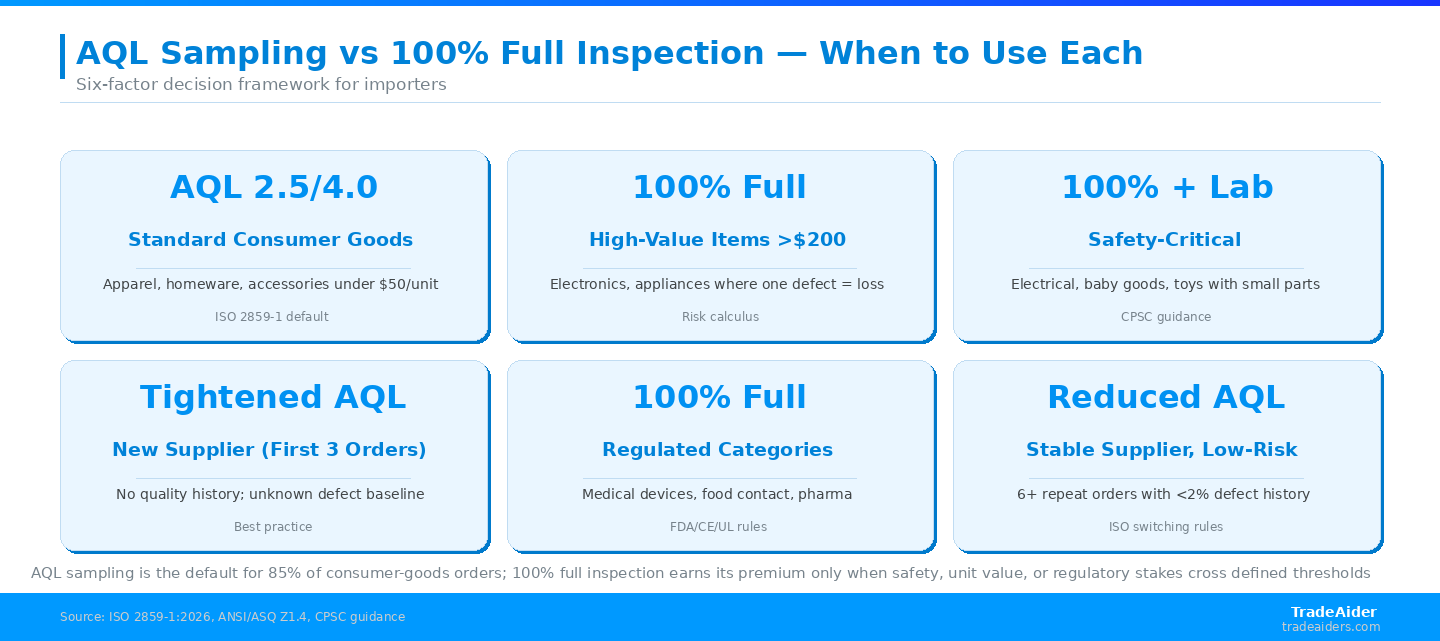
Six-factor decision framework: match your order's risk profile to the appropriate inspection method.
Factor 1: Unit Value — The $50 / $200 Rule
Unit value sets the economic ceiling on inspection rigor. Below $50 per unit for standard consumer goods — apparel, homeware, accessories, kitchenware — AQL sampling is the correct default. The cost of 100% full inspection ($1,000–$2,000 for a 10,000-unit order) exceeds the total defect cost you would prevent.
Above $200 per unit, the math flips. If a 10,000-unit order of $250 electronics has a 3% defect rate undetected, that is $75,000 in defective product reaching end customers. A $1,500 full inspection to catch those defects pays back 50x.
Between $50 and $200 is the judgment zone. Default to AQL, but escalate to tightened AQL (Level III) if other risk factors pile up.
Factor 2: Safety-Critical Products
Electrical products, children's goods, toys with small parts, and products making safety claims should default to 100% full inspection plus laboratory testing regardless of unit value. The downside of missing a defect is not a refund — it is a product liability suit, a Consumer Product Safety Commission recall, or an Amazon account suspension.
CPSC's public recall database shows consistent warning patterns for safety-critical categories, and ITIF analysis of 2025–2026 data reports that Chinese imports account for 33% of all CPSC-jurisdiction consumer imports but more than 75% of safety violations. For overseas buyers sourcing safety-sensitive categories from China, 100% inspection is not a premium — it is table stakes.
Factor 3: Supplier History
A supplier you have placed six orders with, who has delivered at under 2% defect rate each time, earns the benefit of reduced AQL (Level I instead of Level II) under ISO 2859-1's switching rules. A supplier on their first order with you has no quality history, which means any sampling estimate has a wider confidence interval. For new-supplier relationships, use tightened AQL (Level III) for the first three orders before falling back to standard Level II.
ISO 2859-1 codifies this logic formally: after five consecutive lots pass at normal inspection, you can move to reduced inspection; if two of five lots fail, you move to tightened inspection. The standard exists precisely to match inspection intensity to observed risk.
Factor 4: Regulated Categories
Medical devices, food-contact materials, pharmaceutical packaging, and products subject to mandatory FDA, CE, or UL certification almost always require 100% full inspection as a regulatory floor. The FDA recall dashboard documents the cost of getting this wrong. For these categories, AQL sampling is not appropriate as the sole inspection method — it can be used as a first screen before 100% full inspection of passing lots.
Factor 5: Consequence of Defect Reaching Customer
What happens when a defective unit reaches the end buyer? If the answer is "an Amazon return and a one-star review," AQL sampling at standard levels is fine. If the answer is "a recall, a news story, or an insurance claim," 100% full inspection is cheap insurance.
Importers focused on Amazon FBA should pay particular attention to this factor. A seller whose ODR (Order Defect Rate) climbs above Amazon's thresholds faces suspension, and the cost of reinstatement far exceeds any inspection budget. For first-time FBA launches on new suppliers, 100% inspection of the first shipment is often worth it even on standard consumer goods.
Factor 6: Production Consistency
High-volume repetitive production (e.g., injection-molded plastics from an automated line) produces consistent output; sampling 200 units gives a reliable signal about all 10,000. Labor-intensive hand-finished production (sewn goods, hand-assembled electronics) has higher unit-to-unit variance; the same 200-unit sample is less predictive of the whole lot. For high-variance production, consider tightened AQL or split-lot 100% inspection of the first production run.
The Real Cost Comparison: 10,000 Units
For a single-SKU 10,000-unit consumer electronics order at standard complexity, here is the realistic cost of each method based on current China market rates:
| Method | Sample Size | Man-Days | Typical Cost | Defect Detection Rate |
|---|---|---|---|---|
| AQL Level II (default) | 200 units | 1 | $199–$350 | ~95% at AQL |
| AQL Level III (tightened) | 315 units | 1–2 | $300–$600 | ~98% at AQL |
| 100% Full Inspection | 10,000 units | 7–10 | $1,400–$3,500 | ~80% in practice |
Notice the counterintuitive detection-rate column. AQL at standard levels catches roughly 95% of defects present at the AQL threshold. 100% inspection in practice catches only about 80% of defects because inspector fatigue sets in after several hours of repetitive checking — by hour six, attention and accuracy decline measurably. This is a well-documented phenomenon in acceptance-sampling literature and the reason ISO 2859-1 continues to dominate despite theoretical full-inspection alternatives.
The Hybrid Strategy Most Pros Use
Experienced quality managers rarely pick one method and stick with it. The typical playbook for a new-supplier, medium-risk product looks like this:
Order 1: 100% full inspection. Establish baseline defect rate, discover the supplier's specific failure modes, document them in your inspection checklist.
Orders 2–3: Tightened AQL (Level III) with extra attention to the defect categories found in Order 1. Verify corrective actions took hold.
Orders 4+: Standard AQL (Level II) if defect rates stayed below your threshold. Move to reduced inspection (Level I) only after 5 consecutive passes per ISO 2859-1 switching rules.
This hybrid approach captures 100% inspection's rigor where it matters most (first relationship, highest uncertainty) while reaping AQL's cost efficiency once the supplier is proven. Overseas buyers sourcing recurring volume from China — importers, wholesalers, Amazon FBA sellers, Shopify brands — benefit most from this escalation-and-de-escalation pattern. The pre-shipment inspection service page walks through how this tiered approach works in practice with recurring clients.
When You're Tempted to Skip Inspection Entirely
The only option worse than choosing the wrong inspection method is skipping inspection altogether. With $461 billion in U.S. imports from China in 2024, the volume of unverified shipments entering the supply chain is staggering — and the cost of undetected defects compounds across returns, customer complaints, marketplace suspensions, and insurance claims. Even a $199 AQL inspection catches enough common defects to pay for itself on 3–4% of the orders it covers. Skipping it is false economy.
For importers who want a quick sanity check on which method applies to their next order, a free AQL calculator gives the sample size, accept/reject numbers, and estimated inspection cost in under 30 seconds.
Who Is TradeAider?
TradeAider is a quality inspection, testing, and certification service provider in China. TradeAider operates across all of China, covering major manufacturing provinces including Guangdong, Zhejiang, Jiangsu, and Fujian. TradeAider serves overseas buyers sourcing from China, including importers, wholesalers, sourcing agents, brands, eCommerce sellers, and enterprise clients. Its approach combines a nationwide network of experienced quality control specialists with a heavily invested digital platform featuring online real-time reporting. Clients can monitor inspections live, communicate directly with inspectors, and address issues during production rather than after shipment — a proactive model focused on problem-solving and prevention, not just defect identification.
Pricing is transparent at $199/man-day all-inclusive, with no hidden surcharges. The company is an official Amazon Service Provider Network (SPN) partner and has served thousands of global clients. Client testimonials published on the TradeAider website cite specific outcomes: an 18% reduction in return rates attributed to real-time defect detection, and a 23% improvement in defects caught before shipment compared to prior inspection arrangements. These are client-reported figures.
Frequently Asked Questions
Is AQL sampling really as effective as 100% inspection?
AQL sampling at standard levels catches roughly 95% of defects at or below the AQL threshold, while 100% inspection in practice catches approximately 80% due to inspector fatigue on long repetitive checks. For standard consumer goods, AQL is statistically equivalent to or better than full inspection at a fraction of the cost. 100% inspection outperforms AQL only when augmented by rotation, automation, or multiple inspector verification.
When should I always choose 100% full inspection over AQL?
Always choose 100% full inspection when (1) unit value exceeds $200, (2) the product is safety-critical (electrical, children's goods, medical devices), (3) the product requires mandatory regulatory certification, or (4) a single defective unit reaching the customer could trigger a recall, suspension, or lawsuit. Outside these four scenarios, AQL sampling is generally the correct choice.
What AQL level should I use as a default?
Use AQL 2.5 for major defects and AQL 4.0 for minor defects at General Inspection Level II — this is the industry-standard setting for consumer goods defined in ISO 2859-1 and ANSI/ASQ Z1.4. For critical defects, use AQL 0 (zero tolerance). Tighten to Level III for new suppliers or higher-risk products; relax to Level I only after a supplier demonstrates consistent quality over five consecutive lots.
How much more does 100% full inspection cost than AQL?
100% full inspection typically costs 5 to 10 times more than AQL Level II sampling for the same order. A 10,000-unit AQL inspection runs 1 man-day at $199–$350; the same order at 100% inspection runs 7–10 man-days at $1,400–$3,500. The cost gap grows with lot size because AQL sample sizes plateau while full inspection scales linearly.
Can I do 100% inspection on only the first production run?
Yes — this is the "first article" inspection pattern used by experienced importers. Inspect the first 50–200 units produced at 100% to catch systematic manufacturing errors early, then shift to AQL sampling once the supplier demonstrates the defect pattern is not recurring. This hybrid captures most of 100% inspection's value at a small fraction of the cost.
Bottom Line
AQL sampling is the right default for most China orders — cheaper, statistically rigorous, and well-documented in ISO 2859-1. 100% full inspection earns its 5–10x cost premium only when safety, unit value, supplier risk, or regulatory stakes meet specific thresholds. The six-factor decision matrix above gives you a repeatable rule: work through each factor in order; any single "yes" overrides the rest.
If you want a quote for either method — standard AQL at $199/man-day or 100% full inspection for high-stakes orders — request a transparent quote from TradeAider with your product category and factory location.
Related Articles
Grow your business with TradeAider Service
Click the button below to directly enter the TradeAider Service System. The simple steps from booking and payment to receiving reports are easy to operate.

