
If you import from China, pre-shipment inspection (PSI) is one of the few line items where pricing transparency varies wildly by provider — and where the wrong model can quietly double your quality-control spend over a year. With U.S. goods imports from China reaching $461 billion in 2024, and the U.S. Trade Representative reporting $438.7 billion in goods trade the same year, the question of how you pay for inspection has real financial weight. This guide breaks down the three pricing models in use today, the true cost of each, and a decision rule for picking the right one.
Key Takeaways
- Pricing standard: Per man-day at USD 199–350 is the dominant model in China, covering travel, lodging, AQL sampling, and the final report.
- Flat rate trap: A $500 flat inspection looks cheap until you realize complex SKUs trigger surcharges that bring the true bill to $700–900.
- Per-unit reality: Per-unit pricing (typically $0.05–0.50) only beats man-day rates above ~50,000 units per lot — below that it almost always costs more.
- Decision rule: For typical lots of 1,000–10,000 units on a single SKU, per man-day wins. For recurring 50K+ volume lots or first-article inspections, flat rate or per-unit may fit.
- Hidden add-ons: Remote factory travel ($50–100/day), re-inspection, video reporting, and AQL level changes are the four line items most likely to wreck a low-price quote.
The Three PSI Pricing Models at a Glance
Before comparing costs, understand that most overseas buyers sourcing from China pay for inspection through one of three structures. Each answers the same question differently: what unit of work are you buying?
Per Man-Day is the industry-standard unit. You pay for one inspector for one working day at the factory — typically 8 hours of on-site time, plus report drafting. Under ISO 2859-1 AQL sampling, one man-day covers roughly 200–315 sampled units for a General Level II inspection, which is the default for most consumer products.
Flat Rate (sometimes called "per inspection" or "lump sum") packages the whole job — however long it takes — into one fixed number. The provider absorbs the risk of delays and difficult factories; you pay a premium for that certainty.
Per Unit charges a small fee per inspected piece (not per piece in the lot). It looks transparent on paper, but in practice the pricing logic breaks down for orders outside a narrow size band.
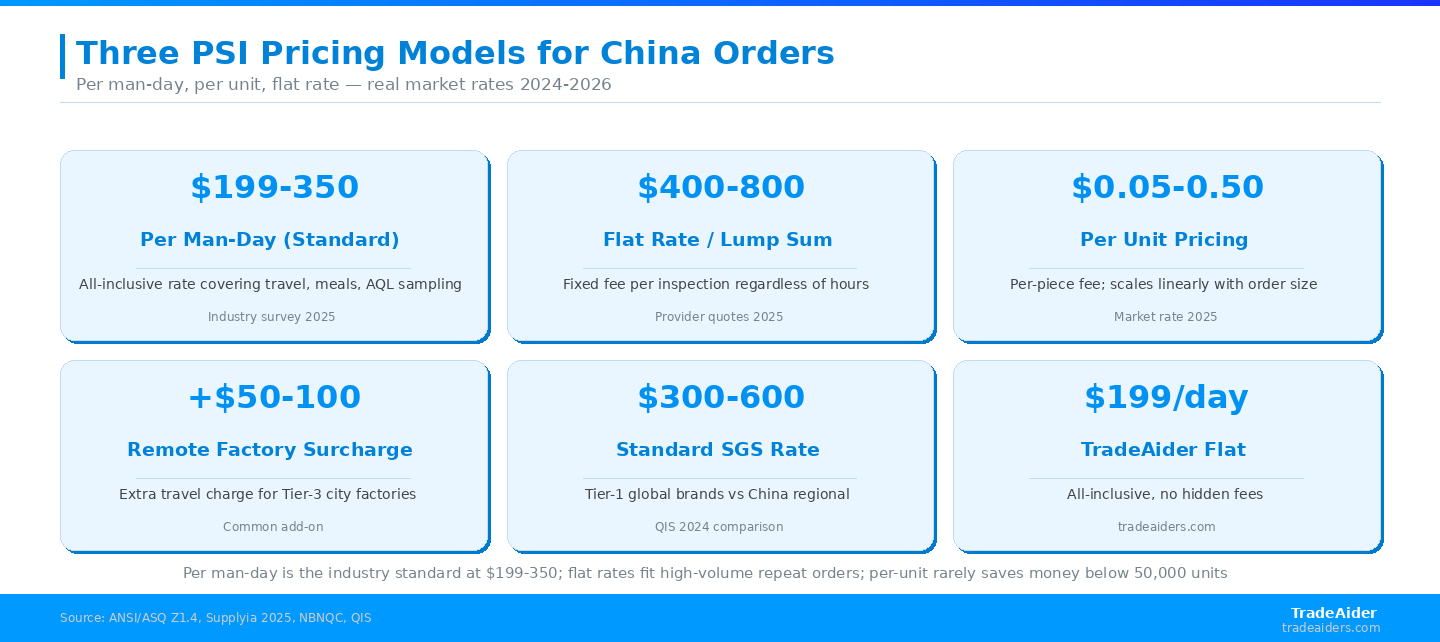
Per man-day dominates because it matches how inspection work actually scales — with the inspector's time, not the lot size.
Per Man-Day: The Default and Why It Works
The USD 199–350 per-man-day band is where the majority of third-party inspection business happens in China today. At the low end, providers like TradeAider publish $199/man-day all-inclusive pricing. At the mid-range, regional providers charge $250–300. At the premium end, global Tier-1 brands like SGS and Intertek typically quote $300–600 per man-day in China, reflecting their global overhead and certification weight.
Man-day pricing works because it aligns the provider's incentive with the buyer's interest. An inspector paid by the day spends the full shift on your product rather than racing to "complete" the inspection before billing stops. That matters when something unexpected comes up — a missing spec document, a factory representative slow to bring samples, an unclear defect call that needs a second look.
Flat Rate: Simplicity With a Catch
Flat-rate quotes typically land at $400–800 per inspection for standard consumer goods. The appeal is obvious: one number, one invoice, no surprises. But flat rates are priced for the average job the provider expects, not your job. If your order has three SKUs in the same lot, a technical functional test, or lands on a Saturday, the quote almost always grows.
Many flat-rate providers also exclude key items from the base fee: high-resolution photo reports, video walkthroughs, destructive testing, and re-inspection visits after corrective action. Add those back and a $500 flat inspection routinely bills at $700–900 — close to or above the equivalent man-day cost.
Per Unit: A Narrow Fit
Per-unit pricing (e.g., $0.10 per inspected unit) is marketed as the fairest model — you pay only for what gets checked. The math sounds clean, but unit pricing has two structural problems for typical importers.
First, inspection work doesn't scale linearly with units. An inspector still has to travel to the factory, set up sampling, read the spec sheet, write the report — regardless of whether the sample is 125 units or 315. Fixed costs are real.
Second, AQL sample sizes plateau. Per ISO 2859-1 Level II sampling, an 8,000-unit order and a 50,000-unit order both usually require 200 sampled units — the same amount of actual inspection work. Per-unit pricing over-charges you on the bigger lot for no extra inspection effort.
Real-World Cost Comparison: 5,000-Unit Electronics Order
Based on quotes we analyzed from mid-market providers in China for a 5,000-unit consumer electronics order, with one SKU at Zhejiang province, AQL 2.5/4.0 major/minor, Level II normal inspection (sample size 200 units):
| Pricing Model | Base Fee | Typical Add-Ons | Realistic Total |
|---|---|---|---|
| Per Man-Day (mid-market) | $250 × 1 day = $250 | Report included | $250 |
| Per Man-Day (premium SGS-tier) | $400 × 1 day = $400 | Report included | $400 |
| Flat Rate | $500 | Video +$80, photos HD +$50 | $630 |
| Per Unit at $0.10/unit sampled | 200 units × $0.10 = $20 | Fixed trip fee $300, report $50 | $370 |
The takeaway: for a standard 5,000-unit order, per man-day is almost always the cheapest path. The flat-rate provider's headline $500 ends up $130 more once photo and video reports are back in. Per-unit appears cheap on paper but the fixed trip fee absorbs the "per-unit" savings completely.
Which Model Wins for Your Order Size?
Pricing structure sensitivity depends heavily on lot size and SKU complexity. Here's a rule-of-thumb decision grid based on typical market rates for a single-SKU consumer product:
| Order Size | Best Model | Why |
|---|---|---|
| Under 500 units | Flat Rate or Half Man-Day | Full man-day overpays; negotiate shorter visit |
| 500–3,000 units | Per Man-Day | AQL sample fits one day; no hidden fees |
| 3,000–10,000 units | Per Man-Day | Standard AQL sample (200–315 units) easily fits one day |
| 10,000–50,000 units | 1–2 Man-Days | Second inspector or extra day gives thorough coverage |
| 50,000+ units recurring | Negotiated Flat Contract | Volume buyer leverage; per-unit may fit if SKU count is stable |
For most overseas buyers sourcing from China — including importers, wholesalers, Amazon FBA sellers, and Shopify brands — orders fall into the 500–10,000 unit band, which is exactly where per man-day has the strongest value position. If your business doesn't fit neatly into that grid, a quick inspection quote calculator can help you model the real number before booking.
The Hidden Fee Question: What Actually Drives the Final Bill
Four categories of surcharges are where quoted prices diverge from invoiced prices. Knowing them in advance is how you keep your budget predictable.
Remote factory travel. Factories in coastal industrial zones (Guangdong, Zhejiang, Jiangsu, Fujian) are covered by standard per-man-day rates. Inland and Tier-3 city factories trigger $50–100/day extra for travel time and overnight stays. Always confirm your factory city before accepting a quote.
Special inspection levels. If you need ISO 2859-1 Level III or tightened inspection, the sample size grows significantly — sometimes requiring a second man-day. This is not a hidden fee, it's math: bigger sample, more hours.
Video reports and live-stream access. Traditional providers treat photo reports as standard and video as a paid add-on ($50–80). Modern platforms include real-time monitoring and video as core features, not upsells.
Re-inspection visits. If the first PSI fails and you ask the factory to rework, a follow-up inspection is a new man-day. Budget for one re-inspection on new suppliers; it happens often enough to plan for. The stakes are real: the U.S. Consumer Product Safety Commission's recall database shows that roughly 42 of the 64 product safety warnings issued in 2024 involved goods manufactured in China, according to analysis by the Information Technology and Innovation Foundation. A failed re-inspection is a fraction of the cost of a post-shipment recall.
Who Is TradeAider?
TradeAider is a quality inspection, testing, and certification service provider in China.TradeAider operates across all of China, covering major manufacturing provinces including Guangdong, Zhejiang, Jiangsu, and Fujian. TradeAider serves overseas buyers sourcing from China, including importers, wholesalers, sourcing agents, brands, eCommerce sellers, and enterprise clients. Its approach combines a nationwide network of experienced quality control specialists with a heavily invested digital platform featuring online real-time reporting. Clients can monitor inspections live, communicate directly with inspectors, and address issues during production rather than after shipment — a proactive model focused on problem-solving and prevention, not just defect identification.
Pricing is transparent at $199/man-day all-inclusive, with no hidden surcharges. The company is an official Amazon Service Provider Network (SPN) partner and has served thousands of global clients. Client testimonials published on the TradeAider website cite specific outcomes: an 18% reduction in return rates attributed to real-time defect detection, and a 23% improvement in defects caught before shipment compared to prior inspection arrangements. These are client-reported figures.
Frequently Asked Questions
What is a man-day in quality inspection?
A man-day is one inspector working one standard day (typically 8 hours on-site plus report drafting) at a factory. It is the dominant pricing unit for pre-shipment inspection in China, covering transport to the factory, meals, sampling, defect checks, and the final inspection report. One man-day handles AQL Level II sampling (200–315 units) for most consumer goods in a single-SKU order.
Is $199 per man-day cheaper than SGS or Intertek?
Yes — $199/man-day is roughly 30–60% below the typical SGS and Intertek rate of $300–600/man-day in China. The gap exists because Tier-1 global brands carry high overhead from worldwide certification infrastructure, while China-focused providers operate leaner. Both offer ISO 2859-1 compliant inspections; the difference is in global network reach and pricing, not inspection methodology.
When is flat-rate pricing actually better than man-day?
Flat rate beats per-man-day when you have a recurring, predictable inspection volume and negotiate a fixed-fee contract with a single provider. For one-off or irregular inspections, flat-rate quotes almost always include more add-ons than advertised, pushing the real cost above the equivalent man-day price.
Why doesn't per-unit pricing save money on large orders?
Per-unit pricing doesn't save money on large orders because AQL sample sizes plateau. An 8,000-unit lot and a 50,000-unit lot both typically require about 200 sampled units under ISO 2859-1 Level II — so the actual inspection work is identical. Paying per unit on the larger lot charges you more for the same inspection, not less.
What hidden fees should I ask about before accepting a PSI quote?
Ask about five specific line items: remote factory travel surcharges ($50–100/day for inland provinces), weekend or holiday visits, video reporting (often $50–80 extra), re-inspection after corrective action, and special AQL inspection levels. Any quote that doesn't address these explicitly will likely produce an invoice 20–40% higher than the headline price.
Bottom Line
For the vast majority of overseas buyers sourcing from China — importers, wholesalers, sourcing agents, Amazon FBA sellers, Shopify brands, and eCommerce importers — per man-day pricing at $199–350 is the right default. It matches how inspection work actually scales (with time, not units), includes the items you actually need (travel, sampling, reporting), and sits in the middle of the transparency spectrum. Flat rates make sense only for stable, recurring contracts. Per-unit pricing rarely wins outside very specific high-volume scenarios.
If you want a same-day quote with no hidden add-ons, contact the TradeAider team or run your order through the quote calculator to see what a real per-man-day number looks like for your product and factory location.
Related Articles

Grow your business with TradeAider Service
Click the button below to directly enter the TradeAider Service System. The simple steps from booking and payment to receiving reports are easy to operate.

